Andrew Joseph Conroy

Andrew J. Conroy, a deputy Pennsylvania State Constable, was shot and killed as he attempted to remove furniture from a home on January 21, 1938. The furniture was to be auctioned to pay overdue rent. Eugene Alexander Cole, the resident of the home, fired the fatal shot.

On May 25, 1938, Cole pled guilty to voluntary manslaughter and was sentenced to five months to six years in prison, reduced to 27 days for time served. In imposing the sentence, the court stated that Conroy pulled his weapon first and that his aggressiveness had provoked Cole.
Robert Leo Kosmal

Robert Leo Kosmal, an officer with the Pittsburgh Police Department, was stabbed and shot after encountering a fight in Homewood on August 16, 1935.

Kosmal was off duty and returning home with his wife and friends when they came upon the two men, Robert Carter and Joseph Thompson. Kosmal died the next day.

Thompson was convicted of first-degree murder on December 14, 1935, and sentenced to life in prison. Carter was not charged.

Martin Pluter

Martin Pluter, a Pennsylvania State Constable, was shot and killed after an altercation with five men in Wall Borough on April 16, 1934. After telling the men to go home, a fight broke out. Pluter drew his gun and shot one of the men in the foot; his gun was then turned against him and he was killed.

Two men, John Arendas and Paul Hardin, were formally charged. Arendas was the son of the former Wall Borough constable; Pluter had been appointed to replace him after the senior Arendas was removed from office for corruption.

John Arendas pled guilty to second-degree murder in September 1934 and was sentenced to six to twenty years in prison. Hardin was convicted at trial of voluntary manslaughter the following month and sentenced to four to eight years in prison.

Herbert Paul Brantlinger

Herbert P. Brantlinger, a patrolman with the Pennsylvania State Police, was shot and killed in Bridgeville on September 3, 1933. He was investigating gasoline theft at a service station when he was shot by Thomas A. Davis, Jr., 19.

Davis was arrested in Kansas City in February 1934 after leaving a gas station without paying.

Returned to Pittsburgh, Davis was acquitted at trial in May 1934 after more than 40 hours of deliberation. The prosecution had sought the death penalty. The trial court subsequently repudiated the verdict as a result of undue sympathy for the young offender. Jurors disputed that view, stating their verdict reflected a weak case and evidence that Davis was beaten by police to force a confession.

Davis was then extradited to Illinois, where he was convicted of assault.

Vernon Porter Moses

Vernon Porter Moses, Chief of the Ross Township Police Department, was shot and killed during a traffic stop on May 3, 1932. John Maug, head of a notorious gang of robbers and bootleggers, was in the car, as were Edward Turpack and Charles Moyer. They shot Moses twice and fled.

The three men were apprehended in October 1932. At trial, Moyer was sentenced to 40 to 80 years in prison; Maug and Turpack received sentences of life plus 60 to 120 years.

Maug and Turpack escaped from Western Penitentiary on April 27, 1933. They were arrested for robbery in Colorado soon after. At trial there, they were convicted and imprisoned for life.

Grover Wolf

Grover Wolf, an officer with the McKees Rocks Borough Police Department, was shot and killed on November 14, 1930, by a disgruntled drunk man he had encountered several hours earlier and told to go home. That man, Otto Parsons, returned and shot Wolf.

Parsons, who claimed the shooting occurred after Wolf struck him and the two fought over a weapon, was convicted of first-degree murder and sentenced to life on January 23, 1931 (Pennsylvania had moved from a mandatory death sentence for first-degree murder convictions to jury discretion to choose life or death in 1925).

In June 1931, Parsons was granted a new trial after the court ruled the evidence did not support a first-degree murder conviction. Parsons pled guilty days later; the court fixed the case at second-degree murder and sentenced Parsons to six to twelve years in prison in June 1931. His sentence was further commuted in 1935 and he was released from prison.

James E. Hughes

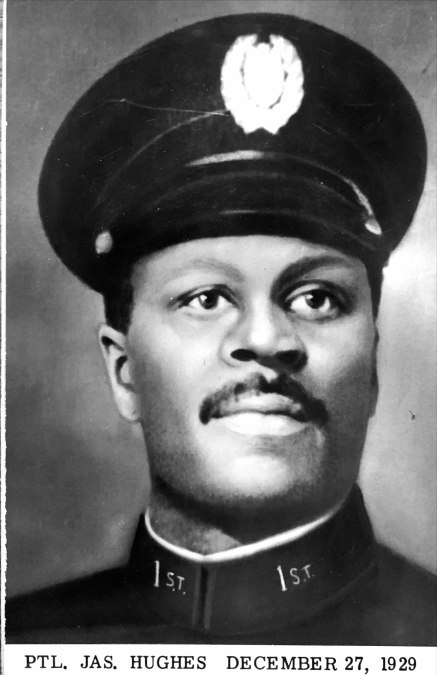
James E. Hughes, a Lieutenant with the Pittsburgh Police Department, was shot and killed after he responded to a grocery store robbery on December 27, 1929. He was the first Black officer to be feloniously killed on duty in Allegheny County history.

image001

Dennie Wilkins and Charles Ricks, Jr, both Black and both from the Hill District, were convicted of first-degree murder in 1930.

In both cases, the jury recommended they be sentenced to life imprisonment. A third suspect, John Franklin, escaped to Mississippi and was not apprehended.

John J. Downey

John J. Downey, a private with the Pennsylvania State Police, was shot and killed on August 22, 1927, during a demonstration of over 1,000 Italian coal miners in “Guido Grove,” near Cheswick, protesting the Sacco-Vanzetti case. Downey had ordered a group of men to disperse when one of the men shot him.

Salvatore Accorsi was arrested in New York almost two years later, on June 12, 1929.

In a case that became a cause celebre, Accorsi was acquitted at trial on December 13, 1929. Famed author Sinclair Lewis, who had come to Pittsburgh to cover the trial, spoke at a post-trial rally and celebration, where he decried the state of civil liberties and workers’ rights in Pittsburgh.

Sacco and Vanzetti, anarchists and convicted murderers whose convictions were widely criticized and whose innocence was widely proclaimed, were executed in Massachusetts on August 23, 1927.

James F. Farrell

James F. Farrell, an officer with the Pittsburgh Police Department, was shot on July 5, 1927, when he stopped two men for questioning on the North Side. He died the next day.

Lannell Duncan and Robert Thomas were arrested in the area soon after but were released the same day due to a lack of evidence. Philip Butler was arrested in connection with the murder in August 1927, though the evidence against him was weak and he was released to face separate charges in Baltimore.

No other arrests were made.

George L. MacPhee

George L. MacPhee, a sergeant with the Rankin Borough Police Department, was shot and killed on April 9, 1926, while attempting to make an arrest at the scene of a store burglary.

Joseph Gariti was arrested weeks later when a hat found at the scene was traced to him. At trial in October 1926, the judge directed a verdict of acquittal on the grounds of inadequate evidence.

No other arrests were made.