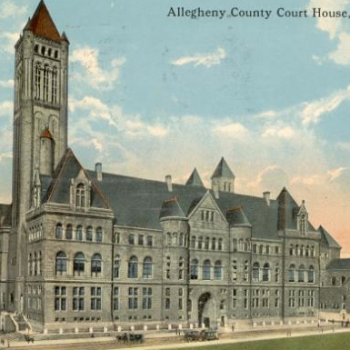
William Green

William Green and his half-brother, Samuel Marshall, were born into slavery in Craig County, Virginia. Their mother, Ann Marshall, who had been sold from plantation to plantation, was an early Black migrant to Allegheny County, arriving with her children soon after Emancipation.

Settling in Mansfield (present day Carnegie), the brothers lived and worked together until experiencing a rancorous split after their shoemaking business failed during the Depression that began in 1873. They then went to work as teamsters on different farms.

image003
Pittsburgh Daily Post, September 3, 1875

The rancor continued. A disagreement about how to divide the family’s modest property and its incoming potato crop came to head on September 2, 1875, when Green shot Marshall. He was arrested in Freedom, Pennsylvania, on September 7.

image002.png

At a trial that produced a transcript not ninety pages in length, Green claimed he acted in self-defense after Marshall assaulted him with a poker. The state argued he acted without provocation in shooting Marshall.

Despite witness testimony of an assault by Marshall and an injury to Green’s head, Green was convicted of first-degree murder on December 16, 1875. He was sentenced to death on July 8, 1876.

image002

Green’s argument that the killing was not properly first-degree was rejected on appeal (Green v. Commonwealth, 83 Pa. 75, 1876). His clemency request was likewise rejected, despite a letter of support from the District Attorney expressing doubt that the killing met the legal standard for first-degree murder.
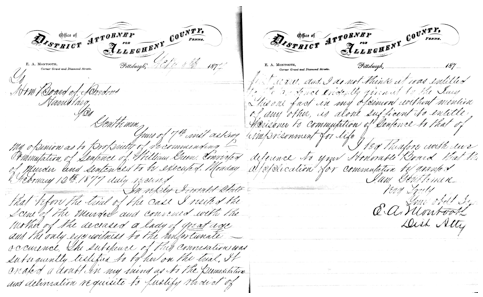
image002.png

Lacking the status or the resources to elicit attention or raise the social or legal cost of his execution, William Green was hanged on February 12, 1877. Green was the third Black man to face the death penalty in Pittsburgh and the third to be executed. He was also the first Black capital defendant whose jury could have included a Black man. It did not.

image001

A long and mostly sympathetic newspaper discussion of his case after his execution emphasized his Christian belief and forbearance.

Ernest Ortwein

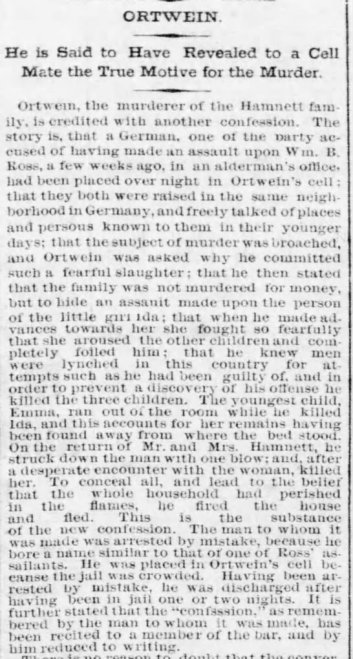
Ernest Ortwein, a 28-year old German immigrant and Franco-Prussian War veteran, worked as a laborer on the farm of British-born John Hamnett, near what was soon to become the industrial center of Homestead.

image001

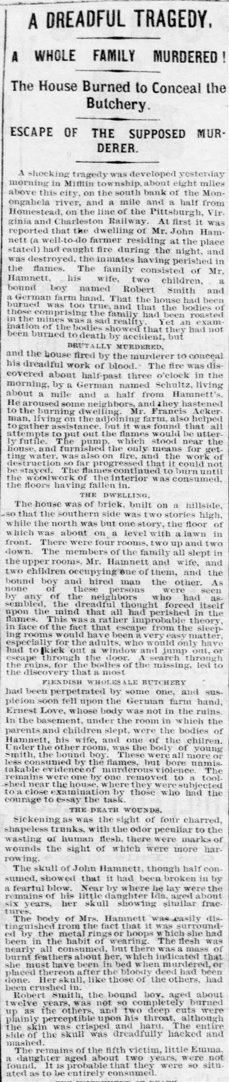
There, on April 29, 1874, Ortwein killed the Hamnett children, Ida and Emma, and Robert Smith, a child who worked as a farmhand, with an axe while they slept. He then killed John and Agnes Hamnett when they returned from visiting friends. After burning their bodies in an effort to conceal his crime, Ortwein fled with a small amount of cash and some jewelry.

image003
Pittsburgh Commercial, May 1, 1874

Passersby saw the house in flames and found the murdered family. Suspicion quickly fell on Ortwein, who was nowhere to be found.

Ortwein was arrested the next day in Troy Hill, a German enclave in Allegheny City, after telling a fellow bar patron that he had committed the killings that were so much in the news. Items he had stolen and traded were recovered as evidence. He provided a full though contradictory confession to police. Residents of Homestead threatened to lynch him if he was not executed.

image001
New York Times, August 7, 1874

At trial in June 1874, various motives for Ortwein’s crimes were offered. At different points, Ortwein claimed that his motive was robbery and rape, stating that he had raped Ida and killed her and her family when she screamed. Most people understood the case as a robbery, with Ortwein having wrongly believed the Hamnetts – who were prosperous – kept a large amount of cash on hand. A third possibility, which may have played a role in either of the preceding scenarios or may stand alone, is that Ortwein’s military service had left him with a brain injury or some other mental illness.

image001
Pittsburgh Daily Commercial, August 5, 1874

Ortwein was convicted on June 14, 1874, and sentenced to death. His appeal, which alleged a number of errors, most prominently that the defense had raised reasonable doubt as to Ortwein’s sanity, was rejected (Ortwein v. Commonwealth, 76 Pa. 414, 1875).

Ernest Ortwein was hanged on February 23, 1875. A very large crowd gathered but was prevented from witnessing the execution by a large wall that screened the jailyard.

image001
Pittsburgh Daily Commercial, February 24, 1875

In a letter to the editor published days after Ortwein’s execution, noted Pittsburgh journalist, feminist, abolitionist, and death penalty opponent, Jane Grey Swisshelm, focused  her ire on Agnes Hamnett, for failing to meet her “obligation of personal care to her children” by going out that evening.

image001
Pittsburgh Daily Commercial, February 26, 1875

Post-mortem examination of Ortwein, crude though it was, found no mental abnormalities.

Due to its scale and circumstances, the Ortwein case is often included among the most notorious cases in Allegheny County history.

The Hamnetts are buried in Munhall.

Project Overview

In the spring of 2015, I began a project to identify and analyze all the death sentences that have been imposed in the history of Allegheny County. After careful review of Allegheny County court and jail records, coroner records, legal records, and the entire published record of Pittsburgh newspapers, that effort is now complete.

My research has identified 201 death sentences, the first of which was imposed on Mamachtaga (or Mamachtaguin), a Lenape Indian who had killed two white settlers, in 1785. As of this writing, the most recent death sentence was imposed on Richard Poplawski in 2011, for the 2009 ambush murder of three police officers. Additional death sentences are likely to be imposed, though with a state death penalty moratorium in place and a broader national reconsideration of the death penalty ongoing, few such sentences are likely. Pennsylvania’s most recent execution was in 1999. The last Allegheny County execution was way back in 1959. I do not expect any additional executions.

Of those 201 death sentences, 102 resulted in an execution. In most of the rest of the cases, the original death sentence was overturned by judicial or gubernatorial action. A few others escaped from death row; most famously, the Biddle boys were killed soon after; others were never apprehended. Also, as of this writing, nine Allegheny County inmates remain on Pennsylvania’s death row.

As a first step in my research, I have posted brief descriptions of every case, with links to supporting documents, photos, and maps where available. You can find all these descriptions in the links to the right. As my work continues, I will be analyzing the ways in which offender and victim race, class, gender, age, and occupation, as well as changing patterns of industrialization, urbanization, immigration, and labor/management relations, have shaped the use of the death penalty in Allegheny County.