I am a sociologist and death penalty scholar at the State University of New York at Geneseo. I am also a Pittsburgh native. My present research focuses on the history of the death penalty in Allegheny County (Pittsburgh), Pa.
Albert Schnittker, a detective with the Pittsburgh and Lake Erie Railroad Police Department, was shot on March 28, 1923, when he opened a railroad car in which he heard a noise. Two men, described as vagrants, jumped from the railroad car, firing two shots at Schnittker as they fled.
Struck in the leg and the abdomen, Schnittker died of his wounds on March 23, 1930.
No arrests were ever made in the shooting, which occurred at the Pittsburgh and Lake Erie’s Southside Yard in Braddock.
Pittsburgh Police Department Officer Roy Freiss was directing traffic on the south side of the Smithfield Street Bridge on February 3, 1935, when he was struck and killed by a car driven by Marcel Forcinal.
Forcinal, proprietor of Frenchy’s Restaurant, was drunk at the time. He pleaded guilty to involuntary manslaughter on May 27, 1935, and was placed on probation for three years and ordered to pay restitution to Freiss’s widow.
Trooper Edward Mackiw, a Pennsylvania State Police Officer, was killed by a speeding motorist while directing traffic around a car accident on the Parkway West near Carnegie on May 31, 1958.
Witnesses reported that a speeding vehicle driven by George R. Currin of Wilkinsburg was passing the scene of the accident late that Memorial Day night when Mackiw was struck.
Currin, who denied that he was speeding or that he saw the roadside flares that had been set, was convicted of involuntary manslaughter on February 10, 1961, nearly three years after the incident. The jury’s recommendation of mercy was accepted by the judge, who sentenced Currin to three years of probation.
Pennsylvania State Constable William Shields was shot and killed during a gun battle with John Houston and James Milton in Glassport on October 16, 1903. Houston was also killed.
Pittsburgh Daily Post, October 17, 1903
The incident began when Officers Shield, Joseph Norris, and Peter Kelly attempted to apprehend Houston and Milton. Descriptions of the the circumstances of the arrest diverge widely. In one account, Houston and Milton were “Negro desperadoes” engaged in an armed crime spree involving a series of robberies and assaults on the streets of Glassport. In another account, the two black men had been reported to police after a minor incident with a local white resident and responded with violence when encountered by police.
Whichever the case, a gunfight ensued when police sought to apprehend the two men in an Allegheny Avenue store. Kelly shot and killed Houston while Norris and Shields engaged Milton, who killed Shields and fled. It does not appear as though Milton (also identified as Meldon, Melton, and Bolden) was ever arrested.
The failure to apprehend Milton led to considerable local controversy, with accusations that both local and county law enforcement officials had not pushed the matter with adequate urgency.
The absence of an arrest or trial leaves considerable uncertainty as to the details of the events leading to Shields’ death.
Pennsylvania State Constable Thomas Pugh was attempting to arrest David Dickerson in Homestead on June 14, 1916, when Dickerson shot Pugh twice. He died the next day. Dickerson, who was wanted on a warrant for brandishing a weapon, was arrested at the scene.
Dickerson was convicted of second degree murder on February 9, 1917, and sentenced to 20 years in Western Penitentiary.
Assistant Deputy Warden John Pieper and Corrections Officer John Coax were killed during the spectacular escape attempt directed by Paul Orlakowski on February 11, 1924.
Orlakowski was serving seven to ten years in Western Penitentiary for a November 15, 1921, bank robbery in Imperial. Taking advantage of weak and corrupt prison security, Orlakowski and fellow inmates Salvatore Battaglia, Michael Norton, and James Yandis, stockpiled dynamite and dozens of weapons.
When the dynamite failed to open the prison wall, the four men were left to fight it out with prison guards. The first two guards to respond, Pieper and Coax, were shot and killed. The riot that followed lasted two hours before guards, reinforced by city police, were able to restore order.
Orlakowski was convicted of first-degree murder on May 16, 1924, and sentenced to death on July 30, 1926. Battaglia and Norton were both convicted of second-degree murder in separate trials. Yandis was acquitted. James Kearns, who was alleged to have aided in the planning but did not participate in the attempted escape and riot, was also acquitted.
On March 8, 1926, Orlakowski, later dubbed “Pittsburgh’s toughest prisoner” (Pittsburgh Press, July 31, 1930),charged after Warden John McNeil with a homemade knife. When stopped, he stabbed two guards, Clarence Welsh and John Bell; both survived.
His appeal and commutation request were rejected. After having spared no effort, legal or otherwise, to prevent his execution, Paul Orlakowski went to the electric chair on December 27, 1926.
An investigation into how so much dynamite and so many weapons were smuggled in to the jail concluded that the contraband, as well as drugs and alcohol, were hidden just outside the prison and smuggled in by trustees allowed to work on the grounds surrounding the prison.
Clifford Grogan, a guard at Western Penitentiary, was stabbed to death by inmate Stanley Howard on November 12, 1965, after coming to the aid of a fellow officer. Howard was serving a 30 to 60 year sentence for a 1962 Philadelphia robbery.
Howard pled guilty to a first-degree murder charge and was convicted on April 11, 1966. He was sentenced to death on November 2, 1966.
The motive for the attack is unclear, though Howard’s guilty plea, his refusal of the assistance of counsel, his history of suicide, and his serious mental health problems suggest he sought the death penalty.
Howard’s death sentence was overturned by the United States Supreme Court’s landmark Furman v. Georgia (408 US 238, 1972) case, which invalidated all death sentences in place at the time. He was resentenced to life imprisonment.
John E. Clifford, an officer with the McKeesport Police Department, was struck by a passing vehicle as he crossed Atlantic Avenue on November 29, 1915. He died of his injuries on December 15.
The driver of the speeding vehicle, Ray E. Dell, of the North Side, was charged with manslaughter on January 12, 1916. He pleaded guilty to aggravated assault and battery.
Captain Walter Lee Peterson, a guard at Western Penitentiary, was killed by inmate Stanley Hoss in a racially-motivated attack on December 10, 1973.
Hoss, a former death row inmate whose sentence had been commuted to life imprisonment, was convicted of first-degree murder for killing Peterson and received a second life sentence. Hoss was originally sentenced to death for killing Verona Police Officer Joseph Zanella on September 19, 1969.
Stanley Hoss hanged himself in prison on December 6, 1978.
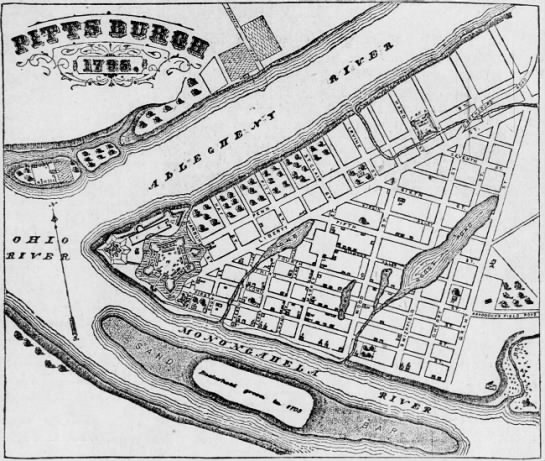
A decade after the end of the Revolutionary War, Thomas Dunning, a private in Captain Faulkner’s Rifle Company, was garrisoned at the newly-commissioned Fort Fayette under General Anthony Wayne. The rifle company had been raised in nearby Washington County.
It was a particularly intense time at Fort Fayette, as General Wayne rigorously pushed and punished his troops in preparation for battle with Native Americans along the new nation’s western frontier. After losses in recent battles led by Generals Harmar and St. Clair, Wayne was determined to prevail.
Fort Fayette is denoted to the right of center
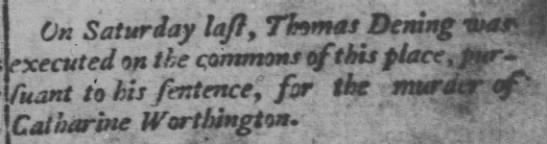
Though little information about this case survives (despite beginning publication in 1786, no known copies of the Pittsburgh Gazette for the years 1791 and 1792 survive), we know that Dunning killed his wife, Catherine Witherington (according to court records, though identified as Worthington in some newspaper accounts), on July 30, 1792. The killing occurred by stabbing. Dunning claimed that he acted in “a frenzy of drunkenness.” He then attempted suicide by stabbing himself.
Connecticut Journal, August 22, 1792
Indicted by a grand jury that included Pittsburgh luminaries such as Ebenezer Denny, who became the city’s first mayor in 1816, Dunning was convicted of murder after a one-day trial before a three-judge panel on September 3, 1792.
Indictment of Thomas Dunning
His death warrant was issued on December 12, 1792. With his pardon request rejected by Governor Thomas Mifflin, Pennsylvania’s first governor, Thomas Dunning was executed on January 26, 1793. Prior to his execution, he was described as showing “the strongest symptoms of sorrow and distress and every appearance of contrition and repentance.” He had no prior record.
Pittsburgh Weekly Gazette, February 2, 1793
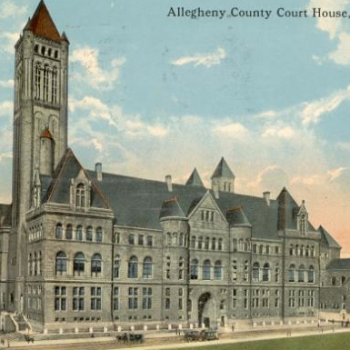
Dunning’s was the first murder trial and first civil execution in Allegheny County. His hanging, at Boyd’s Hill, not far from the present-day courthouse, was public.
As with Mamachtaga’s case, which could well have been treated as an act of war and tried by military authorities, that Dunning’s case (and the Moode case two years hence) were tried in civilian court suggests an effort to separate military and civilian justice and establish the primacy and legitimacy of civil authority, even at this early age in the life of American law.
Pittsburgh Weekly Gazette, April 8, 1875
General Wayne ultimately prevailed against Native American forces at the Battle of Fallen Timbers in August 1794. As a result, the Northwest Territory was open to American settlement as the frontier was pushed further west. Under those circumstances, Pittsburgh moved from being a frontier town and military outpost to a commercial center supporting the westward expansion along the Ohio River.


 Connecticut Journal, August 22, 1792
 Pittsburgh Weekly Gazette, February 2, 1793
 Pittsburgh Weekly Gazette, April 8, 1875
 State Killings in the Steel City: The History of the Death Penalty in Pittsburgh