Edward O’Dwyer, an officer with the Pittsburgh Police Department, was stabbed while attempting to make an arrest on June 30, 1881; he died of his wounds on July 5, 1881.
O’Dwyer was attempting to arrest a 16-year old boy for disorderly conduct when the boy’s parents intervened. The boy’s mother, Kate McClain, attacked O’Dwyer and his father, William McClain, stabbed him. The incident occurred in the defendant’s home at Bedford Avenue and Roberts St., in the Hill District.
Both parents were charged with murder. Kate McClain was acquitted and William McClain was convicted of second-degree murder.
Thomas Lyons, an officer with the Pittsburgh Police Department, died on July 16, 1878, from injuries sustained on July 3, 1878. Lyons was attempting to arrest Frank Craig for disorderly conduct on Butler St., near the Sharpsburg Bridge, when Craig headbutted him and fled.
Samuel Norman, a constable with the Tarentum Borough Police Department, was shot and killed on July 26, 1877, by August Myers, a “drunken German,” when trying to arrest him on a warrant for assaulting a woman.
John A. Weimar, an officer with the Pittsburgh Police Department, was shot and killed on August 24, 1874, at the intersection of Wylie Avenue and Chatham St., in the Hill District.
Weimar and fellow officer David Bailey had arrested Hezekiah K. Hillon, a “colored barber,” and William Sproul, and were escorting them to the jail when Hillon drew a weapon and shot Weimar.
Hillon was convicted of second-degree murder on October 28, 1874. Hillon’s intoxication apparently kept him from a first-degree murder conviction.
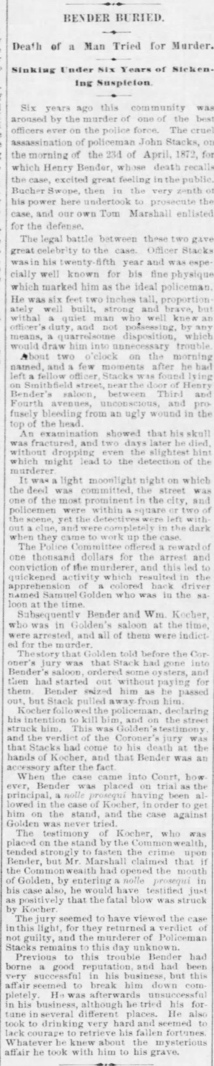
John Stacks, an officer with the Pittsburgh Police Department, died April 24, 1872, from injuries suffered on April 23 on Smithfield St., downtown. Henry Bender, who owned a saloon in which Stacks had just dined, was charged with the killing.
Pittsburgh Daily Gazette, April 23, 1872
Bender was acquitted at trial on June 14, 1872. After this verdict, charges against his alleged accomplice, William Kocher, were dropped. Both defendants were German immigrants.
Daniel McMullen, an officer with the Pittsburgh Police Department, died on December 18, 1869, never having recovered from injuries suffered on July 27, 1867, more than two years earlier.
The coroner ruled that the cause of death was the injuries sustained when McMullen was severely beaten by Teddy McCarthy after intervening in a bar fight on Penn Avenue.
McCarthy was convicted of assault and battery on October 31, 1868, and sentenced to seven years in prison. Officer McMullen was able to testify against McCarthy. McCarthy was pardoned in 1870 after thousands of citizens, including a number of very prominent Pittsburghers, interceded on his behalf, citing the circumstantial evidence on which he was convicted and “very serious doubts concerning his guilt.”
Clarence Williams, Cleo Peterson, and Robert Smith killed August F. Braum, Jr., 52, during a robbery of his meat market in Elizabeth on October 4, 1930. Braum was shot when he tried to defend himself with a butcher knife.
The three assailants fled the scene and robbed a nearby gas station during a spree of robberies that lasted through the following day.
Williams and Peterson were arrested after a gunfight with Donora police on October 17. Smith had been arrested during a robbery on October 11. Under questioning, Williams and Peterson provided information to police that linked Smith to Braum’s killing.
The three were tried together and convicted of first-degree murder on February 13, 1931. The jury recommended death sentences for all three defendants. Smith became ill on March 9 and died of pneumonia on March 14, 1931, before being formally sentenced to death. Williams and Peterson were executed on June 22, 1931.
Rocco Famia was shot three times as he prepared to go to work during the early morning hours of August 26, 1927. The shots were fired from outside through a window and into the kitchen of his Lytle St., Hazelwood home.
Hazelwood, 1918
Reports linked the murder to tensions between bootleggers, a Prohibition-spurred trade that was dominated by Italian immigrants and that became particularly violent in the five-year period beginning in 1927.
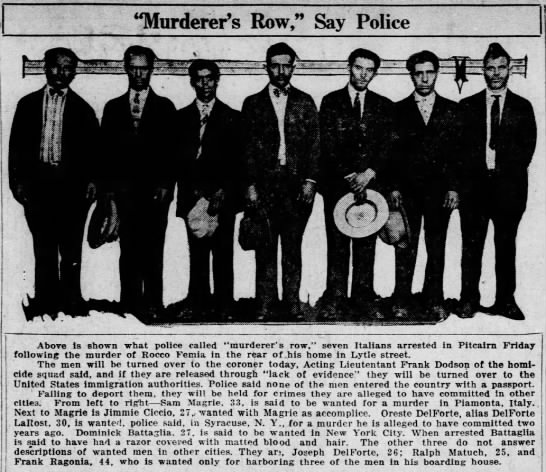
Seven men, all recent Italian immigrants with extensive criminal records, were arrested in Clairton that same day.
Pittsburgh Post-Gazette, August 31, 1927
Famia’s wife, Sophia, testified before the grand jury that her husband was murdered by Vincenzo Ciccia and Oreste Delforte as a threat to her not to testify against the them for a different crime.
Sophia Famia provided that same evidence at trial. Ciccia and Delforte offered an alibi defense, including testimony from multiple witnesses who could place them in Clairton, more than ten miles to the south, at the time of Famia’s killing.
The two men were convicted on December 17, 1927, after a week-long trial. The jury recommended the death penalty.
Pittsburgh Press, December 17, 1927
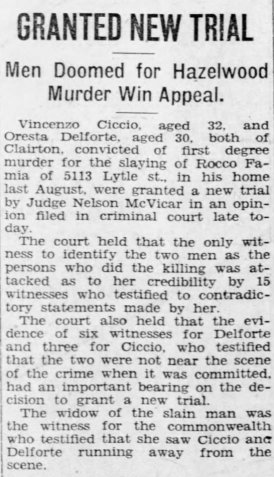
A motion for a new trial was argued on December 27, 1927. Though such a motion was a rarely-granted routine occurrence, a formality between the conviction and the formal imposition of a death sentence, it was granted on December 30, after a three-judge panel determined the evidence did not support their convictions.
Pittsburgh Press, December 30, 1927
At retrial, the state argued the same dubious case, centering on the testimony of Sophia Famia. The defendants offered the same alibi defense. Ciccia and Delforte were acquitted on March 3, 1928. No other arrests were made for the killing of Rocco Famia.
After being released from jail, the two men raised families and ran small businesses. Oreste Delforte died in Canandaigua, NY, in April 1966. Vincenzo Ciccia died in Pittsburgh on December 6, 1973.
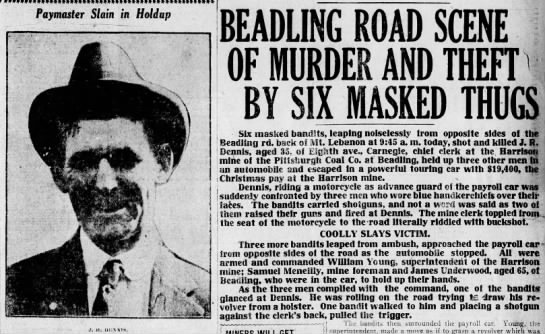
John Ross Dennis was a payroll officer for the Pittsburgh Coal Company’s Harrison mine. While driving a motorcycle escort for the company’s Christmas payroll, a group of three robbers ambushed the convoy and shot and killed Dennis on December 23, 1922. The Beadling Rd., Mt. Lebanon robbery netted $20,000.
Pittsburgh Press, December 23, 1922
Despite considerable law enforcement and public attention, no suspects were initially identified. The Pittsburgh Coal Company also became actively involved, hiring private investigators and promising to “spare no expense” in solving the case. Large awards for information were posted.
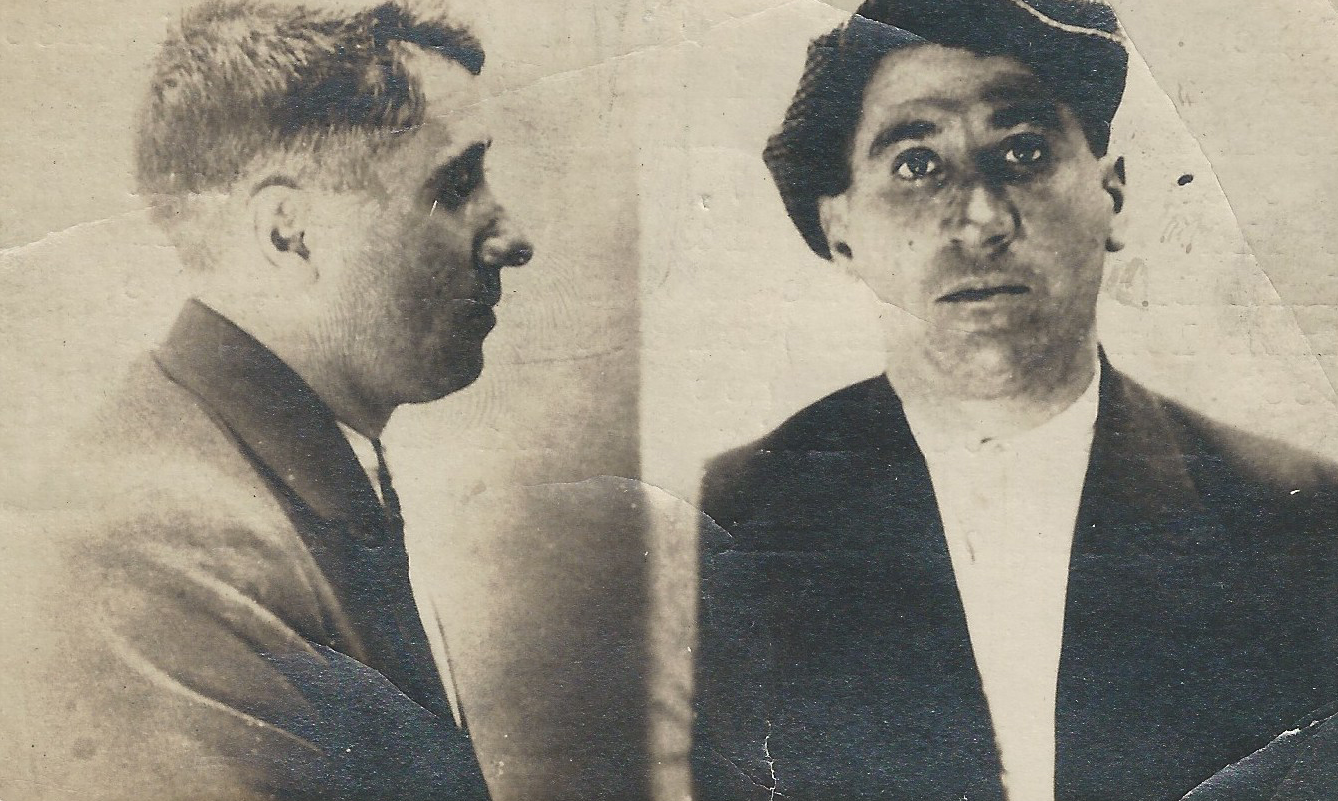
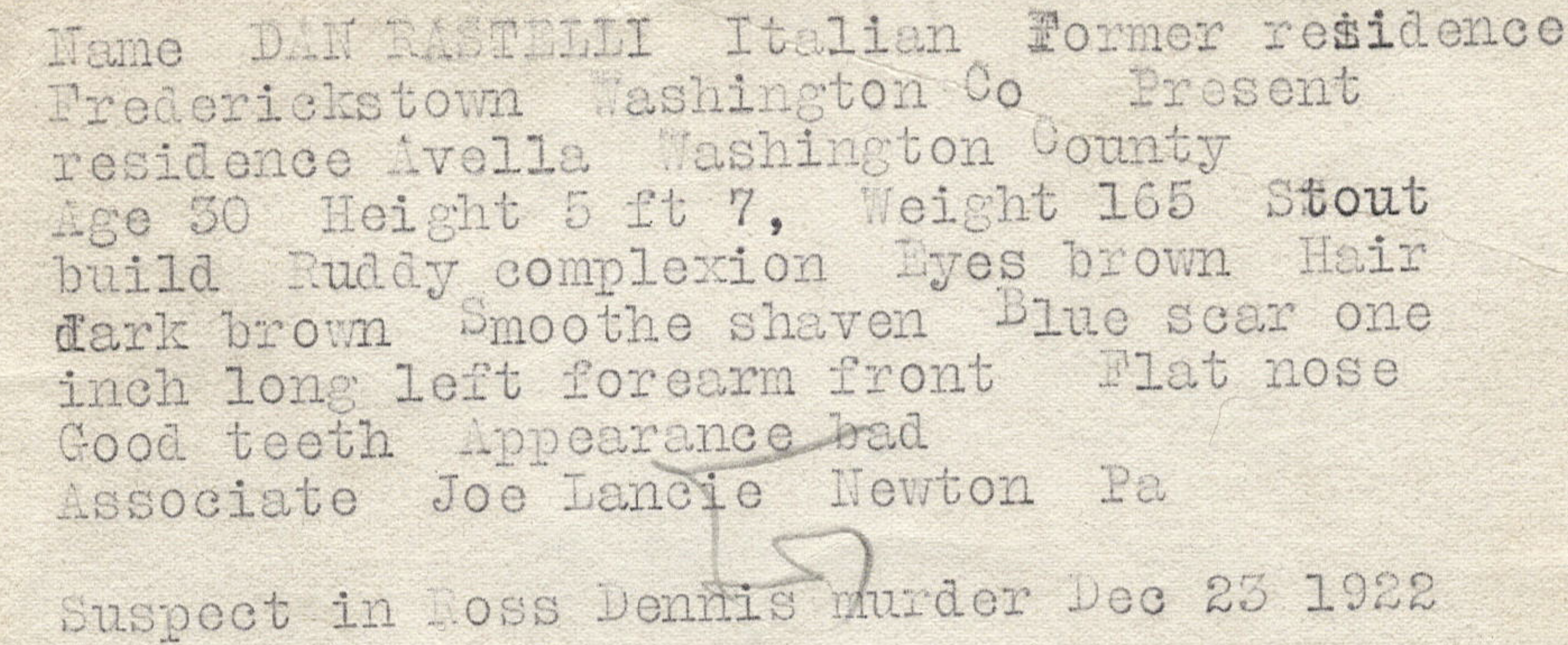
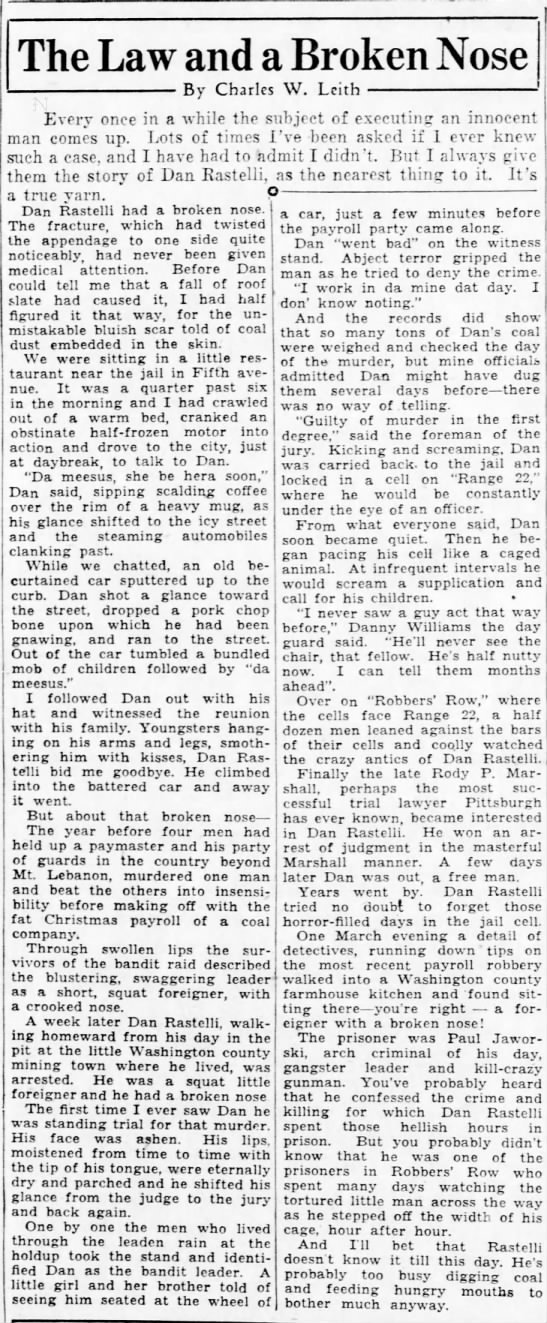
Daniel Rastelli, an Italian-born, Washington County coalminer, was arrested with three other men on December 29. He had no prior record. Rastelli apparently became a suspect after a woman came forward claiming to have overheard a fellow train passenger identify him as a robber. Police surveillance followed, which is reported to have found patterns of spending that supported their suspicions. Once apprehended, survivors of the robbery positively identified Rastelli.
Despite “severe grilling” by police, Rastelli and his alleged accomplices denied any involvement in the case.
After a trial built on circumstantial evidence, Rastelli was convicted of first-degree murder on June 15, 1923. He offered an alibi defense, claiming he was at work at the time of the killing. That defense was corroborated by a company foreman, co-workers, and company records. The jury deliberated 162 hours before returning their verdict.
Rastelli’s two alleged accomplices, Orlando Fabbri and John Burchianti, who offered similar alibi defenses, were acquitted.
Pittsburgh Post-Gazette, December 13, 1924
Rastelli immediately filed a motion with the trial court asking for a new trial due to the weakness of the case against him. That motion was granted.
After a four-day trial and a day of jury deliberations, Rastelli was acquitted on retrial on December 12, 1924.
Once acquitted, he was held for suspicion of involvement in a March 11, 1922 payroll robbery near Connellsville, Pa. He was released when his employer provided an alibi for the date of the crime.
With Rastelli’s acquittal, authorities were “completely baffled as regards the Beadling road holdup.”
After being arrested for the Coverdale payroll robbery, a remarkably similar robbery in the same area south of Pittsburgh in 1927, gangster Paul Jaworski, leader of the notorious Flathead Gang, confessed to killing Dennis and completely exonerated Rastelli.
Pittsburgh Post-Gazette, August 14, 1934
Jaworski was executed on January 21, 1929.
Soon after his release, Rastelli, his wife, Julia, and their son moved to Kansas, where he continued work as a coal miner in Crawford County in the southeast corner of the state. He died in 1937.





 Despite “severe grilling” by police, Rastelli and his alleged accomplices denied any involvement in the case.
 State Killings in the Steel City: The History of the Death Penalty in Pittsburgh