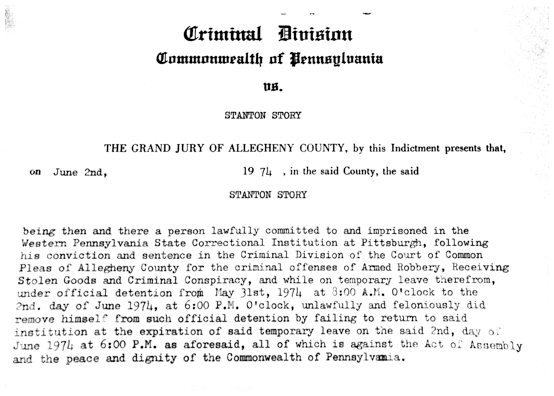
Already known to police as leader of a gang implicated in at least twenty-four armed robberies and a murder before his twentieth birthday, Stanton Story escaped from Western Penitentiary by failing to return from a temporary leave on June 2, 1974.
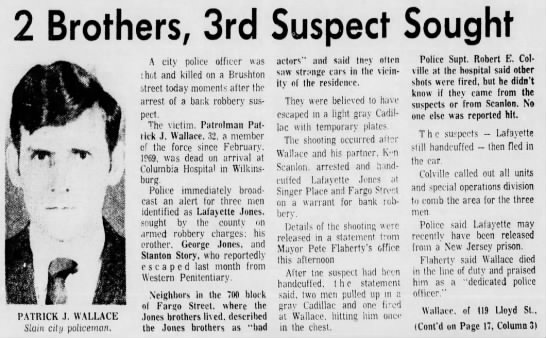
 A month later, on July 3, 1974, Pittsburgh Police Officer Patrick J. Wallace, Jr. and his partner, Kenneth Scanlon, pulled over Lafayette Jones, whom they recognized as a fugitive, in a remote area of Brushton.
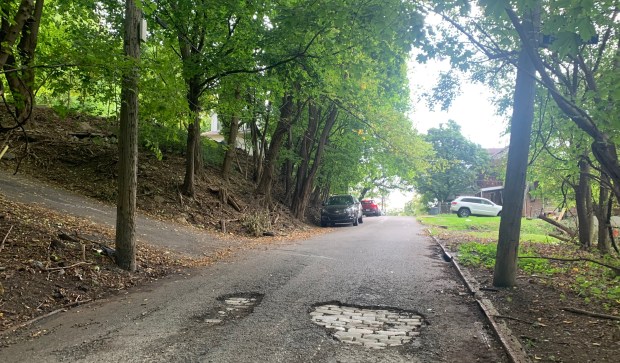
The official account of what followed is that while Jones was being arrested, he broke free of the officers and fled toward a nearby car. Story was crouched behind that car. As Wallace pursued Jones, Story shot and killed him and fled.

An intensive manhunt followed, sparking complaints of police racism and brutality. Story was arrested on September 7, in East Liberty, after an armed standoff with police.
Story was convicted of first-degree murder on March 29, 1975, and sentenced to death the same day. That he was convicted by an all-white jury in a high profile killing of a white police officer in a case involving police brutality, and a series of procedural irregularities set the stage for a contentious post-conviction process.
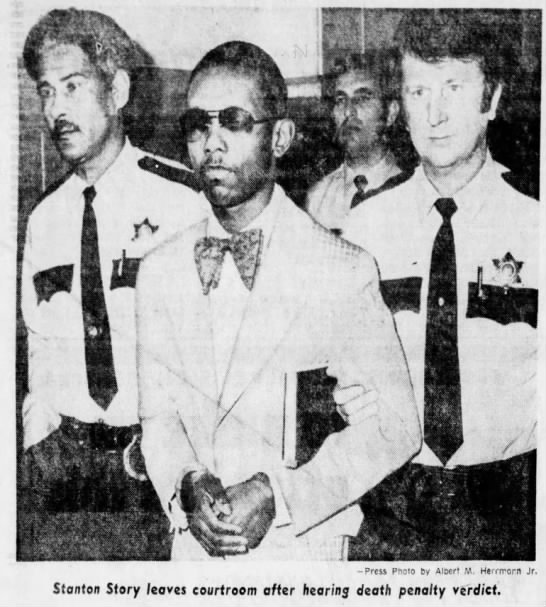
Heightened racial tensions in Pittsburgh and beyond and heightened legal and public attention to the death penalty lent additional valence to the case. Coverage of the case by the Pittsburgh Courier, with a sometimes more strident posture than its traditional Black bourgeoisie voice, countered the white establishment voices of the Press and Post-Gazette by highlighting voices that emphasized the racist character of the incident from police stop through death sentencing and that claimed Wallace was shot by his partner.

The prospect of Story’s execution was quite remote. Though Pennsylvania had enacted a new death penalty statute (P.L. 213, No. 46, May 26, 1974) over Governor Milton Shapp’s veto after its statute had been invalidated by the U.S. Supreme Court’s 1972 decision in Furman v. Georgia (as applied to Pennsylvania via Commonwealth v. Bradley, 295 A.2d 242, September 7, 1972), that statute was untested. What’s more, Shapp had declared that no one would be executed during his term and the state’s electric chair had been dismantled by order of Attorney General Fred Speaker.

On appeal, Story argued that allowing Officer Wallace’s wife, Marilyn, to testify about their marriage and family and other testimony related to Wallace’s reputation was irrelevant and prejudicial. In a lengthy decision, the court agreed, and on January 26, 1978, ordered a new trial (Commonwealth v. Story, 383 A.2d 155).

On retrial, Story was convicted on October 26, 1979 and sentenced to death the next day. On appeal, on December 28, 1981, the Pennsylvania Supreme Court upheld the conviction but reversed the death sentence and resentenced Story to life imprisonment (Commonwealth v. Story, 497 Pa. 273).

The Court’s conclusion was based on a determination that the death penalty statute in place when Story committed his crime was subsequently found unconstitutional (by Commonwealth v. Moody, 382 A.2d 442, 1977) and that Story could not properly be sentenced to death under a statute not in place when he committed his crime.

Terminally ill with cancer, Stanton Story was released from the State Correctional Institution-Frackville in April 2023. He died on June 9, 2023, at age 70.

 State Killings in the Steel City: The History of the Death Penalty in Pittsburgh
I met Stanton Story in person. He is a nasty individual and a racist himself. He deserved to be executed. Period.
The fact that he is black does not obscure the fact that he is a incorrigible, vicious criminal and that he committed the crimes he was charged and convicted. He should have been executed by the electric chair. There is no racism there.
LikeLike
Thank you for your comment. Without taking any side with respect to Mr. Story, the core of the racial argument against the death penalty is that in the aggregate it is applied disproportionally against those who kill white victims. Particularly in cases involving Black defendants. That is an outcome a multiracial democracy should not tolerate, especially when alternative means of protecting society against violent offenders are available.
LikeLike
Stanton Story was not racist but fought for injustice for all inmates. He helped so many people!
LikeLike
I know people who saw Officer Scaland kill Officer Wallace. Where Officer Wallace was killed was an ex officer home he saw Scaland shoot Officer Wallace! If you write an article you should get all the facts! Did you know Officer Wallace was to go before the Grand Jury before he got killed to testify against officers of Number 5 police station? Do research! Did you know the DA knew the Death Penalty was unconstitutional but had a death qualifying jury anyway so that he could run for governor? So research!
LikeLike