John Francis Butler

John Francis Butler was being transported back to Western Penitentiary from a court appearance in Northumberland County when, on May 27, 1959, he shot and killed James R. Lauer, a Northumberland County Sheriff who was transporting him. The driver of the car, Merlin L. Diehl, was threatened with death but was not harmed.

image001

image001
Pittsburgh Sun-Telegraph, May 28, 1959

The incident began when Butler, who was in the backseat of the car handcuffed to a belt, was able to escape from the belt and take the gun from the front seat between Lauer and Diehl. Lauer lunged after him. Diehl stopped the car to assist Lauer just as Butler shot Lauer. Diehl and Butler then fled in different directions. Butler ran into the woods, where he hid overnight. He was captured there by police the next morning.

image001
Pittsburgh Sun-Telegraph, May 28, 1959

The shooting occurred on Route 19 in McCandless Township, about twelve miles north of Pittsburgh.

At trial, Butler, a 49-year old Philadelphia native who was serving a four to ten year sentence for a 1958 armed robbery of a group of priests in a monastery and had a lengthy criminal record, mounted an unsuccessful mental health defense.

image003
Pittsburgh Post-Gazette, October 9, 1957

John Butler was found guilty of first-degree murder on May 20, 1960, and sentenced to death on November 28, 1960.
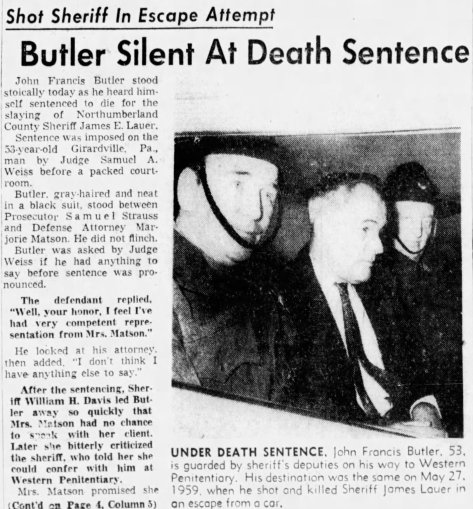
image003
Pittsburgh Press, November 28, 1960

Though the circumstances of the crime, the identity of the victim, and Butler’s record weighed in favor of his execution, the Civil Rights Movement, the legacy of World War II, and other changes broadly understood as the “evolving standards of decency,” were heightening the legal scrutiny and slowing the pace of death sentencing and executions across the United States.

Indeed, Allegheny County’s final execution had occurred less than two months before Butler killed Lauer. Only a handful of executions would occur statewide over the next seven decades. A national death penalty moratorium was only a few years away.

On appeal, Butler argued that his defense was undermined by the partiality of the psychiatrists who evaluated him and by a series of technical errors in the conduct of the trial. His conviction was “strongly sustained” by the Pennsylvania Supreme Court (Commonwealth v. Butler, 405 Pa. 36, 1961).

Butler appealed that ruling to the Third Circuit Court of Appeals in Philadelphia. While dismissing most of his claims, the court agreed that Butler’s due process rights were violated by the failure of the court to admit evidence suggesting that Diehl and Butler had struggled in the backseat of the car for control of the gun that killed Butler. That testimony, it was stated, might have raised doubt about the degree of murder involved in killing Lauer (Butler v. Maroney, 319 F.2d 622, 1963).

As a result, Butler’s conviction and death sentence were overturned.

With his retrial approaching, Butler pleaded guilty on September 16, 1963. The court then fixed the crime at first-degree murder and sentenced Butler to life imprisonment.

In a response that exemplified the tensions generated by the increasing judicial scrutiny of the criminal justice system, Common Pleas Court Judge Samuel Weiss, who presided at the original trial, attacked the Third Circuit as a “haven of refuge for rapists, cop killers, and armed thugs.”A Pittsburgh Press editorial echoed that sentiment.

John Francis Butler died on May 9, 2000. Merlin Diehl died in 1996.

Lester Samuel Welch

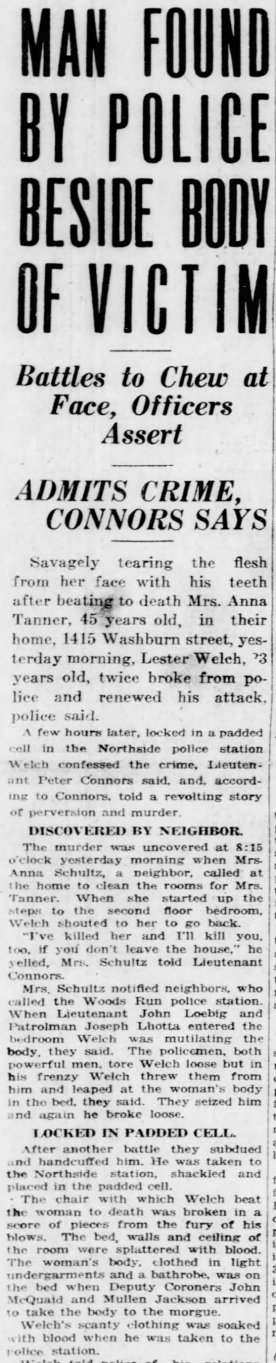
In a scene of shocking brutality and depravity, Lester Welch, 33, killed his common-law wife, Annette Jane (Annie) Exline, 57, on Easter morning, Sunday, April 4, 1926. Exline’s body was badly beaten, mutilated, and dismembered when police entered their rundown North Side home.

image002.png

There was also evidence of cannibalism. Welch was seen by police tearing flesh from Exline’s face with his teeth, a circumstance that led to him being dubbed the “vulture murderer.”

image001

Welch, who was born in Vail, Blair County, Pennsylvania, and worked as a millwright, confessed to police when he was arrested.

image003
Altoona Times, June 13, 1885

Exline, who was born into a prominent Altoona family, worked as a dressmaker as a young woman. By the turn of the century, she was facing legal and reputational troubles related to her involvement with a married man. Soon after, she moved to Pittsburgh.

image003
Pittsburgh Post, September 22, 1900

She and Welch met when he boarded in a home she owned. At some point after that, she moved in with him on Washburn Avenue.

The details of Exline’s murder were so gruesome that women were barred from jury service and even from attending the trial.

image001
Pittsburgh Post, April 5, 1926

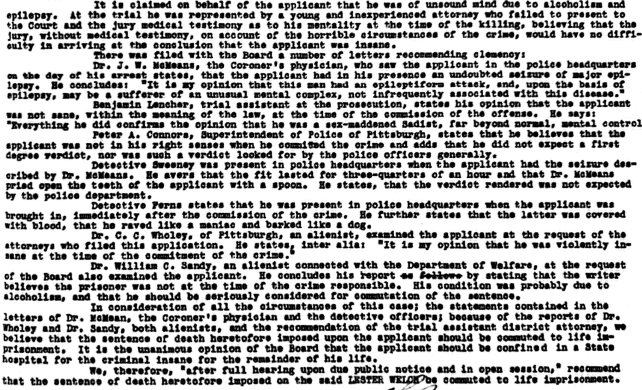
Welch’s temporary insanity defense was rejected by the jury and he was convicted of first-degree murder on October 12, 1926. He was sentenced to death on May 26, 1927.

Welch’s appeal, which focused narrowly on jury instructions related to the degrees of murder, was denied out of hand (Commonwealth v. Welch, 291 Pa. 40, 1927). In its brief opinion, the Pennsylvania Supreme Court skipped over its usual recitation of the crime, characterizing it as too “revolting” to describe.

With the Pardon Board as the last remaining opportunity to avoid the electric chair, Welch’s counsel argued that he was “clearly insane” and unfit for execution (Pittsburgh Post-Gazette, February 16, 1928). Finding that Welch’s trial counsel was inadequate and that Welch was insane, the Pardon Board agreed and his death sentence was commuted to life imprisonment on May 23, 1928. Their decision was supported by medical testimony that Welch had experienced an “epileptiform attack” at the time of the killing.

image001

Lester Welch was transferred to Western Penitentiary, where he died of heart disease on March 17, 1958. He was 65 years old.

image001
Pittsburgh Post-Gazette, May 24, 1928

Welch is the only person sentenced to death in Allegheny County after the enactment of the 1925 state statute giving juries the discretion to choose a life or death sentence in first-degree murder convictions (Act of May 14, 1925, P. L. 759) and before the de facto moratorium on executions in the early 1960s whose death sentence was commuted.

Every one of the other twenty-one men sentenced to death between 1925 and 1960 was executed. Another commutation would not occur for more than 35 years.

The dramatic decline in the use of commutations suggests that the law worked to limit the imposition of death sentences to those cases that met prevailing legal and public standards of deathworthiness. That a vastly disproportionate number of those who were executed were Black indicates whose crimes were considered deathworthy. With rare exceptions, white defendants convicted of first-degree murder were sentenced to life imprisonment while Black defendants were sentenced to death.

Warren Monroe Scott

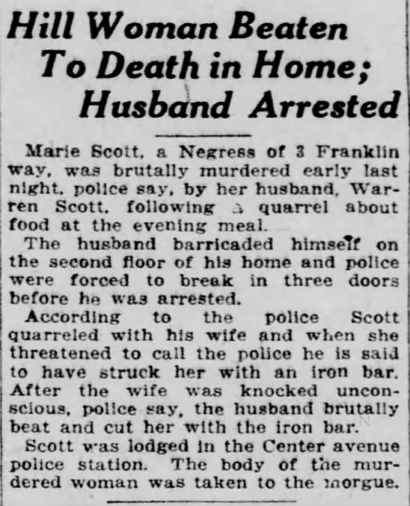
In “one of the most unusual” (Pittsburgh Daily Post, March 4, 1924) murder cases in Allegheny County history, Warren Scott killed his wife, Frances King Scott, by severing an artery near her vagina with the claw end of a hammer in their Franklin Way, Hill District home on September 18, 1923.

image001
Hill District, 1926

The couple, who had come to Pittsburgh from Virginia, had been quarreling when Frances Scott threatened to call the police. Warren Scott responded by beating her, knocking her unconscious, and disemboweling her. She bled to death. He then barricaded himself in the house. Police forced entry and arrested him.

image002
Pittsburgh Daily Post, September 19, 1923

Scott was convicted of first-degree murder on March 5, 1924, after his defense of intoxication was rejected. On May 28, 1924, he was sentenced to die in the electric chair.

Despite the unusual circumstances of the crime, the marginal statuses of the defendant and victim limited the newspaper coverage to mostly single paragraph articles. There is little information available to provide a fuller picture of the lives of the Scotts, their relationship, or Frances Scott’s death.

Warren Scott’s death sentence was respited several times while his case was being appealed. On December 5, 1924, the Pennsylvania Supreme Court reversed Scott’s conviction and granted him a new trial (Commonwealth v. Scott, 281 Pa. 548, 1924). In its decision, quoted below, the court noted that, though the evidence was sufficient to support Scott’s guilt, it was not sufficient to support a finding of first-degree murder.

The Commonwealth charged and presented evidence to prove that death was caused by laceration of the outer lips of deceased’s vagina, produced by the insertion, “not more than a quarter of an inch,” into that part of her body, of the claw-end of a metal hammer, of the type commonly used in opening crates, thus severing an artery. There was no evidence to show the exact circumstances under which this cruel and unnatural act was perpetrated; but, by such a deed, defendant evidently intended to do great bodily harm to his victim, and this, with the attending circumstances, established malice. It was error, however, for the court below to treat the weapon used as prima facie a deadly one and to charge: “He who takes the life of another with a deadly weapon, and with a manifest design thus to use it upon him, with sufficient time to deliberate and fully to form the conscious purpose of killing, and without any sufficient reason or cause of extenuation, is guilty of murder of the first degree.” The circumstances under which employed, the manner of using, and the place on which a weapon, not ordinarily a deadly one, is used may be enough to justify a jury in finding that the weapon was deadly in character; but in the above instruction the trial judge assumed that fact.

Summarizing, the court ruled that it was wrong for the state to assume as a matter of fact that the hammer was a deadly weapon used in a manner reasonably intended to produce death.

image001
Pittsburgh Press, December 7, 1924

Notwithstanding the inappropriateness of the death penalty, the Court’s decision is another – with the McMullen, McGowan, Hillman, Exler, Scherer, and Diano cases – in a long list in which judicial or executive authorities  granted tremendous legal deference to men who killed women (see the discussion here).

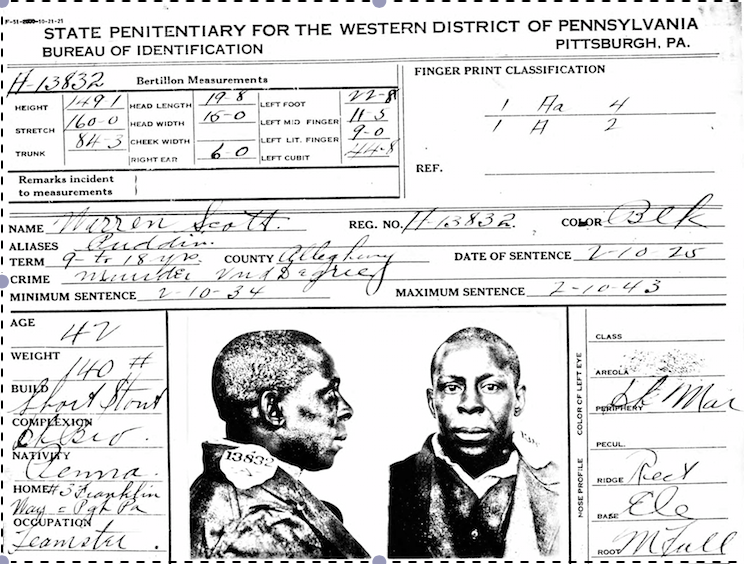
At retrial on February 9, 1925, Scott pleaded guilty to murder. The judge then set the degree of murder at second degree. Scott was sentenced to nine to eighteen years in Western Penitentiary.

Warren Scott died in Mayview State Hospital on November 21, 1947. He was 58 years old.

image001

Albert Charles Carelli

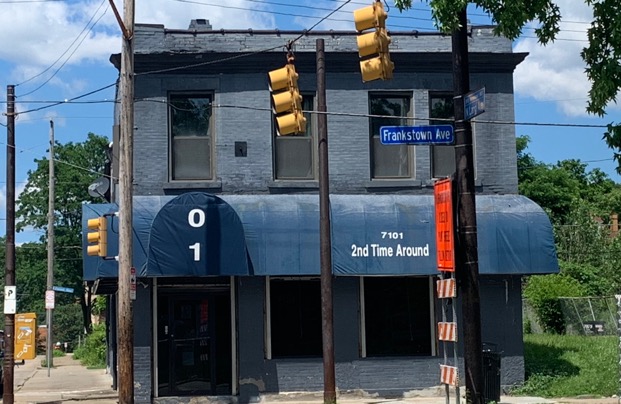
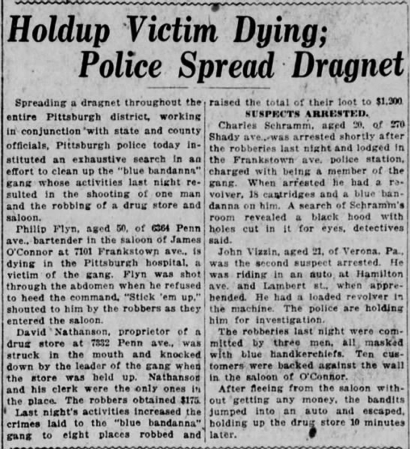
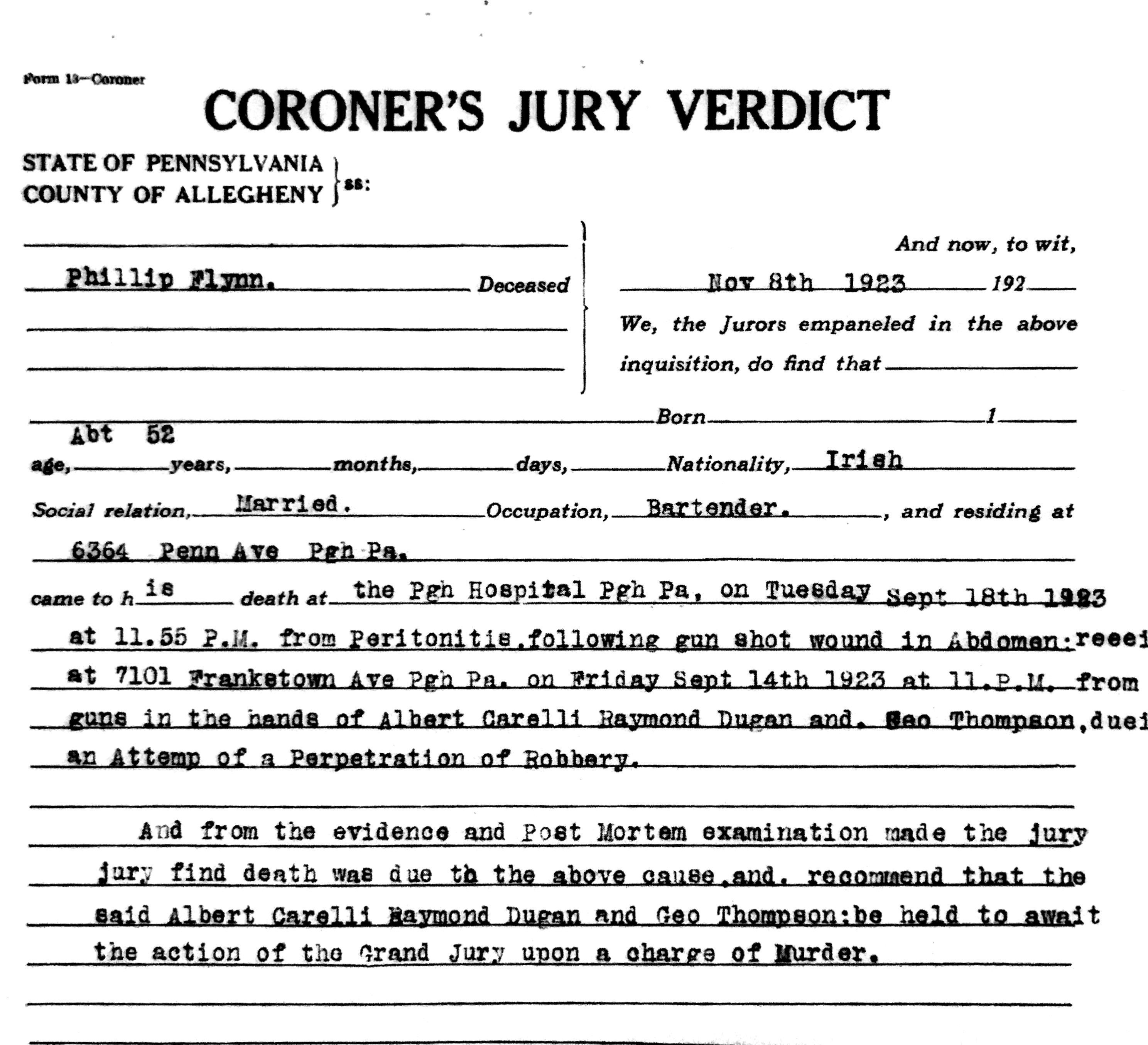
Philip Flynn was tending bar at the Hotel O’Connor on Frankstown Avenue in East Pittsburgh when it was robbed by three masked members of the infamous “Blue Bandana” gang on September 14, 1923.

image001

After refusing the demand for money, Flynn was shot in the stomach. The assailants fled. The robbery was part of a crime spree.

image002
Pittsburgh Press, September 15, 1923

Flynn died on September 18, 1923.

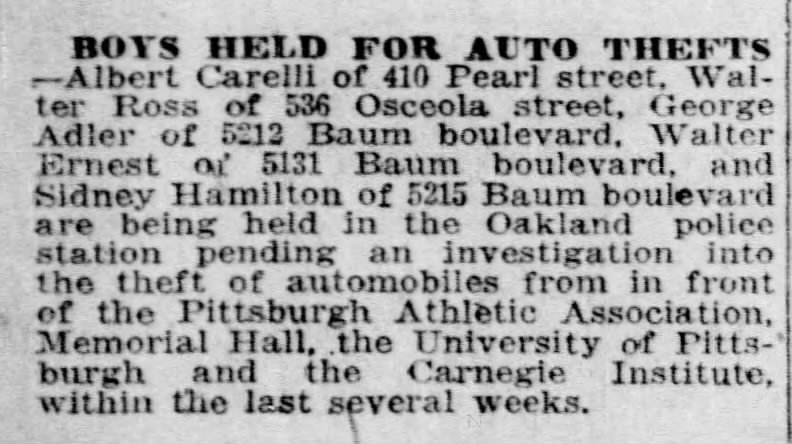
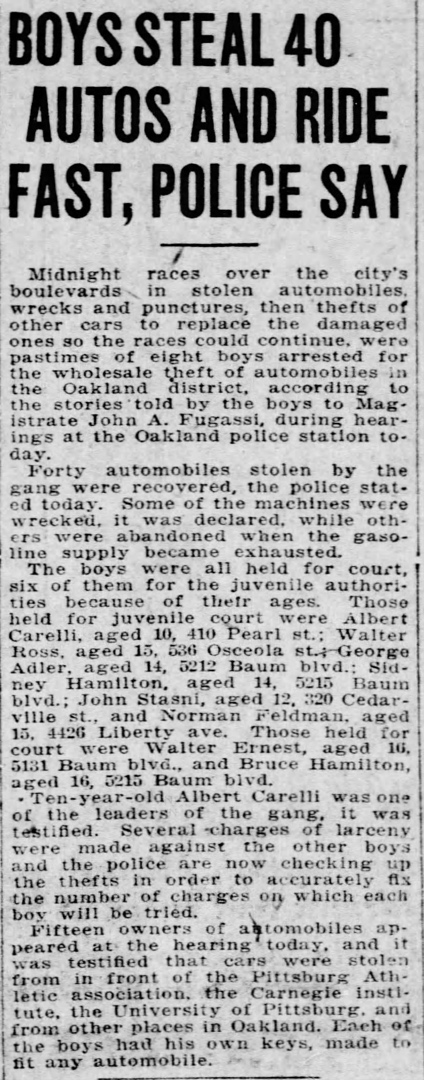
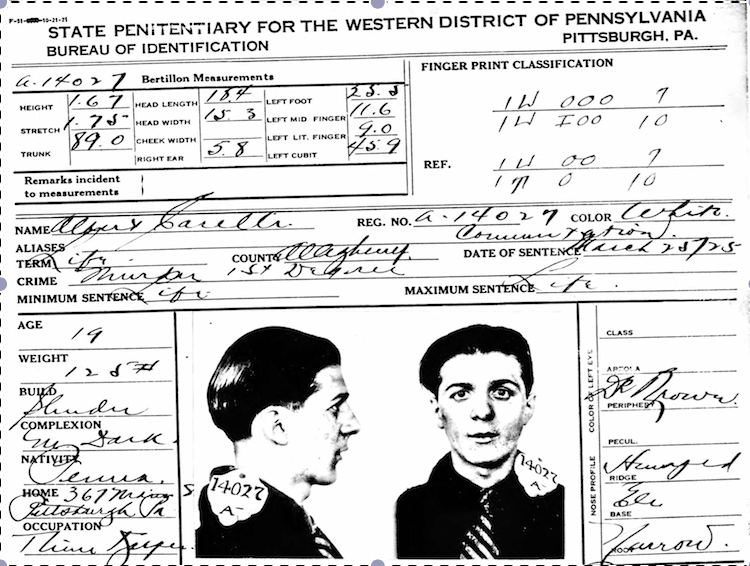
Albert Carelli, a 21-year old member of the gang whose already impressive criminal record began at age 15, was caught in a police dragnet and arrested for shooting Flynn. So began one of the longest and strangest capital cases in the annals of Allegheny County.

image003
Pittsburgh Post, October 24, 1917

image003
Pittsburgh Press, October 25, 1917

Also arrested were Raymond Dugan and George Thompson. Police claimed the three young men confessed to the murder and reenacted the scene for police. The men claimed they were beaten and coerced.

image001

At trial, Carelli denied any involvement in the Flynn case, claiming instead he was beaten into confessing and that he was in Burton, Ohio, at the time of Flynn’s death. That claim was supported by a relative whose home Carelli said he was visiting as well as a number of others from that area.

Carelli, who was tried first, was convicted of first-degree murder on March 17, 1924. Thompson was convicted of voluntary manslaughter and Dugan was convicted of second-degree murder. After his motion for a new trial was rejected, Carelli was sentenced to death on June 24, 1924. He maintained his innocence throughout the case.

The Pennsylvania Supreme Court upheld Carelli’s conviction and death sentence on January 5, 1925, leaning on Carelli’s confession to support its conclusion (Commonwealth v. Carelli, 281 Pa. 602).

The Pardon Board viewed the matter differently. Relying on Carelli’s youth, his clean record (stating he was “never before charged with or convicted of crime”), and affidavits of Ohio residents stating that Carelli was there when Flynn was killed, the board commuted Carelli’s death sentence to life imprisonment on March 18, 1925. His custody was transferred to Western Penitentiary.

image001

A few weeks later, on April 14, 1925, Carelli, along with his confederates Dugan and Thompson, pleaded guilty to five charges of robbery and three charges of larceny related to their involvement in the Blue Bandana Gang. Sentences for those offenses were suspended due to Carelli’s life imprisonment.

image001
Pittsburgh Press, April 14, 1925

Six months later, Carelli was pardoned by Governor Pinchot after the secretary of the Pardon Board traveled to Burton to verify Carelli’s alibi. He was released from prison on October 2, 1925.

image001

The day after his pardon, news reports indicated Carelli was attempting to flee to Italy to escape sentencing for his suspended robbery and larceny convictions. A massive police search was launched, but was unsuccessful.

After Carelli was arrested in connection with a robbery and shooting in Cleveland in  January 1926, he fought extradition all the way to the United States Supreme Court. Returned to Pittsburgh, he was sentenced to 28 to 56 years in prison for robbery on October 21, 1926. His appeal of that sentence, which argued that the court lacked the authority to reimpose sentences that previously had been suspended, was rejected (Commonwealth v. Carelli, 90 Pa. Super. 416, 1927).

With the support of prominent Pittsburgh attorney, Michael A. Musmanno, and newspaperman, Ray Sprigle, a second pardon effort was mounted in 1934. That effort achieved some success in 1935 when Carelli’s sentence was commuted from 28 to 56 years to a minimum of 11 years. Pennsylvania Attorney General Charles J. Margiotti expressed strong opposition to any additional leniency for Carelli, declaring “his [1925] pardon was a great miscarriage of justice, the greatest ever perpetrated in this state” (Pittsburgh Post-Gazette, February 22, 1935). Carelli was paroled in 1938.

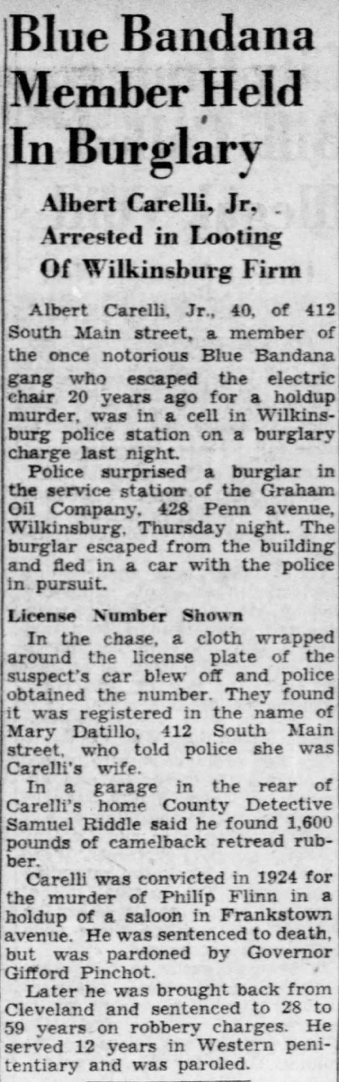
After avoiding conviction on federal counterfeiting charges in 1942, Carelli was convicted of burglary in 1945 and sentenced to 3 to 6 years in prison after being arrested for stealing tires from a service station.

image003
Pittsburgh Post-Gazette, January 13, 1945

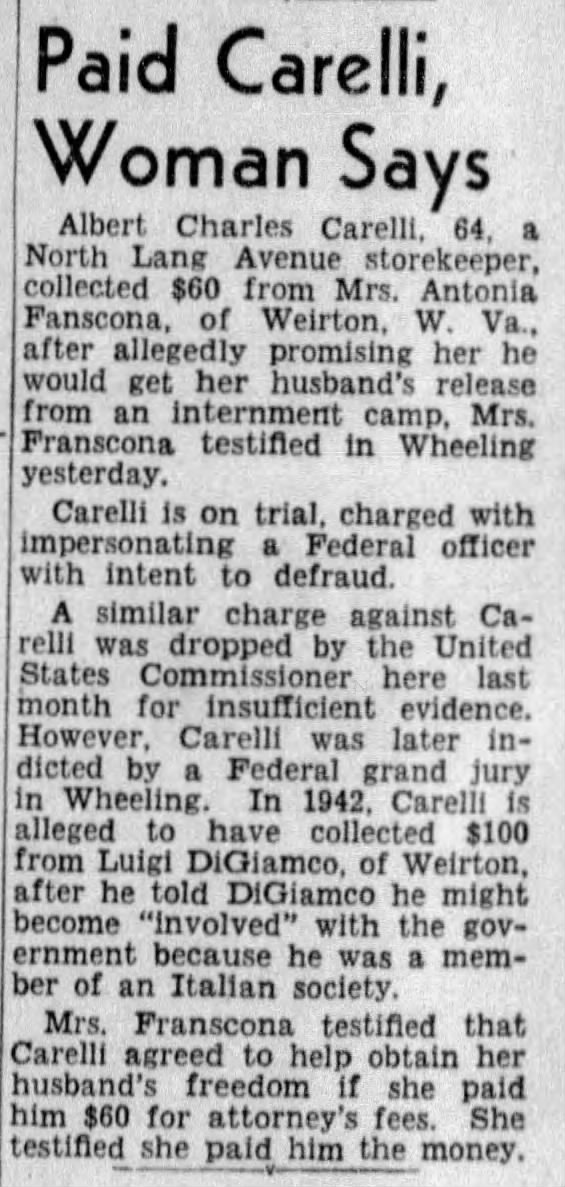
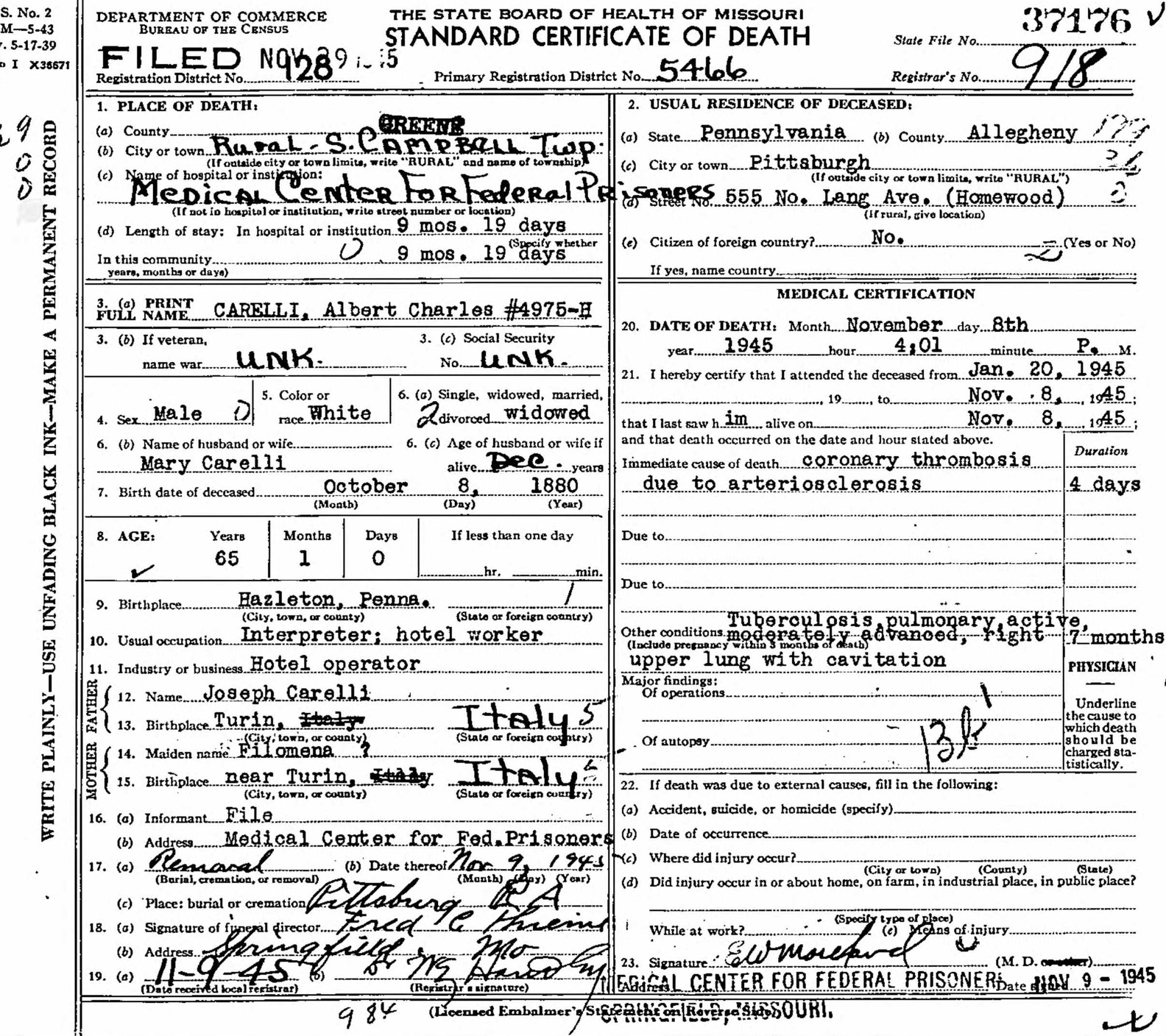
At the same time, Carelli’s father, also named Albert Charles, was convicted on federal charges of impersonating a federal officer. Health problems led to his collapse during legal proceedings. The elder Carelli, who was sentenced to six years, died in federal prison in Missouri in 1945.

image003
Pittsburgh Sun-Telegraph, November 12, 1944

image001

Younger Albert’s 1945 conviction and sentence were supplemented by the violation of his 1938 parole, extending Carelli’s prison term until he was paroled again on December 1, 1952. A 1955 commutation prevented Carelli from returning to prison for a parole violation if he were to be arrested again.

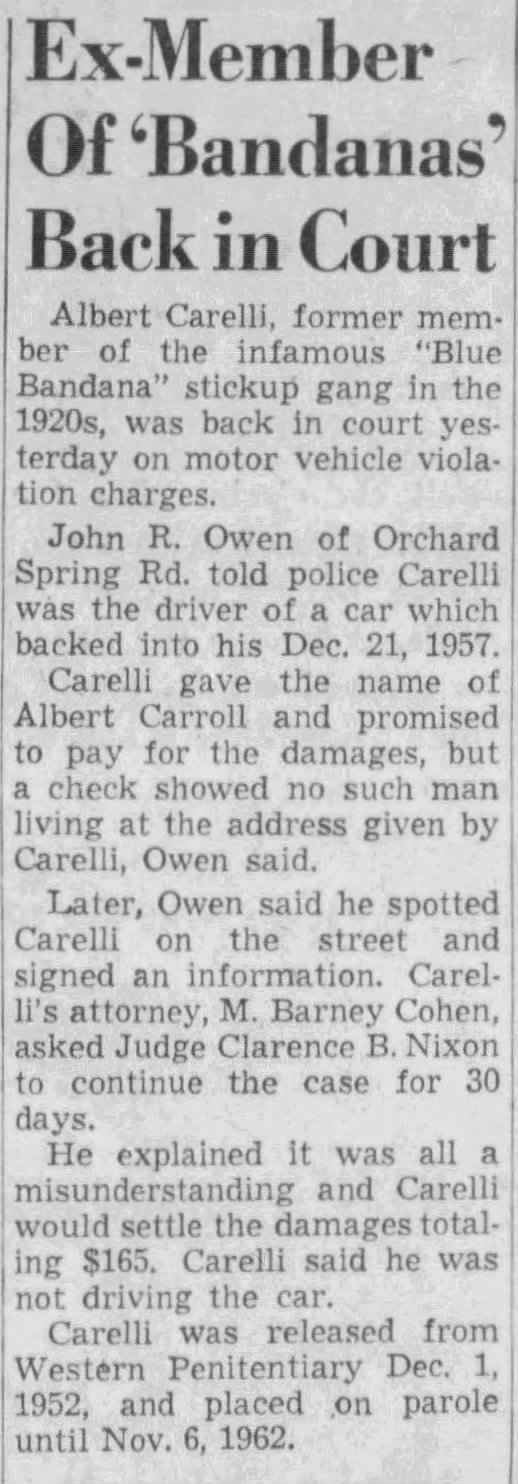
Carelli was back in court in 1958, this time for failure to pay damages related to a car crash.

image003
Pittsburgh Sun-Telegraph, November 7, 1958

So ended Carelli’s long criminal career, at least as far as I can determine, but not the debate over whether he was a small-time offender caught up in a series of mistakes and frame-ups or a serial and violent robber and killer able to persuade powerful people of his innocence.

Albert Carelli died in 1982 at age 80. He is buried at Calvary Cemetery.

Joseph Diano

Unwilling to endure any additional violence, Nancy Diano had separated from her husband, Joseph, and filed for divorce. On the evening of July 25, 1923, after his efforts to reconcile were rebuffed, Joseph Diano shot his estranged wife four times in the back in her Cliff St., Hill District home. He then left the house and was apprehended by a neighbor, Morris Grodstein, to whom he confessed.

image002

Nancy Diano died in the hospital on August 4, 1923.

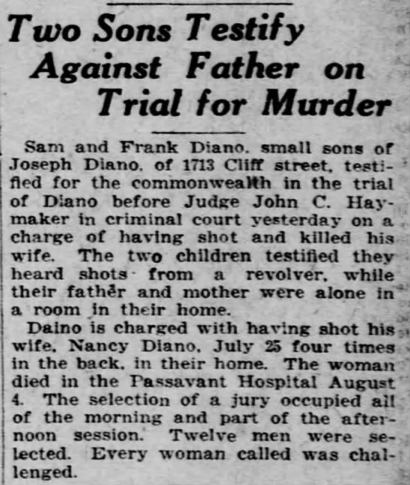
During jury selection, all women were removed by challenge and a jury of twelve men was seated. At trial, Diano’s claim of self-defense was refuted by his own confession, statements provided by his wife before she died, Grodstein’s testimony, and the testimony of his own children.

image002
Pittsburgh Daily Post, February 26, 1924

Joseph Diano was convicted on February 28, 1924. After his motion for a new trial was rejected, he was sentenced to death on July 25, 1924, exactly one year after his fatal assault.

Unable to afford counsel to advance his clemency request, Diano, a fruit and vegetable vendor, took the unprecedented step of filing on his own behalf. The narrative he advanced – in which his wife had contracted syphilis while the couple still lived in Italy, had infected her husband in the United States, had been deported to Italy as a result, had reconciled with him and returned to Pittsburgh, had been unfaithful again, and had separated from her husband again –  appeared nowhere in the coroner’s investigation or newspaper accounts of the trial.

In this version of the case, Diano killed his wife when, at his mother-in-law’s urging, he approached her about reconciling again and she attacked him with a gun. He responded by shooting her with the gun he happened to be carrying.

Accepting Diano’s apparently novel claims, the Pardon Board commuted his death sentence to life imprisonment on January 29, 1925, after six months on death row.

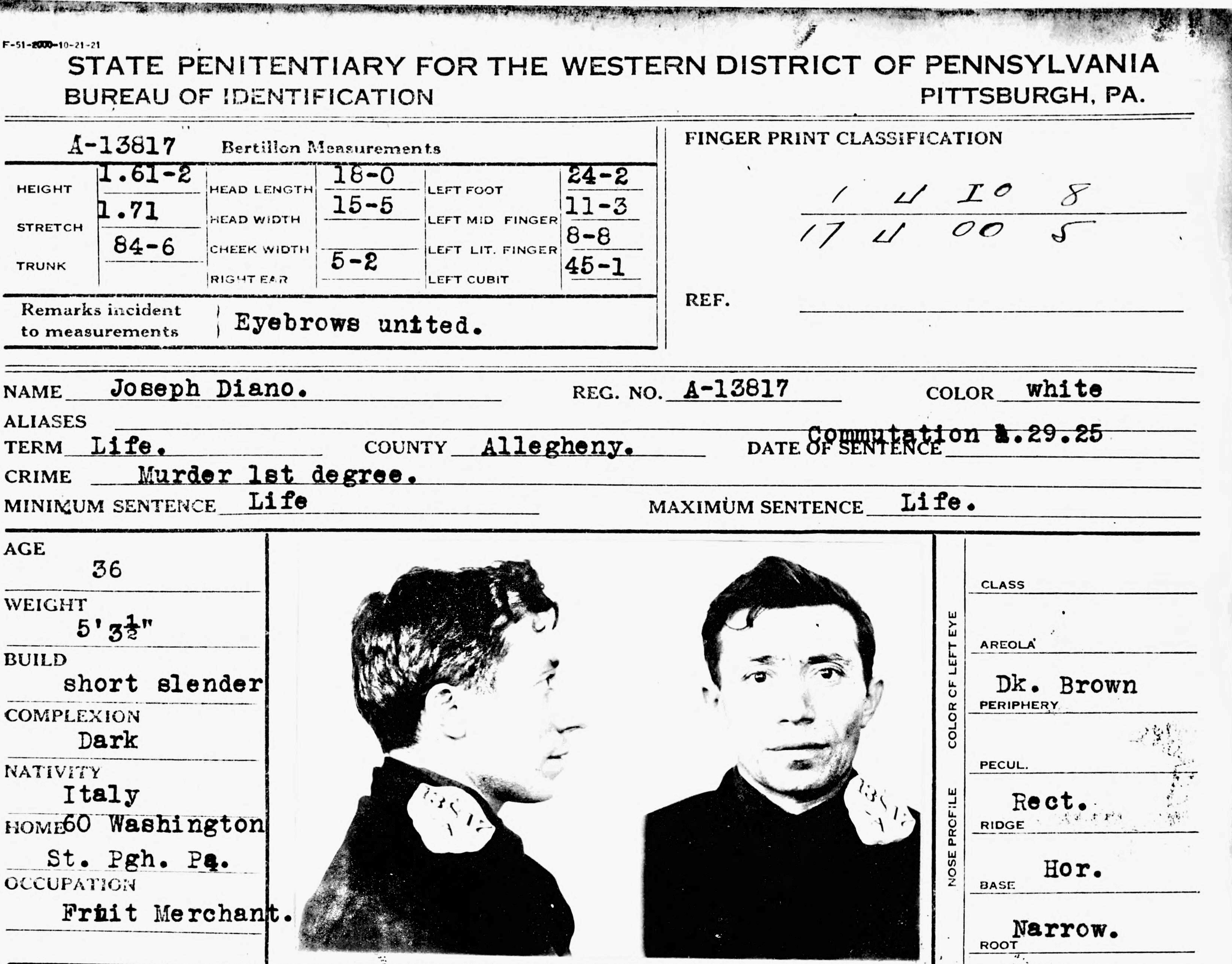
Diano was transferred to Western Penitentiary.

image001

An Italian immigrant, World War I veteran, and former city worker, Diano unsuccessfully sought a full pardon and release from prison annually from 1933 at least through 1940. His clemency petition included a statement from his son claiming his mother was “always nagging” his father (Pittsburgh Post-Gazette, January 16, 1936).

Joseph Diano died in Pittsburgh on December 23, 1949.

image001                                                                   1713 Cliff St.

Joseph Valotta

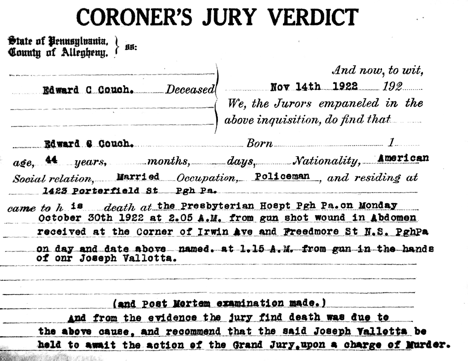
When Thomas Hopkins, a railroad worker, encountered co-worker Joseph Valotta on Irwin Avenue on the North Side just after midnight on October 30, 1922, Hopkins called him a “scab” for not honoring the strike against the Pennsylvania Railroad the previous summer.

image001
1919 Steel Strike

Valotta responded by shooting and killing Hopkins. When Pittsburgh Police Officer Edward Couch responded to the shooting, Valotta shot and killed him as well. He then fled.

image002

image001

A nationwide manhunt ensued. With police going door to door in the “foreign” section of Pitcairn, Valotta was arrested on November 5, 1922. He confessed to police, claiming he acted in self-defense when Couch, whom he did not recognize as a police officer, confronted him.

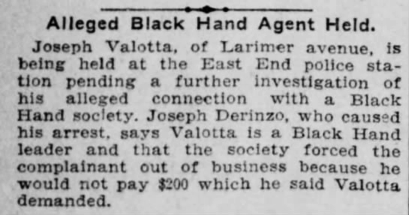
Valotta, an Italian immigrant, had earlier been linked to the Black Hand.

image001
Pittsburgh Daily Post, August 7, 1908

The gun Valotta used in the killings had been provided to him by police as part of their effort to support Pennsylvania Railroad and its non-striking workers against strikers. These kinds of police tactics, reminiscent as they were of the notorious Coal and Iron Police, led the American Civil Liberties Union only a few years later to publish “The Shame of Pennsylvania,” an indictment of the state’s police claiming that the state led the nation in “police brutality and violence.”

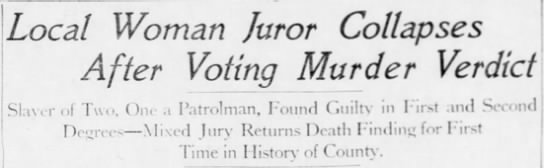
After a brief trial and ninety minute jury deliberations, Valotta was convicted of second-degree murder for killing Hopkins and first-degree murder for killing Couch on March 14, 1923. He was sentenced to death on June 28, 1923.

His jury included Mrs. Wesley Hale, the first woman to serve on a trial jury in a capital case in Allegheny County history. 

image001
Pittsburgh Post-Gazette, March 15, 1923

The long and winding path to the disposition of Valotta’s cases is in keeping with the moral, legal, and political challenges of executing the sentence of a defendant whose crimes were facilitated by the state charged with punishing him.

Valotta’s death sentence was postponed eleven times as he pursued his appeals. After the Pennsylvania Supreme Court “found no errors in his trial” (Commonwealth v. Valotta, 279 Pa. 84, 1924), he pursued relief in federal court. In “an unprecedented legal move,” a federal judge intervened to stop Valotta’s execution while it considered his claim that simultaneous trials for the killings of Hopkins and Couch were unconstitutional.

In a decision dated November 17, 1924, the same federal court reversed Valotta’s convictions (United States ex rel. Valotta v. Ashe, Warden of State Penitentiary, 2 F.2d 735, 1924). Reviewing Pennsylvania law all the way back to 1684 and common law from across the country and England, the court found that a single trial for two indictments charging separate crimes was unprecedented and impermissible.

image002

image002
Pittsburgh Press, December 18, 1924

The state appealed that ruling, resulting in a long series of respites of Valotta’s execution date while the matter worked its way through the courts.

Finally, the United States Supreme Court affirmed Valotta’s conviction and death sentence (Ashe, Warden of State Penitentiary v. United States ex rel. Valotta, 270 US 424, 1926). In his opinion, Justice Oliver Wendall Holmes wrote that “there was not the shadow of a ground for interference with this sentence by habeas corpus.”

image002
Pittsburgh Daily Post, March 16, 1926

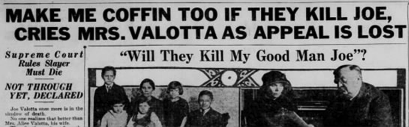
With that ruling, the state Pardon Board became Valotta’s last chance. During a hearing in May 1926, Valotta’s attorneys argued that their client had acted without premeditation and presented a letter in support of commutation signed by a federal judge, a senator, and several local dignitaries. Officer Couch’s widow spoke against commutation.

After numerous delays, Valotta’s capital case finally came to an end with the commutation of his sentence to life imprisonment on June 23, 1926. In support of its decision, the Pardon Board stated that the excitement, tension, and darkness surrounding the killings created circumstances that “do not fully measure up to first degree murder” He was transferred to Western Penitentiary.

The day after his commutation, the Post-Gazette wrote that Valotta’s was the “longest murder trial in the annals of American courts and the most unique criminal litigation of record under English Common Law.”

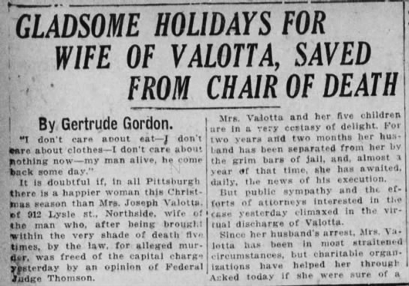
Valotta then pursued the last available remedy, a pardon. Despite support from Pittsburgh Mayor Charles H. Kline, who as a judge had presided over Valotta’s trial, federal judge W.H.S. Thomson, and the District Attorney’s Office, that request was refused on December 31, 1927.

Joseph Valotta died in Western Penitentiary on January 5, 1929. He is buried on the North Side.

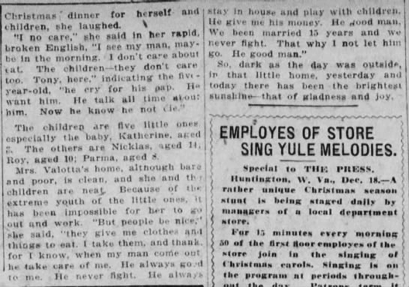
Throughout his long legal ordeal, newspaper coverage of Valotta was overwhelmingly warm and supportive. Likely reflecting its anti-labor position, a largely sympathetic press referred to Valotta as an “Americanized Italian” and welcomed his every legal victory.

Elmer Clyde Johnston

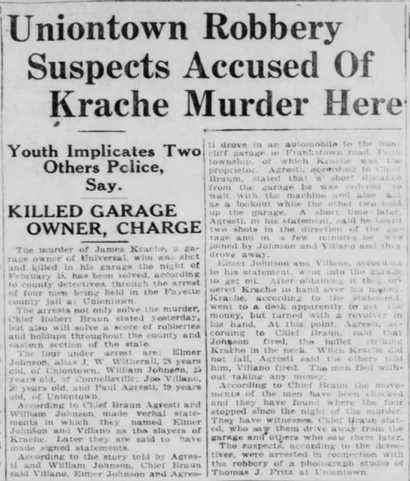
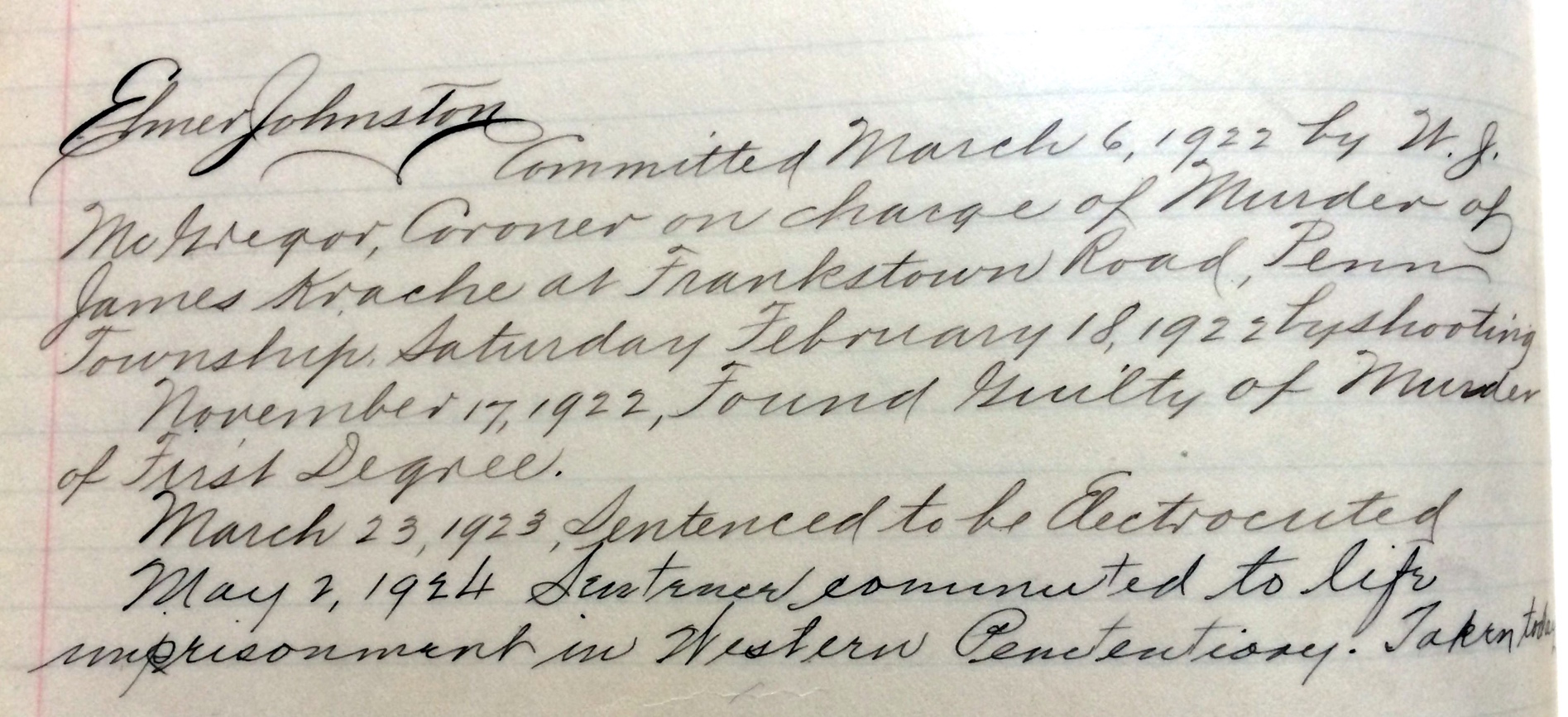
James Krache was shot during a robbery of his business, Suncliff Garage, on Frankstown Rd., Penn Township, late in the evening of February 18, 1922. He died early the next morning.

image001
James Krache in front of his business (undated photo)

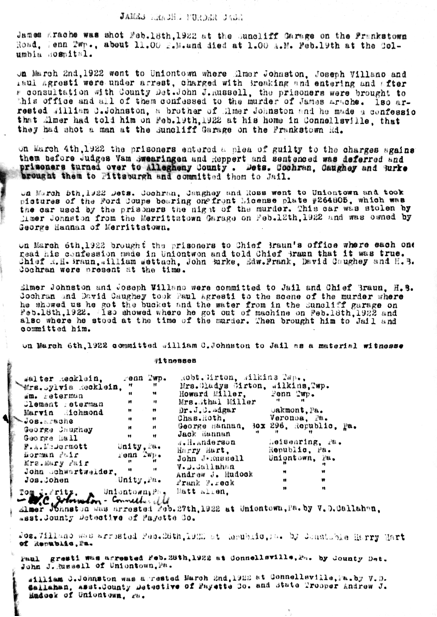
Elmer Johnston, his brother, William Johnston, Joseph Peter Vallino (identified in newspaper and court records and Villano), and Paul Agresti were arrested March 2 in Uniontown for their involvement in an unrelated theft case. Once in custody, they confessed to police that they had robbed and killed Krache. They were also implicated in a series of robberies in the area.

image002
Pittsburgh Daily Post, March 2, 1922

Based on their confessions, it was determined that Elmer Johnston, a 23-year old coalminer, was the group’s leader. He stole the car used in the robbery. He entered Krache’s business while his accomplices stayed outside. He fired the initial shots, though Agresti later fired the fatal shot.

image002

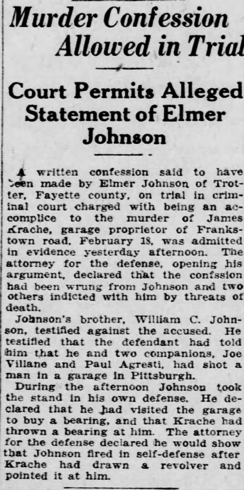
At trial, Johnston argued that his confession was coerced and should be excluded. That argument was rejected. His argument that he went to the garage to transact legitimate business and acted in self-defense when Krache argued with him and threatened him was likewise rejected.

image002
Pittsburgh Daily Post, November 16, 1922

Elmer Johnston was convicted of first-degree murder on November 17, 1922.

Agresti, who testified against Johnston, was convicted of second-degree murder on January 8, 1923, and sentenced to five to ten years in Western Penitentiary. Vallino was convicted of second-degree murder on November 24, 1922, and sentenced to eighteen to twenty years in Western Penitentiary.

image003
Pittsburgh Post, June 13, 1923

On appeal, Johnston argued a series of technical points; all of them were rejected (Commonwealth v. Johnson, 279 Pa. 40, 1924).

Johnston’s death sentence was commuted to life on April 17, 1924. In making its decision, the Pardon Board noted that Johnson’s accomplices were convicted of second-degree murder and that Johnson had not fired the fatal shot.

image001
From Allegheny County Jail’s Murder Book, courtesy of Ed Urban

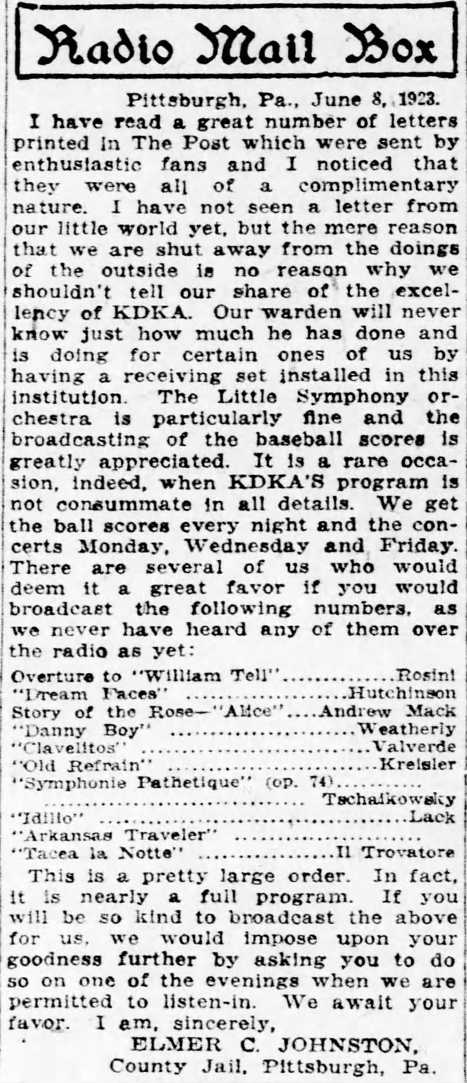
Elmer Johnston was transferred to Western Penitentiary. After at least ten pardon requests, he was released from prison in 1941. He moved to Victory, Venango County, where he died in 1992.

image002

Paul Agresti died in 1997 at age 94. Joseph Peter Vallino died in 1978 at age 75.

image001
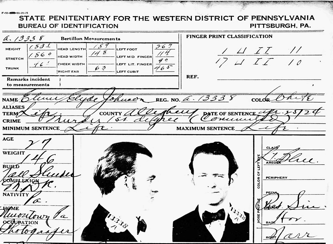
Western Penitentiary Records of Agresti and Villano

George Pritchard

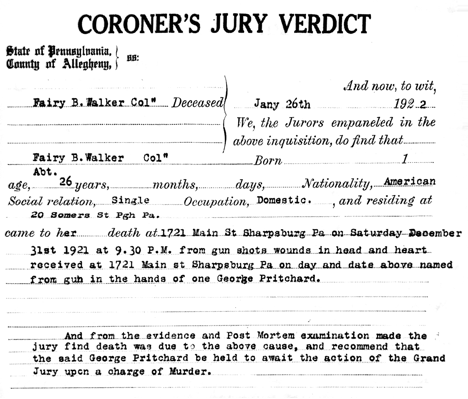
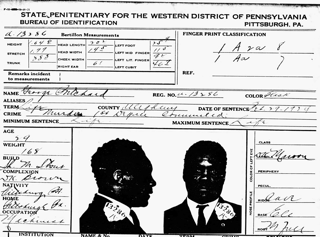
George Pritchard shot and killed Fairy Belle Walker in the Sharpsburg home of her sister, Ruth Garrison, on New Year’s Eve, 1921. She died immediately. He then shot himself in the head in a failed suicide attempt. Pritchard was reported to be jealous of attention Walker had given to another man.

image002

Pritchard, who was married and worked as a chauffeur, was infatuated with Walker, an unmarried domestic. The two had been neighbors in the Hill District, where Walker continued to live, while they were growing up. Pritchard’s employer was Judge Charles H. Kline, who would be elected mayor of Pittsburgh in 1925 and resign in the face of scandals in 1933.

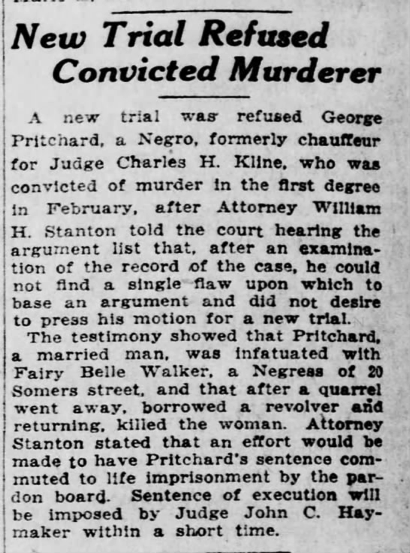
In a trial that received scant attention, Pritchard used an insanity defense. He was convicted of first-degree murder on February 21, 1923, and sentenced to death on July 27. After his attorney, William H. Stanton, one of the first Black criminal defense attorneys to practice in Pittsburgh, concluded that a motion for a new trial and an appeal would be futile, attention turned to the Pardon Board.

image002
Pittsburgh Daily Post, May 30, 1923

Questions about Pritchard’s mental health led Governor Pinchot to commute his sentence to life imprisonment on March 5, 1924. He was transferred to Western Penitentiary.

image002

George Pritchard died in Western Penitentiary on April 20, 1952. He was 57 years old.

As a young man, Pritchard had twice been recognized for heroism. First after injuring himself in an effort to alert a family to a fire in their home in 1913 and then again in 1914 when he assisted in apprehending a knife-wielding robber.

Pritchard’s was the fourth capital case in less than thirty years involving a man who killed his real or imagined intimate partner on New Year’s Eve; the others were McMullen, McGowan, and Malinowski. In three of the four cases, the male killer subsequently attempted suicide. All four cases resulted in commutations.

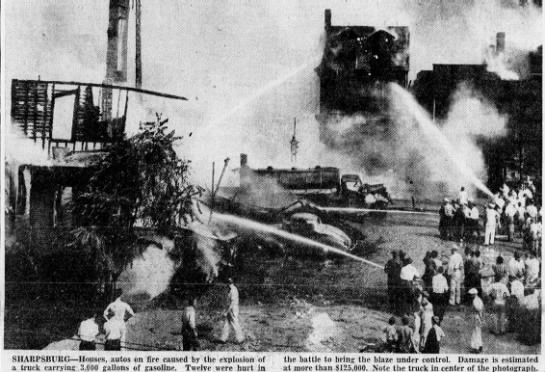
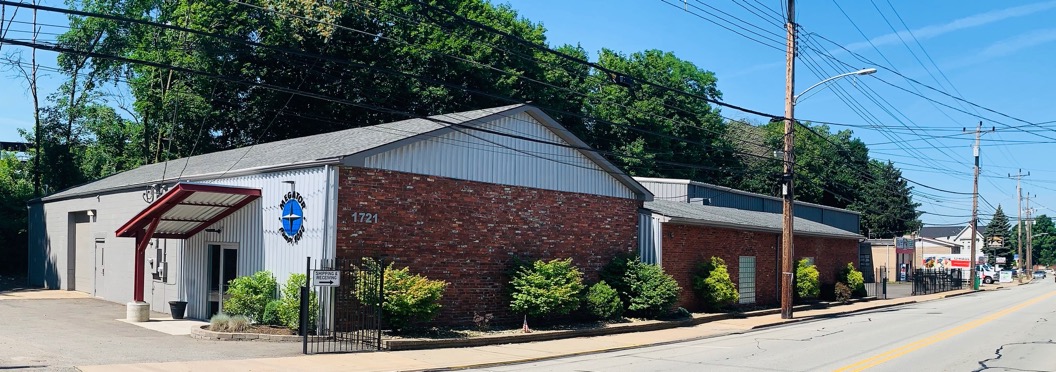
Garrison’s home was damaged and then demolished after a gasoline truck that had stopped at a red light exploded, injuring at least a dozen people and leveling much of the block, on August 29, 1939.

image001
Pittsburgh Sun-Telegraph, August 30, 1939

image001                                               1721 Main St., Sharpsburg today

John Peter Rush

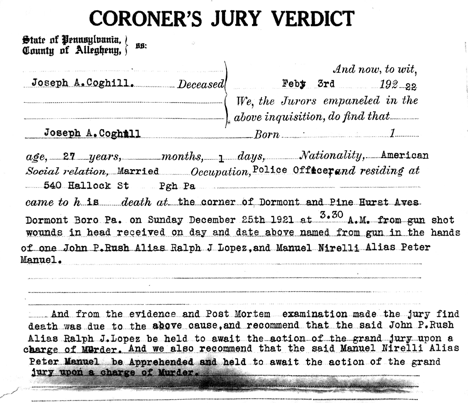
On Christmas morning, 1921, Dormont Police Officer Joseph Allen Coghill was shot in the head and killed instantly while he and his partner, Byron Schwartz, arrested two men reported to be burglarizing homes on Dormont Avenue. After placing the men in a patrol vehicle, one of the men drew a concealed weapon and shot the officers. Schwartz recovered from his injuries. The assailants fled.

image001
Intersection of Dormont and Pinehurst Avenues, Dormont

The search for the killers was so intense that a group of citizens nearly lynched two men caught during a burglary on December 27. Police intervened to prevent any injury. A similar vigilante group chased a group of robbers in Brookline on December 28. Shots were fired in that case. None of the assailants were involved in Coghill’s murder.

image002
Pittsburgh Daily Post, December 28, 1921
image002
Pittsburgh Post-Gazette, December 29, 1921

John Rush (aliases Ralph Lopez and Manuel Nirelli), who was well known to police, was among those who were arrested in the days after the killing, only to be released due to a lack of evidence.

Continuing investigation allowed police to develop enough evidence to link Rush to Coghill’s killing. He was arrested again on January 23, 1922, on an unrelated charge in the Hill District and was held for Coghill’s murder. He attempted suicide in his jail cell that same day.

image001
Officer Joseph Coghill

Under police questioning, Rush provided inculpatory information. He was also identified as Coghill’s killer by Officer Schwartz as well as Dormont burglary victims and witnesses. He subsequently provided a written confession.

image003
Pittsburgh Press, January 26, 1922

Vincent Paoletti, originally implicated by Rush as his accomplice, was later released after Rush’s statements cleared him. Rush’s accomplice was never definitively identified or apprehended.

image002

Determined to avoid confinement, on March 20, 1922, Rush was found in  possession of a gun and was implicated as the leader of an escape plot that included three other inmates facing murder charges, including Walter Troy and Joseph Thomas.

At trial, Rush repudiated his confession, claiming that he gave it in an effort to secure his own execution. He also offered witnesses placing him in the Hill District at the time of the killing. Confronted by eyewitness testimony and that confession, Rush was convicted of first-degree murder on June 24, 1922, and sentenced to death on November 18, 1922.

image001
Pittsburgh Press, June 19, 1922

On appeal, Rush challenged the admissibility of his confession. That challenge was rejected (Commonwealth v. Rush 277 Pa. 419, 1923).

In considering his commutation request, the Pardon Board was persuaded by expert testimony of Rush’s mental instability, including his history of suicide attempts, that his death sentence should be commuted to life imprisonment. Governor Pinchot agreed on October 31, 1923. A serious head injury Rush suffered as a railroad worker a decade earlier was noted as an explanation for his mental instability.

Rush was transferred to Western Penitentiary, where he served until being paroled on June 10, 1946. 

image003
Pittsburgh Press, October 3, 1947

His criminal career was not over.  John Rush was arrested again in 1947, at age 58, for possession of a firearm and explosives that he planned to use in safe-cracking. He pleaded guilty and was returned to Western Penitentiary, where he died of cancer on June 18, 1960. He was 71 years old.

image001

Antonio Caliendo

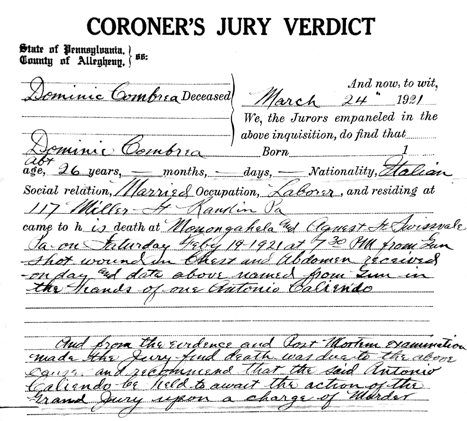
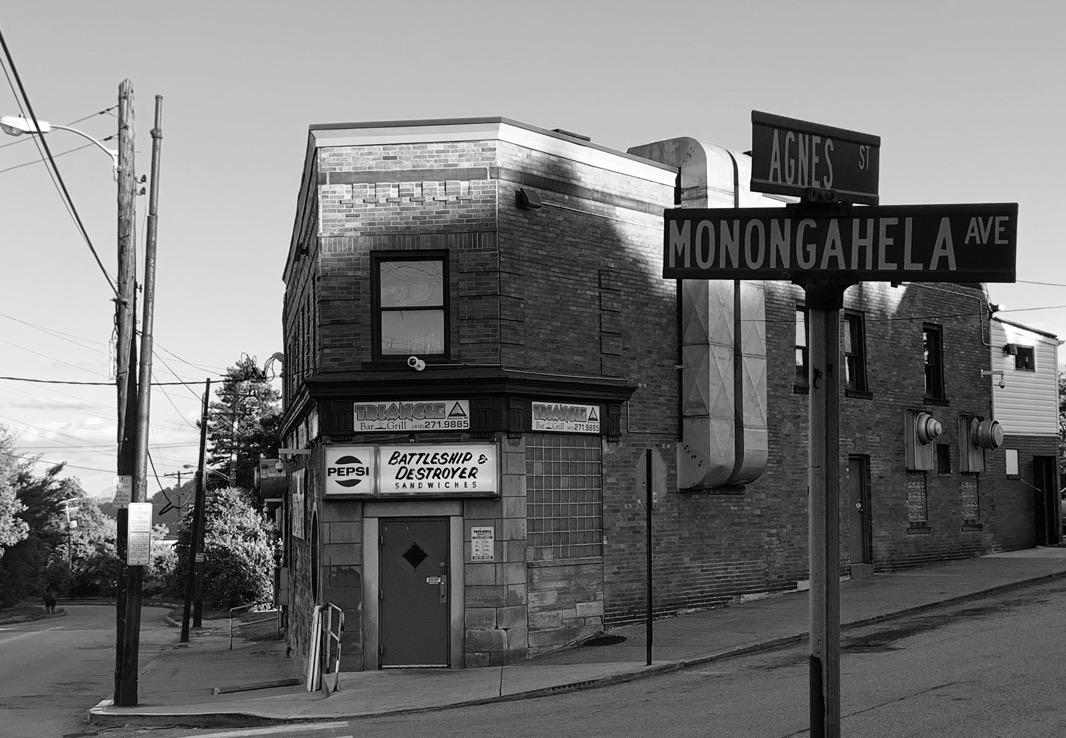
Dominic Combrea and Dominic Fiorentino were walking in Swissvale on the evening of February 19, 1921, when Antonio Caliendo approached them from behind and shot them both. Combrea, the target of the attack, died at the scene. That was the state’s original version of this complicated case.

image002

The killing was reportedly a Black Hand operation, an extortion racket that proliferated among Italian immigrants in the first quarter of the twentieth century. Such rackets, in which Italian immigrant gangsters extorted primarily Italian immigrant businessmen, were active in Pittsburgh and throughout Western Pennsylvania as well as in immigrant enclaves around the country.

In addition to the Caliendo case, the capital murder cases of the Russogulos and Guastaferros and Georgio Quagenti and Giovanni Graziano were also tied to Black Hand activities.

Caliendo, 24, who owned a Swissvale pool hall, was reportedly leading an effort to extort money for the legal defense of Italians. Apparently Combrea, an Italian immigrant steelworker, and Caliendo had argued about the issue in the past. When Caliendo saw Combrea on the street he argued with him further, then pulled out a gun and shot him multiple times. Caliendo fled the scene.

image001

Apprehended in Chicago on June 28, Caliendo fought extradition before being returned to Pittsburgh on July 14, 1921.

At trial, Caliendo, a World War I veteran, argued self-defense, though Combrea was said to be unarmed when he was killed. He was convicted of first-degree murder on October 26, 1921, and sentenced to death.

On appeal, he again argued self-defense, an argument the court dismissed by noting that a jury had already considered it and was “not impressed” (Commonwealth v. Caliendo, 279 Pa. 293, 1924). Finding no errors, the court noted, “our function in dealing with the case is at an end.”

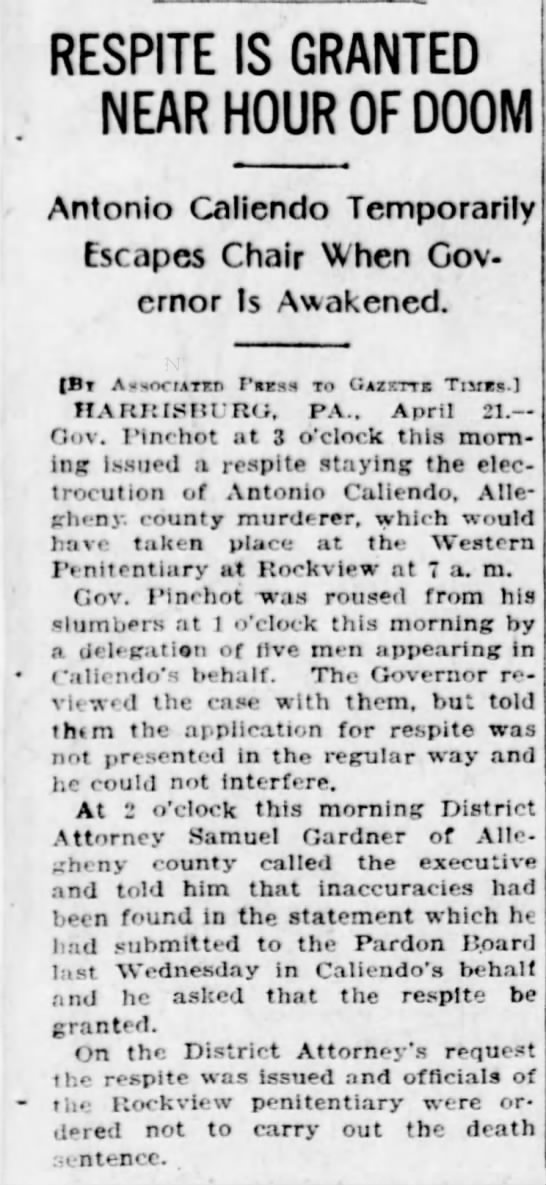
With significant resources behind him, Caliendo mounted a clemency campaign that, after multiple reprieves, succeeded in having his sentence commuted to life on June 25, 1924. In its recommendation, the Pardon Board reversed the state’s theory of the case in convicting Caliendo, and characterized Combrea as a Black Hand member who was extorting Caliendo.

Caliendo was transferred to Western Penitentiary.

image001
Pittsburgh Post-Gazette, April 22, 1924

Suggestions of corruption by organized crime interests led to an investigation in which the District Attorney disclosed that he had received information just before Caliendo’s scheduled execution that led him to believe that Caliendo was not guilty of first-degree murder and that he notified the governor of this information.

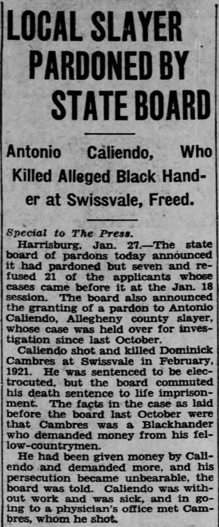
Continuing his clemency campaign, Caliendo was pardoned and released from prison on January 27, 1928. In announcing its decision, the Pardon Board stated that Combrea, a Black Hand hitman sent to kill Caliendo, was threatening him with a gun when Caliendo killed him in self-defense.

image002
Pittsburgh Press, January 27, 1928

Caliendo died of heart failure in Pittsburgh on September 18, 1956. At the time of his death, he worked at Pittsburgh International Airport as a senior construction and materials inspector.