Frank Dombek

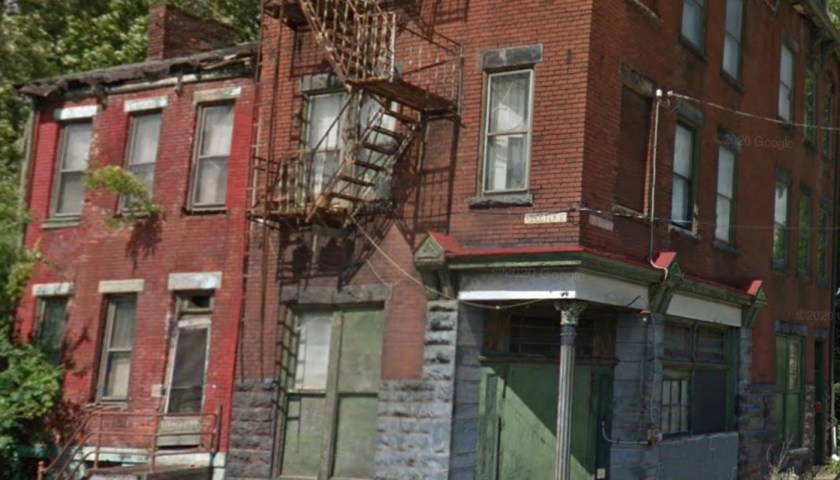
On the morning of February 3, 1919, Frank Dombek went to the Bingham St., South Side home of Jacob and Marie (Latocha) Rzasa, with whom he had previously boarded. All were Polish immigrants.

image001
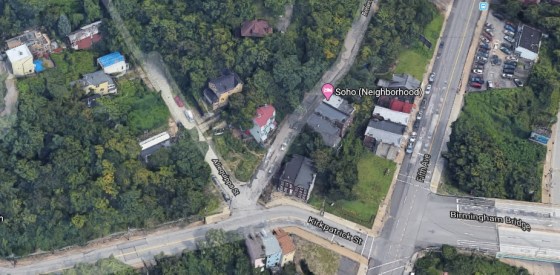
1102 Bingham St, Summer 2019

Finding Marie alone, Dombek demanded all her money. When she refused, he beat her with a brick and strangled her. He then stole several hundred dollars in cash and securities and fled.

image001
Pittsburgh Post, February 4, 1919

The murder occurred in the midst of the effort to enact Prohibition, which Pennsylvania had voted to support the same day as the murder.

image002

That effort was supported by sensationalistic stories of alcohol-fueled immigrant lawlessness. Probably not coincidentally, alcohol figured prominently in the official narrative of Rzasa’s death, though it is not clear that it figured prominently in Dombek’s actions that day.

image003

image004
February 5, 1919

Dombek, 26, who had a 1911 conviction for burglary, was apprehended more than a month after Rzasa’s killing, on March 8, 1919, in a New Jersey post office. He had gone there to pick up a letter containing the money he needed to return to Pittsburgh to turn himself in.

It was subsequently revealed that not long after the murder, Dombek, overcome by remorse, sought the counsel of a priest and made arrangements to return to Pittsburgh. At his arrest, he immediately confessed.

image001
Pittsburgh Post, March 19, 1919

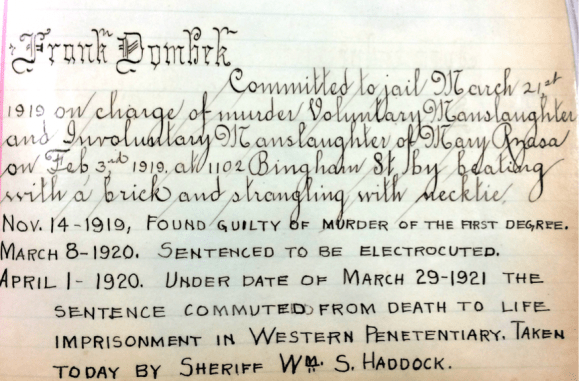
On the basis of his signed confession, strong witness testimony, and evidence he had used stolen securities to purchase jewelry, Dombek was convicted of first-degree murder on November 14, 1919.

Immediately after Dombek’s conviction, his attorney filed a motion for a new trial alleging that the foreman of the jury was biased against him, that one juror had misrepresented himself in being seated as a juror, and other improprieties. That motion was rejected and Dombek was sentenced to death on March 8, 1920.

Dombek then appealed his conviction, raising the same issues about juror misconduct. His conviction was affirmed in an unusual single paragraph decision (Commonwealth v. Dombek, 268 Pa. 262, 1920).

Members of the jury supported and advocated for Dombek’s commutation, which was granted on March 29, 1921. In its recommendation, the Pardon Board went so far as to suggest Dombek may not have been responsible for Rsaza’s death.

image001
Pardon Board recommendation, March 28, 1921

Dombek was transferred to Western Penitentiary, from which he was paroled in 1933.
Screenshot 2019-02-01 09.01.06

From the Allegheny County Jail Murder Book, courtesy of Ed Urban

Claiming he had been coerced into confessing to a crime he did not commit, Dombek sought a full pardon. His request was granted on July 18, 1940.

image003
Pittsburgh Sun-Telegraph, July 19, 1940

Once released, Frank Dombek returned to Chicago, where he had lived before moving to Pittsburgh. He died there on September 25, 1984, at the age of 89.

image001

Jacob Rzasa died in Pittsburgh in 1958.
Anton Weber

Anton Weber and Mary Kiem lived together in meager circumstances at 221 Voegtly St. on the North Side.

image001
All that remains of Voegtly St..

As neighbors later testified, the couple quarreled during the evening of November 11, 1918, the day that marked the end of World War I. Several hours later, Weber killed Kiem, a 54-year old Hungarian immigrant, while she slept, stabbing her multiple times and slitting her throat. He then attempted suicide by slashing his own throat. Their bodies were found in bed when the police broke into the home on the morning of November 13.

image001

Two weeks prior to the killing, Weber, a 52-year old fellow Hungarian immigrant, had been seriously injured in a workplace accident at a steel mill. It is speculated that he was despondent over the loss of vision in one eye and the loss of his job.

image002.png

At trial, Kiem’s daughter testified that Weber had confessed to her. Weber claimed he acted in self-defense after Kiem attempted to stab him. The trial and jury deliberations were brief; Weber was convicted on June 6, 1919. After his motion for a new trial was rejected, he was sentenced to death on December 20, 1919. The case received little newspaper attention.

Weber’s appeal, which argued that his self-defense claim had not been adequately considered, was dismissed in a two paragraph opinion (Commonwealth v. Weber, 271 Pa. 330, 1921).

After his death warrant was read and respited multiple times, Weber’s death sentence was commuted to life imprisonment on November 17, 1921. The Pardon Board cited his advanced age and below average intelligence in explaining their decision.

image001.jpg

Anton Weber died of cancer in Western Penitentiary on February 22, 1942; he was 76 years old.

image001

Joseph Ross

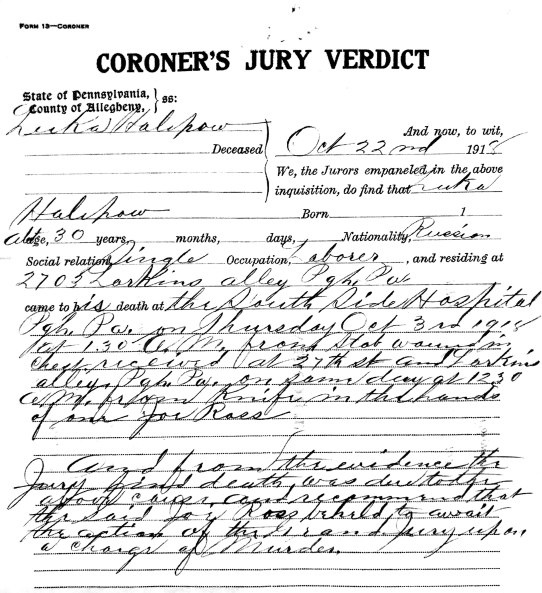
In the final weeks of World War I, Joseph Ross, a Russian immigrant steelworker, and Luka Halipow, his Polish immigrant neighbor and fellow steelworker, got into an argument about the war in a South Side bar. Halipow struck Ross, who reportedly responded by telling Halipow that he was carrying a knife. The quarrel ended.

image001
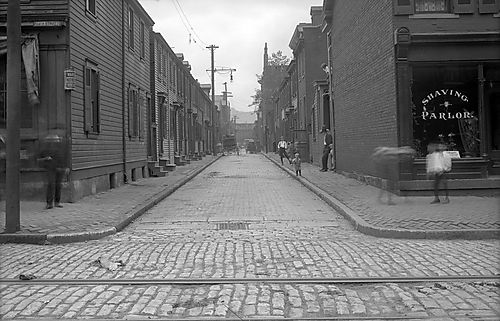
Larkins Alley, 1909

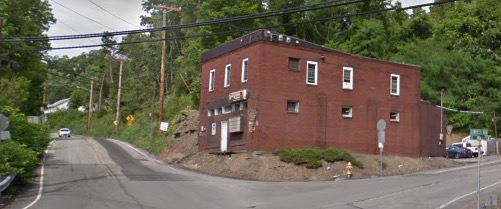
As the men walked home early that morning, October 3, 1918, the quarrel resumed. Halipow struck Ross, causing him to bleed. Ross returned to his boardinghouse, washed his wounds, and went back on Larkins Alley to find Halipow. When he did, he stabbed Halipow, who died at the hospital soon after.

image001.jpg

At trial, it was established that the two had quarreled over the course of the night. Ross claimed he acted in self-defense, after being attacked by Halipow. The prosecution argued that Ross acted without adequate provocation.

Under such circumstances, and in the absence of compelling eyewitness testimony, a conviction to a lesser degree of murder was expected. The jury returned a verdict of first-degree murder on May 9, 1919. After his motion for a new trial was rejected, Ross was sentenced to death on December 13, 1919.

image004
Pittsburgh Gazette Times, May 10, 1919

On appeal, the Pennsylvania Supreme Court reversed Ross’s conviction due to concern that the original trial court had communicated an improperly demanding standard for establishing self-defense (Commonwealth v. Ross, 266 Pa. 580, 1920).

Screenshot 2019-02-01 09.07.58

From the Allegheny County Jail Murder Book, courtesy of Ed Urban

At retrial, Ross pleaded guilty and the court fixed the crime as second-degree murder. On April 16, 1920, he was sentenced to 15-18 years in prison.

After nearly twelve years in prison, Ross was released on November 16, 1931. He returned to work in the steel mills. Joseph Ross died in Pittsburgh on January 30, 1946.

image002
Pittsburgh Press, February 3, 1932

Whether due to the attention given to the end of World War I or the low status of the parties to this case, the crime and the case received very little newspaper attention.

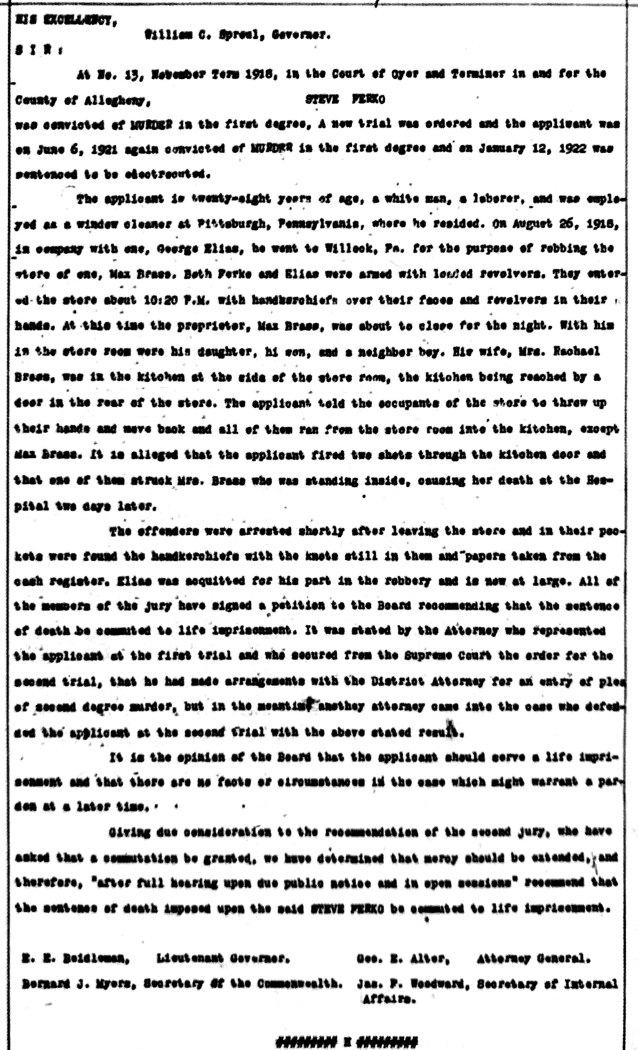
Steve Ferko

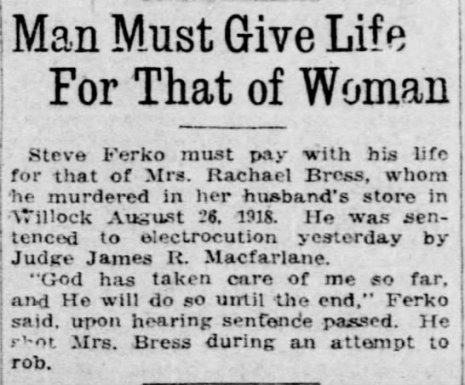
The same summer that Dunmore, Rowland, Brown, and Russell committed felony murders for which they would be sentenced to death, Steve Ferko killed Rachel (Warshawski) Bress as she was working in her family’s grocery store in Willock, a small coal mining town south of Pittsburgh.

image001
East Willock Rd., Willock

It was after 10 pm on August 26, 1918. The robbery yielded only a few dollars but cost Bress her life.
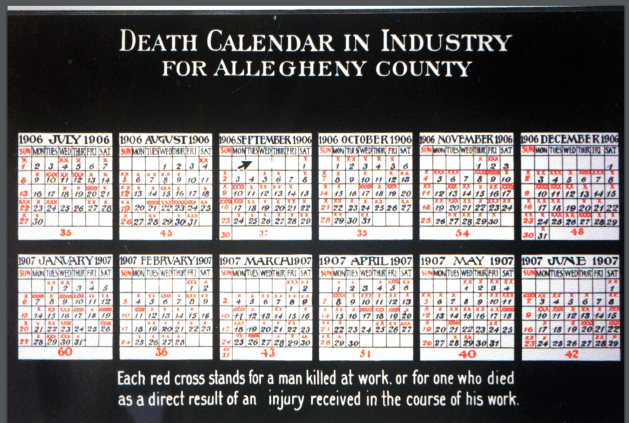
image001
Pittsburgh Daily Post, August 29, 1918

While Ferko’s race and religiosity were likely central to him being spared execution for a felony murder in which his guilt was not in doubt, the other four men, all Black, were executed as racial animus escalated amidst increased Black migration.

Bress, her husband, Max, and their four children had immigrated from Russia in 1906, as the civil unrest that would culminate in the Russian Revolution was escalating.

image002

Ferko, a Hungarian-immigrant former coalminer who was familiar with the area, and George Elias, who roomed together in Pittsburgh, were apprehended soon after the shooting. Money from the store cash register was found in their possession. They confessed to police, with Ferko admitting to being the shooter.

At trial, Elias was acquitted after the jury credited his claims that Ferko had forced him to participate in the robbery and had fired the fatal shot. Ferko was convicted of first-degree murder on May 21, 1919, and sentenced to death on October 20, 1919.

image001
Pittsburgh Daily Post, October 21, 1919

On December 31, 1920, Ferko’s conviction was reversed on appeal (Commonwealth v. Ferko, 269 PA. 39, 1920) after the Pennsylvania Supreme Court ruled that the jury had been misinstructed that felony murder was necessarily first-degree murder. The statute empowers the jury to fix the degree of murder and requires that the jury be read this instruction.

On retrial, Ferko was again convicted of first-degree murder on June 10, 1921, and sentenced to death on January 12, 1922.

With a letter of support from his trial jury and a statement from his original attorney that the District Attorney was willing to accept a plea to second-degree murder in the second trial, the Pardon Board commuted his death sentence to life imprisonment in Western Penitentiary on April 20, 1922.

image001.jpg

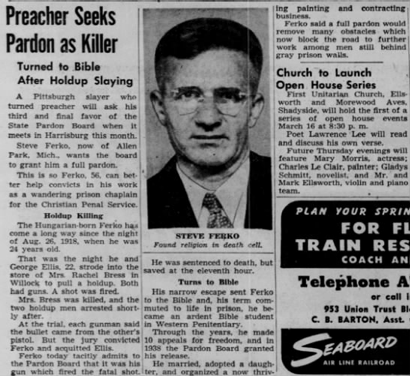
Ferko sought a pardon more than ten times before being paroled on November 21, 1938. He was released from parole in 1950. Throughout his efforts to obtain release, Ferko emphasized his strong Christian faith and his intention to go into ministry. Upon release, he did so, and gained recognition for his ministry over the remainder of his life.

image002
Pittsburgh Press, March 8, 1950

Steve Ferko died in San Bernardino, California, on November 27, 1976. He was 82 years old. Max Bress died in Pittsburgh in 1959.

Charles Edward Scherer

Born and raised in Wilmington, North Carolina, Charles Scherer was recently widowed with seven children when he married Bertha Banks in 1909. She was twenty years his junior. They moved to Pittsburgh in July 1917. Their time there was brief.

Scherer was obsessively, violently jealous and possessive of his wife; a trait that had long been in evidence. Compounded by alcohol abuse, his jealousy led him to quit his job in March 1918 so he could watch his wife.

He believed she was involved with Peter Butkiewicz, a barber whose shop was across the street from their 3531 Butler St., Lawrenceville home. Scherer had even complained to police about their relationship, though police had investigated and not found any evidence to support Scherer’s concerns.

On April 27, 1918, the morning after another argument, Scherer shot and killed his wife as she was getting dressed. He said he was awakened by a noise and fired his gun in response. Scherer immediately turned himself in to police.

image002
Coroner’s Inquest, May 15, 1919

At trial, Scherer claimed a lack of premeditation, a defense overwhelmed by inculpatory evidence that included a recently purchased gun, a history of fight and threats, his confession to police of shooting his wife due to jealousy, and a letter to his sister expressing regret for what he had done.

image002

Pittsburgh Press, February 24, 1919

Scherer was convicted of first-degree murder on March 1, 1919. After his motion for a new trial was rejected, he was sentenced to death on July 10, 1919. His appeal, which raised no new defense and offered no new evidence or argument, was rejected (Commonwealth v. Scherer, 266 Pa. 210, 1920).

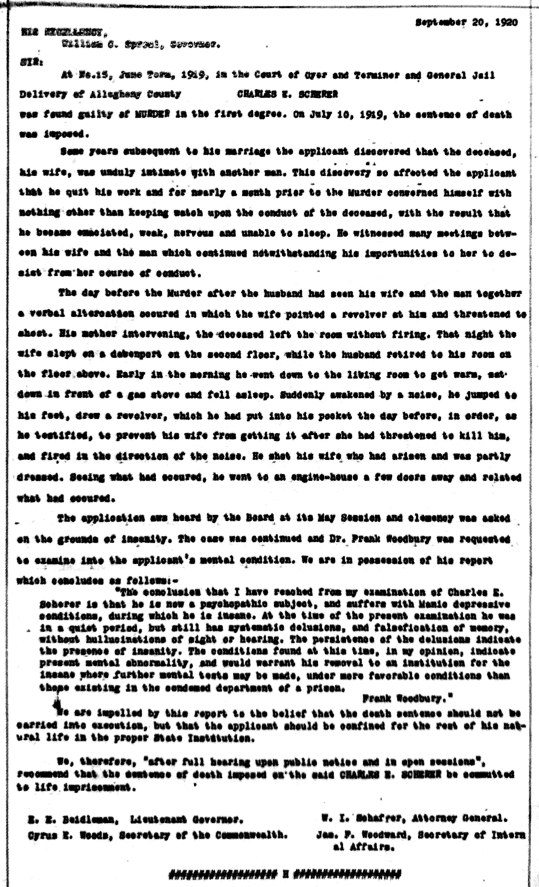
The Pardon Board viewed Scherer’s actions much more favorably, believing that Scherer’s wife had been unfaithful to him, that Scherer had witnessed these infidelities and was distraught by the violation they represented, and that she had pointed a gun at him the day before the murder.

image001

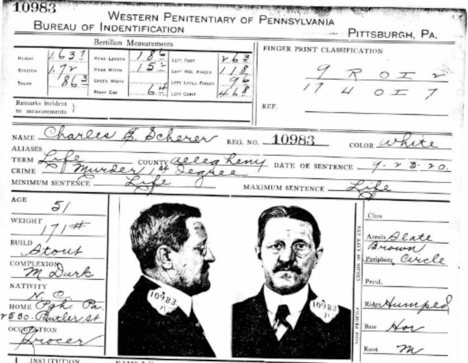
Charles Scherer was granted a commutation to life imprisonment on the grounds of insanity on September 20, 1920, and transferred to Western Penitentiary.

A decade later, the Pardon Board reviewed the case again, determined that Scherer’s sentence should be reduced to time served, and recommended a period of probation. His “prior good record”was also noted.

He was released from prison on December 11, 1930, after serving 11 years.

image002

After marrying a third time, Charles Scherer died in Sharon, Pa., on October 20, 1953. He was 82 years old.

The portrayal of Scherer as the aggrieved husband is challenged by two cases from North Carolina. In February 1908, just before the death of his first wife, Scherer was arrested for assault with a deadly weapon and aggravated assault in what appears to be the attempted rape of Mamie Brock, who operated a local “disorderly house.” He pleaded guilty to several related charges on March 30, 1908. His first wife, Iola, died two from complications related to childbirth two months later.

On April 11, 1917, only months before Scherer moved to Pittsburgh, Neal Walton was killed while in the company of a young woman in Wilmington, N.C. Scherer was the main suspect in the case. Some speculated at the time that Scherer mistook Walton for a man he suspected of being involved with his wife. After returning to North Carolina to stand trial, the charges against Scherer were dismissed due to a lack of evidence.

image002
Asheville Citizen Times, September 11, 1917

James Archer Gibson

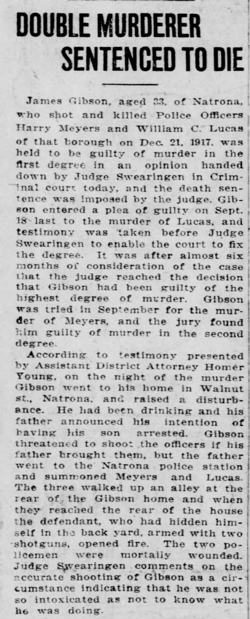
On the evening of December 21, 1917, Joseph Gibson went to the Natrona police to report that his son, James, a 33-year old unemployed steelworker, was loud, drunk, and abusive, and that he wanted to have him arrested. James had reportedly told his father he would shoot any officers who came to arrest him.

When Officers William Lucas and Harry Meyers responded to the Gibson’s 93 Walnut St. home, they were shot by Gibson as he lied in wait in a shed. Gibson was armed with two double-barreled shotguns; he discharged both. The officers were shot in the face at close range. Lucas died on December 23; Meyers died on January 6, 1918. It was the first double murder of Allegheny County police officers.

image001
Pittsburgh Press, December 22, 1917

Gibson, one of fourteen children, had a history of abusive behavior that included abusing his parents. On June 27, 1918, he was convicted of second-degree murder and sentenced to 16-17 years in prison for killing Officer Meyers. His father was the key prosecution witness. Gibson’s defense was that he was intoxicated.

Believing he would receive a similar disposition, on September 18, 1918, Gibson pleaded guilty to killing Officer Lucas. The judge deliberated until May 14, 1919, before determining that Gibson had committed first-degree murder. As required by statute, he was sentenced to death.

image002
Pittsburgh Press, March 14, 1919

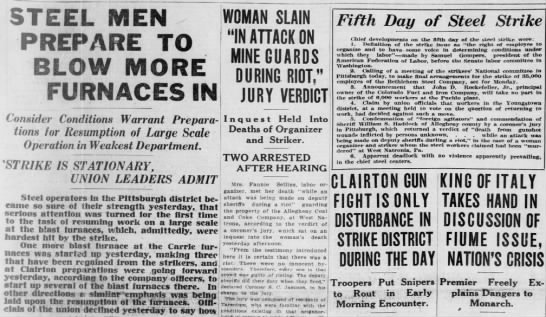
As Gibson sat in jail, labor unrest in the steel industry was moving toward the 1919 Steel Strike while unrest in the coal industry brought labor activist Fannie Sellins to Natrona to advocate on behalf of striking miners. The notorious Coal and Iron Police, which served as a publicly-created private police force for the coal industry, shot and killed her on August 26, 1919, less than a mile from Gibson’s home. As a measure of the power of industry and the impunity of its protectors, the killing was ruled justifiable.

image001
Pittsburgh Daily Post, September 27, 1919 Sellins’ killing is the subject of the central column.

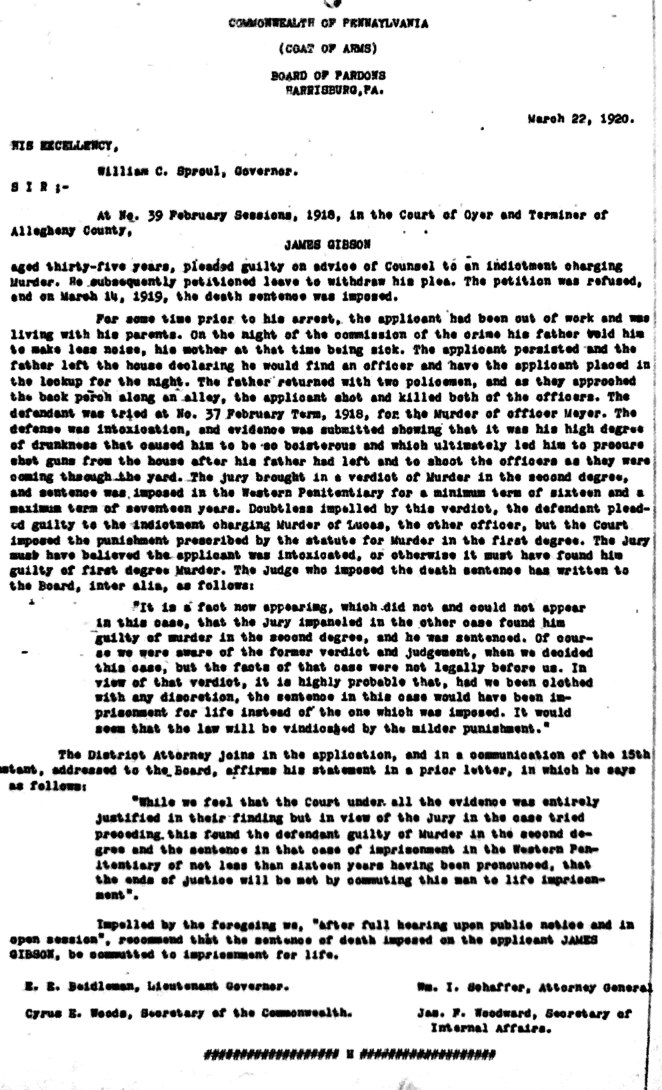
Claiming insanity, James Gibson petitioned the Pardon Board for commutation. Troubled by the different dispositions of Gibson’s two convictions, the Pardon Board concluded that the second court erred in not considering the evidence of Gibson’s intoxication.

image001.jpg

His death sentence was commuted to life imprisonment on March 18, 1920, and he was transferred to Western Penitentiary.

James Gibson died in prison on October 11, 1951, at age 67.

In broad outline, this case is remarkably similar to the 2009 Poplawski case, Pittsburgh’s most recent capital case. Both involved killings of multiple police officers by a defendant lying in wait after officers were called to the scene by a parent alleging abusive behavior by an adult child still living at home.

image001

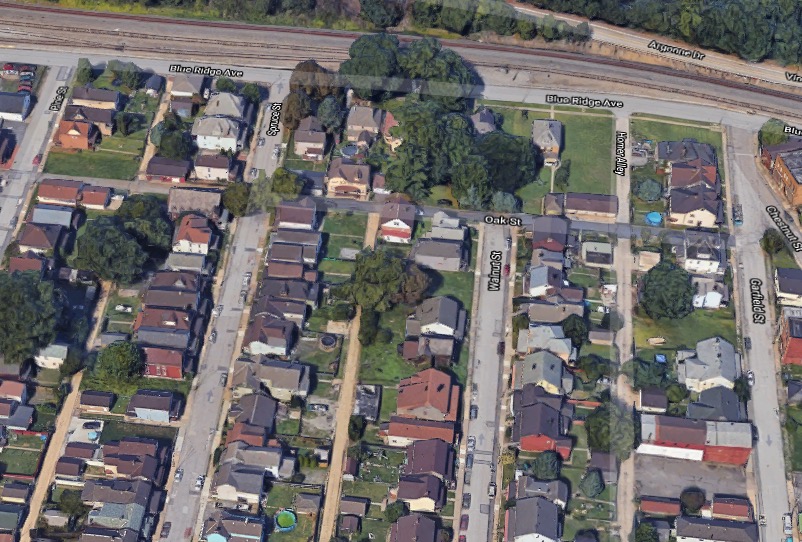
Presumably due to the notoriety of this case, the street grid of Natrona was altered to remove the section of Walnut St. on which the Gibson’s lived. That marks another similarity to the Poplawski case, whose home was razed.

Salvatore Cardamone

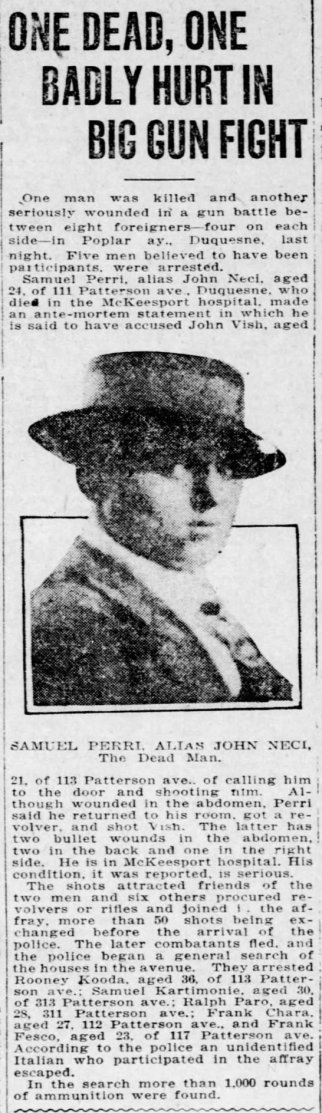
A long-standing dispute between the families of John Vesh and Salvatore Cardamone spilled over into a lengthy gun battle between Cardamone and his companions and Vesh and his companions as they waited for a streetcar in Duquesne on Sunday, October 8, 1916.

image001
Carnegie Steel’s Duquesne Works

During the fight, Cardamone’s friend, Sam Parri was shot and killed by Vesh before Cardamone killed Vesh. All of the men were Italian immigrant steelworkers at Duquesne’s Carnegie Steel plant.

image001
Pittsburgh Press, October 9, 1916

After being arrested, Cardamone claimed Vesh killed Parri and that he acted in self-defense.

Charged with both murders, Cardamone was convicted of first-degree murder for Vesh’s killing on March 9, 1917, after multiple witnesses to the late afternoon gun battle testified. He was acquitted of Parri’s murder.

Cardamone was sentenced to death on February 27, 1918.

His co-conspirators, Bruno Cuda, Frank Cero, and Raffali Perri, were tried for their roles in the incident. Cero and Perri were convicted of second-degree murder and sentenced to seven to ten years in prison. They were released from prison in 1924. Cuda was acquitted.

Cardamone’s case for commutation was heard by the Board of Pardons on June 21, 1918. On the basis of statements from trial judge A.B. Read, an attorney for Vesh’s family, and the Assistant District Attorney who tried the case that Cardomone’s punishment should not exceed that of his co-conspirators, commutation of his sentence to life imprisonment was recommended. He was transferred to Western Penitentiary to serve that sentence.

image002

After two unsuccessful pardon requests, Cardamone was pardoned on July 5, 1929, and released from prison after more than twelve years behind bars. In its recommendation, the Pardon Board stated that Sam Perri had instigated the fight and reiterated that Cardamone was no more responsible for the killings than those who received lesser punishments.

Salvatore Cardamone returned to work in the steel mill. He died in Pittsburgh on April 10, 1965, at age 78.

Andrew Malinowski

In an all too familiar scenario, Andrew Malinowski shot his wife, Helen, after she refused to reconcile with him due to his abusive conduct. The killing occurred on the morning of New Year’s Day, 1914, at the 2815 Spring Alley (now Way), Strip District home of Helen’s mother, Mary Zagorski. Helen and her two daughters had moved in with her mother to escape her husband’s abuse.

image001
Circa 1910 row houses on 3000 block of Spring Way

After shooting his wife six times, Malinowski, a Polish immigrant steelworker at Pittsburgh Screw and Bolt Company, attempted suicide by shooting himself in the head.

image001
From Coroner’s Inquest, January 28, 1914

The immediate precipitant of the shooting was that Malinowski had seen his wife at a New Year’s Eve dance with another man. He stayed awake all that night drinking, then shot Helen the next morning. She died fifteen days later. A thousand people are said to have attended her funeral at the now historic St. Stanislaus Kostka Church.

At trial, Malinowski’s defense emphasized the depth of his love for his wife. That defense failed in the face of eyewitness testimony of the shooting and he was convicted of first-degree murder on May 14, 1914. After his motion for a new trial was rejected, he was sentenced to death on June 13.

image002
Pittsburgh Press, June 13, 1914

Malinowski was the first person in the state convicted under the new statute that provided the electric chair for executions (P.L. 528, No. 338, June 19, 1913).

His friends provided financial support for an attorney to support his commutation. Their efforts, which portrayed Malinowski as a reputable and hardworking man affected by a “crazy impulse of frenzy,” were successful.

image003
Pittsburgh Sunday Post, January 17, 1915

After he had been transported to the new state prison at Bellefonte (now SCI-Rockview) to await execution, Andrew Malinowski’s death sentence was commuted to life on March 19, 1915.

image001.jpg

The circumstances of Malinowski’s mental health problems and of the many men like him whose lives involved interpersonal violence are not possible for us to know. However, the role of the everyday danger and violence and exploitation of the steel industry in which he and many thousands of others labored certainly merits consideration. Crystal Eastman’s groundbreaking “Work Accidents and the Law,” published in 1910 as part of the Pittsburgh Survey, documented the extent of this violence and produced this calendar.

image001

Malinowski’s efforts to escape punishment continued. He was pardoned and released from prison in December 1922, after nearly nine years behind bars.

After his release, Andrew Malinowski remarried, returned to the steel mill, and lived in Ambridge. He died in Pittsburgh on May 19, 1959.

Joseph McGill

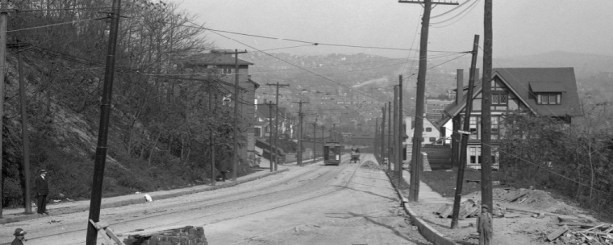
On November 28, 1912, Joseph McGill went to purchase some whiskey in preparation for that afternoon’s Thanksgiving meal. When he returned to his 546 Allequippa St. home, his wife, Dolly Brown, was not there. Concerned that she was at the nearby home of Dora Henry, McGill went to find her.

image001
Allequippa St, 1912

Henry’s lengthy record of altercations with the police for theft, assault, and drunkenness was well known to McGill, who had apparently called police to her home in the past.

Henry met McGill at her door. An argument began, which escalated into a fight when Henry insisted Brown was not there and McGill insisted on seeing her. When Brown suddenly fled from the house, McGill lunged at her with a knife.

image002
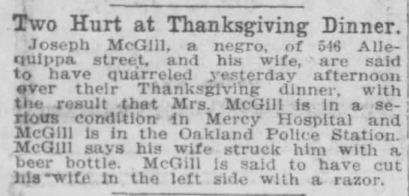
Pittsburgh Post-Gazette, November 29, 1912

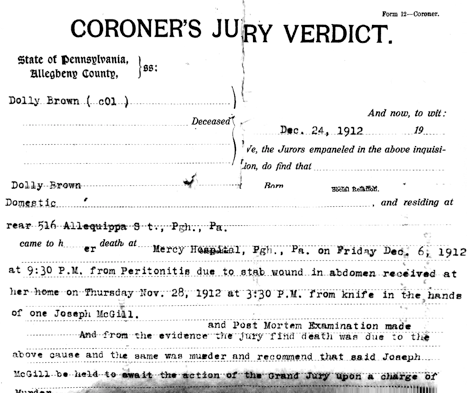
Brown died of stab wounds at Mercy Hospital on December 6, 1912. It was the second capital murder case in Pittsburgh in twenty-four hours.

image002

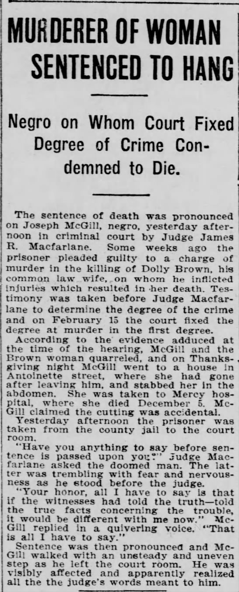
Arrested soon after the stabbing, McGill confessed to neighbors and police. In a fast-moving sequence of events, he pleaded guilty to murder on February 10, 1913. On February 15, the judge fixed the crime at first-degree murder. McGill, who worked as a teamster and had a prior record for vagrancy, was sentenced to death on March 5.

image002
Pittsburgh Daily Post, March 6, 1913

Though McGill’s guilty plea foreclosed the possibility of an appeal, he did pursue clemency. Robert L. Vann, then a young attorney who would go on to become editor of the Pittsburgh Courier, a leading figure in Pittsburgh’s Black community during that community’s most vibrant era, and a nationally-prominent political figure, represented McGill before the Pardon Board.

McGill’s death sentence was commuted to life imprisonment on September 17, 1913, based on a finding that the case lacked the premeditation necessary to sustain a first-degree murder conviction. He was transferred to Western Penitentiary and, later, to Eastern Penitentiary.

McGill made annual requests for pardon in the 1920s; all were refused. Finally, his life sentence was commuted to time served on March 1, 1937 and he was released after nearly twenty-five years behind bars.

Joseph McGill died on September 23, 1977.

image001
Lower section of Allequippa St. today. 546 Allequippa St. was demolished to allow the expansion of the University of Pittsburgh.

Characteristic of cases involving Black defendants and victims at the time, only once did the case receive more than a single paragraph of news coverage. While every story focused on the race of the parties, little information was provided about their lives.