Dennis Cloonan

Dennis and Bridget (Skahill) Cloonan, long-married, with four sons, and in their 50s, lived at 52 Congress St. in the Lower Hill District.
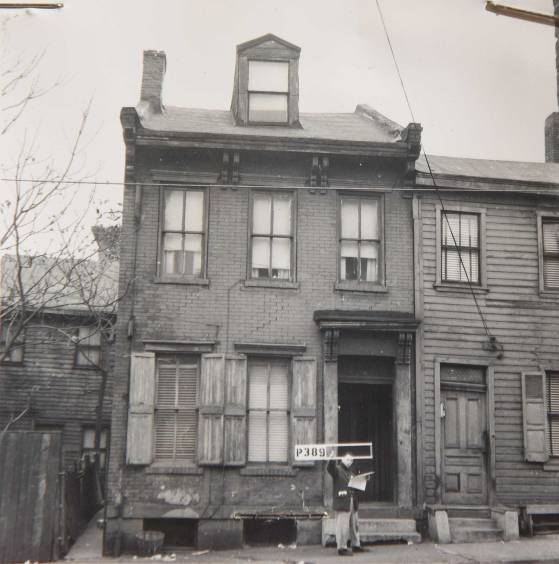
image001
49 Congress St., https://newsinteractive.post-gazette.com/lower_hill/

They quarreled frequently, though reports indicated that their unhappiness did not involve violence. An apparent source of tension was a property Bridget had purchased in her own name and had refused to co-title with her husband.

image003
Pittsburgh Press, October 29, 1891

Then, on March 17, 1892, St. Patrick’s Day, the Irish-immigrant Cloonan returned from work at the Pennsylvania Railroad, intoxicated, ate the dinner his wife had prepared, and brutally beat her with a chair. He then went to the neighbor’s home and told her to go to his house to see what had happened. There he told a witness that he had suffered long enough and was not going to suffer any more.
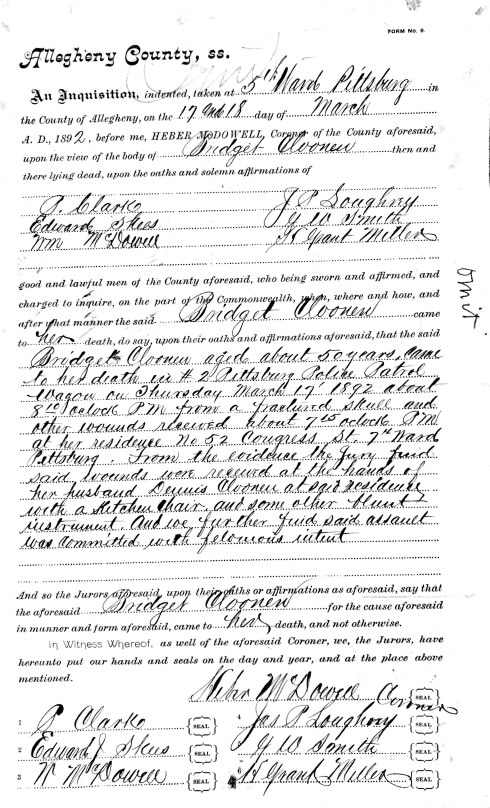
image001Police were summoned and Cloonan was arrested as he walked away from the scene. He confessed immediately and asked the arresting officer to shoot him. After a brief trial, Cloonan was convicted on June 4, 1892, and sentenced to death. He showed little interest in his trial, conviction, or execution.

After an unsuccessful appeal, a surprisingly vigorous clemency campaign was mounted, portraying Cloonan as a particularly pitiful and benign character; “a simple minded ignorant, illiterate man, faithful, industrious and kindly in the discharge of his laborious duties…always kind, obedient and faithful.”
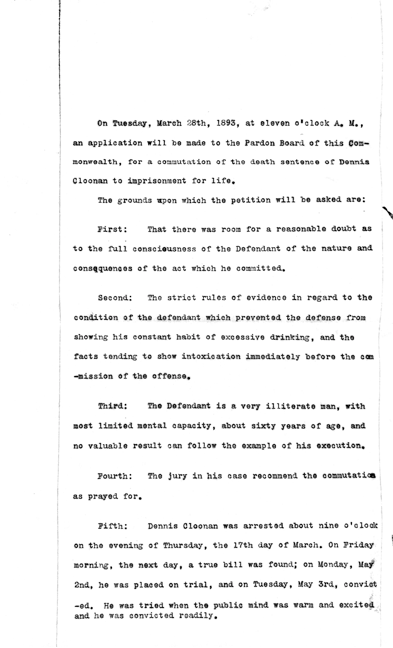
image002.png

Despite hundreds of signatures of support obtained from his Hill District neighbors, Dennis Cloonan’s clemency request was rejected and he was hanged on April 4, 1893.

image002

Cloonan’s was the first execution in Pittsburgh after the Homestead Riot. Inasmuch as Homestead represented the defeat of labor unionism and helped to usher in an era of mass production, it may be used to mark the beginning of the peak industrial era in Pittsburgh that lasted until the steel industry began to move closer to the resource deposits and shipping routes along the Great Lakes after 1920.

During this era, Pennsylvania – not Virginia or Georgia or Texas – was the nation’s leading executioner; a result of the migration, immigration, urbanization, and associated racial and ethnic tensions of industrialization.

image001                                                         Congress St. today; a post-industrial landscape

James McSteen

James McSteen, 36, his wife, Mary Toole, both Irish-born, and four children lived in a log cabin along the B&O Railroad line near Hazelwood, just as the area was being transformed into an industrial center. McSteen worked at Jones & Laughlin’s burgeoning Eliza furnace and at Glenwood Steel Works.

image001
Eliza Furnace boiler house crew, 1894

During the late afternoon of June 9, 1882, McSteen viciously attacked his wife with an axe and then fled. As he left, he asked his neighbor, Mrs. Mary Welch, to look after his children, leading her to the discovery of the dying Mary Toole.

McSteen was arrested aboard a Pittsburgh-bound train. He confessed to having struck his wife. His motive was jealousy.

McSteen and Toole had been married for five years. She had one child (Patrick, who testified against McSteen) at the time of their marriage. They had three children together.

Newspaper accounts describe McSteen as “ordinary looking” and his wife as “comely,” “honest,” “faithful,” and a “good mother” of “considerable popularity.” Accounts also suggest McSteen may have been of unsound mind, having previously been institutionalized at Dixmont.

Trial testimony indicated McSteen was acting peculiarly on the day of the murder, was “insanely jealous,” and had tried to kill his wife two years earlier (resulting in his arrest and jail sentence). There is no evidence of her unfaithfulness.

McSteen was convicted of first-degree murder on September 22, 1882 after brief jury deliberations, and sentenced to death. Barely three months had passed since the murder.

Prior to the verdict, there was sentiment that the murder was appropriately second-degree, a far more common outcome in cases of intimate partner homicide. No appeal was undertaken, though a pardon request was filed and rejected.

image001
Pittsburgh Daily Post, September 23, 1882

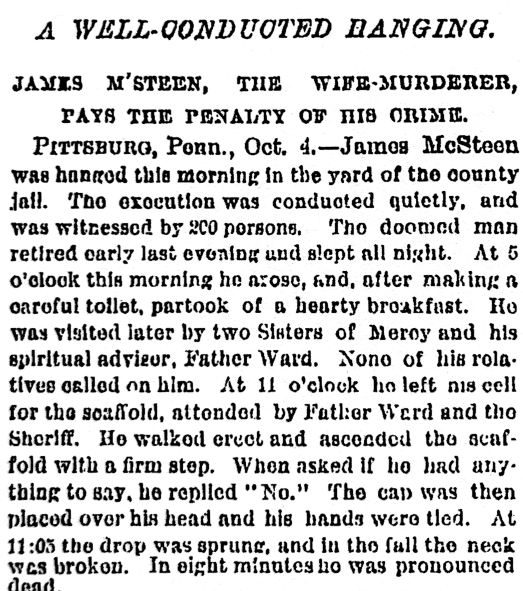
James McSteen was hanged in the yard of the county jail on October 4, 1883. Though described as a “well-conducted hanging,” McSteen slowly asphyxiated. More than 200 witnesses were in attendance and more than 2,000 had applied for admission. He is buried in St. Mary’s Cemetery.

image001New York Times, October 5, 1883

William Green

William Green and his half-brother, Samuel Marshall, were born into slavery in Craig County, Virginia. Their mother, Ann Marshall, who had been sold from plantation to plantation, was an early Black migrant to Allegheny County, arriving with her children soon after Emancipation.

Settling in Mansfield (present day Carnegie), the brothers lived and worked together until experiencing a rancorous split after their shoemaking business failed during the Depression that began in 1873. They then went to work as teamsters on different farms.

image003
Pittsburgh Daily Post, September 3, 1875

The rancor continued. A disagreement about how to divide the family’s modest property and its incoming potato crop came to head on September 2, 1875, when Green shot Marshall. He was arrested in Freedom, Pennsylvania, on September 7.

image002.png

At a trial that produced a transcript not ninety pages in length, Green claimed he acted in self-defense after Marshall assaulted him with a poker. The state argued he acted without provocation in shooting Marshall.

Despite witness testimony of an assault by Marshall and an injury to Green’s head, Green was convicted of first-degree murder on December 16, 1875. He was sentenced to death on July 8, 1876.

image002

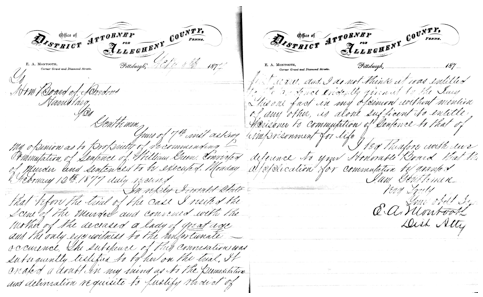
Green’s argument that the killing was not properly first-degree was rejected on appeal (Green v. Commonwealth, 83 Pa. 75, 1876). His clemency request was likewise rejected, despite a letter of support from the District Attorney expressing doubt that the killing met the legal standard for first-degree murder.

image002.png

Lacking the status or the resources to elicit attention or raise the social or legal cost of his execution, William Green was hanged on February 12, 1877. Green was the third Black man to face the death penalty in Pittsburgh and the third to be executed. He was also the first Black capital defendant whose jury could have included a Black man. It did not.

image001

A long and mostly sympathetic newspaper discussion of his case after his execution emphasized his Christian belief and forbearance.

Ernest Ortwein

Ernest Ortwein, a 28-year old German immigrant and Franco-Prussian War veteran, worked as a laborer on the farm of British-born John Hamnett, near what was soon to become the industrial center of Homestead.

image001

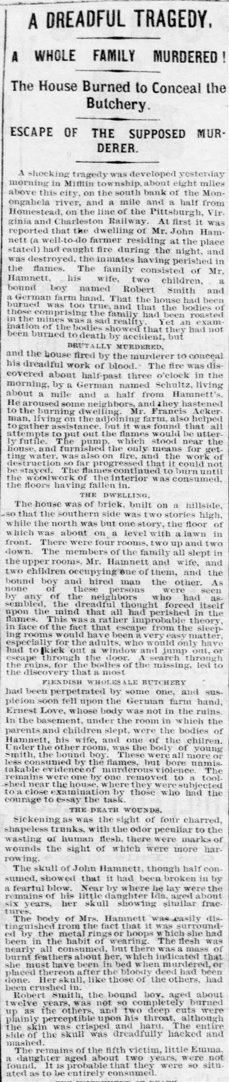
There, on April 29, 1874, Ortwein killed the Hamnett children, Ida and Emma, and Robert Smith, a child who worked as a farmhand, with an axe while they slept. He then killed John and Agnes Hamnett when they returned from visiting friends. After burning their bodies in an effort to conceal his crime, Ortwein fled with a small amount of cash and some jewelry.

image003
Pittsburgh Commercial, May 1, 1874

Passersby saw the house in flames and found the murdered family. Suspicion quickly fell on Ortwein, who was nowhere to be found.

Ortwein was arrested the next day in Troy Hill, a German enclave in Allegheny City, after telling a fellow bar patron that he had committed the killings that were so much in the news. Items he had stolen and traded were recovered as evidence. He provided a full though contradictory confession to police. Residents of Homestead threatened to lynch him if he was not executed.

image001
New York Times, August 7, 1874

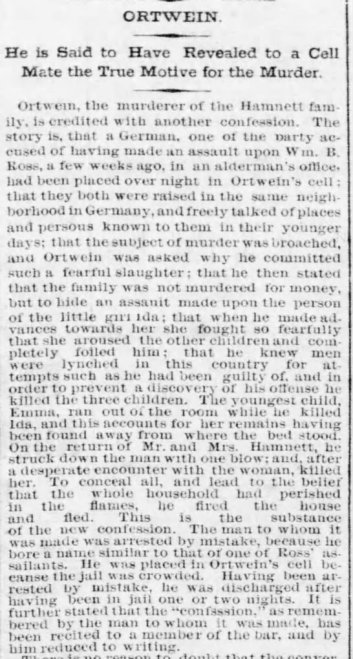
At trial in June 1874, various motives for Ortwein’s crimes were offered. At different points, Ortwein claimed that his motive was robbery and rape, stating that he had raped Ida and killed her and her family when she screamed. Most people understood the case as a robbery, with Ortwein having wrongly believed the Hamnetts – who were prosperous – kept a large amount of cash on hand. A third possibility, which may have played a role in either of the preceding scenarios or may stand alone, is that Ortwein’s military service had left him with a brain injury or some other mental illness.

image001
Pittsburgh Daily Commercial, August 5, 1874

Ortwein was convicted on June 14, 1874, and sentenced to death. His appeal, which alleged a number of errors, most prominently that the defense had raised reasonable doubt as to Ortwein’s sanity, was rejected (Ortwein v. Commonwealth, 76 Pa. 414, 1875).

Ernest Ortwein was hanged on February 23, 1875. A very large crowd gathered but was prevented from witnessing the execution by a large wall that screened the jailyard.

image001
Pittsburgh Daily Commercial, February 24, 1875

In a letter to the editor published days after Ortwein’s execution, noted Pittsburgh journalist, feminist, abolitionist, and death penalty opponent, Jane Grey Swisshelm, focused  her ire on Agnes Hamnett, for failing to meet her “obligation of personal care to her children” by going out that evening.

image001
Pittsburgh Daily Commercial, February 26, 1875

Post-mortem examination of Ortwein, crude though it was, found no mental abnormalities.

Due to its scale and circumstances, the Ortwein case is often included among the most notorious cases in Allegheny County history.

The Hamnetts are buried in Munhall.

Christian Jacoby

Christian Jacoby, his wife, Lena, their four children, and a servant, Anna Maria Suttler, arrived in Pittsburgh from Offenbach, Germany, on July 7, 1858. Upon arrival, they checked into the hotel of Daniel Herwig at Penn Avenue and Canal St., downtown, using the name Suttler.

Jacoby had lived in Pittsburgh and worked in a rolling mill for two years prior to his marriage and was returning with his wife and family en route to Chicago to start a life in the United States.

image001

That evening, Christian and Lena Jacoby went on a long walk across the Monongahela River and to the west along the Ohio River to a remote area. There Jacoby shot and killed his wife. It was the first capital case involving a gun murder.

The next morning, with Anna Maria Suttler, who was pregnant, posing as his wife, the Jacobys continued to Chicago.

Riverboats approaching Pittsburgh, 1850s
Pittsburgh from the Ohio River, 1850s, very near the site where Lena Jacoby was killed

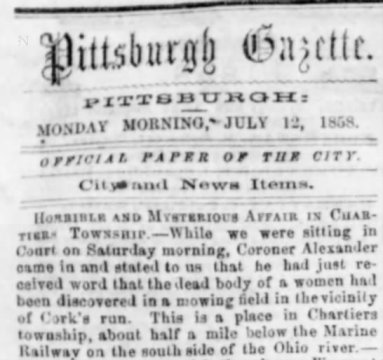
After Lena Jacoby’s body was found near Cork’s Run on the Ohio River on July 10, an investigation began that ultimately led to her identification and to Christian Jacoby’s arrest in Indiana on August 27. Investigators found that ammunition in his possession matched the gun and ammunition found with Lena Jacoby’s body.

image001
Pittsburgh Daily Post, August 30, 1858

Reports from Germany supported the understanding that was coming into focus; that Lena Jacoby was poorly treated by her husband, that Christian Jacoby was the father of the child Suttler was carrying, and that their illicit relationship was the cause of Lena’s death.

At trial, the state used the gun and ammunition evidence, including a bullet taken from the victim’s disinterred body, as well as his relationship with Suttler, to implicate Jacoby. In his defense, Jacoby claimed his wife committed suicide. Suttler testified in support of that argument, stating that Lena Jacoby had told her that she felt unvalued next to Suttler. After six days of testimony and twenty minutes of deliberations, Jacoby was convicted of first-degree murder on November 20, 1858.

After his motion for a new trial was rejected, Jacoby was sentenced to death on December 11. After his appeal (Commonwealth v. Jacoby, Volume VI, p. 177, 1858) was rejected on January 14, 1859, no recourse remained.

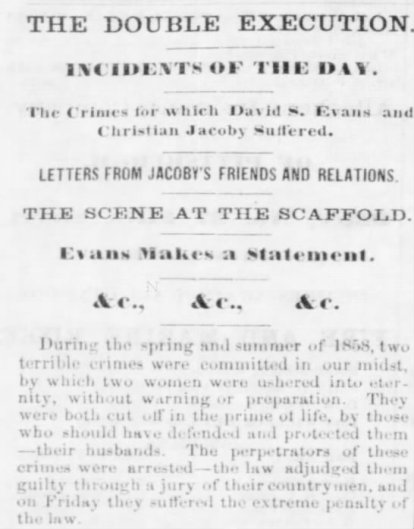
Christian Jacoby was hanged on May 20, 1859, side-by-side with David Evans, who had also murdered his wife.

image001

In another tragic turn, Anna Marie Suttler’s baby died shortly after birth.

David Jewell

David Jewell was well-known around mid-nineteenth century Pittsburgh. Born and raised in the city, he worked as a painter and was the Captain of the Neptune Fire Company, a volunteer fire company and active social organization. In an era before organized policing, he had even served as a watchman.

image001
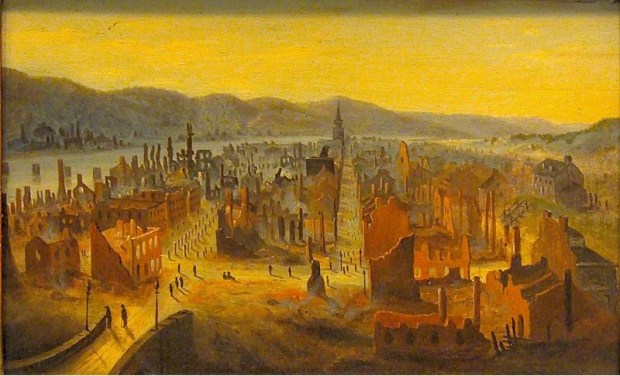
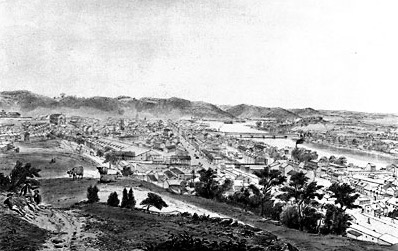
Pittsburgh After the Fire from Boyd’s Hill

Jewell was also known as a rogue character, “a desperado of respectable connections” frequently involved in fights and living rougher than his upbringing would indicate. At the same time, volunteer fire companies, once viewed as essential civic organizations, were devolving into little more than street gangs.

In a series of cases that foreshadowed greater violence to come, Jewell was twice arrested for stabbing another man during a street fight. The first assault occurred in 1848.

image002
Pittsburgh Daily Post, April 10, 1848

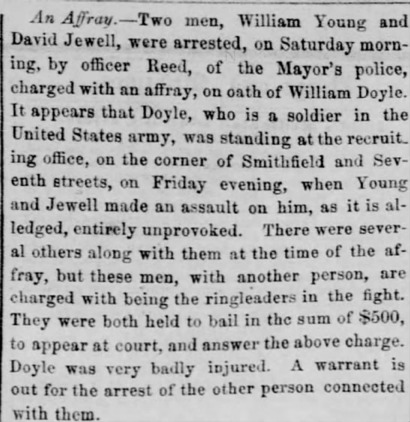
In a second assault, Jewell and a friend were arrested for an unprovoked assault on a soldier, William Doyle, on May 28, 1852.

image002
Pittsburgh Morning Post, May 31, 1852

Only six weeks later, during the Fourth of July celebration of local fire companies, James A. Cochran, a friend of Jewell’s, got into a fight with Samuel Mitchell, a fellow firefighter and former jail guard, who is alleged to have insulted Cochran. Jewell, who was free on bail in the Doyle case, and others joined in the fight, with Jewell stabbing and killing Mitchell.

image002.png

The privileged white man, free despite a history of violence, served as a stark contrast to the message of Frederick Douglass’s famous, “The Meaning of the Fourth of July for the Negro” oration, given that same day at Rochester’s Corinthian Hall.

The “cutting affray,” as such incidents were described at the time, was a growing source of concern as young, single men became more numerous in industrializing Pittsburgh. Volunteer fire companies, for all of the important service that they provided, were also notorious for the raucous and often violent behavior of their members.

In a closely watched trial, Jewell was convicted of first-degree murder on December 8, 1852, and sentenced to death. Cochran and William E. Gaw were acquitted.

Despite the strength of the case against him, concerted efforts to save Jewell’s life were undertaken by his many friends and supporters.  First was his appeal to the Pennsylvania Supreme Court, which raised issues about the composition of the jury and the conduct of the trial (Jewell v. Commonwealth, 22 Pa. 94, 1853). That effort failed when the court concluded that overturning Jewell’s conviction on such narrow, technical grounds “would render justice impossible in many cases, and expose society unprotected to the danger of the worst crimes.”

Next was a pardon campaign that included petitions signed by numerous citizens. That effort also failed. An unprecedented effort to interfere in the judicial process by enacting legislation calling for a new trial was also undertaken. That bill failed by a single vote (Pittsburgh Morning Post, February 11, 1854).

image002
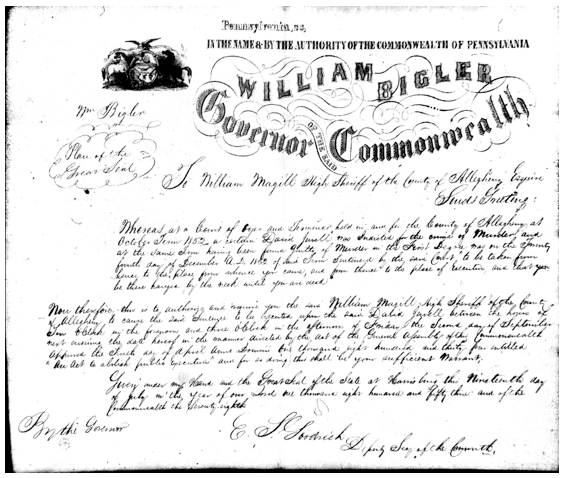
Death Warrant, David Jewell, July 19, 1853

Just prior to his execution, Jewell nearly escaped when friends smuggled him a saw. When he was taken to the gallows on March 24, 1854, poison was found in his cell.

After having exhausted all legal and other means to avoid execution, David Jewell spoke from the gallows to decry the process that convicted him and declare himself “a man in the full vigor of life, who is about to die.”

image002
Pittsburgh Gazette, March 25, 1854

In the context of rising anti-slavery sentiment and approaching civil war, Jewell’s execution was taken up by anti-slavery advocates as a “barbarous practice” that accomplishes no public good.

image002
Anti-Slavery Bugle, Lisbon, OH, April 1, 1854
image002
The Liberator, Boston, May 12, 1854, excerpted from the Pittsburgh Tribune

James Galligo

James Galligo and Jacob (Jake) Rogers, both of whom were described as Black or mulatto, were involved in some way with the same woman, whose name is not recorded but who is described as white. Though Galligo and the woman were described as husband and wife, the men were rivals who used the legal system to punish the other while the woman moved between them.

image001
Pittsburgh in 1840

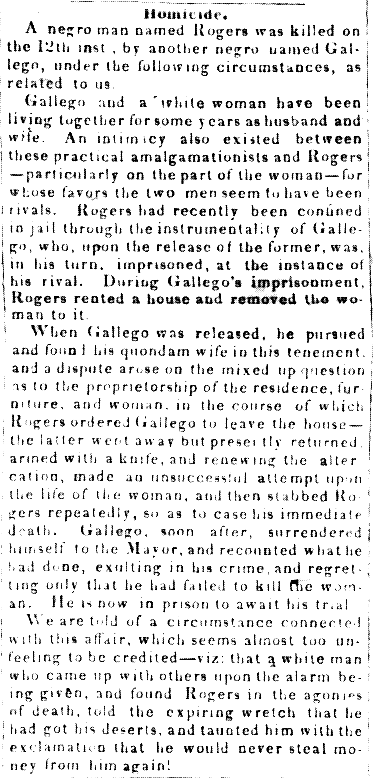
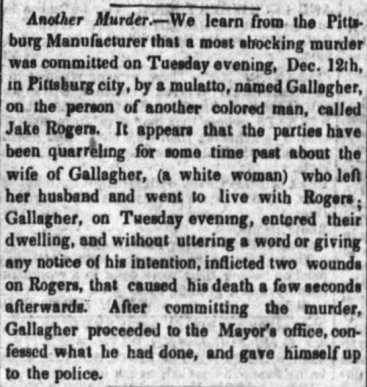
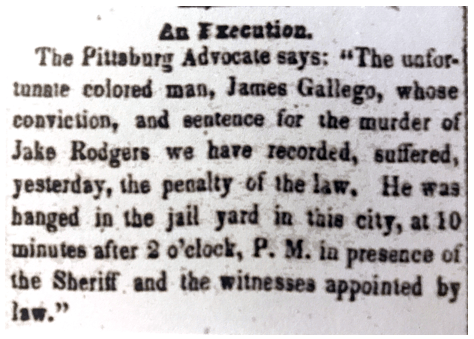
Seeking revenge after having been jailed on Rogers’ complaint, Galligo went to Rogers’ home and stabbed him to death on December 12, 1837. His efforts to kill the woman were unsuccessful. Galligo then turned himself in to the mayor’s office and confessed immediately afterwards.

image001
Pittsburgh Mercury, December 20, 1837

image001Public Ledger (Philadelphia), December 21, 1837
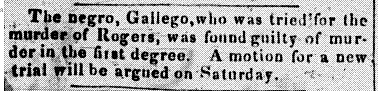
After pleading not guilty, Galligo was convicted of first-degree murder on December 20, 1837, less than three weeks after Rogers’s death.

image001
Pittsburgh Mercury, January 3, 1838

Galligo’s motion for a new trial was rejected and his death sentence was imposed the following week, on January 8, 1838. A month had not yet passed since Roger’s killing.

image001

In his pardon request, Galligo’s attorney noted that “a large portion of this community have manifested a considerable degree of sympathy in his behalf, and a decided disinclination to see the unfortunate man made the subject of capital punishment.”

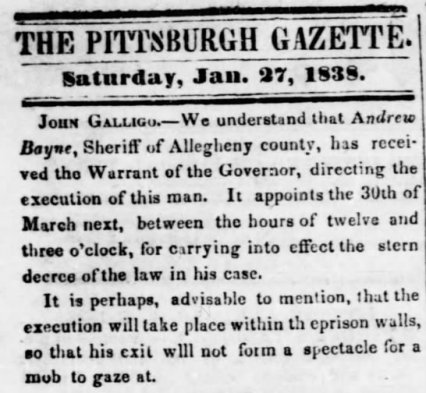
That request was rejected by Governor Joseph Ritner, who was running – unsuccessfully – for reelection. James Galligo was hanged on March 30, 1838, before hundreds of witnesses.

 image002

This is all we know of the crime and punishment of James Galligo. Its veracity is impossible to determine. Official records have not survived to document the proceedings and the limited newspaper coverage available was little afforded to a crime involving a Black offender and a Black victim.

On April 10, 1834, Pennsylvania enacted an Act to Abolish Public Executions, becoming the second state to do so (following Rhode Island in 1833). Galligo was thus the first person executed inside the Allegheny County Jail, the first execution in the county in twenty years, and the first execution of a Black defendant.

In the fifty years since Mamachtaga’s execution, a period in which I have been able to identify twenty murder trials in Pittsburgh, seven cases resulted in a first-degree murder conviction and four resulted in executions. Despite a Black population of less than four percent on the city’s population, two Black defendants had been sentenced to death and one was executed.

John Tiernan

John Tiernan and Patrick Campbell, fellow Irish immigrants, lived and worked together in Turtle Creek. Campbell had a contract to build a mile of the Pittsburgh and Greensburg Turnpike, the final leg of the first road linking Pittsburgh to Philadelphia. Tiernan, a middle-aged man who left behind a family in County Kildare (and, reportedly, another in New York and a third in Philadelphia), subcontracted from him.

image001

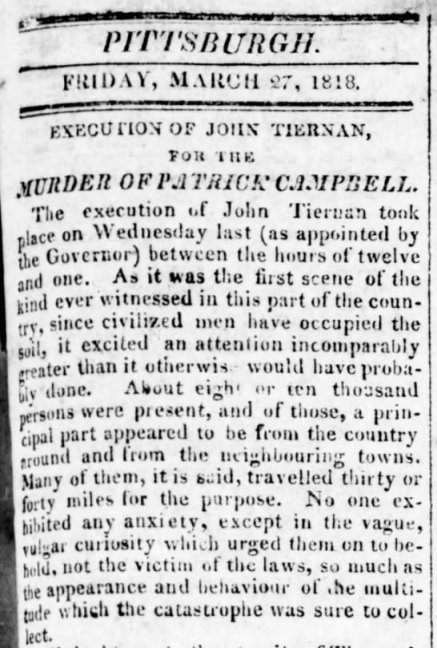
On December 7, 1817, a year and a half after beginning their work together and a few days after Campbell received a large cash advance for his work, Tiernan killed him with an axe and buried his body under the floorboards of their cabin. Tiernan fled, taking Campbell’s horse and other of his possessions. He was arrested in Westmoreland County on December 11, after suspicious neighbors found Campbell’s body and began a search for Tiernan.

image001
Pittsburgh Weekly Gazette, December 12, 1817

After being indicted on January 15, 1818, Tiernan was tried, convicted after fifteen minutes of deliberation, and sentenced to death on January 17, just six weeks after the killing. In the absence of eyewitnesses, the case against Tiernan was circumstantial, though the chain of events pointed clearly to his responsibility. His execution was set for March 25, 1818.

On that day, Tiernan was conveyed by cart to the gallows at Boyd’s Hill, guarded by city militia and with a long public procession in tow. A crowd estimated in the thousands watched an event so momentous in the city’s history that it was used for years to mark time. Almost exactly twenty-five years since Dunning’s execution, Tiernan became the second and last person to be publicly hanged in Allegheny County.

image001
Weekly Franklin Repository (Chambersburg, Pennsylvania), April 7, 1818

Already forgetting the short history of the newly formed city, the Pittsburgh Weekly Gazette wrote that “it was the first scene of the kind ever witnessed in this part of the country, since civilized men have occupied the soil” and that “eight or ten thousand persons were present.” Tiernan was buried under the gallows.

In the manner of the day, an abridged version of the trial and of Tiernan’s confession was published soon after the events.

image001

The turnpike connecting Pittsburgh and Harrisburg, a much needed route over the Allegheny Mountains, opened on May 20, 1818.

image001

Moved by the spectacle of large crowds and disorderly displays at hangings across the state but unable to achieve abolition legislatively, on April 10, 1834, the Pennsylvania General Assembly passed an “act to Abolish Public Executions.” This compromise, understood as a partial abolition, moved hangings from a public locale to within the confines of the jail in the county in which the sentence was imposed.

Pennsylvania was the second state to make this change.* Rhode Island had banned public executions in 1833. It would be more than a century before Missouri followed suit, ending public executions in the United States.

* Between 1682-1834, 252 public executions were recorded in Pennsylvania, including two in Allegheny County.

Thomas Dunning

Thomas Dunning, a private in Captain Faulkner’s Rifle Company that had been raised in Washington County and had fought and lost in various Indian skirmishes, was garrisoned at the newly-commissioned Fort Fayette (in the present location of Pittsburgh’s Cultural District) under General Anthony Wayne. It was a particularly intense time at Fort Fayette, as General Wayne rigorously pushed and punished his troops in preparation for battle with Native Americans who had been victorious in recent battles.
Though little information about this case survives, we know that Dunning killed his wife, Catherine Worthington, on July 30, 1792. The killing occurred by stabbing and involved multiple stabbing wounds. Dunning then attempted suicide by stabbing himself. He claimed that the stabbing occurred during “a frenzy of drunkenness.” Subsequent accounts reported that Dunning and Worthington had a good relationship with no history of discord.
Dunning was convicted on September 5, 1792. His death warrant was issued on December 12, 1792. With his pardon request rejected, he was executed on January 26, 1793. Prior to his execution, he was described as showing “the strongest symptoms of sorrow and distress and every appearance of contrition and repentance.” He had no prior record.
Dunning’s was the first murder trial and first civil execution in Allegheny County. His hanging, at Boyd’s Hill, near the present-day courthouse, was public. As with Mamachtaga’s case, which could well have been treated as an act of war and tried by military authorities, that Dunning’s case (and the Moode case two years hence) were tried in civilian court suggests an effort to separate military and civilian justice and establish the primacy and legitimacy of civil authority, even at this early age in the life of American law.