Benjamin Ginyard

On the morning of June 27, 1939, Benjamin “Duke” Ginyard and William Walker robbed J.P. Saunders’ wholesale grocery at 119 Dahlem St. in East Liberty. They arrived at the scene in a stolen car.

image001
Google’s Pittsburgh offices in the background of a gentrified East Liberty

While Walker was emptying the cash register in the front of the store, police officer Edward Conway, 39, and his partner entered the rear of the store. Ginyard met them there with gunfire, killing Conway.

image003

Ginyard, 25, and Walker, 24, both Southern-born migrants, had extensive criminal records for property and gun crimes and were on parole at the time of the killing.

image001.png

Immediately after the killing, police in East Liberty put out a dragnet, “one of the most thorough in the history of the city,” arresting at least 25 Black men. Included was William Walker. Under intensive questioning by police, Walker confessed and implicated Ginyard.

image001
Pittsburgh Post Gazette, June 28, 1939

Shortly afterwards, Ginyard was arrested in his Brushton home.

Walker, who claimed that he was unaware of any plan to use deadly force, pleaded guilty to murder on October 9, 1939, and testified against Ginyard. He was sentenced to life imprisonment in Western Penitentiary.

Ginyard pleaded not guilty. Faced with the testimony of Conway’s partner, Thomas Cox, Walker, and eyewitnesses, as well as physical evidence linking him to the crime, Ginyard was convicted on October 11, 1939, and sentenced to death.

Benjamin Ginyard went to the electric chair on January 29, 1940, only seven months after Conway’s murder. In a breach of state policy, Officer Cox and Officer Conway’s brother were allowed to witness the execution.
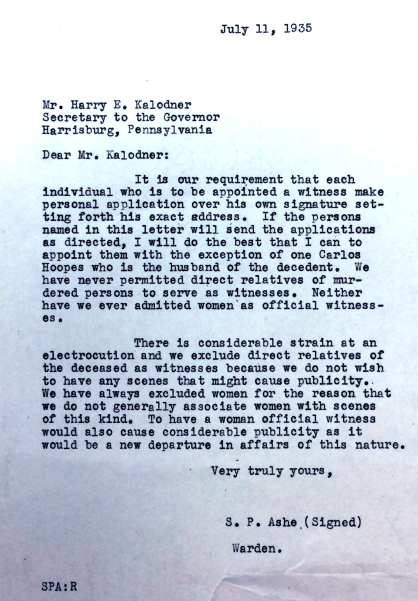
image001

William Walker was paroled in 1960. Throughout his time in prison and beyond, he maintained that he was unaware that he was pleading guilty to murder, that he was poorly represented by counsel, and that he was coerced into the robbery by Ginyard.

In 1973, Walker filed a request for post-conviction review of his guilty plea. The trial court rejected his request, though the Pennsylvania Supreme Court reversed that decision (Commonwealth v. Walker, 460 Pa. 658, 1975). His guilty plea was subsequently sustained.

In 1978, Walker sought a reversal of his conviction and a retrial (Pittsburgh Post-Gazette, February 24, 1978). That effort also ultimately failed (Pittsburgh Post-Gazette, July 8, 1978).

Martin Joseph Sullivan

Perhaps the most disturbing and improbable capital case in Pittsburgh’s history involved sixty-seven year old serial rapist and Duquesne police officer, Martin J. Sullivan, who killed five people while ostensibly in police custody on December 17, 1936.

image001

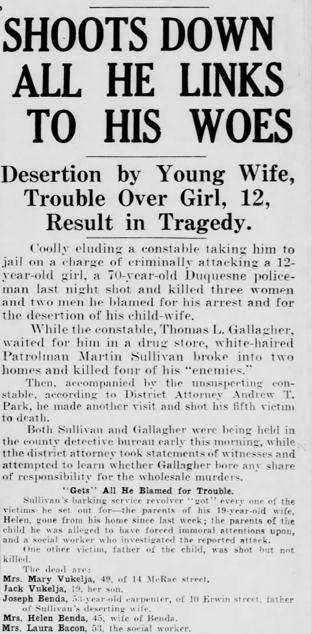
The road to that tragic evening began several years earlier when, not long after the death of Sullivan’s wife, Phoebe (McShane), his fourteen or fifteen-year old neighbor, Helen Benda, moved into Sullivan’s home. Their relationship, which may have begun with young Helen working as a housekeeper, became sexually predatory. Though some reports characterized the two as married, Sullivan’s efforts to marry Helen had been rejected by her parents; not long after, Helen moved out.

Sullivan quickly identified another neighbor, eleven-year old Antoinette Vukelja, as his next victim. Over the next six months, he raped her repeatedly.

On December 11, 1936, Antoinette’s mother, Mary, filed a formal complaint against Sullivan, including the allegation he had raped Antoinette that day.

image002.png

Sullivan was arrested on those charges on December 17. At his initial appearance that evening, Mary Vukelja and Laura Bacon, head of the Duquesne Community Center, who had investigated the alleged rape, testified against him. He was ordered held without bail.

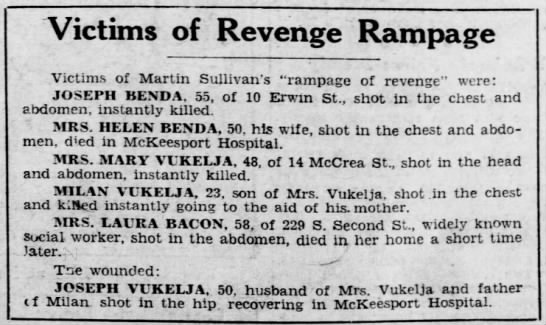
The job of jailing Sullivan was given to Constable Thomas L. Gallagher, a lifelong Duquesne resident, colleague of Sullivan, and son of a Duquesne police officer who had also served with Sullivan. As the two men walked to the Duquesne jail, Sullivan requested the opportunity to stop at his son’s home to discuss his arrest. Agreeing, Gallagher waited outside on the sidewalk talking with neighbors and shuffling his feet to keep warm for forty minutes during which Sullivan entered his son’s home alone, exited by the back door, went to his home to get his gun and then to the home of Joseph and Helen Benda, parents of Helen Benda, and killed them. He then walked to the home of Mary Vukelja and killed her and her son, Milan, when he ran to her aid.

image001

Having killed four people, Sullivan then rejoined the police officer waiting for him, went with him to a saloon for a drink, and requested and was granted permission to talk with Laura Bacon. He was escorted to her home by Officer Gallagher. Still armed, Sullivan briefly questioned Bacon and then shot and killed her while Gallagher looked on.

image002

image002
Pittsburgh Post-Gazette, December 18, 1936

Having killed everyone involved in the case against him, Sullivan made a complete confession and asked to be executed.

image001
Pittsburgh Press, December 18, 1936

He had spared Antoinette Vukelja and a number of other witnesses against whom he bore no grudge.image002

Sullivan, who was born in Ireland and had ten children, was tried only for the murder of Laura Bacon. With a confession, multiple witnesses, and clear motive, the state’s case was overwhelming. Sullivan’s insanity defense failed.

In its subsequent rejection of his motion for a new trial, the court ruled that Sullivan had “utterly failed” to meet the burden of demonstrating insanity. Rather, “the evidence, both lay and medical, was overwhelmingly to the contrary.”

Sullivan was convicted on May 21, 1937, after which he again requested a death sentence. That sentence was formally imposed on July 29, 1937.

image002

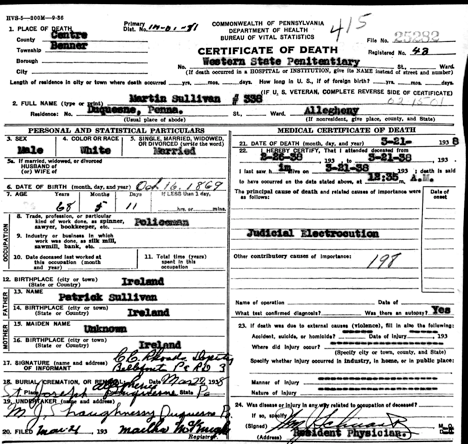
After his clemency plea was rejected in February 1938, Martin Sullivan was executed on March 21, 1938. He is the oldest person ever executed in the state. He had attempted suicide the week before his execution.

image002.png

Officer Gallagher stood trial in January 1939 for criminal negligence in allowing Sullivan’s escape. Though he was found guilty, a petition signed by Duquesne residents persuaded the court to sentence Gallagher to probation. He also lost his job.

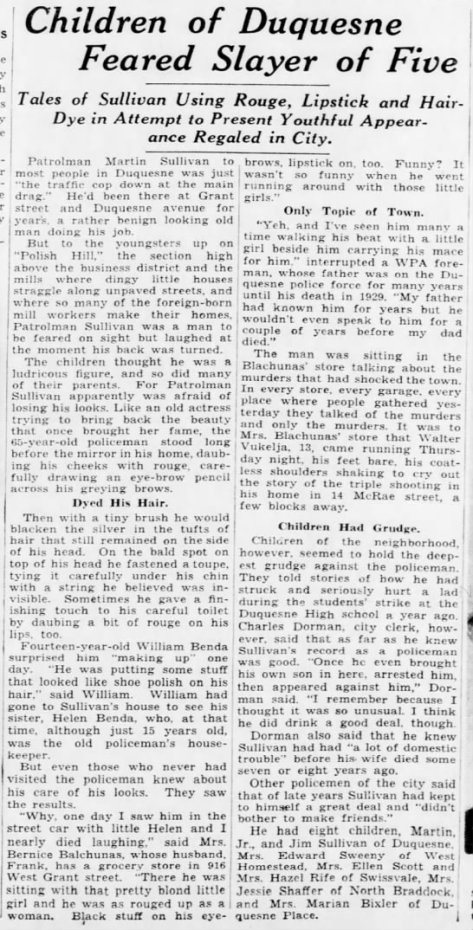
Sullivan, who was both feared and mocked in Duquesne, is reported to have serially raped girls while working as a police officer (Ray Sprigle, Pittsburgh Post-Gazette, July 24, 1949).

image001
Pittsburgh Post-Gazette, December 19, 1936

Antoinette Vukelja died in Pensacola, Florida, on January 9, 2000.

image001
Pittsburgh Sun-Telegraph, December 18, 1936

Cleveland Thompson

In a case that began all too routinely and ended by ushering in a new era of death penalty politics in Allegheny County, Cleveland Thompson killed bartender Wallace Junior Russell, 56, during a robbery of the Barbary Coast Club on Townsend St. in the Hill District on the night of September 13, 1949.

image001
Townsend St., 1956

What followed was the longest, most contentious, and last Allegheny County case to end with an execution, nearly a decade later.

image001.png

Fleeing the bar, Thompson shot Aaron Daniels, a bar patron, in the arm. He later went to the nearby home of Mattie Spells and borrowed $2, before going to the Triangle Bar. When a bartender there observed Thompson’s concealed gun, he called police and Thompson was arrested.

image001The Mississippi-born Thompson, 26, was convicted of first-degree murder on January 20, 1950, and sentenced to death on May 1, 1950.

Over the following decade, Thompson gained a new trial, a new death sentence, and fourteen stays of execution, before being executed. Though the broad factual case against Thompson itself was straightforward and his role in killing Russell was well established, including by eyewitness testimony, the investigation and prosecution of that case raised issues that occupied the courts for years.

In his initial appeal (Commonwealth v. Thompson, 367 Pa. 102, 1951), Thompson claimed his counsel was unprepared and inadequate and the district attorney and the judge made prejudicial statements. Those claims were rejected. Thompson’s petition for certiorari to the United States Supreme Court (342 U.S. 835, 1951) was also denied.

Thompson then filed multiple applications for federal habeas corpus relief. The first of those applications, which focused on the competency of his counsel, was denied (203 F. 2d 429, 1953). The second application, which argued that his conviction should be invalidated because the state withheld statements from Officer William Heagy that Thompson was drunk and high at the time of the killing, evidence that might have led the jury to a lesser conviction, was accepted (Thompson v. Dye, 221 F.2d 763, 1955) and Thompson’s conviction was reversed.

image001

Even with the admission of the statements of Officer Heagy, who was shot and killed while on duty in the Hill District in 1954, Cleveland Thompson was convicted of first-degree murder in a second trial on May 30, 1956, and sentenced to death on November 27, 1956.

After his motion for a new trial was rejected, Thompson appealed again. This time he argued that he acted in self-defense when Russell attacked him and that his prior civilian and military records, which included a 1943 court martial for assault, was improperly admitted into evidence and prejudiced the jury against him. The Pennsylvania Supreme Court rejected Thompson’s claims (Commonwealth v. Thompson, 389 Pa. 382, 1957). Justice Musmanno, a noted racial liberal, issued a sharply worded dissent, in which he attacked the willingness of Pennsylvania courts to allow evidence of unrelated crimes to be admitted.

After a new round of appeals, including an appeal to the United States Supreme Court, was unsuccessful, Thompson sought clemency. Particularly notable about his request, which raised the same issues he had been raising on appeal, was the way in which it signaled that the death penalty had become a racial justice issue within the larger Civil Rights Movement. As such, death penalty proponents sought to neutralize its racial dimensions (see the letter of the right below) while opponents sought to elevate them (see the letter on the left below, from Civil Rights leader Adam Clayton Powell, Jr.).

image002image003

Cleveland Thompson’s clemency request was rejected and he was executed on April 4, 1959. He was buried in the prison cemetery at Rockview.

image002

He remains the last person from Allegheny County to be executed. His eight years of time served in the Allegheny County Jail are unmatched in that institution’s history.

image001

The long ordeal that culminated in his execution resulted in this particularly poignant final account.

image001.pngThe Barbary Coast Club and the once-vital neighborhood of which it was a part were razed a few years after Russell’s killing as part of the “urban renewal” project that replaced much of the Lower Hill District with the Civic Arena.

Clarence Williams, Cleo Peterson, and Robert Smith

In a case that closely resembled the Sled and Avery case in both crime and punishment and in the aggravating racial dynamics of each, Clarence Williams, Cleo Peterson, and Robert Smith killed August F. Braum, Jr., 52, during a robbery of his West Elizabeth meat market on October 4, 1930.

image001
Pittsburgh Press, October 10, 1930

Braum, a prominent local businessman and elected official whose family had operated the butcher shop for at least 40 years, was shot when he tried to defend himself with a butcher knife.

image001.png

image001
First and Mill Sts., West Elizabeth

The assailants fled the scene and robbed a nearby gas station, part of a spree of robberies that continued until the next day. Williams, 20, and Peterson, 22, were arrested on October 17 after a gunfight with Donora police who suspected them of involvement in the recent robberies. Williams was shot while being apprehended. Smith had been arrested during a robbery on October 11.

Williams and Peterson provided information to police that linked Smith to Braum’s killing.

image002

The three defendants, all single and all recent migrants who worked in U.S. Steel’s massive Clairton works, were tried together and convicted of first-degree murder on February 13, 1931.

image002

The case against them was quite strong. They had committed numerous robberies, were involved in multiple shootings, and were in possession of stolen merchandise.

image001
Pittsburgh Press, February 13, 1931

The jury recommended death sentences for all three defendants, a highly unusual disposition for a murder with a single victim. A similar disposition had occurred only twice before in Allegheny County. Both cases involved minority-group defendants killing white victims in eras of heightened discrimination: in an 1891 case involving three Eastern European immigrant steelworkers wrongly convicted of murdering a white boss during a labor dispute and a 1905 case involving three Black defendants convicted of killing a white victim in a felony murder.

Robert Smith became ill in jail on March 9 and died of pneumonia on March 14, 1931, before being formally sentenced to death. Williams and Peterson were sentenced to death on March 31.

image001

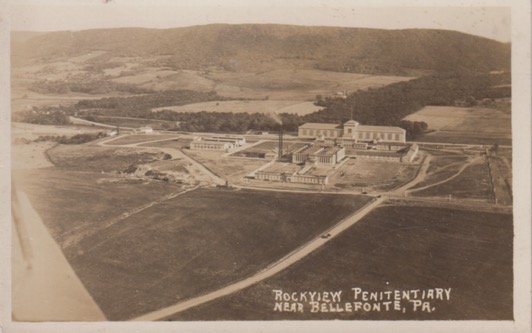
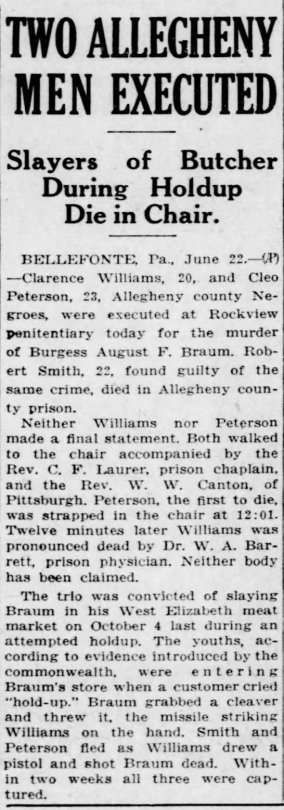
Routine appeals and pardon requests were filed, without success. Clarence Williams and Cleo Peterson were executed in succession on June 22, 1931, eight months after being arrested. The two men were buried where they were executed, at Western Penitentiary  (SCI Rockview) in Bellefonte, Pennsylvania.

image001
Pittsburgh Post-Gazette, June 23, 1931

With their executions, six Black men had been tried for the murders of two white men in the space of one year. Five of them had been sentenced to death and four had been executed.

Both inside the criminal justice system and outside, already high levels of racism were compounded by the economic hardship and competition for jobs caused by the Depression to produce a spike in racial violence.

image001
Pittsburgh Post-Gazette, September 17, 1934

William Henry Sled and Martin Avery

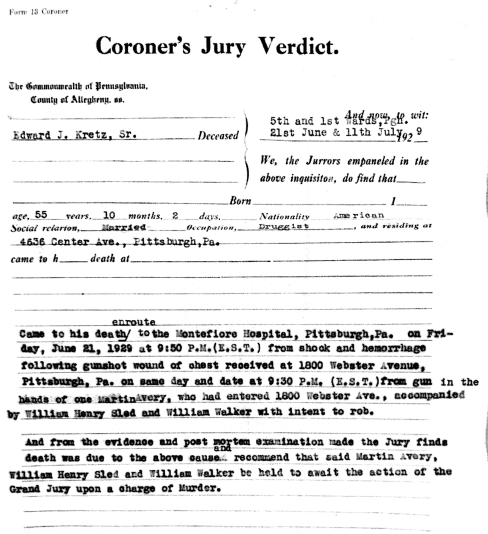
William Sled and Martin Avery entered the drugstore of Edward J. Kretz, Sr., in the Hill District late in the evening of June 21, 1929, intending to commit robbery. As Kretz reached for a pack of cigarettes that Sled requested, the 18-year old Avery shot and killed him. A third man, William Walker, may have been stationed outside the store. Several customers witnessed the killing.

image001
The Pharmaceutical Era, 1923

The three assailants, all residents of the Hill District, were arrested on June 24. Under questioning by police, Avery confessed, acknowledged firing the fatal shot, and implicated Sled and Walker. Sled and Avery, both Southern-born migrants, the former a World War I combat veteran, had criminal records.

image001.png

Kretz was a prominent businessman and the son of a wealthy family.

image003
Pittsburgh Press, July 15, 1894
image004
Pittsburgh Press, August 25, 1895

Robbery combined with revenge to form the motive for the killing. Avery acknowledged that after entering the store and recognizing Kretz as having testified against a friend of his in an earlier robbery case, he shot him.

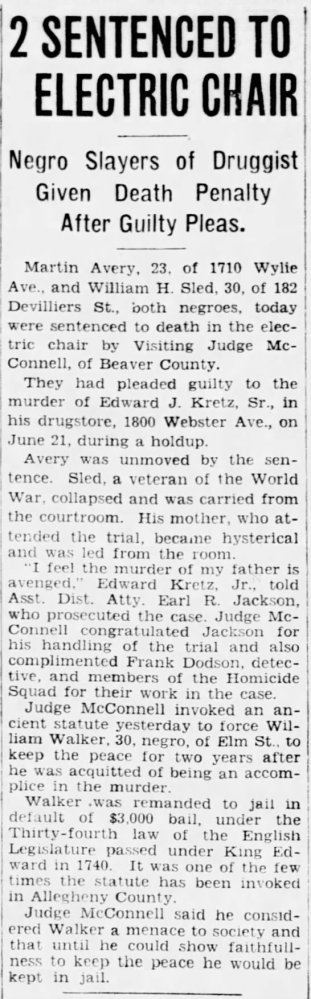
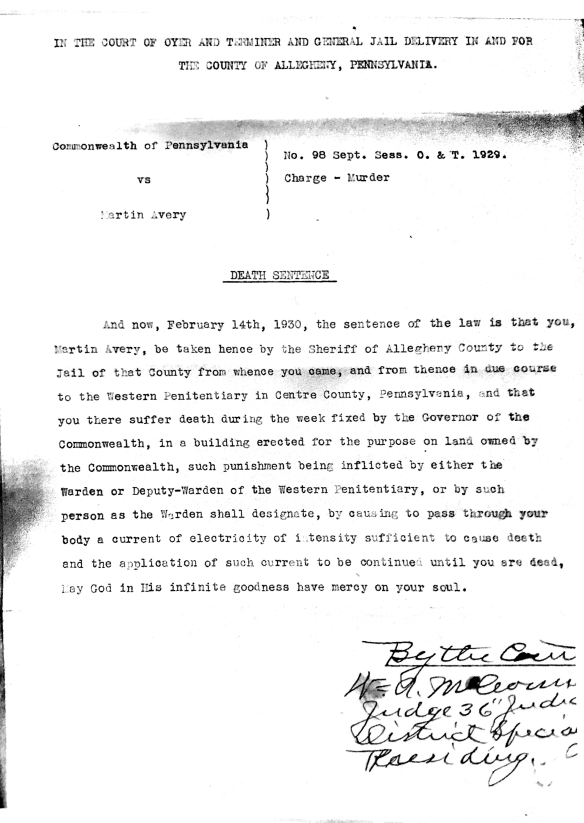
Having confessed to a crime committed in front of multiple witnesses, with many other witnesses after the fact, Avery and Sled pleaded guilty. On February 12, 1930, the court fixed their crime at first-degree murder. They were sentenced to death on February 14.

image001
Pittsburgh Press, February 14, 1930

Walker pleaded not guilty. At trial, his alibi defense of having been at the movies that evening was successful; he was acquitted on February 13. Despite the acquittal, Judge McConnell invoked a rarely used English common law allowing Walker to be held pending payment of a $3,000 bond intended to insure that he keep the peace.

image001
Pittsburgh Post-Gazette, February 14, 1930

With juries now having the option to impose a life sentence or a death sentence for first-degree murder, Sled and Avery were the first convicted murderers sentenced to death since the Jaworski case almost three years earlier.

As Black migrant laborers and perpetrators of an interracial felony murder of a prominent victim, such a result was to be expected. Though Black Pittsburghers had by this time developed an “impressive set of institutions” (Glasco, 2001), including the Pittsburgh Courier, Pittsburgh Crawfords, Homestead Grays, and Urban League, levels of racial tension and racist activity were also peaking ahead of the white flight and “urban renewal” that would soon decimate the Hill District in particular.

image001.png

Their clemency requests unsuccessful, William Sled and Martin Avery were electrocuted in quick succession on the morning of June 30, 1930, barely a year after Kretz’s murder. A third man, Frank Tauza of Wilkes Barre, was executed after Sled.

In a sharp criticism of “reformers,” an editorial in the Pittsburgh Press (June 24, 1929) suggested that those who opposed placing the full weight of the law on the offenders in this case should themselves be shot: “…a bullet which would most rudely stop all flow of the milk of human kindness…there’d be no harm in trying it out.”

image001                                              1800 Webster Avenue today

Raymond Winter

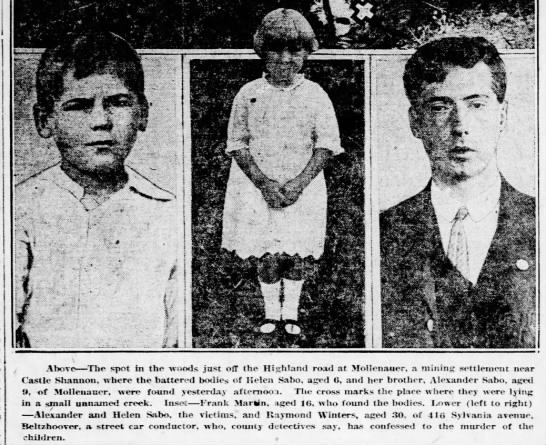
Eight-year old Alexander Sabo and his six-year old sister, Helen, were reported missing in the mining hamlet of Mollenauer, near Castle Shannon, on May 27, 1925. The two youngest children of poor, Hungarian-immigrant parents, Charles and Rosa (Rose) Sabo, were found beaten to death in the woods near their home the next day. They had been sexually assaulted before being killed.

image001.jpg

image001

Notified of the children’s disappearance, police attention quickly turned to Raymond Winter, a street car conductor and noted artist who worked in the area and had been seen with the children just before their disappearance. He was arrested even before their bodies were found.

image001
Pittsburgh Post-Gazette, May 29, 1925

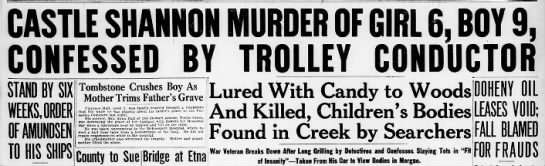
Winter, a World War I Army combat veteran who had been gassed and shelled, quickly confessed to police that he lured the children into the woods with a bag of candy. He had unsuccessfully tried to solicit two older Sabo children for sodomy prior to enticing their younger siblings.

image002

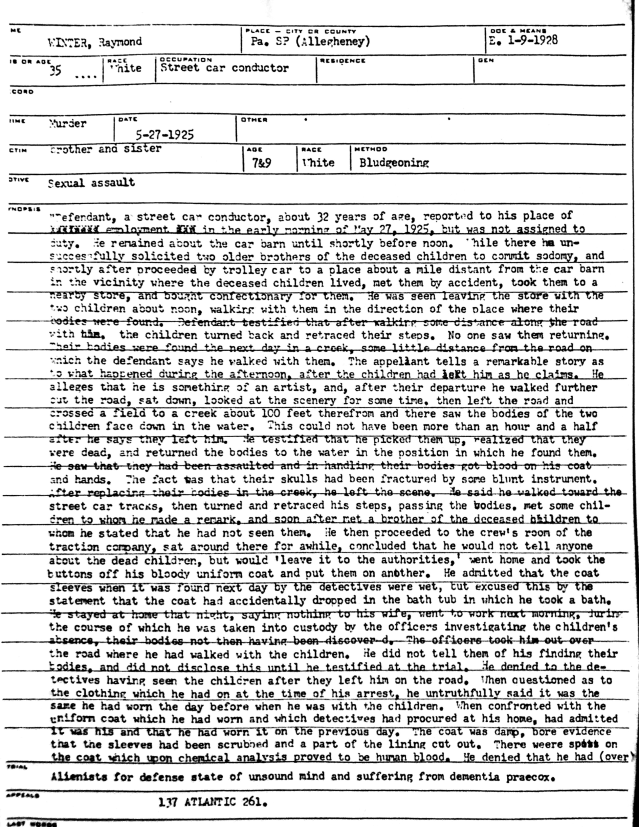
Though the case had the elements that made it particularly tragic and sensational, as a legal matter it was quite straightforward. Winter’s defense, that he had found and moved the dead bodies of the children while strolling through the woods, but was otherwise uninvolved in their deaths, was weak.

The only legal question of any doubt was whether Winter, who had no prior record, was mentally ill or cognitively impaired, whether by his traumatic war experiences or for other reasons.

In a case that generated enormous public interest, Raymond Winter was convicted of first-degree murder on March 26, 1926, and sentenced to death. His was the first Allegheny County case in which a jury that had the choice of life or death for a first-degree murder conviction chose death. Only four of the fifteen Allegheny County executions conducted under that rule were of white defendants.

With the assistance of his wife and parents, Winter aggressively and unsuccessfully pursued appeals (Commonwealth v. Winter, 289 Pa. 284, 1927) and clemency. In each case, his mental health claims were considered and rejected.

image001.png

Raymond Winter was executed on January 9, 1928.

image004
Pittsburgh Press, January 9, 1928

Charles Sabo died in November 1980. Rose Sabo died in April 1942. They are buried together in Springdale Cemetery.

John McNeil, who was the warden of the Allegheny County Jail at the time, later said Winter should not have been executed because he was clearly mentally ill and that his execution troubled him more than any other with which he was involved.

Charles Steele

Semple Hill in Millvale, described as “Pittsburgh’s greensward Monte Carlo,” was “the site of “the biggest open-air crap games in this part of the country” in the 1920s, commonly drawing fifty or more players and thousands or even tens of thousands of dollars in wagers.

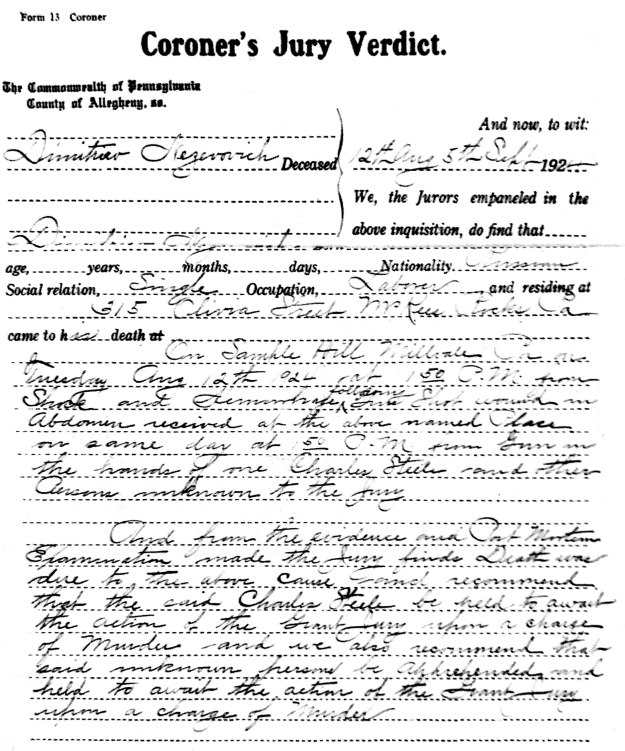
Attracted by the action, Charles Steele (aka Alvin Case), a professional gambler, came to Semple Hill and lost big during the summer of 1924. To recover his losses, Steele and his associates robbed the game during the afternoon of August 12, 1924.

Tying thirty or more men to trees, they robbed them of thousands of dollars in cash and jewelry. Dmitri Nezevorich, a Russian steelworker at the Pressed Steel Car Company, was shot and killed when he tried to escape.

image001

Steele was apprehended the next day; no one else was arrested in the case.

image001
Warren (Pa) Tribune, August 13, 1924

At trial, Steele denied shooting Nezevorich or giving the order to do so, though witnesses testified he fired the fatal shot. He was convicted of first-degree murder on April 30, 1925. After his motion for a new trial was rejected, he was sentenced to death on November 25.

image001
Pittsburgh Press, April 30, 1925

In his clemency request, Steele argued that his childhood poverty, lack of education, and independence from his family since he was 13 or 14 should be considered in sparing him. He also claimed that an accomplice who had since died was responsible for the killing and that he had become a Christian. His request was supported by his trial jury.

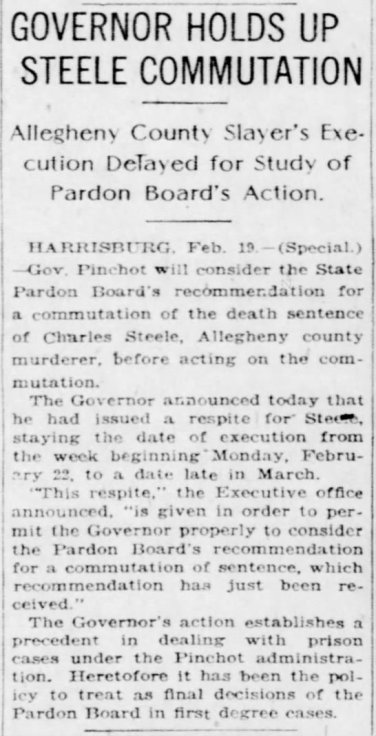
In a highly unusual sequence of events, the Pardon Board recommended commutation by a 3-1 vote – a decision that had previously been treated as dispositive – but Governor Gifford Pinchot rejected their recommendation.

image001
Pittsburgh Gazette Times, February 20, 1926

After a series of respites, Charles Steele was executed on June 1, 1926.

image001
Pittsburgh Post, June 2, 1926

 Illegal gambling and related violence continued at Semple Hill, “the greatest gambling resort in Western Pennsylvania,” due in part to police corruption (see Pittsburgh Daily Post, April 13, 1925).

image001.jpg

John Elbert Daily

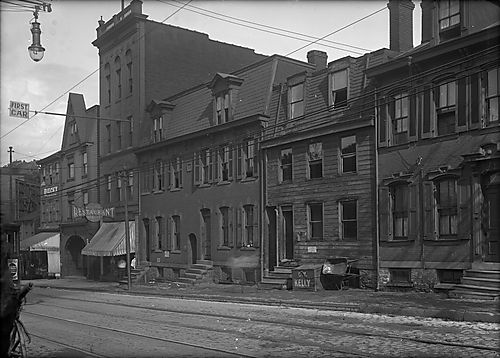
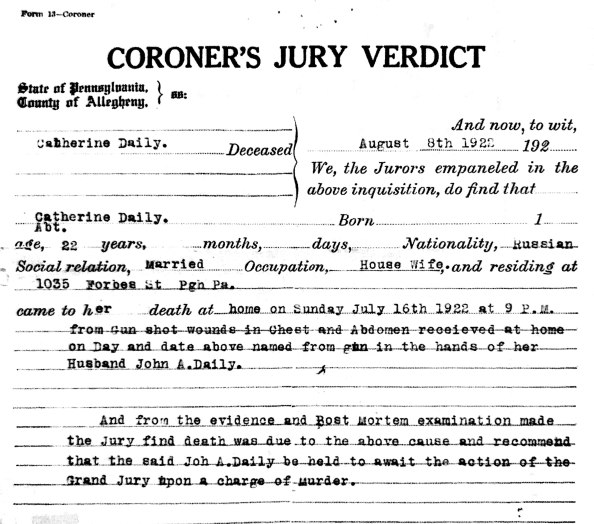
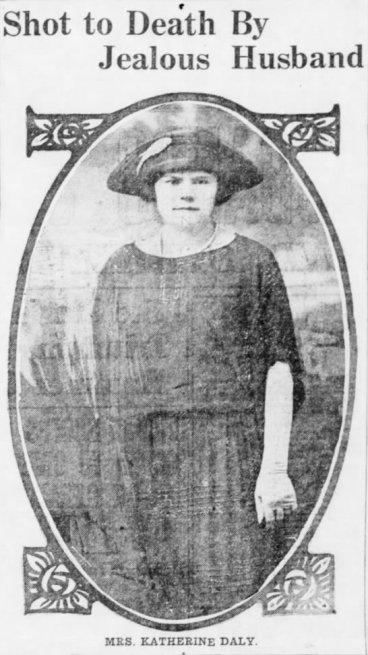
John Elbert Daily (born Giovanni D’Elia in Regina, Cosenza, Italy, in 1886), and his wife, Catherine (nee Spozarski), a Polish immigrant, lived in a boardinghouse at 1035 Forbes Avenue, in the Uptown section of the city.

image001
Forbes Avenue, Uptown, 1921

Together in their second floor room, the couple quarreled on the evening of July 16, 1922. Neighbors heard the sounds of fighting, followed by three gun shots and then two more. They also witnessed an armed Daily leaving the house.

image001

Daily, 35, was quickly apprehended by police. His clothes and shoes were bloody. A search of his room found the murder weapon. Catherine Daily, 22, had been shot five times.

image001
Pittsburgh Daily Post, July 17, 1922

The couple had been married for seven months.

With four murders occurring in a twenty-hour period, the Daily murder was part of “the greatest wave of murder” in Pittsburgh in more than 25 years.

image001
Pittsburgh Daily Post, July 17, 1922

Daily later reported that his wife had requested a divorce. Another report was that they quarreled after Daily accused her of being unfaithful.

At trial, Daily pursued a third approach, claiming that a stranger entered their room, assaulted him, and shot his wife. With the neighbors as prosecution witnesses, Daily was convicted of first-degree murder on March 23, 1923, and sentenced to death.

After his conviction, Daily charged that his attorney forced him to present a “framed” defense, when the truth was that the shooting was the accidental result of a scuffle with his wife for possession of the gun. His wife, he said, was a dope fiend who was going to shoot him.

On appeal, the court rejected the argument that Daily’s new defense warranted a new trial (Commonwealth v. Daily, 280 Pa. 59, 1924). Whatever his defense, the court held, the jury had found him guilty beyond a reasonable doubt.

In his clemency request, Daily claimed he and his wife were quarreling over her divorce request when she pulled a gun. They struggled over the gun and Catherine was killed. That story was also rejected.

John Daily was executed at Rockview on July 7, 1924, and buried in the prison cemetery.

image001
Pittsburgh Daily Post, July 8, 1924

Daily, who worked at Mangieri’s, a downtown bar turned café after Prohibition that was the focus of multiple Prohibition-law violations, was reputed to be involved in organized crime. His extensive criminal record of burglary, possession of stolen goods, and related crimes, dated at least to 1906. He was out on bail awaiting trial at the time of the murder.

image001                                                       1035 Forbes Ave. today

George H. Prescott

George H. Prescott was a close friend of Charles F. and Fern F. Thase, who lived nearby on the North Side. Beneath the seeming contentment of their friendship, George Prescott and Fern Thase carried on a long-term clandestine relationship. Prescott, who sold pianos, used periodic visits to the Thase residence to collect their piano payment as cover for their intimacy.

image001
Jacksonia St., today. 306 is the second house from the left.

When Prescott became concerned that Thase was becoming too friendly with other men, he confronted her in her 306 Jackson St. (now Jacksonia St.) home on the morning of April 8, 1924. Their quarrel escalated, and Prescott slashed Thase with a razor and, failing to kill her, shot her. He then left the Thase home.

image001

After being identified by Thase’s neighbors, Prescott was arrested at home that afternoon. As he was being led into the police station, he attempted suicide by slashing his own throat. It was initially believed his wounds were fatal.

image001
Pittsburgh Daily Post, April 9, 1924

As Prescott recovered, he confessed to police that he killed Thase because she was ending their relationship. Prescott later repudiated his confession.

At trial, Prescott claimed that he was too drunk at the time of the killing to know what he was doing. He was convicted of first-degree murder on October 16, 1924. His jury was among the first in a capital case to include a woman.

image002After his petition for a new trial was rejected, Prescott was sentenced to death on May 28, 1925.
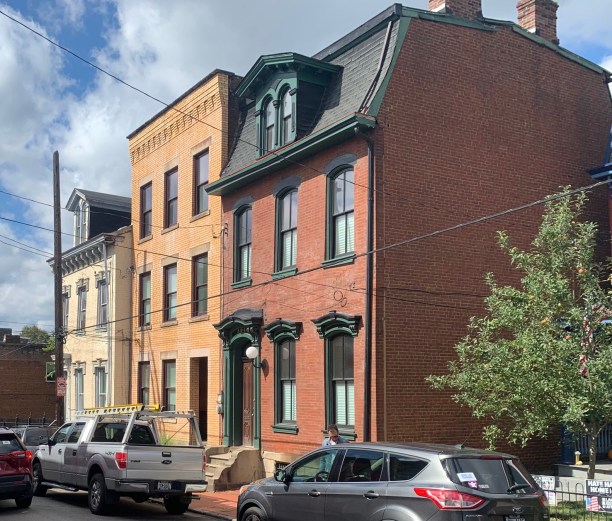
image001
Pittsburgh Daily Post, May 29, 1925

His aggressive pursuit of an appeal (Commonwealth v. Prescott, 284 Pa. 255, 1925) and commutation unsuccessful, Prescott vowed that he would not be executed. In keeping with this vow, he stashed a razor blade in his cheek and slit his throat and wrists on February 20, 1926, two days prior to being transported to the electric chair for his scheduled execution.

He recovered in Mercy Hospital and was executed a month later, on March 29, 1926.

image001
306 Jacksonia (in center), October 2020

Charles Thase died in Pittsburgh on January 4, 1949.

Milo Dwight Dorst

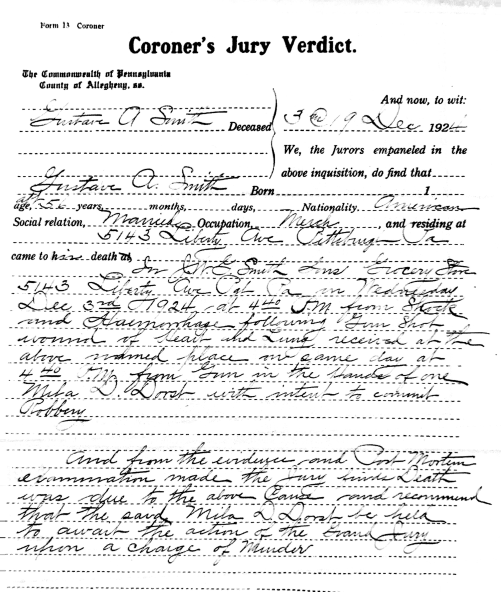
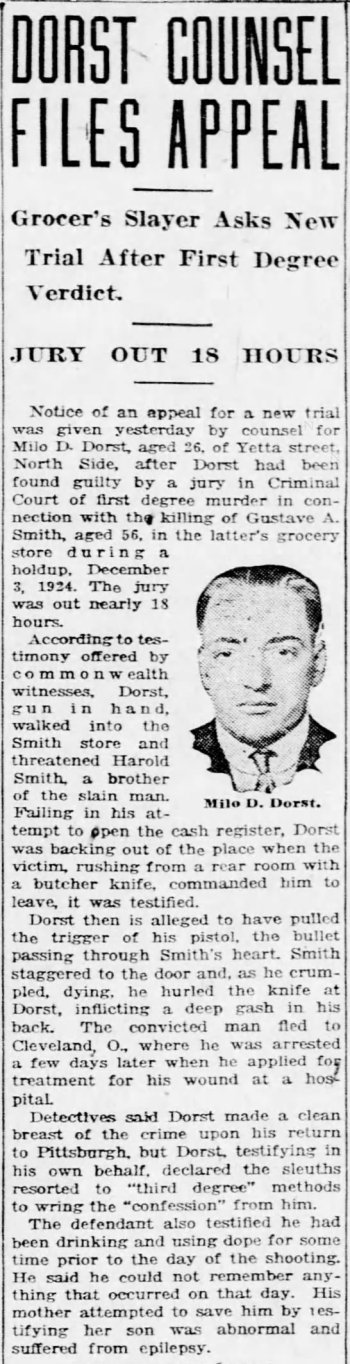
Immediately after robbing a nearby grocery, Milo Dorst entered the 5143 Liberty Ave., Bloomfield grocery of Gustave Adolph Smith on December 3, 1924, pulled a gun, and announced his intention to rob the store. Smith responded by charging Dorst with a large knife. Dorst fired, killing Smith. Fleeing, Dorst suffered a stab wound in the back from the knife thrown at him by the dying Smith.

Escaping without any money, Dorst fled to Youngstown, Ohio, and then to Cleveland. He was arrested there on December 6, after going to Lakeside Hospital for treatment of his wound and being recognized by a nurse who had seen the notification sent there by Pittsburgh police.

image001Under a “severe grilling,” Dorst, 26, confessed to police. He also confessed to numerous other robberies committed since being released on parole in June 1924 following a 1922 robbery conviction.
While jailed, Dorst attempted suicide on December 7, 1924, by reopening the stab wound made by Smith’s knife.

At trial, Dorst claimed his confession was coerced and that drunkenness prevented him from recalling the events leading to his arrest. He was convicted of first-degree murder on May 13, 1925.

image001
Pittsburgh Gazette Times, May 14, 1925

While death sentences had been mandatory for first degree murder convictions since Pennsylvania’s murder statute was enacted in 1794, the Split Verdict Act (P.L. 759, May 14, 1925), which gave jurors discretion to impose a life or death sentence upon conviction, was signed into law the day after Dorst’s conviction.*

Dorst used that statutory change in arguing, ultimately unsuccessfully, for clemency.

After his appeal was rejected (Commonwealth v. Dorst, 285 Pa. 232, 1926) and vigorous commutation efforts by his wife and mother, president of the local chapter of the Women’s Christian Temperance Union, delayed but did not change his fate, Milo Dorst was executed on May 24, 1926. He is buried in the prison cemetery in Bellefonte, Pennsylvania.

Cora Dorst died in Orlando, Florida, on March 11, 1957.

* The enactment of the Split Verdict Act had the effect of sharply curtailing the use of the death penalty on white offenders and, relatedly, the use of executive clemency. In the 35 years prior to its enactment, approximately 40% of all death sentences were commuted. In the 35 years after its enactment, only 7% of death sentences were commuted. By effectively limiting the death penalty to Black defendants and all but the most heinous white defendants, the use of commutations was unnecessary.