I am a sociologist and death penalty scholar at the State University of New York at Geneseo. I am also a Pittsburgh native. My present research focuses on the history of the death penalty in Allegheny County (Pittsburgh), Pa.
In a case that garnered enormous media and public attention from the moment it occurred through every twist and turn of its decades-long history, twelve-year old Lillian Walker Schadle was raped and killed not long after leaving her North Versailles home on the afternoon of Wednesday, November 27, 1912. She had sent her on an errand to buy groceries for Thanksgiving.
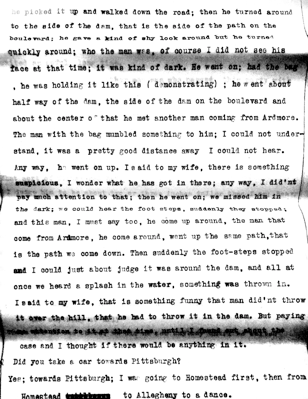
A massive search followed news of Schadle’s disappearance. Her body was recovered from the Westinghouse Reservoir, Wilkins Township, on Thanksgiving evening. Attention had been focused on the area after a neighbor, Frank Neeper, reported a man carrying a large bag acting in an unusual manner. Threats of lynching were heard. Her killer, it was later learned, watched as the reservoir was drained and her body recovered.
From the coroner’s jury testimony of Frank Neeper
A week-long intensive police manhunt led to Edward Exler, who was arrested December 4. Police had determined that Lillian’s last stop was at a 636 Linden Avenue, North Braddock butcher shop, owned by Edward’s father, Frank Exler. Schadle had been seen walking with 25-year old Edward Exler, whom she knew from deliveries he had made to her home, from the shop toward a stable at Exler’s home. The rape likely occurred in the stable, after which Exler moved her body to the reservoir.
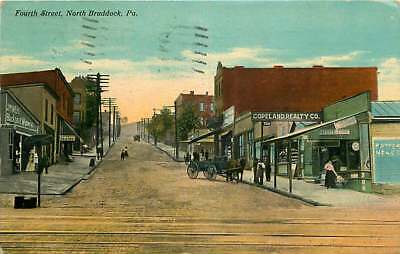
North Braddock, 1912
On the day prior to the murder, Exler had broken his engagement to be married. The wedding had been scheduled for Thanksgiving weekend.
Once arrested, twenty-eight hours of continuous “sweating” by rotating teams of detectives did not produce a confession. Exler, who had a prior arrest for improper contact with girls, consistently denied any involvement in the case.
Witness testimony and evidence collected at the scene and at Exler’s home formed the core of the state’s case. After very brief jury deliberations, Exler was convicted of first-degree murder on March 1, 1913. His motion for a new trial was refused and he was sentenced to death on July 25, 1913.
Pittsburgh Daily Post, March 2, 1913
Exler’s father was stalwart in his defense and financial support of his son, declaring that he would spend his last dime and the money of wealthy relatives to free his innocent son. Top quality legal counsel was retained toward that end.
On appeal, Exler argued that Schadle’s death did not constitute first-degree murder. In a split decision (Commonwealth v. Exler, 243 Pa. 155, 1914) premised on an exceedingly strict construction of the underlying statute, the Pennsylvania Supreme Court agreed.
Though young Lillian’s death occurred during the perpetration of a rape and therefore would seem to constitute felony murder, which is first-degree murder, the state supreme court held, quite controversially, that minor drafting differences between the state’s 1860 statute defining murder and the 1887 statute defining rape created a loophole in the punishment proscribed for the rape of a child through which Exler could pass.
Exler’s conviction was reversed on January 5, 1914, and a new trial was ordered. Due to the statutory concerns identified by the court, Exler was then indicted for rape rather than murder. After a long and contentious second trial, in which Exler offered an alibi defense, he was convicted of rape on July 1, 1914, and was sentenced to 12-13 years in prison.
He appealed that conviction, which was sustained (Commonwealth v. Exler, 61 Pa. Super. 423, 1915) on October 11, 1915.
Eleven months after his release from Western Penitentiary in 1928, Exler was arrested for raping a six-year old girl on March 22, 1929. His father posted bail. Exler skipped bail and fled, never to be seen again.
His family had Edward Exler declared legally dead in 1940, though there is no evidence of his subsequent whereabouts.
A lengthy 1949 Post-Gazette article by Ray Sprigle was sharply critical of the handling of the case, arguing that the “drooling sentimentalists” on the Supreme Court “tossed law and common sense into the ash can” by not allowing Exler’s capital conviction to stand.
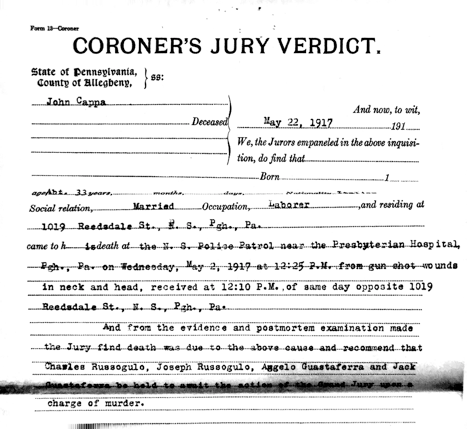
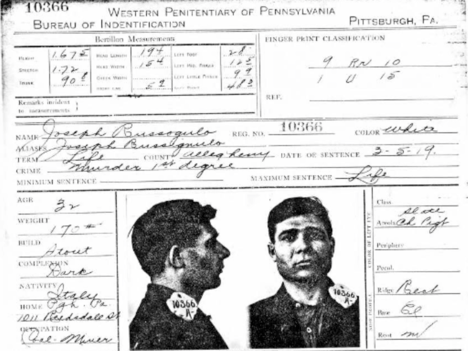
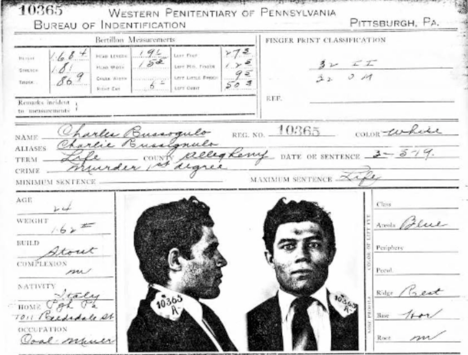
In a continuation of Black Hand-related violence, brothers Charles and Joseph Russogulo, their step-brother, Jack Guastaferro, and step-father, Angelo Guastaferro, killed John Cappa outside their 1019 Reedsdale St., North Side home on May 2, 1917.
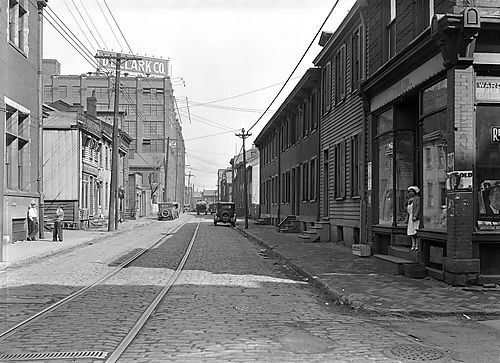
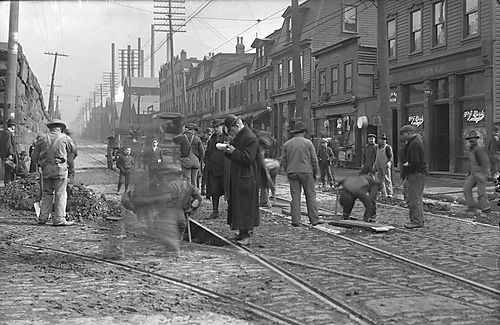
Reedsdale St., 1929
The killing occurred in reprisal for an attack by Cappa and another man, John Lapaglia, in which they attempted to extort the group.
All of those involved in the incident were Italian immigrants from Sicily. Charles Russogulo was 22 years old; his brother, Joseph, was 20. Jack Guastaferro was only 17; probably the youngest person ever sentenced to death in Allegheny County.
The four men were tried together. At trial, the state claimed the defendants formed the core of an active and violent criminal organization.
The defendants claimed they acted in self-defense against the violent extortion attempt of Cappa and Lapaglia. Their defense was weakened by evidence that they had retreated into their home after the initial encounter and had shot Cappa through the window.
Pittsburgh Daily Post, May 3, 1917
The three younger men were convicted of first-degree murder on November 28, 1917, and sentenced to death on April 5, 1918. Angelo Guastaferro was convicted of second-degree murder and sentenced to 12 years in prison.
The defendants’ combined appeal, which argued a series of minor points related to the jury instructions, was rejected (Commonwealth v. Russogulo, 263 Pa. 93) in January 1919. In unusually plain language, the Court wrote “the jury were entirely justified in finding all four defendants participated in the actual shooting of John Cappa, and that the killing of the latter was an inexcusable cold-blooded murder. Angelo Guastaferra is fortunate that he, too, was not convicted of murder of the first-degree; none of the defendants can properly complain of the trial.”
After a clemency request that characterized the defendants as hardworking and reputable immigrants being extorted by a violent gang, the Pardon Board recommended that their death sentences be commuted to life imprisonment in February 1919.
Governor Sproul signed the order on March 14, 1919. The three men were transferred to Western Penitentiary.
Their legal efforts to reverse their convictions continued, with some success. Charles Russogulo was paroled on March 5, 1932, and pardoned on September 13, 1935. He moved back to his family’s North Side home, not far from Western Penitentiary, and worked in construction.
While serving his life sentence, Joseph Russogulo was declared insane and transferred to Farview State Hospital for the Criminally Insane on December 14, 1933. He died there on January 17, 1945.
Jack Guastaferro was released on parole on March 5, 1932. He returned to the North Side and worked in the steel industry. He died on April 21, 1970.
John Lapaglia rose to greater prominence in Pittsburgh’s underworld during Prohibition, only to be murdered in more Black Hand violence on October 18, 1924.
Pittsburgh Daily Post, October 19, 1924
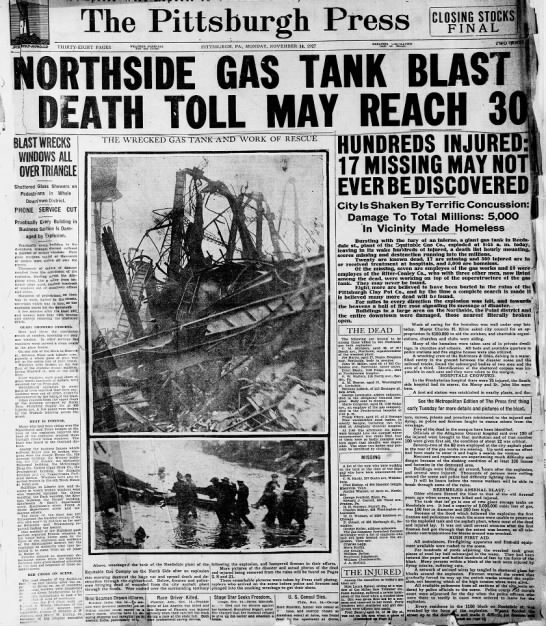
On November 14, 1927, at Equitable Gas Company’s storage facility very near the site of Cappa’s murder, the largest natural gas storage tank in the world exploded. Twenty-eight people were killed.
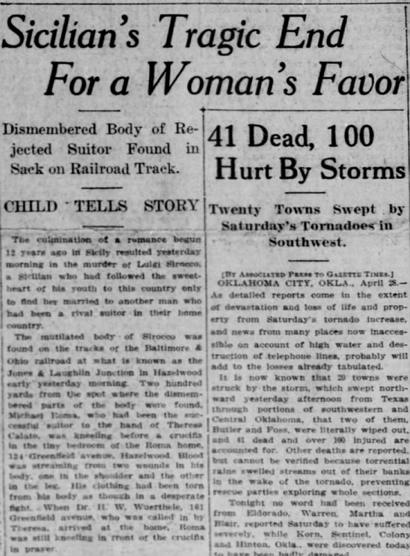
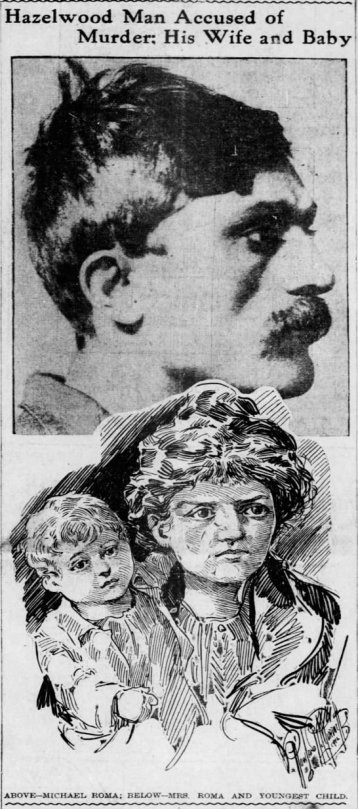
Early in the morning of April 28, 1912, Michael Roma shot and stabbed Luigi Sirocchi in the kitchen of his 135 Greenfield Avenue, Hazelwood home in “one of the most ghastly and revolting murders ever committed in Allegheny County.” Roma’s wife, Therese, was present during the killing. Her role was a matter of dispute.
Pittsburgh Post, April 29, 1912
In a feeble effort to disguise the murder, Sirocchi’s body was dismembered with a hatchet and dragged to nearby railroad tracks to create the appearance of an accident. It was discovered there by a railroad crew that same morning.
Following a trail of blood, police went to the Roma home later that morning. There they found Roma with two gunshot wounds and discovered parts of Sirocchi’s body.
Greenfield Avenue, Hazelwood, 1906
In his confession to police, Roma, 30, said he had been involved in a violent altercation with a group of four men that included Sirocchi’s brother. It was then that he was shot twice. When Roma returned to his home, he said, he found Sirocchi, who had previously boarded in his home, intimately involved with his wife. Enraged, Roma killed Sirocchi.
Coroner’s Inquest, May 9, 1912
Therese Roma had been involved in a relationship with Sirocchi while they both lived in Italy. Michael Roma’s jealousy over their efforts to continue that relationship in Pittsburgh had led to a series of previous physical and legal entanglements with Sirocchi and his brother.
Pittsburgh Post-Gazette, April 29, 1912
Roma’s trial was complicated by the law which protects a wife from testifying against her husband and by his manifest mental health problems, which prevented him from offering a defense.
Relying on Roma’s confession, the murder weapon, and overwhelming physical evidence, he was convicted of first-degree murder on June 25, 1912. After his motion for a new trial was rejected, Michael Roma was sentenced to death on July 5.
Therese Roma, also tried for murder, was acquitted two days later after testifying that her marriage was abusive.
Pittsburgh Press, April 29, 1912
After his conviction, Roma’s attorneys petitioned the court for the establishment of a lunacy commission to investigate Roma’s “mental soundness.” That request was granted and Roma was declared insane on February 11, 1913. He was transferred to Mayview State Hospital.
Pittsburgh Daily Post, November 2, 1918
Michael Roma died at Mayview on November 28, 1918, a victim of the influenza epidemic. That epidemic had peaked a month earlier, leading to pressure to ease restrictions on business and movement and, predictably, a resurgence of illness and death.
Frank H. Bezek, a 40-year old Slovenian immigrant who had risen to a position as manager at Pittsburgh Coal Company, was walking home from work along a remote stretch of Moon Run Rd. on the evening of September 6, 1911, when a man stepped out of the shadows and shot and killed him.
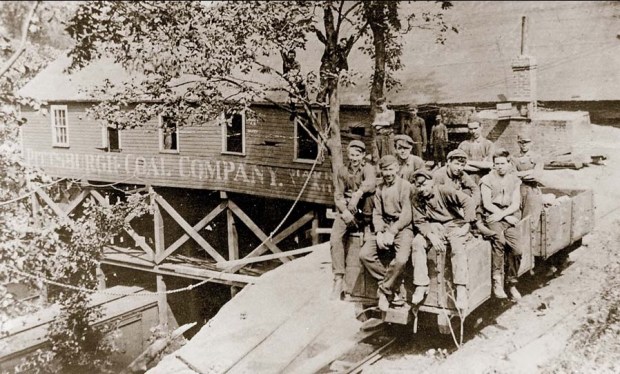
View of Pittsburgh Coal Company mine, Moon Run area
Bezek’s pockets were cut and their contents stolen, leading police to initially suspect robbery as the motive.
After that line of investigation failed to produce any evidence or suspects, attention was focused on Bezek’s young wife, Mary. In her possession was found a letter that had been written by Frank Maly, 24, a Slovenian-immigrant coalminer who boarded in her home. The letter, written after the murder, provided evidence that Maly and Mary Bezek were lovers who had conspired to kill Frank Bezek.
Pittsburgh Press, September 16, 1911
The letter also contained an address where Maly could be reached, having fled after the murder. Posing as Mary Bezek, police wrote to Maly there and arrested him when he picked up the letter.
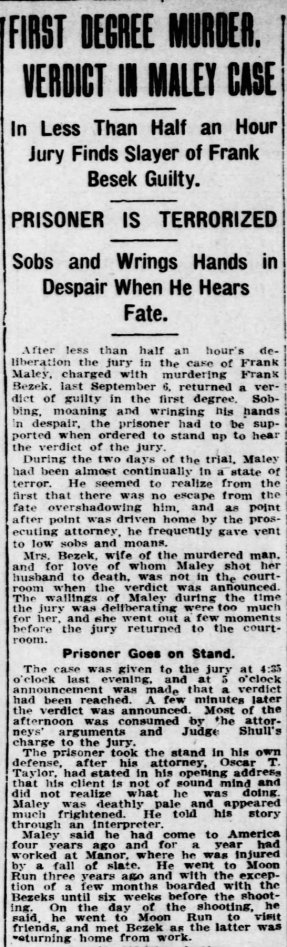
Once arrested, Maly quickly confessed, admitted to lying in wait and firing the fatal shot, and explained that he and Mary Bezek had plotted together to kill Frank Bezek so that they could marry. Mary Bezek denied any such plans and any relationship with Maly.
After brief jury deliberations, Maly was convicted of first-degree murder on December 12, 1911, and sentenced to death on December 29. In one of the perverse benefits of chivalry, Mary Bezek was never charged but was often blamed.
Pittsburgh Post, December 13, 1911
A determined and successful clemency effort was mounted. It centered on the then-popular theory of female criminality that emphasized the role of women in manipulating men into committing crimes. Specifically, the Pardon Board found that Mary Bezek was “infatuated” with Maly; that her “lustful desires,””persuasion,” and generous servings of food and liquor overwhelmed his efforts “to tear himself away” from her; and that she provided the gun and the plan and “commanded him” to kill her husband.
Maly’s death sentence was commuted to life in prison in Western Penitentiary on June 18, 1913.
After more than twenty-two years in prison, Frank Maly was paroled on January 24, 1934, on the condition that he be deported from the country.
Within months of the murder, Mary Bezek married coalminer Cyril Zaverl. The couple raised a family in Bridgeville, Pa., where she died on July 29, 1966.
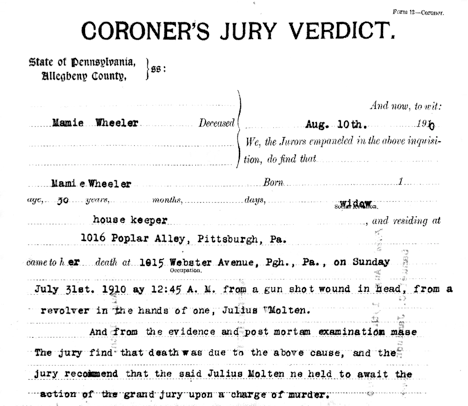
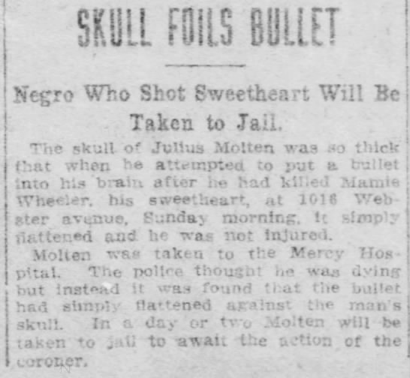
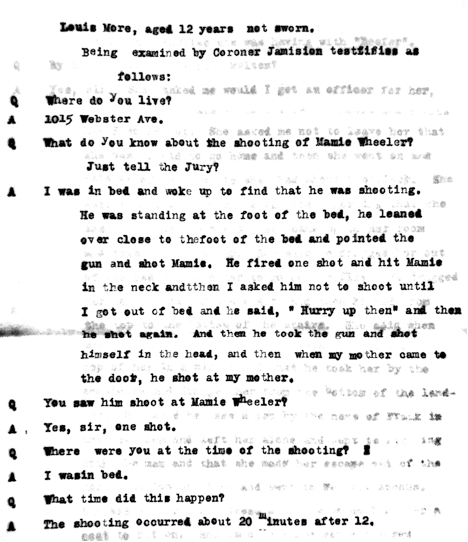
Julius “Beefer” Moten,* a 36-year old railroad porter, and his common-law wife, Mamie Wheeler, a domestic, fought frequently. Shortly after midnight on July 31, 1910, drunk again and jealous, Moten shot and killed Wheeler. He then attempted suicide by shooting himself once in the head. Wheeler’s 12-year old son was in the room at the time.
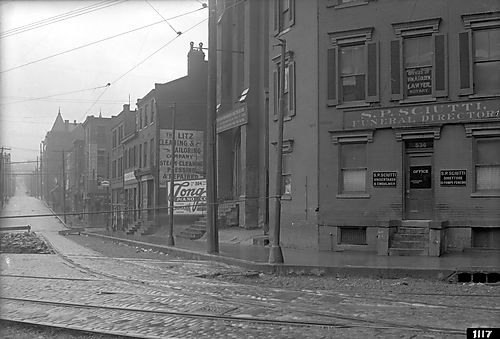
The killing occurred in the 1015 Webster Avenue, Hill District home of Sallie Davis, Wheeler’s friend, where she had gone to escape Moten’s abuse.
Webster Avenue, 1912
After Moten and Wheeler, both Virginia-born, fought on July 29 at their home, she called the police. Wheeler had been badly beaten. Moten was arrested, fined, and released the next day. After being released, he told others that he would kill Wheeler and another man, Frank, her alleged lover.
Pittsburgh Post-Gazette, August 2, 1910
At trial, Sallie Davis described the night of the shooting and the history of abuse that preceded it. Wheeler’s young son, Louis Moore, described the scene inside the bedroom where the shooting occurred. Moten, who argued that he had been mentally incapacitated by delirium tremens two years earlier, was convicted of first degree murder on October 14, 1910.
After his motion for a new trial was rejected, Moten was sentenced to death on November 26, 1910.
His conviction was reversed on appeal on February 6, 1911, due to a “manifestly erroneous” charge to the jury related to Moten’s insanity (alcoholic dementia) plea (Commonwealth v. Molten, 230 Pa. 399, 1911).
On retrial, on February 22, 1911, Moten was convicted of second-degree murder and sentenced to twenty years in Western Penitentiary. He was paroled on October 22, 1917.
After his release, Moten remarried, remained in Pittsburgh, and worked for Carnegie Steel. He died on February 17, 1936.
* Court records list Moten’s name as Molten. However, census, military, and death records record his name as Moten.
Nineteen-year old Gertrude Nichols and her family had recently migrated from North Carolina and she had begun work as a domestic in Bellevue, an early streetcar suburb on the Ohio River northwest of Pittsburgh.
Angelo Jackson, an older South Carolina-born man who migrated to Pittsburgh after his wife died, worked as a gardener and handyman in nearby Sewickley.
After spending time together at Nichols’ Maple Avenue home on October 24, 1905, the couple quarreled over mutual jealousies. Those quarrels escalated, fueled by alcohol, and Jackson shot Nichols on the sidewalk in front of her home.
Pittsburgh Daily Post, October 25, 1905
Jackson fled, and was arrested later that evening; he confessed to police. Nichols survived long enough to identify Jackson as her shooter to friends.
At trial, Jackson pleaded not guilty. Facing multiple eyewitnesses and his earlier confession, Jackson’s defense emphasized that he had experienced a head injury due to a fall on the ice in 1903 and had been acting in an unusual manner since then. He was convicted of first-degree murder on February 7, 1906. The jury deliberated two days before reaching its verdict. Jackson was sentenced to death on December 22, 1906.
After a vigorous commutation effort by his attorney, Jackson’s death sentence was commuted to life imprisonment on July 17, 1907, on the basis of evidence of insanity. His previous head injury and its role in his unstable behavior figured prominently in the Pardon Board’s recommendation.
Jackson was transferred to Western Penitentiary.
By the 1920s, Jackson was making annual requests for a full pardon. Those efforts were finally successful on November 3, 1927. In its recommendation, the Pardon Board offered a new narrative of the case, in which Nichols had a “bad reputation,” was drunk, and had threatened to kill Jackson. After she motioned as though to pull a weapon on him, the Board continued, Jackson fired defensively and inadvertently killed Nichols.
Pardon Board recommendation, October 26, 1927
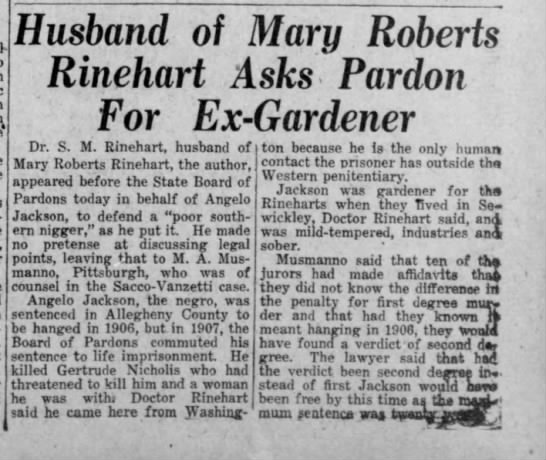
Jackson’s pardon was aided by the intercession of famed novelist, Mary Roberts Rinehart and her husband, Dr. S. M. Rinehart, for whom Jackson had worked as a gardener more than two decades earlier. Testifying before the Pardon Board, Dr. Rinehart offered a racist and paternalistic defense of Jackson.
Representing Jackson in his clemency and pardon requests was attorney Michael A. Musmanno, who had represented Sacco and Vanzetti in the highest profile capital case of the era, and who argued Jackson acted in self-defense against a jealous Nichols. Musmanno wrote about the case in his 1958 memoir, Verdict!
Released from Western Penitentiary, Angelo Jackson returned to South Carolina. He died there on March 25, 1931.
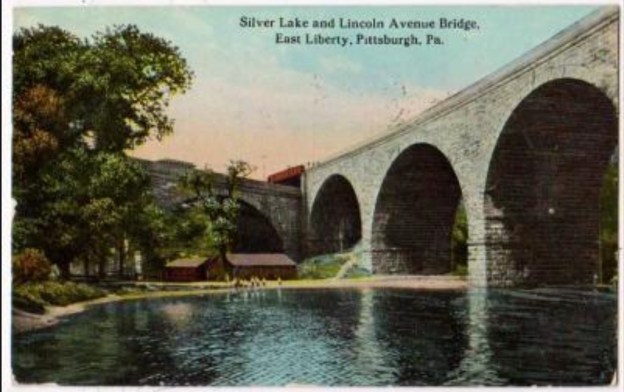
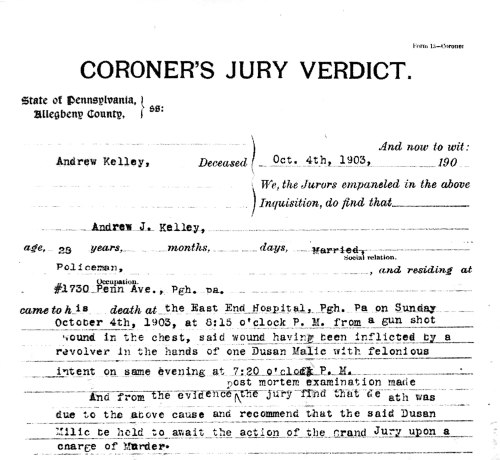
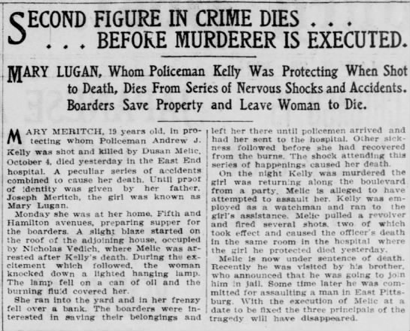
Two competing stories were told about the circumstances under which Dusan Milic, a twenty-year old Croatian-immigrant steelworker, shot and killed Pittsburgh Police Officer Andrew J. Kelly under the Lincoln Avenue Bridge in East Liberty on Sunday evening, October 4, 1903.
Most likely is that Milic and his companion, Mary Lugan, were walking home from a wedding when, in a “spirit of fun or youthful buoyancy,”(Pardon Board recommendation, March 15, 1915), Milic fired his gun and Lugan screamed.
Kelly, a police officer who was walking in the area, responded to the sounds by running at Milic with his gun drawn. Milic shot Kelly, who died at the scene. Milic was shot in the hand.
Kelly, a native of Indiana County, was not in uniform. He had been removed from uniformed patrol for unspecified disciplinary reasons and was instead working as a watchman guarding against theft at the Columbia Construction Company labor camp.
Milic, who boarded with the Lugan family and was dating 18-year old Mary, claimed that Kelly fired first and that he did not know Kelly was a police officer.
After the shooting, Milic was apprehended by police. He confessed, claiming he acted in self-defense. In addition to arresting Milic, approximately 50 other “foreigners” living in area boarding houses were arrested as part of an anti-immigrant dragnet.
At trial, Milic’s claim of self-defense was rejected and he was found guilty of first-degree murder on Christmas Day, 1903, the first time a county jury met on that day.
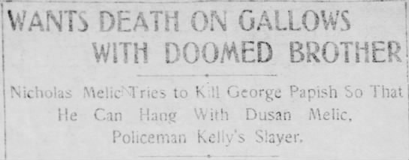
In February 1904, Milic’s brother, Nicholas, committed assault with intent to kill so that he could be arrested in an effort to be executed with his brother.
Pittsburgh Weekly Gazette, February 27, 1904
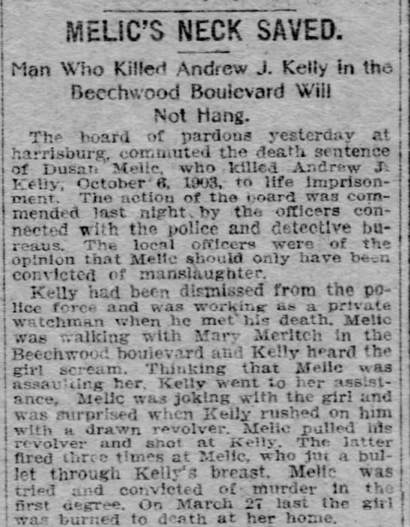
Milic’s death sentence was commuted to life by the Board of Pardons on December 21, 1904. Police officers supported the commutation, saying the case was appropriately manslaughter.
Finding that his case was appropriately one of self-defense or, at most, voluntary manslaughter, the Pardon Board granted Milic a full pardon on March 18, 1915, and released him from prison.
Pittsburgh Weekly Gazette, December 22, 1904
In a tragic addendum to the case, Mary Lugan died of burns sustained in a household accident on March 27, 1904.
Pittsburgh Daily Post, March 28, 1904
In the other version of the case, Milic is said to have attacked, raped, or threatened to kill Lugan and Kelly is said to have been a uniformed police officer.
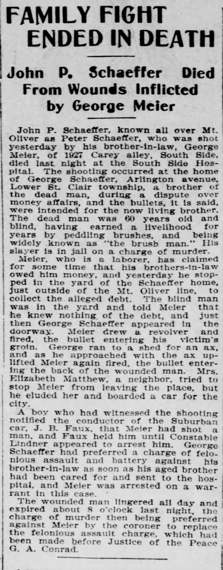
John Peter Schafer, 60, was well-known and well-regarded in his Mt. Oliver neighborhood, where he worked as a broom and brush maker despite having lost his vision. His brother-in-law, George Meier, had a very different reputation, as friendless and disturbed. Both were German immigrants.
Arlington Avenue, 1907
After loaning Schafer some money to assist him in his business, Meier brooded over the unpaid debt until shooting Schafer twice and killing him at his Arlington Avenue home on October 27, 1902. The shooting, witnessed by Schafer’s brother and neighbors, occurred in Schafer’s yard after the two men had spoken, apparently peacefully. Meier had told associates that he was going to see Schafer to collect the debt. He was arrested at the scene.
Pittsburgh Press, October 28, 1902
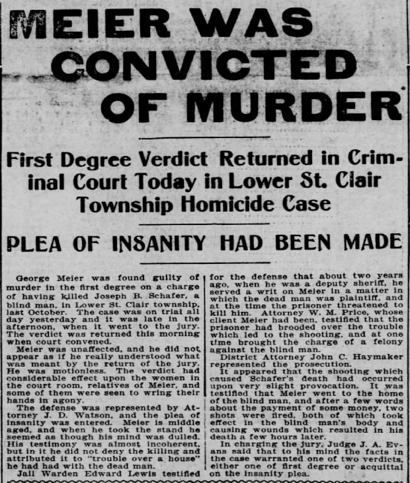
At trial, Meier’s defense was insanity. Though his testimony was said to be incoherent, he was convicted of first-degree murder on April 28, 1903, and sentenced to death a month later, on May 28.
Pittsburgh Press, April 28, 1903
After a lunacy commission was appointed to consider his case, Meier was declared insane on December 8, 1903. His custody was transferred to Dixmont State Hospital on December 11, 1903.
George Meier died at Woodville State Hospital on June 10, 1912. The cause of death is listed as terminal dementia.
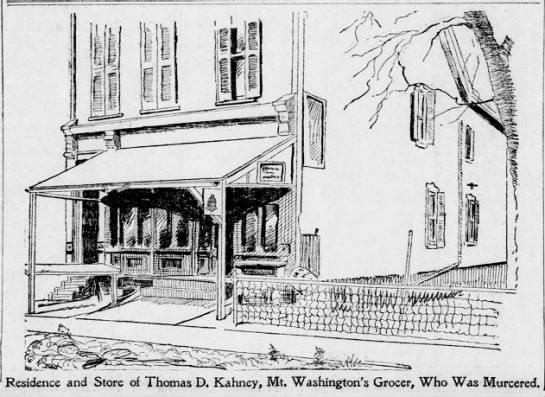
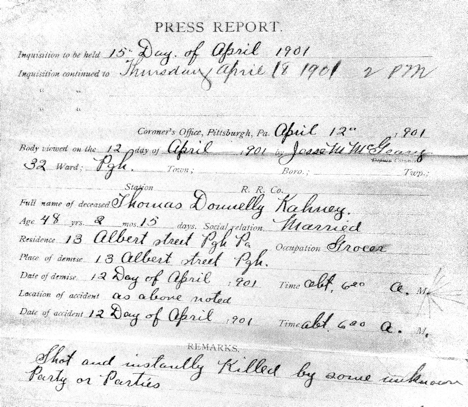
The most notorious death penalty case in Pittsburgh history began on April 11, 1901, when brothers Edward and John Biddle, leaders of the Chloroform Gang, and Walter Scheffler Dorman (aka R.D. Wilcox), killed Mt. Washington grocer Thomas Donnelly Kahney during a robbery of his Albert St. home and grocery.
Pittsburgh Daily Post, April 13, 1901
After having cased the home and store the previous day, the robbery began just after midnight. Their usual modus operandi of chloroforming their victims to render them unconscious failed when Mrs. Sarah Kahney was startled from her sleep, waking her husband. As he began to respond to the situation, the 50-year old Kahney was shot and killed.
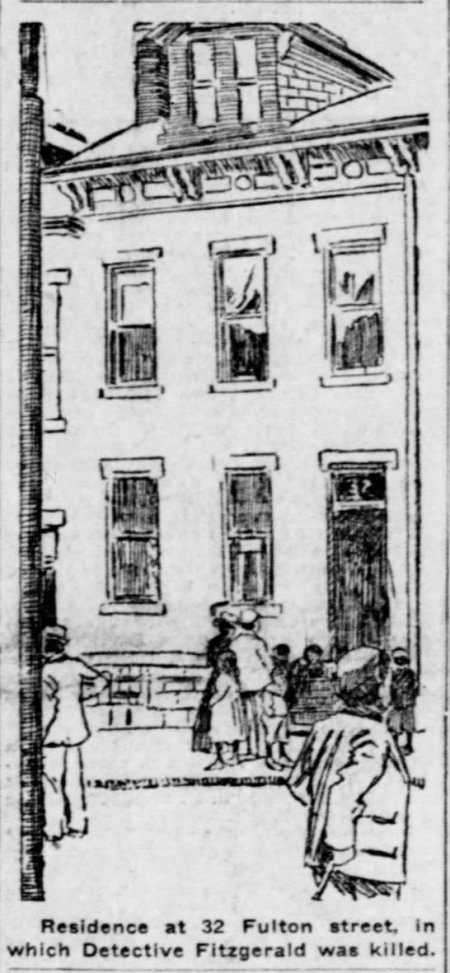
The gang then fled to the North Side. Acting on information provided by informants, the police tracked them to 32 Fulton St.
Pittsburgh Daily Post, April 13, 1901
When police sought to arrest the three assailants, a gun battle broke out and highly regarded Pittsburgh Police Officer Patrick E. Fitzgerald, a 45-year old Canadian-born detective, was shot and killed. The three men were arrested at the scene. All of this transpired in a single day.
Pittsburgh Post-Gazette, April 13, 1901
At trial, witnesses were able to place the gang in the vicinity of Kahney’s home. Mrs. Kahney also identified the defendants. Other witnesses implicated the gang in numerous other burglaries.
John Biddle was convicted of Kahney’s murder on June 14, 1901; his brother, Edward, was convicted six days later.
Dorman, 24, who admitted his guilt and testified against the Biddle brothers, was nonetheless found guilty of first-degree murder on July 18, 1901.
The Biddle brothers and Dorman were sentenced to death that same day. Dorman’s death sentence was imposed with the understanding that his sentence would be commuted to life imprisonment for his earlier testimony against the Biddles.
The Biddle brothers’ executions were respited to consider their appeals. Those appeals were sharply rejected, the court finding the “evidence indisputable” and the first-degree murder conviction “scarcely worthwhile to discuss” (Commonwealth v. Biddle, 200 Pa. 640 and Commonwealth v. Biddle, 200 Pa. 647, 1901).
The Biddles then filed a clemency request that secured additional respites. Their clemency requests were rejected in early January 1902, clearing the way for the execution of their sentences.
The newspaper coverage of their case was unprecedented, at least since the trial of Martha Grinder.
The already sensational case became an international phenomena when, while being held in the Allegheny County Jail, Edward Biddle seduced the warden’s wife, Kate Soffel, who then smuggled a gun into the jail and disabled her husband, Peter Soffel, allowing the brothers to escape on January 30, 1902. Their plan was to flee to Canada. Their timing was inopportune; a snowstorm had begun.
“Soffel, who was reported to be a reserved, God-fearing woman … joined the Biddles as they hopped a trolley to West View. From there the fugitives walked to a farmhouse on Route 19 where they stole a horse-drawn sleigh and a shotgun. They headed toward Butler with the intent of escaping into Canada. Police officers from Allegheny and Butler counties plotted how to thwart the trio, taking up a position at the Graham farm. When the fugitives arrived at the farm, they were ordered to surrender. A shootout ensued, wounding both Biddle brothers and Kate Soffel. The Biddles died, but not before Ed admitted to shooting Kate at her request. She survived her injuries and was convicted for her crimes, spending several years in the Allegheny County jail, the same jail from where she had helped the Biddles escape.”
Edward and John died of their wounds on February 1, 1902. The Pittsburgh Press devoted its entire front page that day, all eleven stories, to the case.
They were interred at Calvary Cemetery in Pittsburgh on February 5, 1902. Officer Fitzgerald is also buried there.
On May 10, 1902, Kate Soffel was sentenced to two years in prison for her role in their escape. After her release, Soffel worked as a seamstress and played herself in stage performances of the Biddle boy saga. She died on August 30, 1909. The 1984 movie, Mrs. Soffel, is based on the case. In the aftermath of serious security breaches at the jail, five men, including Kate Soffel’s father, James McGeary, were fired. Warden Peter Soffel was also removed, of course.
Walter Dorman received his commutation on June 18, 1902, and was transferred to Western Penitentiary. In some respects a model prisoner – he was leader of the prison orchestra and is reported to have learned multiple languages – Dorman was also implicated in multiple escape attempts.
Pittsburgh Press, October 5, 1904
Pittsburgh Gazette Times, July 18, 1907
Pittsburgh Press, June 25, 1908
His prison record complicated his numerous pardon requests and delayed his release.
Telegraph from warden of Western Penitentiary as quoted by Pardon Board, October 17, 1923
After twenty-two years in prison, Dorman was pardoned on November 1, 1923, and quickly faded from public view.
Pittsburgh Gazette Times, November 2, 1923
Alexander Berkman, who had attempted to kill Henry Clay Frick for his role in the violent suppression of striking workers at Homestead in 1892, spent time in Western Penitentiary with Dorman. Based on that experience, he wrote the following in his Prison Memoir of an Anarchist:
“In reference to French leave, have you read about the Biddle affair? I think it was the most remarkable attempt in the history of the country. Think of the wife of the Jail Warden helping prisoners to escape! The boys here were simply wild with joy. Every one hoped they would make good their escape, and old Sammy told me he prayed they shouldn’t be caught. But all the bloodhounds of the law were unchained; the Biddle boys got no chance at all.
The story is this. The brothers Biddle, Jack and Ed, and Walter Dorman, while in the act of robbing a store, killed a man. It was Dorman who fired the shot, but he turned State’s evidence. The State rewards treachery. Dorman escaped the noose, but the two brothers were sentenced to die. As is customary, they were visited in the jail by the “gospel ladies,” among them the wife of the Warden. You probably remember him—Soffel; he was Deputy Warden when we were in the jail, and a rat he was, too. Well, Ed was a good-looking man, with soft manners, and so forth. Mrs. Soffel fell in love with him. It was mutual, I believe. Now witness the heroism a woman is capable of, when she loves. Mrs. Soffel determined to save the two brothers; I understand they promised her to quit their criminal life. Every day she would visit the condemned men, to console them. Pretending to read the gospel, she would stand close to the doors, to give them an opportunity to saw through the bars. She supplied them with revolvers, and they agreed to escape together. Of course, she could not go back to her husband, for she loved Ed, loved him well enough never even to see her children again. The night for the escape was set. The brothers intended to separate immediately after the break, subsequently to meet together with Mrs. Soffel. But the latter insisted on going with them. Ed begged her not to. He knew that it was sheer suicide for all of them. But she persisted, and Ed acquiesced, fully realizing that it would prove fatal. Don’t you think it showed a noble trait in the boy? He did not want her to think that he was deserting her. The[Pg 445]escape from the jail was made successfully; they even had several hours’ start. But snow had fallen, and it was easy to trace two men and a woman in a sleigh. The brutality of the man-hunters is past belief. When the detectives came upon the boys, they fired their Winchesters into the two brothers. Even when the wounded were stretched on the ground, bleeding and helpless, a detective emptied his revolver into Ed, killing him. Jack died later, and Mrs. Soffel was placed in jail. You can imagine the savage fury of the respectable mob. Mrs. Soffel was denounced by her husband, and all the good Christian women cried “Unclean!” and clamored for the punishment of their unfortunate sister. She is now here, serving two years for aiding in the escape. I caught a glimpse of her when she came in. She has a sympathetic face, that bears signs of deep suffering; she must have gone through a terrible ordeal. Think of the struggle before she decided upon the desperate step; then the days and weeks of anxiety, as the boys were sawing the bars and preparing for the last chance! I should appreciate the love of a woman whose affection is stronger than the iron fetters of convention. In some ways this woman reminds me of the Girl—the type that possesses the courage and strength to rise above all considerations for the sake of the man or the cause held dear. How little the world understands the vital forces of life!” (pp. 444-445).
The Biddles were born in Ontario to a father who fled to Canada to avoid Civil War service. They had prior records in Ohio and Illinois. Dorman was born in Cleveland, Ohio.
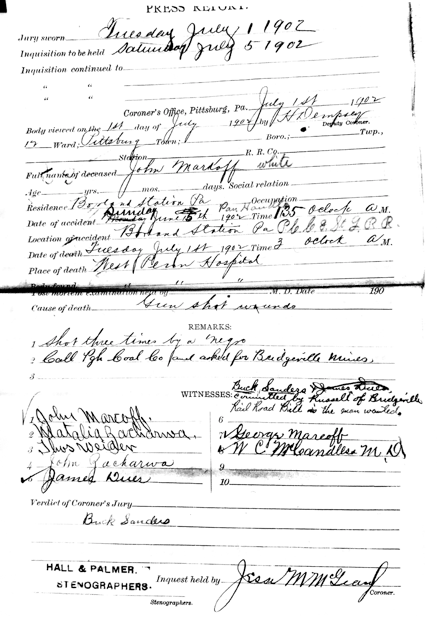
On Sunday afternoon, June 15, 1902, a group of Black coal miners from the Bishop Mine at Borland Station, near Beadling, were drinking beer on their day off. A fight broke out and Russian-born John Markoff, who apparently owned the shanty where the miners drank, was shot three times.
The mining town on Beadling
Left paralyzed, Markoff died on July 1, 1902. Four men, including “Buck” Saunders, were arrested.
Witness and newspaper reports of the killing varied. Some indicated the miners robbed and killed Markoff. Others told of a fight among the miners that Markoff intervened in and was shot.
Still others suggested a racial dynamic, with an argument between the Black miners and Markoff and his white friends.
Pittsburgh Press, October 13, 1902
Saunders was convicted of first-degree murder on October 14, 1902. Though acknowledging his presence at the shooting, his defense was that in the midst of the melee, someone else fired the fatal shot. William Bowden, the only other miner charged in the case, was acquitted.
Saunders was sentenced to death on November 28, 1902.
Pittsburgh Press, November 28, 1902
With lingering doubts about what happened and Saunders’ consistent denials of having fired the fatal shots, his death sentence was commuted to life imprisonment on December 11, 1903. He was transferred to Western Penitentiary to serve out his sentence.
George “Buck” Saunders died at Mayview State Hospital, very near the site of Markoff’s killing, on July 27, 1925. He was 72 years old.
























 Albert St. today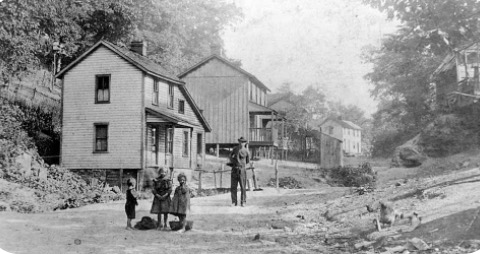


 State Killings in the Steel City: The History of the Death Penalty in Pittsburgh