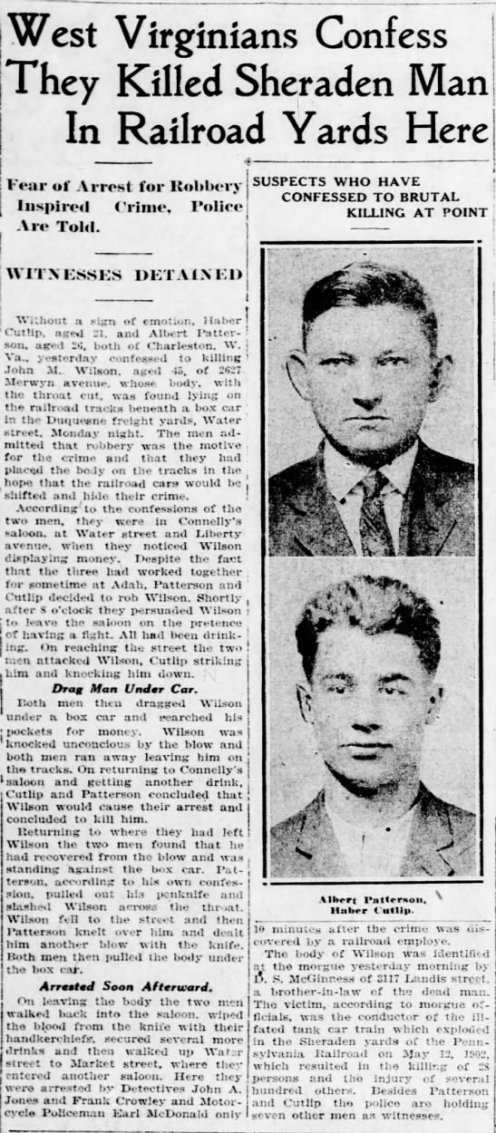
After luring John M. Wilson from Connelly’s Saloon to the freight yard of the Pennsylvania Railroad at Water St. and Liberty Avenue, on October 8, 1917, Albert Patterson and Havern Lee Cutlip robbed and beat him.
After returning to the bar, they decided to kill Wilson and hide his body under a train car in the hope that it would be crushed by the traffic. Returning again to Connelly’s, they then went to a bar on Market Square. They were arrested there soon after Wilson’s body was discovered.
After hours of “third degree” interrogation, the two men confessed to the killing. The story that emerged was that, after Wilson showed a large wad of cash while in the saloon, Patterson and Cutlip decided to rob him. Concerned that Wilson would be able to identify his assailants, they then decided to slit his throat.
Pittsburgh Gazette Times, October 10, 1917
The three men had previously worked together at Adah, a Frick coal mining town in Fayette County.
Patterson and Cutlip, both of whom worked in the steel industry after migrating from West Virginia, were tried separately.
Patterson was convicted of first-degree murder on March 1, 1918. Cutlip was similarly convicted on April 12, 1918, after lengthy and contentious jury deliberations. Cutlip’s role as the secondary and younger party to the crime might have been expected to bring a lesser conviction.
Pittsburgh Press, April 13, 1918
After their motions for new trials were rejected, they were sentenced to death on June 8, 1918.
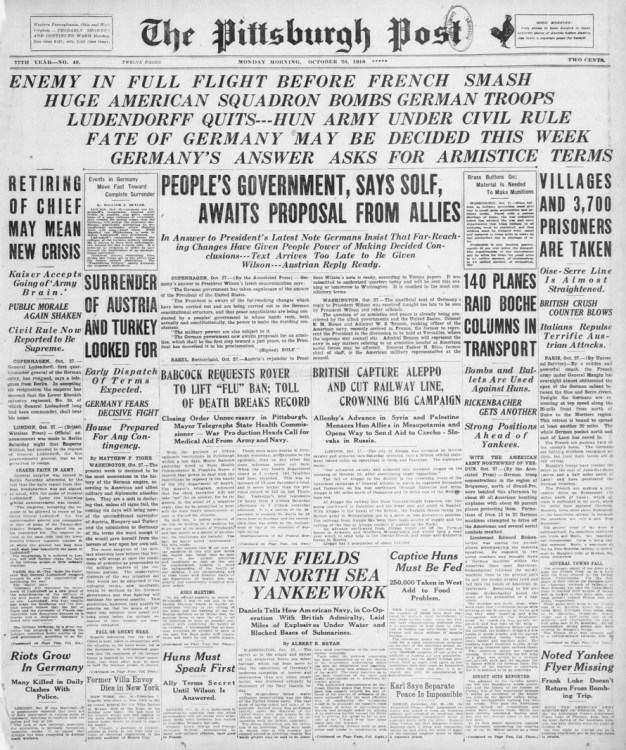
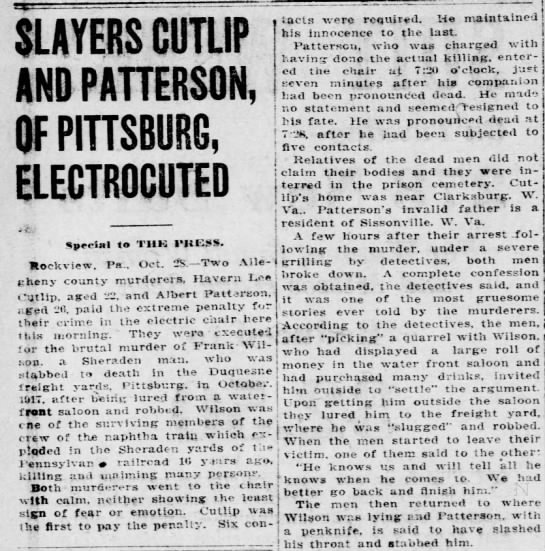
With attention focused on end of the Great War in Europe, Albert Patterson and Havern Lee Cutlip were electrocuted in succession on the morning of October 28, 1918.
Pittsburgh Press, October 28, 1918
Wilson had been the engineer on a train that exploded on May 12, 1902, killing 29 people and injuring more than 100 people. He was determined not to have been at fault in that incident.
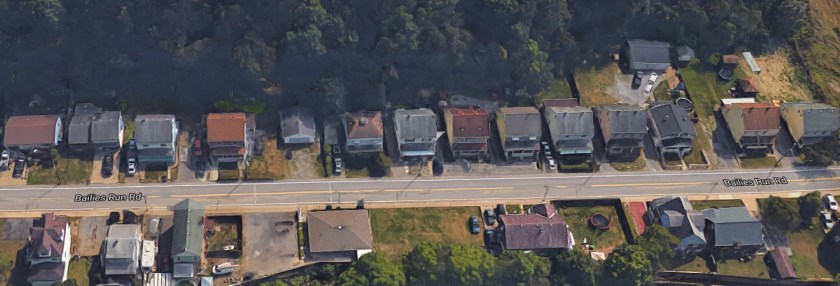
Samuel Dolish worked as a coal miner and kept a boarding house on Bailies Run Road in the company town of Creighton, northeast of Pittsburgh. The town and the mine operated in service to Pittsburgh Plate Glass, which had built their original factory there in 1883.
Bailies Run Road, Creighton
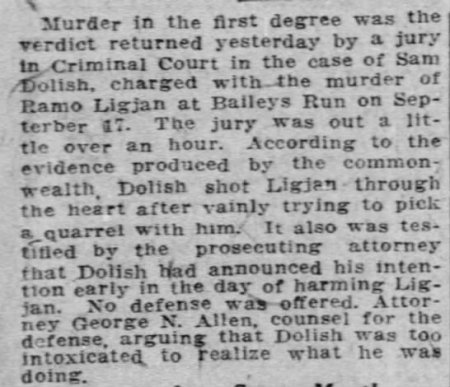
Among Dolish’s boarders was fellow Hungarian immigrant and coal miner, Ramor Ligjan. For reasons that are not entirely clear, Dolish, 33, developed an antagonistic relationship with Ligjan. After having been heard declaring his intention to harm Ligjan, Dolish shot and killed him at the boarding house on the afternoon of September 17, 1918. He was arrested immediately.
Dolish had served time in the Allegheny County Workhouse in 1916 for an assault and battery conviction.
In another sparsely covered case involving single men living on the margins of society in the shadow of World War I, Dolish’s insanity defense was rejected and he was convicted of first-degree murder on May 23, 1919. After his motion for a new trial was also rejected, Dolish was sentenced to death on July 31, 1919.
Pittsburgh Gazette Times, May 24, 1919
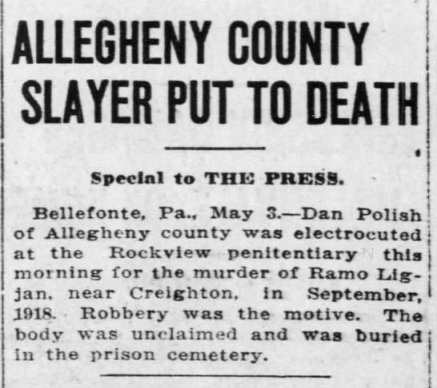
His pardon request refused, Samuel Dolish was executed on May 3, 1920. He was buried in the prison cemetery.
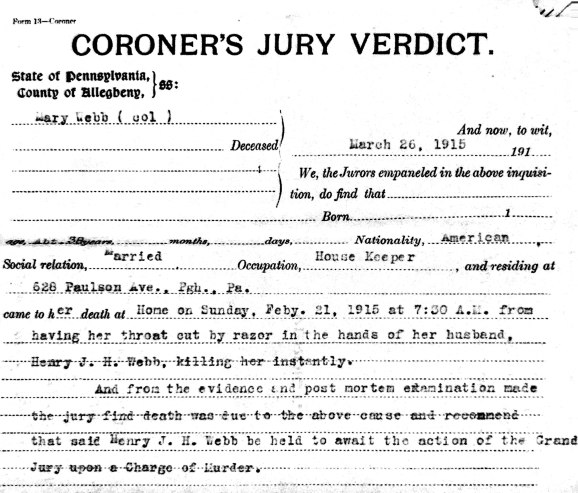
On February 20, 1915, Henry and Mary Ellen Webb, who had married the previous June, began quarreling at their home at 628 Paulson Avenue in Larimer. The quarrel reportedly centered on money. Mary is said to have threatened to leave her husband, an unemployed hotel worker, for another man due to his inability to support her.
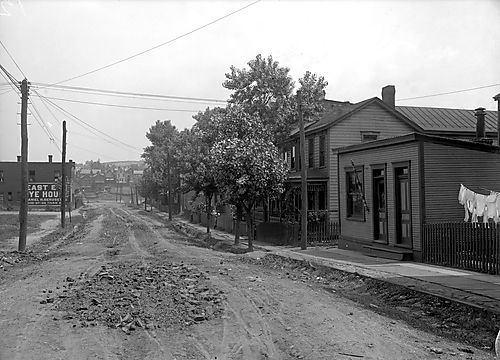
Paulson Avenue, 1916
When the quarrel escalated the next day, Mary Webb struck her husband with a poker and he responded by slashing her, fatally, with a razor. He then fled the scene. Webb was arrested hours later. He confessed to police and led them to the murder weapon.
Newspaper accounts report that Mary (Fisher) Webb was the daughter of a prominent family and was so well liked that threats of lynching were directed toward Webb when he was arrested.
Pittsburgh Post-Gazette, February 22, 1915
My research reaches a somewhat different conclusion. Mary was raised in a family of modest means (her father worked as a hod carrier), though she may have experienced the status associated with passing as white (as she is listed on her death certificate, despite being born to Black parents). Indeed, one newspaper account identified her nickname as “The Angel” (Pittsburgh Gazette Times, February 22, 1915).
Henry Webb, who was born in Virginia, was previously married and had a prior assault arrest.
At trial, Webb’s attorney argued that Webb had acted in self-defense and that the evidence justified a manslaughter verdict. He was convicted of first-degree murder on June 18, 1915, and sentenced to death on September 2.
Webb appealed his conviction. In a lengthy appellate opinion (Commonwealth v. Webb, 252 Pa. 187, 1916), his self-defense claim was rejected on the grounds there was no evidence he was injured during the quarrel and no evidence her provocation was sufficient to justify lethal self-defense.
Paulson Ave., Summer 2019
His pardon request also rejected, Henry Webb was executed on May 2, 1916. He is buried in the prison cemetery at Rockview. Webb was the first African American in Pennsylvania to die in the electric chair.
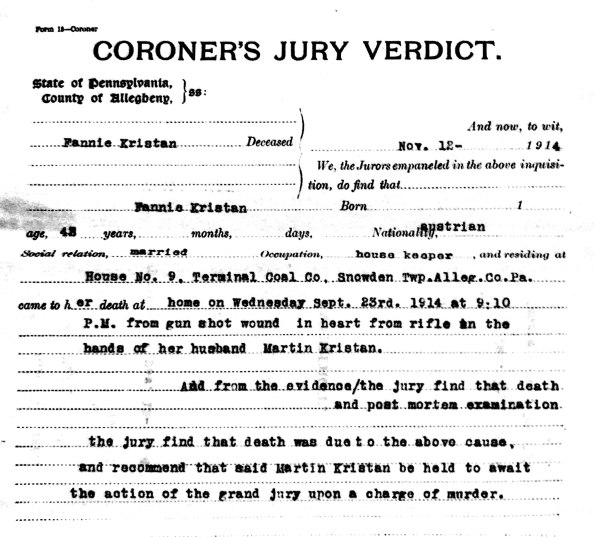
Due to a history of domestic violence, Martin Kristan, 41, and his wife, Mary (“Fannie”), had been separated for two years. During that time, Mary had entered into a relationship with another man, Martin Schreiber.
Angry that she was not willing to reconcile with him, Kristan shot her with a rifle through the window of her home on September 23, 1914. Their children were home at the time.
Kristan was arrested soon after the shooting when his young son went to police. He confessed at the time of his arrest.
A Slovenian immigrant and coalminer for the Terminal Coal Company, Kristan lived and worked in a company town in Curry, Snowden Township, in southern Allegheny County. The Kristans, who had five children, had married prior to immigrating to the United States in 1901.
After a short trial in which he was confronted with his confession and the testimony of his children, Kristan was convicted on December 22, 1914. He was sentenced to death on February 5, 1915.
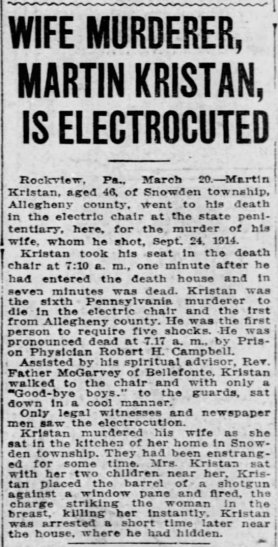
Following an unsuccessful clemency request and the court’s determination that he was mentally fit, Martin Kristan was executed on March 20, 1916. It had been nearly five years since an Allegheny County inmate had been executed, the longest such delay in twenty-five years.
Pittsburgh Press, March 20, 1916
Kristan was the first Allegheny County inmate to be electrocuted and the first to be executed outside of Allegheny County.
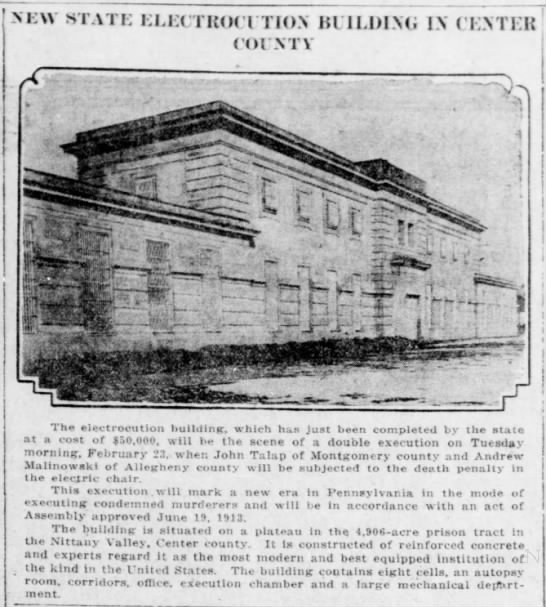
Pennsylvania’s Electric Chair, Pittsburgh Press, February 22, 1981
On June 19, 1913, Pennsylvania had enacted legislation centralizing executions under state authority, moving all executions to the newly constructed Rockview State Penitentiary, and establishing that all executions would be done by electric chair (Act of June 19, 1913, Pa. Laws 528). After having set the standard for penal progressivism in the Revolutionary era, Pennsylvania had become a laggard. With this step, it moved, haltingly, into the modern era.
Pittsburgh Gazette Times, February 21, 1915
Another modernizing reform, allowing juries the discretion to impose a death or life sentence for a first-degree murder conviction, would not be enacted in Pennsylvania until 1925, well after that discretion had become commonplace, particularly outside of the south.
Since New York conducted the first execution by electrocution in 1890, a consensus had emerged that the electric chair represented a more humane means of execution. Whether it actually was is debatable, though it is clear that botched hangings were common. Contrary to the “science” of executions that was emerging at the time that indicated that hangings could reliably be achieved without strangulation, newspaper descriptions indicate strangulation, sometimes in combination with some other element of a botched execution, occurred routinely even into the Twentieth century.
This era was also marked by an abolition movement more extensive than in the previous seventy years. Between 1907 and 1917, eight states – Kansas (1907), Minnesota (1911), Washington (1913), Oregon (1914), South Dakota (1915), North Dakota (1915), Tennessee (1915), Arizona (1916), and Missouri (1917) – succeeded, at least temporarily, in abolishing the death penalty.
Though there was a distinct lull in death penalty activity in Pittsburgh during this era – with no executions in a thirty-four month period between 1908 and 1911 – the racial tensions of mass migration and immigration militated against abolitionism. University of Pennsylvania law professor Russell Duane articulated this position when he warned legislators that abolition was dangerous in a state “composed so largely of foreigners and Negroes.”
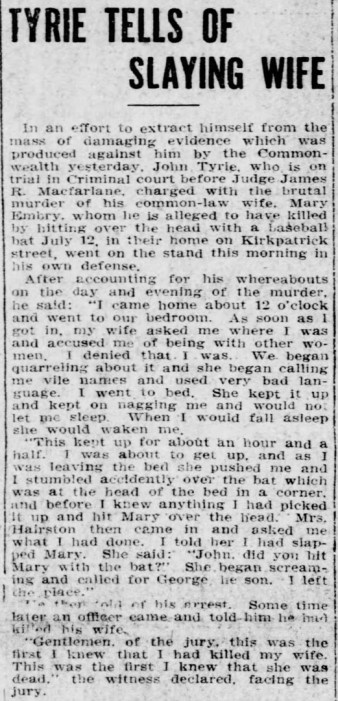
In another case of fatal domestic violence, John Tyrie, 47, killed his common-law wife, Mary Emery, 35, on July 12, 1910. She was beaten to death with a baseball bat in their home at 276 Kirkpatrick St., Hill District. Tyrie is reported to have beaten Emery frequently.
Kirkpatrick St., 1913
The evening of the murder, Tyrie, who worked as a stonemason, came home from work and demanded dinner. He then went out drinking, returning home around midnight. Upset that Tyrie was out drinking and carousing, Emery’s questioning of him when he returned home led to a quarrel that quickly escalated into the fatal incident.
Pittsburgh Press, August 12, 1910
Emery’s sister, Louise Hairston, was living with them at the time. She heard the entire incident, as did Emery’s children. Tyrie was arrested as he tried to flee the scene.
Tyrie and Emery lived previously in Ohio, where they both were born.
With Hairston’s eyewitness testimony and Tyrie’s own admission to having struck Emery with a bat, Tyrie’s trial was brief and his first-degree murder conviction, on November 11, 1910, straightforward.
Pittsburgh Press, November 10, 1910
His motion for a new trial was rejected on December 13, 1910. Lacking the resources to pursue an appeal and his clemency request rejected on May 17, 1911, John Tyrie was executed on May 23, 1911.
Pittsburgh Daily Post, May 23, 1911
John Tyrie was the last Allegheny County inmate to be hanged and the last to be executed in the Allegheny County Jail. In 1913, Pennsylvania enacted legislation (Act of June 19, 1913; P.L. 528) that shifted authority for executions from individual counties to the state, established electrocution as the method of execution, and established the new Western Penitentiary in Centre County (now SCI-Rockview) as the location of the state’s execution chamber.
Murder Docket entry for John Tyrie, courtesy of Edward Urban
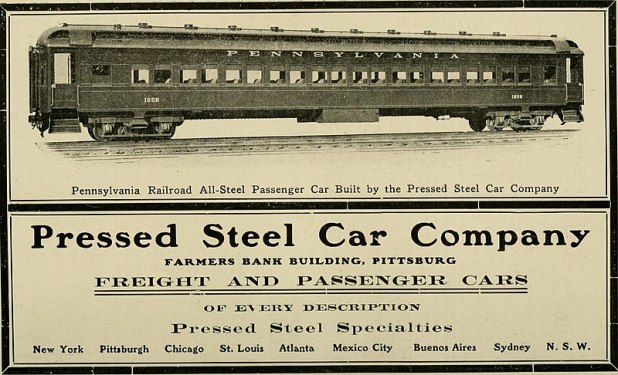
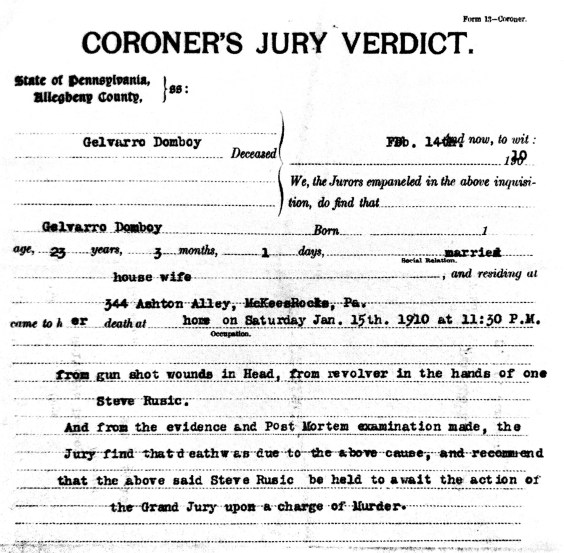
Hungarian immigrant Steve Rusic boarded in the Ashton Alley, McKees Rocks home of Louis and Galvarra Domboy and worked at the nearby Pressed Steel Car Company.
Referred to as “The Slaughterhouse,” the plant had recently been the site of a lengthy strike that exposed the system of industrial sharecropping, including frequent workplace deaths, forced labor, debt peonage, and systematic rape faced by its almost exclusively Eastern European labor force, and that ended in a violent attack by state police officers referred to by the strikers as “cossacks.”
Digital StillCamera
Only months after that strike, after Mrs. Domboy refused Rusic’s advances on the evening of January 15, 1910, Rusic shot her while she slept with her husband, Louis, and baby. She died immediately. Rusic also fired at Louis Domboy, but missed.
Rusic was arrested in the home of friends the following morning. Questioned by police, he claimed that he and Mrs. Domboy had been involved for several years in a consensual relationship she had initiated.
At trial, Louis Domboy was the featured prosecution witness. Rusic called no witnesses and offered little defense. He was convicted on May 17, 1910, and sentenced to death on June 2. After an unprecedented period of death penalty activity between 1897 and 1907, Rusic’s was the first death sentence imposed in the county in more than two years.
Pittsburgh Press, March 21, 1911
After an unsuccessful appeal (Commonwealth v. Rusic, 229 Pa. 587, 1911) and without resources to pursue a pardon, Steve Rusic went to the gallows singing a battle hymn on March 21, 1911.
While Rusic’s case is a rather ordinary capital homicide, it became a part of a much larger controversy when Frederick Merrick, editor of the local Socialist newspaper, Justice, published an editorial, titled “Justice, Thy Name is Mud,” critical of the presiding judge, Marshall Brown, for the harsh treatment of Rusic compared to the much more lenient treatment he provided to Brooks C. Buffington, in a homicide case that he tried at the same time. Brown, Merrick claimed, discriminated against Rusic as an Eastern European immigrant laborer at a time of heightened anti-immigrant and anti-labor tensions.
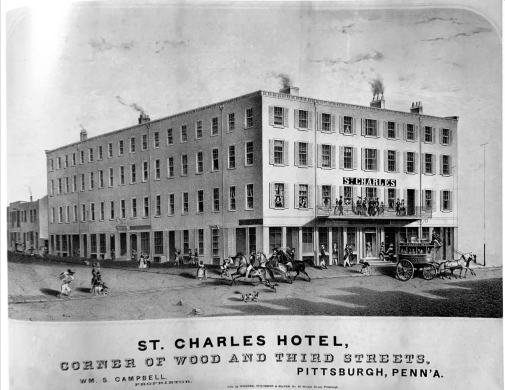
Buffington, meanwhile, escaped conviction for murder. On December 20, 1910, heavyweight boxing champion Jack Johnson was in Pittsburgh to watch a fight. Buffington, angered that a Black man held the heavyweight title and that he was in Pittsburgh on behalf of a white boxer, shot and killed Robert Mitchell in the bar of the St. Charles Hotel on Wood St. when Mitchell refused to share his racist views.
At trial, Buffington was acquitted on the grounds of alcohol-related insanity, though testimony indicated he was sober at the time and subsequent medical evaluations confirmed his good health.
Judge Brown sued Merrick for criminal libel, an unusually harsh allegation. Merrick was convicted.
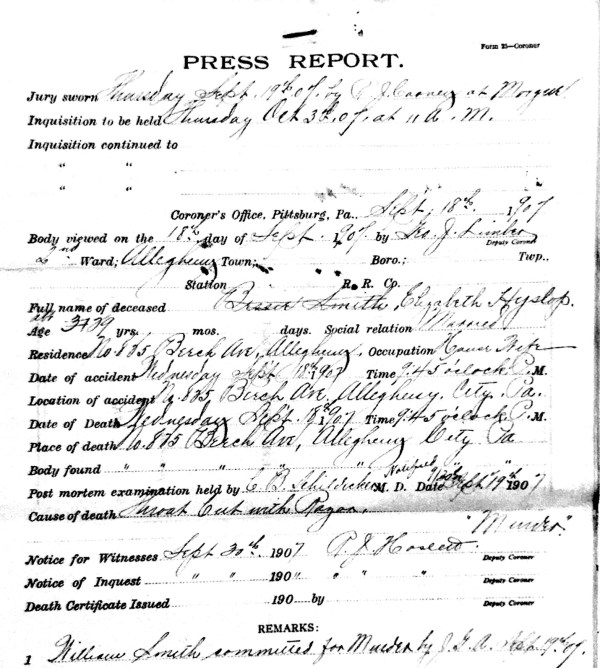
In another case of fatal jealousy, William McLeod McDonald, alias Smith, recent emigre from England, killed his common law wife, Mrs. Bessie Hyslop Smith.
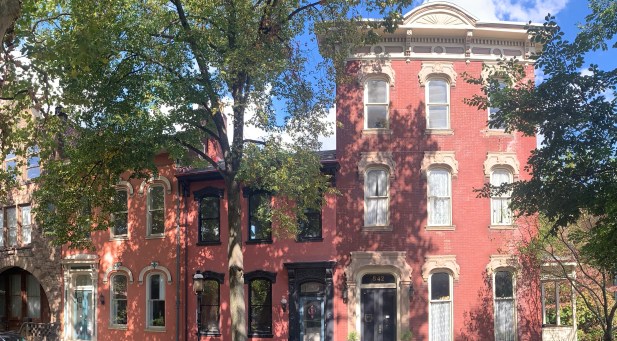
Across the street from 825 Beech, which has been torn down. Gertrude Stein was born several doors down in 1874
He cut her throat with a razor at their home at 825 Beech Avenue, North Side, on September 18, 1907, upon discovering that she had been receiving letters from a man in England. After killing his wife, McDonald drank poison in an attempt to commit suicide.
Pittsburgh Press, September 19, 1907
The couple had left England for Pittsburgh after McDonald secured his release from prison, where he was serving a sentence for non-support of his wife and six children. They arrived in Pittsburgh only six weeks before the murder.
Ms. Smith, a spiritualist medium, had confided in friends that McDonald was intensely jealous of the people she met in connection with her work.
At trial, the principal witness against McDonald was Smith’s young son, who witnessed the killing. In his defense, McDonald claimed insanity. After lengthy jury deliberations, McDonald was convicted of first-degree murder on October 25, 1907; only five weeks after the murder. Court-watchers anticipated a second-degree murder conviction.
Pittsburgh Press, September 19, 1907
After his conviction and subsequent death sentence, McDonald actively wrote letters to friends in England urging assistance in stopping his execution. Those efforts led to a pardon campaign by fellow Scots in Pittsburgh and abroad.
Though entreaties by high-ranking British officials brought a stay of execution, the Pardon Board refused to intervene and efforts to have McDonald’s sanity reviewed were unsuccessful.
Pittsburgh Press, April 28, 1908
Blaming Smith for turning him from a Christian life, William McDonald was hanged in the Allegheny County Jail on April 28, 1908. He was the first person hanged using the new, permanent, and more efficient gallows.
Pittsburgh Press, October 7, 1928
Accompanying its coverage of the execution, the Pittsburgh Press published a remarkable front-page article. Written by an unnamed minister and witness to the execution, it aggressively supported the death penalty. The author begins by noting that “[t]aking human life, with the sanction and hand of the law, is not so fearful a thing as it seems. In fact, there is little or no feeling of distress when a man, whose career has been a menace to his time and his kind, is taken away…It is only soft, squeamish sentimentalism which thinks and expresses itself otherwise.” The author continues, drawing on the Social Darwinism of the era, by noting that “there are many persons…who would be well out of the way. The world would be better for the elimination of such persons….The execution…is merely, as I take it, a help to nature.”
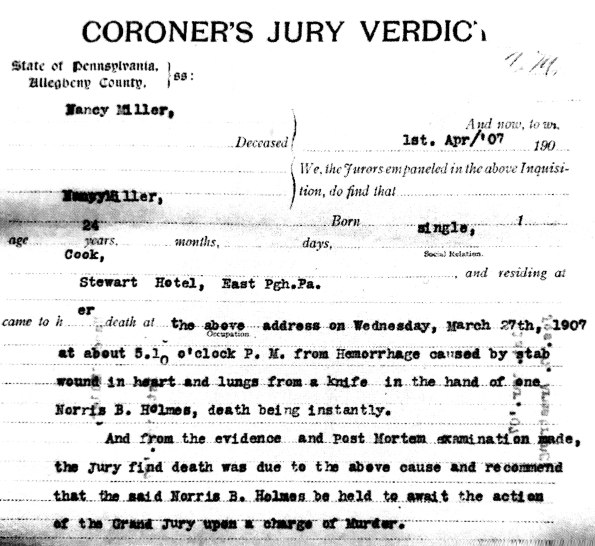
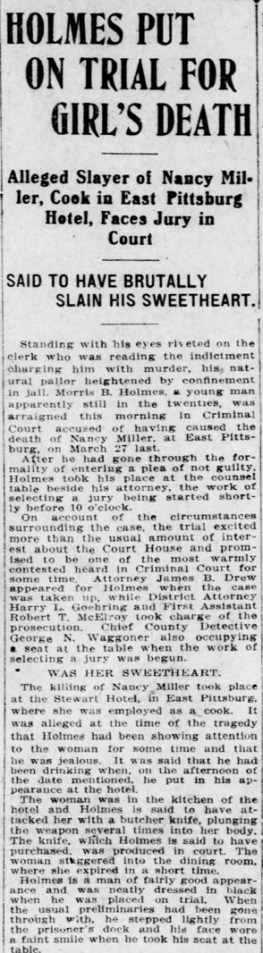
Nancy Miller worked in the kitchen at the Stuart Hotel, Beech and Linden Sts., in East Pittsburgh. Norris B. Holmes, who lived the area, had become infatuated with Miller. When his efforts to develop a relationship continued to be rebuffed, Holmes, originally from Ohio, became more menacing.
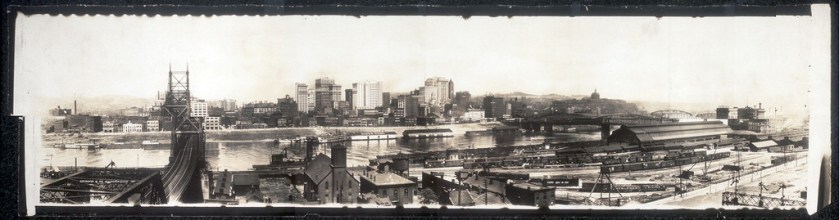
Pittsburgh, 1907
After fighting with another man whom Holmes imagined as his rival, he purchased a butcher knife and fatally stabbed Miller, who grew up in nearby Westmoreland County, in the hotel kitchen on March 27, 1907.
There were multiple witnesses to the killing. Holmes (aka Walter Howard) was held by some of those witnesses until police arrived.
Newspaper reports were peculiarly charitable toward Holmes, characterizing him as “youthful” and Miller as his “sweetheart,” despite the absence of evidence of any prior relationship between the two and an account in the coroner’s record that “Nancy told me several times that she did not want to have anything to do with him.” As in the Hillman, Wasco, Patterson, and Dabrydino cases, among others, such language normalized the calculus by which female rejection invites male violence.
Pittsburgh Press, September 11, 1907
As in the Woodley and Glazner cases, news accounts also sought to distance the white and native-born Holmes from immigrant and Black working men by emphasizing that he possessed a “mentality considerably above the average” (Pittsburgh Press, March 12, 1908).
A crowd of 1,000 gathered the day after the killing of the popular Miller and pressed toward Holmes as he was being moved by police, perhaps with the intention of lynching him.
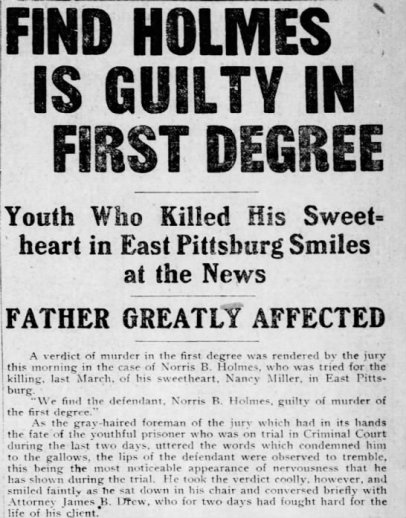
At trial, the twenty-four year old Holmes claimed he was too drunk to realize what he was doing. With numerous eyewitnesses and no doubt about the circumstances of the crime, he was convicted of first-degree murder on September 13, 1907.
Pittsburgh Press, September 13, 1907
Holmes was sentenced to death on October 5, 1907. When Judge Swearingen, newly appointed to the bench, collapsed after reading the sentence, Holmes “smiled contemptuously at the judge” and laughed (Washington Post, October 6, 1907).
His pardon request refused, Norris Holmes went to the gallows on March 12, 1908. As he awaited execution, he delivered a message urging men to “flee from women and whisky as you would from Hell itself.”
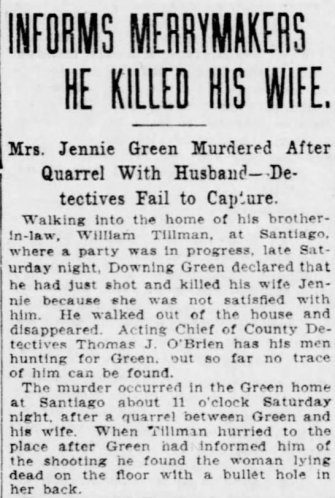
Dowling Green and his young wife, Jennie Tillman Green, were Virginia-born migrants to the Pittsburgh-area coalfields during the turn of the century industrial expansion. Their short marriage, plagued by poverty and jealousy, was already unhappy.
After having returned to their home in Santiago, a mining town on the western edge of the county, after a party on Saturday night, August 25, 1906, Green shot and killed his nineteen-year old wife. He had decided while at the party that she was involved with another man.
He then returned to the party at his brother-in-law’s house, confessed his crime, and fled. Green was apprehended two days later, on August 27, 1906.
Pittsburgh Daily Post, August 27, 1906
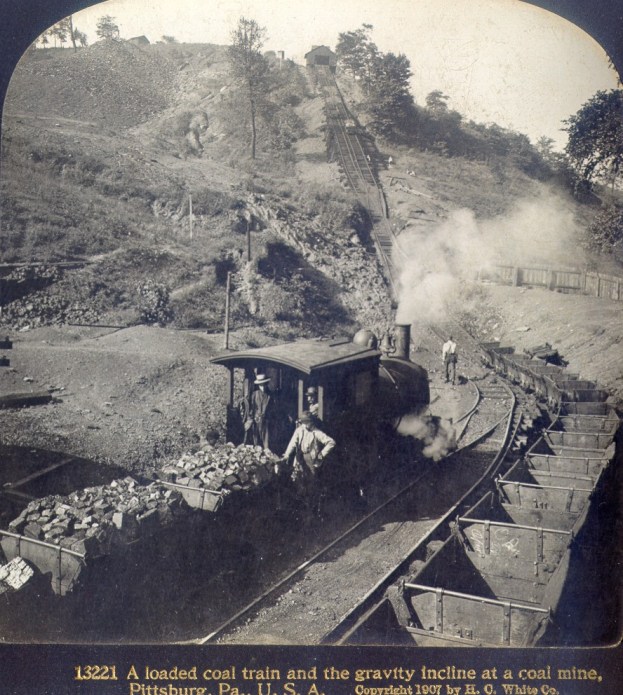
Only several weeks later, amidst a series of violent incidents that evoked references to the events at Unity nearly a decade earlier, the Pittsburgh Daily Post published a lengthy article declaring Santiago “hell’s half-acre,” and decrying the terrible conditions that prevailed in that company town.
Pittsburgh Daily Post, September 23, 1906
Poor, Black, unpopular, socially isolated, and without support, Green’s case received as little process as was deemed due someone of his status. His lawyer was appointed two days before trial. He did not understand the plea he was entering. His trial lasted less than a day and his jury deliberated less than an hour before finding him guilty of first degree murder on January 31, 1907.
Pittsburgh Press, February 1, 1907
His request for a new trial was rejected and Green was sentenced to death on March 1, 1907. No appeal or clemency effort was undertaken.
The contrast to the case of George McMurray, a privileged white man who committed a more deliberate murder in the coal fields only a few miles away a few years earlier, could hardly be sharper.
Pittsburgh Press, July 22, 1907
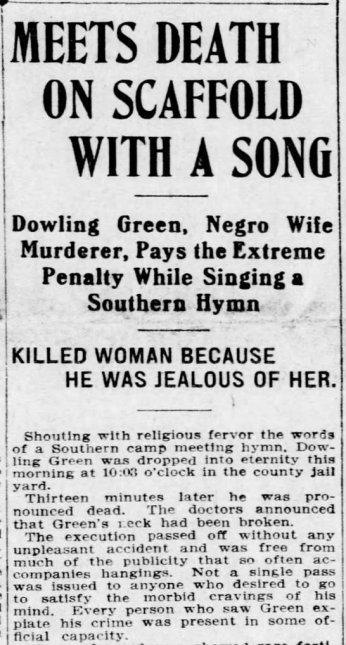
Dowling Green was executed on July 23, 1907, almost without notice. While usually a well-attended event, new rules were enforced for Green’s execution and “not a single pass was issued to anyone who desired to go to satisfy the morbid cravings of his mind.”
Pittsburgh Press, July 23, 1907
Though his execution was pronounced “an entire success” and his cause of death was identified as a broken neck, witness reports indicate that he clearly suffocated, as characterized by “prolonged twitching [and] spasmodic workings of the hands, arms and legs.”
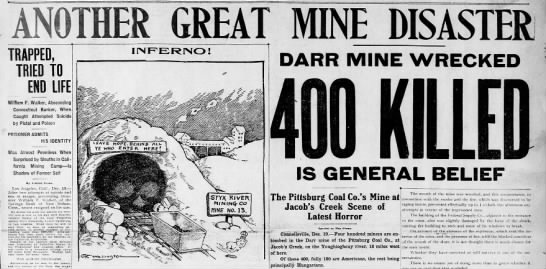
As testimony to the danger and exploitation of the mining camps, five months later the region experienced four major mining disasters that killed more than 700 miners.
John Williams and his wife, Goldie, were fighting so much that she left their Wadsworth St., Hill District home with their newborn child and moved in with her mother, Mrs. Mary Quinsey, on Locust St. in the Uptown neighborhood.
Wadsworth St., 1911
The two women made plans to travel to Cincinnati, away from the violence that John Williams threatened.
Enraged over the separation and his mother-in-law’s perceived interference, Williams shot Quinsey five times in her home on September 16, 1905. He then shot his brother-in-law, Charles Quinsey, twice. Charles survived to testify against Williams.
Knowing that her husband was armed and dangerous, Goldie Williams ran to the police when he arrived at the Quinsey residence. The killing occurred while she was away.
John Williams fled on foot after the shootings, waving his gun at bystanders. Once apprehended by police, he confessed to the arresting officer.
Pittsburgh Post, September 17, 1905
Unsurprising in a case with a Black defendant with no resources to support his defense, Williams’ trial came quickly and ended quickly. With strong inculpatory evidence, the testimony of the surviving victim, and his confession to police, he was convicted of first-degree murder a month after the killing, on October 17, 1905.
His defense argued that he was intoxicated and that his mother-in-law had sewn discord in the home.
The Virginia-born John Williams was hanged in the Allegheny County Jail on September 6, 1906, moments after Cornelius Combs was executed for domestic murder and less than a year after killing his mother-in-law. The newspaper described a gruesome scene of Williams’ prolonged suffering before being declared dead.
Pittsburgh Press, September 6, 1906
Williams and Combs were the first men hanged on the county’s new steel gallows.


















 Pittsburgh Press, September 13, 1907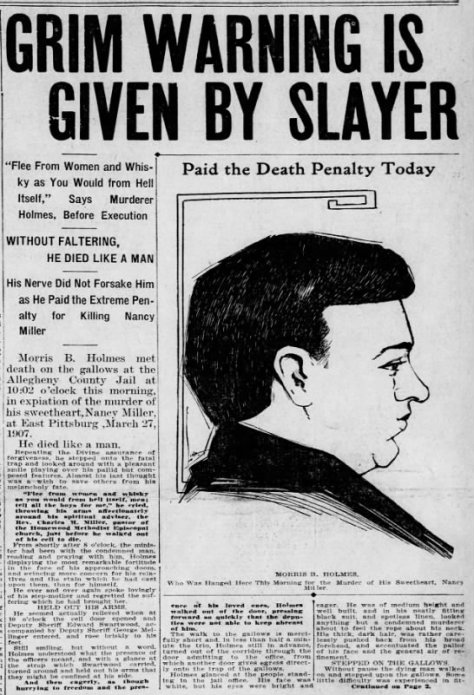

 Pittsburgh Daily Post, September 23, 1906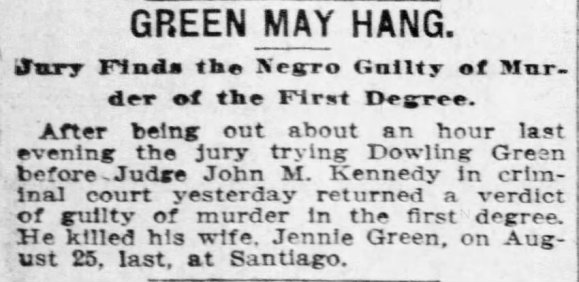




 State Killings in the Steel City: The History of the Death Penalty in Pittsburgh