Cornelius Combs

In a case that resembles the Werling case of a decade earlier in its documented history of serious and serial domestic violence and inadequate official concern for that violence, Cornelius Combs shot Mrs. Mary Elizabeth (Lizzie) Dickerson, his former landlady, in her McKeesport home on February 8, 1905. Dickerson died the following morning.
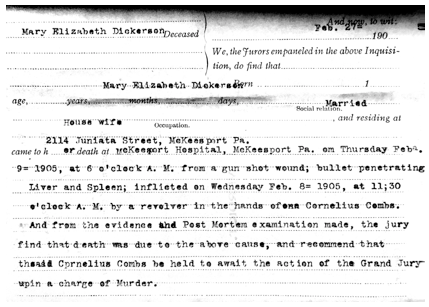
image002

This final incident in a long-running series of threats and assaults began when Combs walked into the Dickerson home at 11:30am and began shooting without warning. He shot and wounded Dickerson and George Simmons, a police officer and boarder in the home at the time. Both victims fled to the cellar; Combs followed and continued shooting.
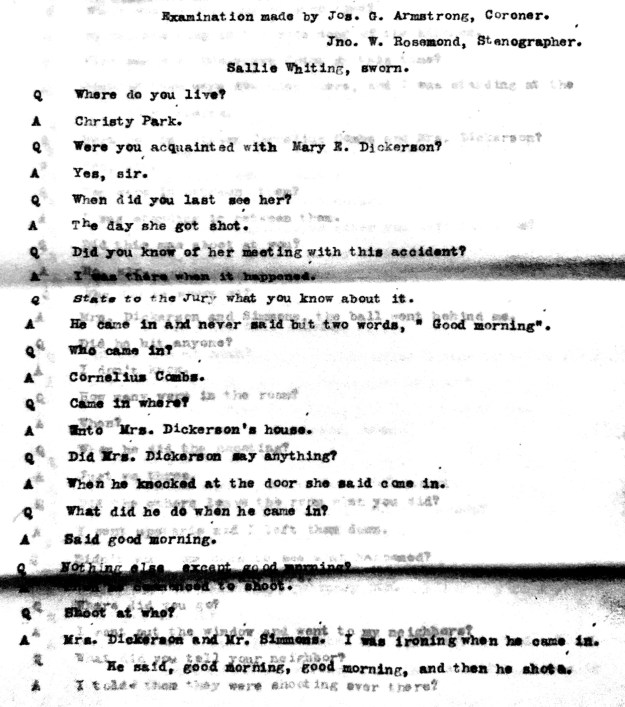
image001

Dickerson fled the house. Combs followed, caught her in the street, and fired the fatal shot. He was apprehended while fleeing and promptly confessed to police.
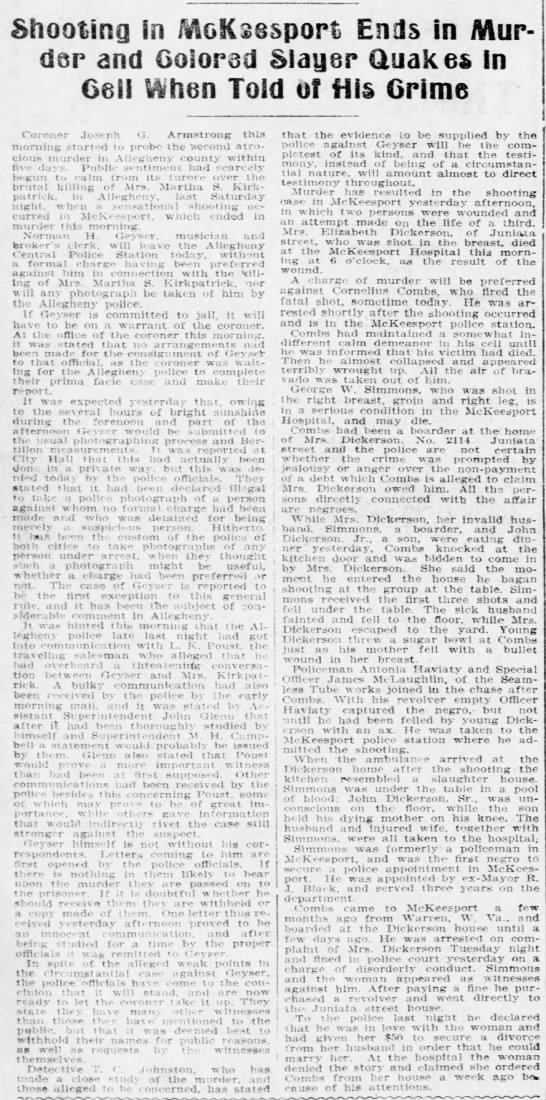
image001
Pittsburgh Press, February 9, 1905

Combs, who began boarding at the Dickerson home after moving from West Virginia, had grown infatuated with Mrs. Dickerson. Over the previous months, he had harassed, sexually assaulted, and injured her. In several of those incidents, he was forcibly removed from the premises by police.

Most recently, Dickerson had Combs arrested on February 7, the day before her murder. He was fined for disorderly conduct and released from jail the next day. He promptly obtained a gun and returned to Dickerson’s home to kill her.

With his confession and the eyewitness testimony of several witnesses, Combs was convicted on September 29, 1905. His defense of intoxication failed.

His request for a new trial was rejected and he was sentenced to death on December 1, 1905. John Dickerson, Lizzie Dickerson’s husband, who was in the home at the time of her killing, died on December 8; his death from edema was said to have been hastened by the trauma of the murder.

On appeal, Combs argued that the case was properly second degree murder. That claim was rejected (Commonwealth v. Combs, 216 Pa. 81, 1906) by reference to trial evidence of premeditation and deliberation.

Cornelius Combs was executed on September 6, 1906, the same day as John Williams. They were the first men to be executed on the county’s new steel scaffold.

At the time of his execution, the Pittsburgh Press noted that Combs “alone in the world, had been living a loose life about McKeesport for some time.”  He is reported to have approached his execution with little concern.
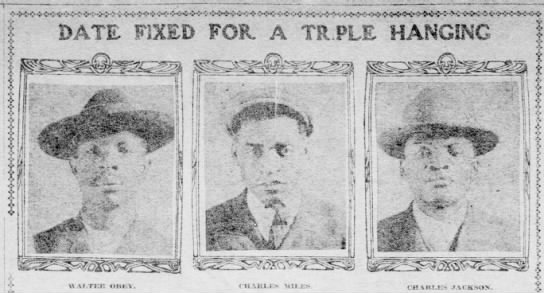
Charles Jackson, Charles Miles, and Walter Obey

image001
Pittsburgh Gazette, December 9, 1904

Charles Jackson, Charles Miles, and Walter Obey, Black laborers who worked on the Wabash Railway and were active armed robbers, robbed and shot Ivan Kluzor, a Croatian-immigrant, in Leetsdale on May 7, 1904. Kluzor, who was shot once, died the next day.

The three “negro highwaymen,” all of whom were armed, accosted Kluzor, his brother, Jacob, and a friend, Mike Villen, on the street. Kluzor, who worked at American Bridge Company in Ambridge, was shot when he tried to flee.

image001.png

After the incident, Miles, Obey, and Jackson, who, according to police, “were armed to the teeth with heavy revolvers,” fled to Allegheny City and were arrested there “only after a lively encounter and chase.” They were subsequently identified as Kluzor’s assailants by the surviving victims.

image001
Annual Report, City of Allegheny, 1904

Jackson and Obey had previously been among those arrested in the dragnet that followed the murder of Hill District grocer James Donnelly.

Tried together, the three men were convicted on June 29, 1904. The surviving victims and the arresting officers provided compelling testimony for the state, though who had fired the fatal shot was never established. Their death sentences were imposed on September 3, 1904.

image001
Pittsburgh Press, June 30, 1904

After the defense sought a continuance of its appeal, a tactic the Pittsburgh Weekly Gazette (October 29, 1904) called out as “encouraging the lynching spirit,” the state refused and the appeal was dismissed on October 24, 1904.

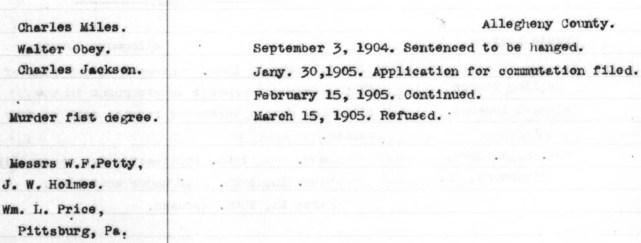
Originally scheduled to be executed in February, respites were granted to consider their pardon requests. Those requests, which challenged the imposition of three death sentences for a single killing, were also rejected.

image001
Pardon Board records

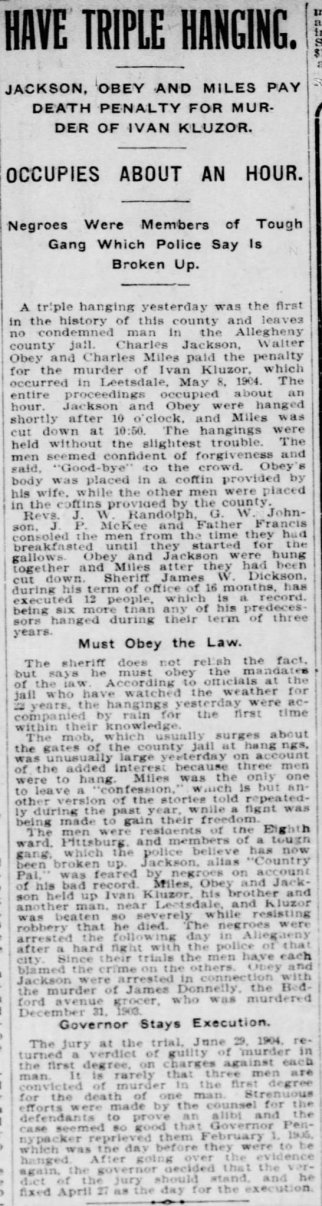
Charles Jackson, Charles Miles, and Walter Obey were hanged in the Allegheny County Jail on April 27, 1905, less than a year after having committed murder. Jackson and Miles were executed together on the double scaffold. After their bodies were cut down, Obey mounted the gallows and was executed.

image001
Pittsburgh Post, April 28, 1905

The case was unusual in that each defendant was charged with, convicted of, and executed for first-degree murder. This is the only case in Allegheny County history in which three people were executed for the same crime and one of only three cases in which three people were convicted of the highest available charges for a single killing.

One of the other cases likewise involved three Black defendants and a white victim. In multiple defendant cases, it is usual for at least one of the defendants to be able to demonstrate a lesser degree of culpability. The third three-defendant case involved Eastern European steelworkers wrongly convicted of killing a mill boss in a period of fervent anti-immigrant tension.

Acknowledging the unusual intensity of the activity on the gallows, the news noted “[w]ith today’s executions Sheriff Dickson has pulled the lever that has sent 12 condemned men into eternity in the one year and four months he has been in office. In that period he has broken all previous records, hanging six more men in that time than any other sheriff has hanged in three years, the full term of office.”

In conjunction with the executions of Ousley and Johnson less than a year earlier, five Black men had been executed for killing two white men. A campaign of white vengeance was underway.

William John Byers

image001
Pittsburgh Daily Post, June 14, 1901

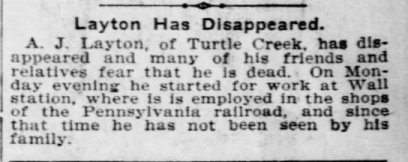
August Layton’s body was found in a field on the Taylor farm in East McKeesport on June 17, 1901. Missing for weeks and presumed dead, he had been shot five times.

image001.jpg

So began one of the more remarkable and labyrinthine capital cases in Pittsburgh history.

Initial suspicion focused on robbery or a work-related motive. Further investigation, however, led police to believe Layton’s wife, Nellie (nee Hilson), was involved in his death.

On that basis, police arrested 25-year old John Davidson McWilliams, who was involved in a relationship with Nellie Layton, but did not have the evidence to hold him.

The case languished until February 1902, when Cleveland police received a tip from a woman named Gertie Culp that William Byers had confided in her about the killing. Cleveland police contacted Pittsburgh police, who did not follow up until April 1902. When they did, they found the story to be quite credible, and arrested Byers, McWilliams, and McWilliams’ new wife, Nellie, the former Mrs Layton, on April 14, 1902.

image001
Pittsburgh Daily Post, April 15, 1902

The story that emerged was that Byers, who was 18, had became infatuated with Mrs. Layton while boarding in the Layton home. Taking advantage of his naivete, Nellie Layton suggested to Byers that he kill her husband while allowing Byers to believe that doing so would allow them to be together. Byers did as she suggested, giving Mrs. Layton the opportunity to pursue her relationship with Mr. McWilliams.

Spurned by Layton after the murder, Byers moved to Cleveland and started a relationship with Culp.

At trial, Byers was convicted on his own confession on February 5, 1903. In the confession he implicated Nellie Layton McWilliams and John McWilliams, who had married in December 1901.

In the trial of the McWilliams the following month, the state portrayed Nellie as the mastermind of the crime. In a widely criticized verdict, both Nellie, who was pregnant, and John McWilliams were acquitted on March 13, 1903. Their trial had been delayed until after McWilliams gave birth. Claiming that Byers had acted alone and that the state had failed to implicate the former Mrs. Layton, they had offered no defense.

image001               Pittsburgh Press, March 13, 1903

Nellie and John McWilliams divorced less than two months later. By that time, John McWilliams had relocated to Carnegie, married Sadie Stroup, taken a job in the railroad industry, and started a family. Their marriage license, dated February 1903, was issued before McWilliams’ trial and before John and Nellie’s divorce. It falsely claimed McWilliams had not previously been married.

John McWilliams died in Carnegie in 1937.

William Byers was sentenced to death on October 23, 1903.

In a highly unusual set of circumstances, Byers was executed on March 23, 1905, despite a Board of Pardons recommendation of commutation to life imprisonment.

His hanging was badly botched. When the trap was sprung the loop of the noose pulled away and he fell to the ground. Byers staggered about under the scaffold until the Sheriff removed the black cap and returned him to the jail. The rope was again adjusted and, pale and trembling, Byers was again placed on the scaffold and the trap sprung. This time there was no mishap and death resulted.

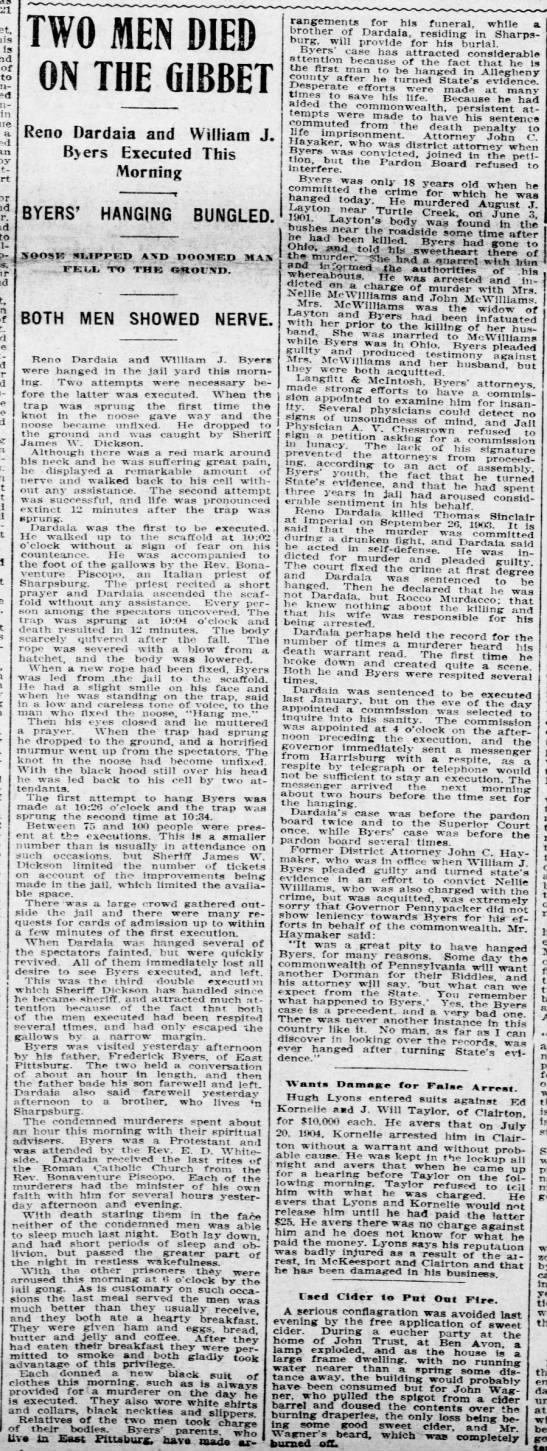
Reno Dardaia had been hanged without incident just prior to Byers’ execution.

The failure to accept the Board of Pardons’ commutation recommendation, which apparently stemmed from Governor Pennypacker’s belief that the acquittals of the McWilliams indicated that Byers had testified untruthfully, was particularly remarkable considering Byers’ role as a cooperating witness against the McWilliams.

image001Pittsburgh Press, February 2, 1904

Indeed, the District Attorney at the time of Byers’ conviction, John C. Haymaker, said at the time of Byers’ execution: “There was never another instance in this country like it. No man, as far as I can discover in looking over the records, was ever hanged after turning State’s evidence.”

* Yvonne M. Wilson has written and self-published a fascinating and detailed account of the case titled Murder Will Out (ISBN 978-0-36-843231-6).

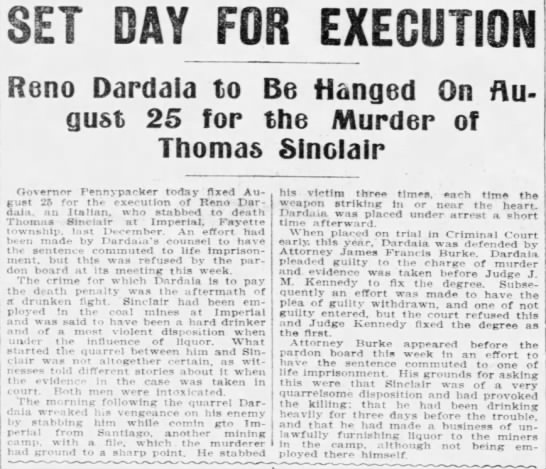
Reno Dardaia

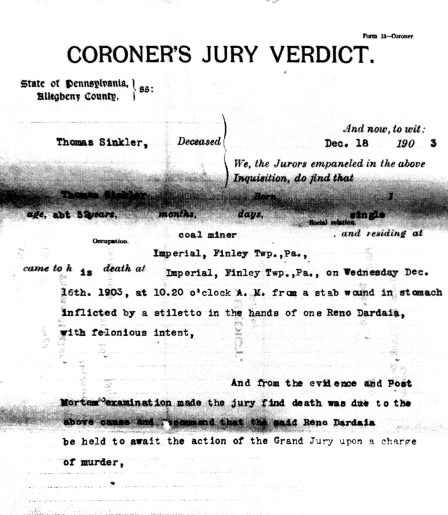
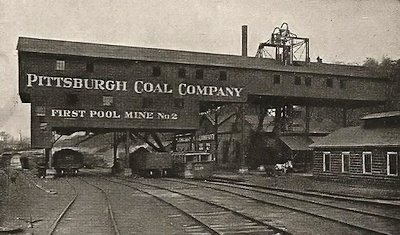
Reno Dardaia, an Italian immigrant working in the Pittsburgh Coal Company mines of Imperial, west of Pittsburgh, stabbed fellow miner Thomas Sinclair with a stiletto during the morning of December 16, 1903.

image001

Dardaia and Sinclair, a Scottish immigrant, had quarreled the night before. Reportedly, Sinclair owed Dardaia a dollar and refused to pay it back and refused to share his whiskey. During the quarrel, Sinclair struck and cut Dardaia, who threatened revenge.

The next morning, Dardaia approached Sinclair as he stood outside and stabbed him in the abdomen. He was apprehended immediately by a group of miners and turned over to authorities. There was talk of lynching him.

Having confessed to police and with few resources to support his defense, Dardaia’s case was resolved quickly and easily. On March 4, 1904, just eleven weeks after Sinclair’s murder, he was convicted of first-degree murder.

image001

His pardon request was rejected on June 15, 1904, and his appeal (Commonwealth v. Dardaia, 210 Pa. 61, 1904) was rejected in a one-page opinion on November 4, 1904.

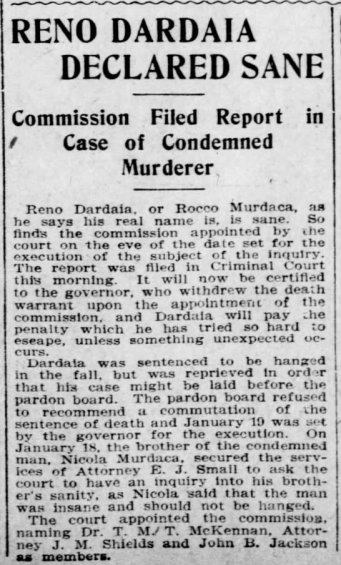
Dardaia’s execution was much slower in coming. Claims that the killing he committed was properly second-degree murder and that he was mentally unfit to be executed resulted in four postponements of his execution.

image001
Pittsburgh Press, February 14, 1905

After a sanity commission deemed him fit for execution, Reno Dardaia went to the gallows on March 23, 1905.

image001
Pittsburgh Press, March 23, 1905

William Byers, whose sensational case overshadowed Dardaia’s, was hanged immediately afterwards.

image001

As with many other steel and coal towns of that era, Imperial was a company town. Imperial Coal Company, which established its operations in the community formerly-known as Montour City in the 1880s, was purchased by Pittsburgh Coal Company in 1899.

On December 19, 1907, Pittsburgh Coal Company’s Darr mine in Westmoreland County exploded, killing 239 men. It was the worst mining disaster in Pennsylvania history and was one of three major mine disasters that month, An explosion at Monongah, West Virginia, on December 6, killed at least 362 men and boys, the worst single-incident loss of life in American mining history. On December 1, an explosion at the Naomi minein Fayette City, Fayette County, Pa. killed 32 miners. In all, at least 3,242 people were killed in coal mining incidents that year, making it the deadliest year in American mining history.

Albert Dabrydino

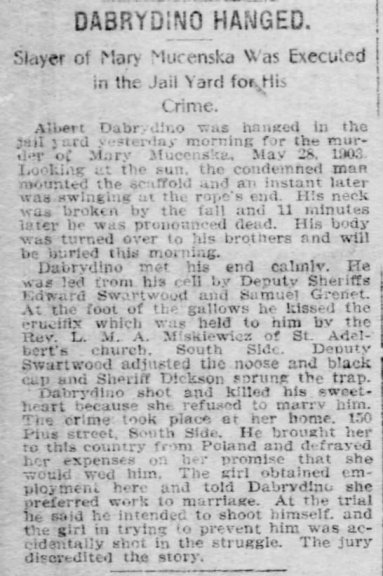
In an all too familiar set of circumstances, Albert Dabrydino, a Polish immigrant steelworker, killed Mary Mucynska, a Polish immigrant domestic he was dating, at her 150 Pius St., South Side residence during the afternoon of May 28, 1903. Mucynska was shot once in the chest. Dabrydino then slashed his own throat in a failed suicide attempt.

image001
150 Pius St.

Dabrydino and Mucynska planned to marry in Poland but, Dabrydino reported, were unable to because he could not prove to the priest that he had not already married after having first immigrated to Pittsburgh several years earlier.

image001

The couple arrived in the United States only a week before the murder and were staying in a boarding house. After preparing for the wedding, Mucynska told  Dabrydino she did not want to marry him. Reports varied as to the reason for her change of heart. Some said she had fallen in love with his brother; others indicated she did not think he had enough money.

Dabrydino was mobbed and beaten by neighbors after the killing.

image001
Pittsburgh Press, December 15, 1903

With limited resources for his defense and strong inculpatory evidence, Dabrydino was convicted of first-degree murder on December 15, 1903, after a one day trial and twenty minutes of jury deliberations. The jury rejected his claim that Mucynska was killed when she interfered in Dabrydino’s attempt to kill himself.

His motion for a new trial refused, Dabrydino was sentenced to death on February 23, 1904.

image001
Pittsburgh Gazette, October 28, 1904

After delaying Dabrydiono’s execution to allow his pardon request to be considered, Governor Pennypacker set the execution for October 27, 1904. Albert Dabrydino hanged as scheduled. He was buried at St. Adalbert’s Catholic Church on the South Side.

It was the seventh and last execution of the year, more than had ever been carried out in Pittsburgh. That same number was achieved only one other year: 1920.

image001                                                     The view from Pius St.

Nicholas Glazner

Nicholas Glazner, a well-known trolley motorman, dated Margaret Hall, who lived and worked as a servant in the 412 Atwood Street home of John M. Roberts, a downtown jeweler. Glazner, who was 46, was separated from his disabled wife, Louisa. Hall was 35 and single.

image001
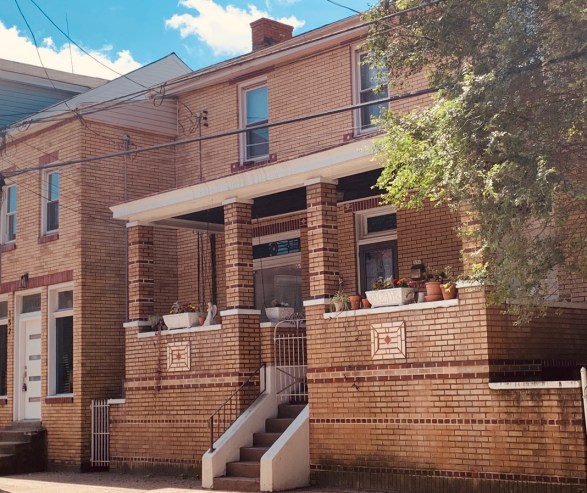
412 Atwood St., 2020

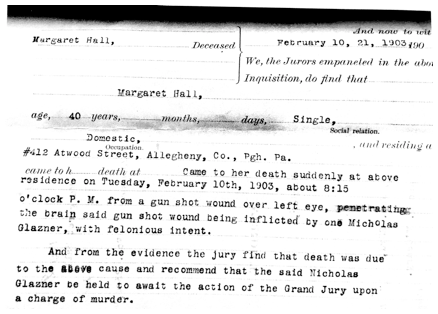
After returning from an evening together in the city on February 10, 1903, Glazner and Hall were heard by neighbors to be arguing near the rear door of the Roberts’ home. Glazner then shot Hall once in the face. He attempted suicide immediately after the killing, but sustained only a minor bullet wound to the head. He was moved from the hospital to the jail on February 11.

image002

Prior to his trial, Glazner claimed Hall was the shooter, having shot him before taking her own life. At trial on September 28, 1903, however, Glazner refused counsel and insisted on pleading guilty. The state’s efforts to encourage him to withdraw his plea and go to trial were unsuccessful.

Testimony given to determine the degree of murder refuted Glazner’s claim that he was drunk at the time of the killing. Rather, the story that emerged was that Hall was involved in a relationship with another man, also a trolley motorman, and that she had received and worn two rings from that other man, Isaac L. Glump. Glazner’s murderous jealousy related to that relationship, rather than any diminished capacity on his part.

Glazner was sentenced to death on December 5, 1903. His pardon request, which was financed by his fellow motormen and which advanced a claim that he suffered from post-typhoid insanity, was rejected.

As with the Woodley case eight years earlier, newspaper accounts seemed to struggle to reconcile Glazner’s crime with his race and station in life, referring to him as “intelligent looking” and emphasizing the atypicality of his crime.

Nicholas Glazner was hanged on July 21, 1904, steadfast to the end in his refusal to discuss his crime. The speed of his death made his “one of the most successful hangings that has taken place in the county for years.”

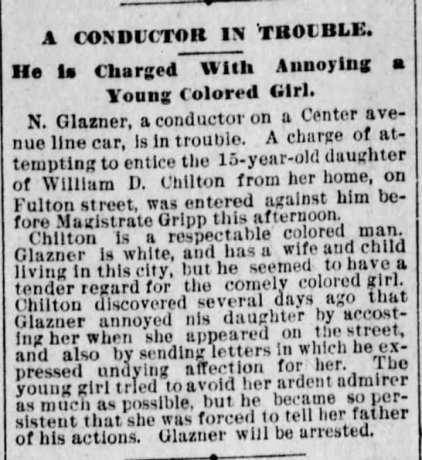
Glazner’s past legal troubles were not mentioned during his trial.

image001
Pittsburgh Press, August 12, 1892

Louisa Byerly Glazner died in Pittsburgh on June 11, 1911.

John M. Roberts & Son Jewelers, which originally opened in Pittsburgh in 1832, closed in 1997.

William L. Hartley

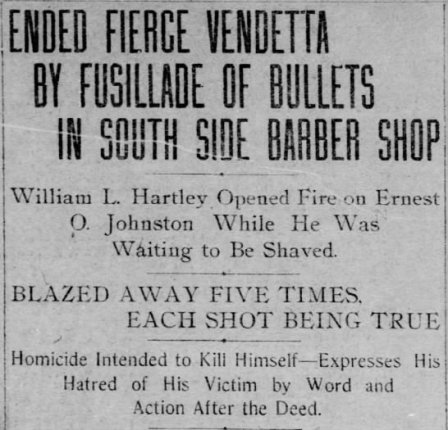
William L. Hartley and Ernest O. Johnston, co-workers at the Pittsburgh, Virginia and Charleston Railroad, had been on bad terms for some time.  Johnston had gotten the better of Hartley in several fights, the last of which led Hartley to vow revenge.

image001

Armed in anticipation of an encounter, Hartley happened upon Johnston at Henry Jouver’s barbershop at 2832 East Carson St, South Side, on March 28, 1903.

image002

As Johnston sat in the barber’s chair, Hartley shot him five times at close range. The barbershop was crowded at the time of the killing.

image001
Pittsburgh Weekly Gazette, March 29, 1903

Captured as he tried to flee down the street, Hartley was prevented by the arresting officer from carrying out his intention to commit suicide. He confessed to police, saying that Johnston deserved it.

Confronted by numerous witnesses for the prosecution and his own statements, Hartley was convicted of first-degree murder on October 3, 1903, and sentenced to death on December 5. A record three death sentences were handed down that day.

A noteworthy feature of an otherwise unremarkable and lightly contested conviction was evidence that Hartley had been treated for years for head pain and that episodes of such pain were associated with erratic and violent behavior. He had a record of violence in his native Maryland, including a non-fatal shooting and a non-fatal stabbing. Such evidence was insufficient to prevent Hartley’s conviction or to gain him commutation.

Johnston likewise had a history of violence, including an assault charge against a teacher when he was fifteen.

image001
Pittsburgh Weekly Gazette, March 11, 1904

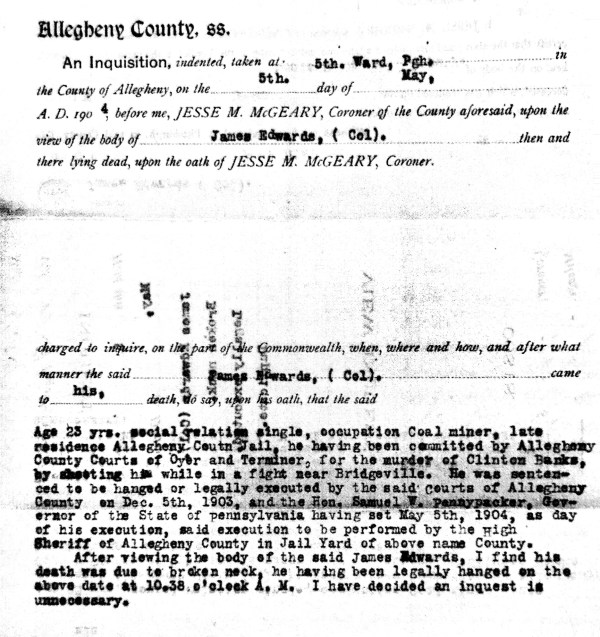
William Hartley was hanged on May 5, 1904. Originally scheduled to hang next to James Edwards, who is Black, on a double scaffold erected for the occasion, Hartley’s request that they be hanged separately so as to spare his family the indignity was granted. The men were hanged in succession. Hartley hanged first.

James Edwards

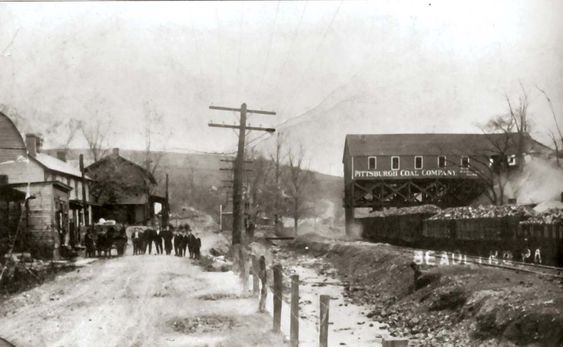
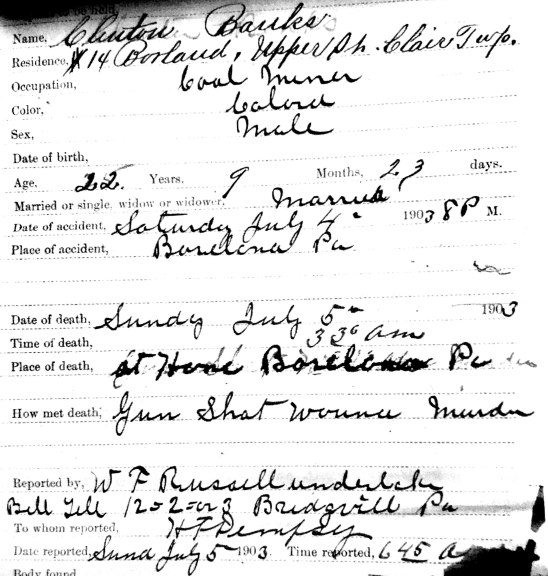
The Fourth of July, 1903, was a rare day of rest at the Borland mining camp in Upper St. Clair. At a dance that evening, miners James Edwards and Clinton Banks, both labor migrants from Virginia, fought over a young woman. Carrie Mills, who had recently left her husband in Virginia to be with Edwards, was dancing with Banks.

image001
Coal mining in Upper St. Clair, circa 1900

Edwards took exception to Banks’ interest in his date and shot Banks, who died early in the morning of July 5.

image001

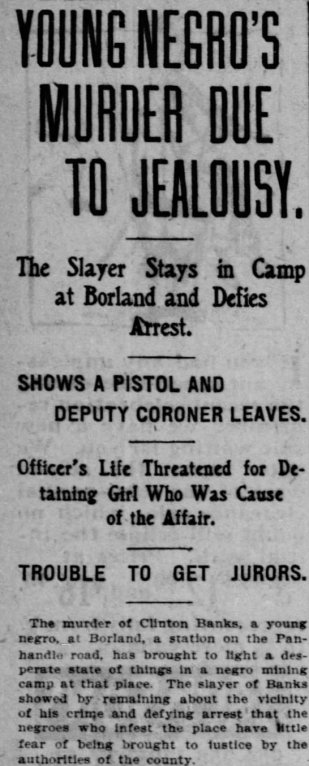
Efforts by police to move into the mining camp and investigate the killing were reportedly rebuffed at gunpoint by miners. Untroubled by the racial hostility its campaign against black laborers was contributing to, the Pittsburgh Daily Post expressed alarm that “the negroes who infest the place have little fear of being brought to justice by the authorities” (July 6, 1903).

image001

Edwards fled after the shooting and was captured in Montgomery, West Virginia, on July 27. He confessed to the killing. He was also implicated in several other killings in mining towns in the region.

Without resources or supporters, Edwards pleaded guilty and was convicted of first-degree murder on December 5, 1903. He was sentenced to death the same day.

James Edwards was hanged on May 5, 1904.

image001

In what the Washington Post described as the “color line on scaffold,” William Hartley, who is white and executed on the same day, requested that he and Edwards be executed separately so that his family would not “bear the disgrace” of people thinking he committed his crime with a black person. The request was granted.

John Conroy

Irish immigrants John Conroy and his wife, Margaret, and their two small children scraped together a meager existence from his work as a hod carrier. They quarreled frequently, apparently over a period of years. Conroy, who was two decades older than his wife, had been married previously.

image001
Wickliff St., 1908

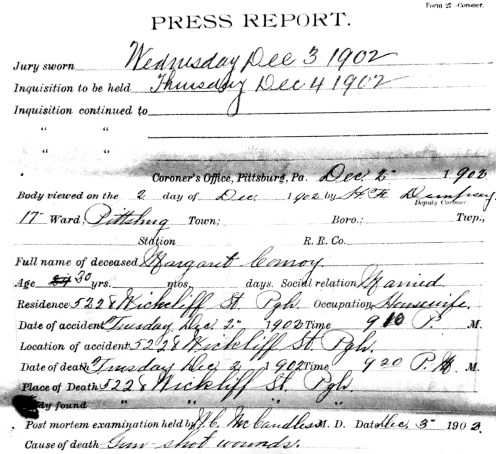
On the evening of December 2, 1902, their neighbors on Wickliff St. in Lawrenceville heard the familiar sound of their arguing. Margaret had accused her husband of infidelity. As he fumed, she fell asleep with their youngest child.

image001

An hour later, four shots were heard. When the neighbors responded, Conroy told them he had killed his wife. The neighbors held Conroy until police arrived.

image001
Pittsburgh Post, December 3, 1902

In his defense, Conroy claimed that after their quarrel had ended, he was kneeling in prayer at his bedside when he opened his eyes to see Margaret pointing a gun at him. He turned the gun on her and shot her three times.

At trial, Conroy faced crime scene evidence and testimony from neighbors that painted a clear picture of the evening’s events. He was convicted of first-degree murder on April 30, 1903. After his motion for a new trial was rejected, he was sentenced to death on May 28.

image001
Pittsburgh Post, May 1, 1903

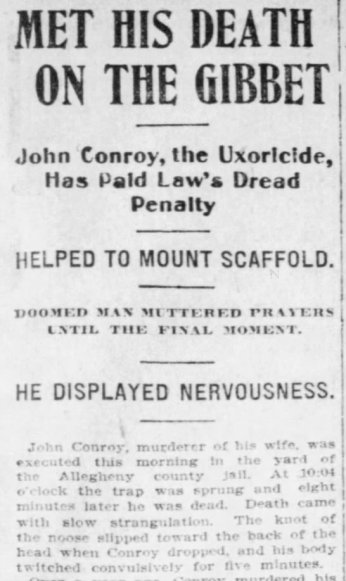
His routine appeal (Commonwealth v. Conroy, 207 Pa. 212, 1903) was rejected on November 9, 1903. John Conroy went to the gallows on February 25, 1904. Newspaper accounts indicate he died by asphyxiation.

image001
Pittsburgh Press, February 25, 1904
image002
5228 Wickliff St., 2019

Joseph Chanosky

In the now defunct mining town of Milesville,* in the remote southern tip of Allegheny County, Polish-immigrant miner Joseph Chanosky killed his wife, Mary, on Wednesday, January 7, 1903. She was sexually mutilated, beaten, and kicked to death; a killing “almost without precedent for barbarism.”

image001

The beating, which reportedly started as a quarrel about doing the dishes, was heard by fellow miners who boarded with the Chanoskys but were too afraid to intervene. The men worked at the Jones & Laughlin Steel Company’s Ella Mines.

image001
Jones & Laughlin Coal Tipple

With the boarders testifying for the prosecution and no resources to support a vigorous defense, the case proceeded quickly and without complications. Chanosky’s defense that his wife was an alcoholic and unfaithful failed to persuade the jury to find a lesser degree of murder.

image001

Chanosky was convicted of first-degree murder on June 30, 1903. After his motion for a new trial was rejected, he was sentenced to death on July 15.

image001
Pittsburgh Press, June 29, 1903

After a routine appeal, Joseph Chanosky was hanged on December 3, 1903.

image001Chanosky’s was the first case since Mamachtaga’s execution in 1785 in which the murder, conviction, and execution occurred within a single calendar year.

image001
Map of Forward Township, 1900

* Though official and newspaper accounts of the case usually referred to the location as Minersville, maps from that era and histories of Forward Township refer to the location as Milesville. The error is likely attributable to the remote location and small size of the company town. Whatever the name, the town and the coal mines that brought it into existence are defunct.