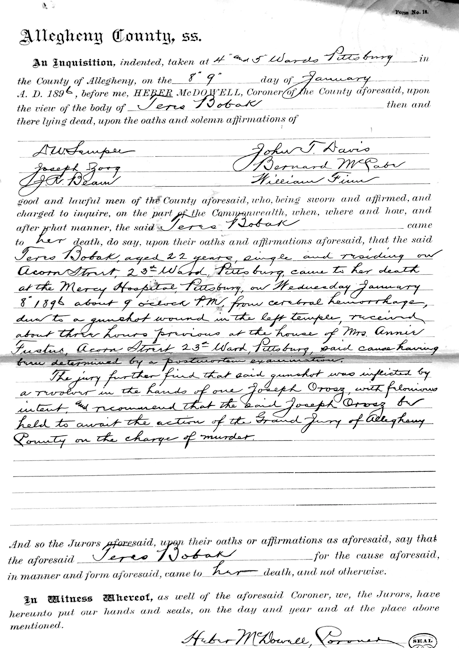
In a scenario that would be repeated a few years later – a single, male immigrant steelworker killing a single, female immigrant over a spurned proposal – Joseph Orosz killed Teresa Bobak on January 8, 1896, in Greenfield. Both were from Hungary.
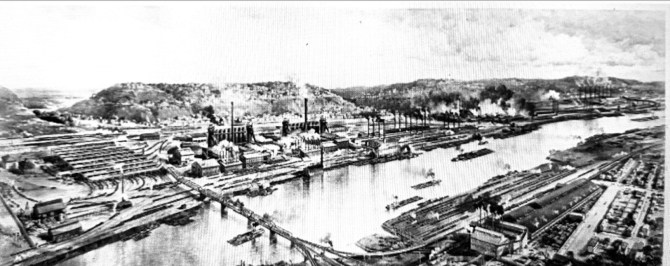
Eliza Furnace, 1902
Orosz had arrived several years earlier and had established himself at Jones & Laughlin Steel’s Eliza Furnace. Bobak, an attractive and much in demand recent arrival, had worked in a home on Second Avenue in Greenfield in which Orosz boarded before moving to a new position.
While Orosz fell desperately in love with Bobak, there are conflicting reports as to whether she reciprocated. Believing that they would marry, Orosz began to prepare for their life together. As Bobak became aware of these plans, she indicated she would not marry him.
Orosz became increasingly frantic and insistent. He also began drinking. After one final rejection, Orosz told Bobak he was going to kill her, went directly to purchase a gun, returned to her residence, asked one more time to marry her, and shot her in the face when she refused.
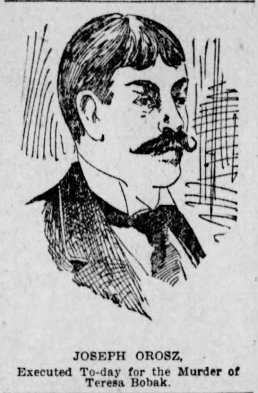
Pittsburgh Press, February 9, 1896
He then attempted suicide, shooting himself in the chest after the murder. Only slightly injured, Orosz then ran from the house and was apprehended that evening.
With a strong case against him, Orosz offered only a drunkenness defense. In a particularly fast-moving sequence of events associated with a poorer and socially isolated defendant, he was tried and convicted on February 18, 1896, only five weeks after the murder, and sentenced to death on February 29.
No appeal was filed. In a rather perfunctory clemency request, Orosz’s counsel argued that the circumstances of the killing – that Orosz acted under the influences of drunkenness and passion – left him “unable to deliberate and premeditate and incapable of forming a specific intent.” No signed petitions or supportive letters accompanied Orosz’s request.
The District Attorney brusquely dismissed the matter.
Joseph Orosz was hanged on September 1, 1896.
Suggesting just how common it was for hangings to produce death slowly by asphyxiation, Orosz’s hanging was reported as unusual in that his neck was broken and, therefore, his death was faster than most.
Pittsburgh Press, September 1, 1896
Eleven years and a day after Bobak’s murder, an explosion at the Eliza Furnace killed fourteen men. Thirty years after that, Jones & Laughlin was the defendant in a landmark case in which the United States Supreme Court upheld the long-sought right of workers to unionize.
Albert Woodley, a 36-year old widower, and Jennie Buchanan, 28, and soon-to-be-divorced, were planning to marry. Though the couple was reported as happy, dormant tension came to the surface when Woodley lost his job and resumed drinking.
On May 9, 1894, one day after Buchanan expressed disapproval of his drinking and threatened to break off their relationship, Woodley purchased a gun and shot her. He attempted suicide by shooting himself in the head immediately afterwards.
The killing occurred in Buchanan’s father’s Sturgeon St., Allegheny City home, where she lived. Buchanan’s father was in the home at the time.
Sturgeon St., Allegheny City
On the way to the hospital, Woodley admitted the murder, claiming jealousy and drunkenness.
After a trial in which Woodley argued that the death of his wife had left him morose, unstable, and reliant on alcohol, he was convicted of first-degree murder on July 12, 1894. The verdict surprised legal observers who had expected a second-degree conviction. After his motion for a new trial was rejected, he was sentenced to death on October 7.
Pittsburgh Commercial Gazette, July 13, 1894
Born to British parents in Washington, D.C., Presbyterian, and until recently employed as a painter in a variety of industries, Woodley was consistently portrayed in sympathetic terms, as attractive, composed, polite, and well-mannered.
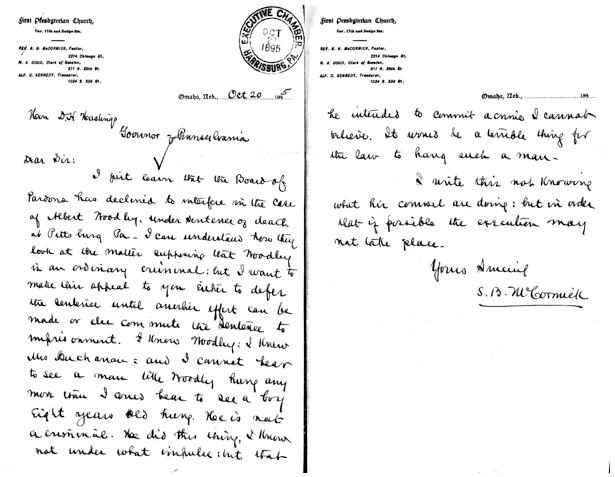
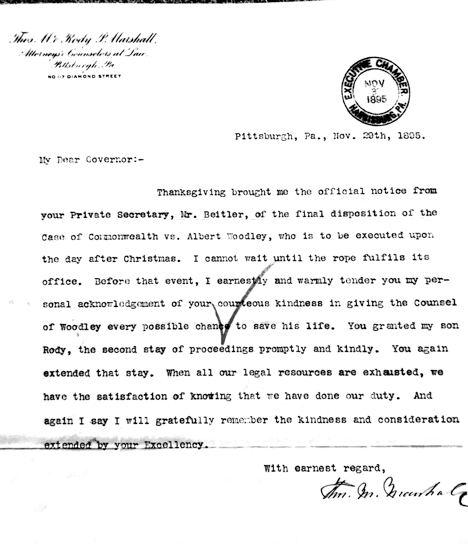
Drawing on the connections his favorable treatment suggested, he aggressively contested his conviction and execution on appeal (Commonwealth v. Albert Woodley, 166 Pa. 463, 1895) and through a pardon request.
The focus of these efforts was that Buchanan’s killing was not appropriately first-degree, though evidence that Woodley purchased the pistol the previous day and deliberated the day of the killing suggested otherwise. Though these efforts ultimately failed, it was reported that his execution was respited more than any other in state history.
Albert Woodley was hanged in the Allegheny County Jail on January 2, 1896. Accounts of his execution indicate that he slowly strangled to death.
In a conclusion seemingly drawn more from Woodley’s race and upbringing than an assessment of his abilities, the Pittsburgh Press noted afterwards that “beyond question, the man hanged today was far superior in intelligence and accomplishments to any who have suffered the extreme penalty of the law in this county for years.”
At the peak of the Gilded Age, among industrialists who made Pittsburgh home to some of the richest men in the world, George Schmous, a German-immigrant iron worker, lived in poverty with his wife, Catherine, and their four children on Oak Alley, on the steep slopes of the South Side just above the Knoxville Incline.
Knoxville, circa 1900
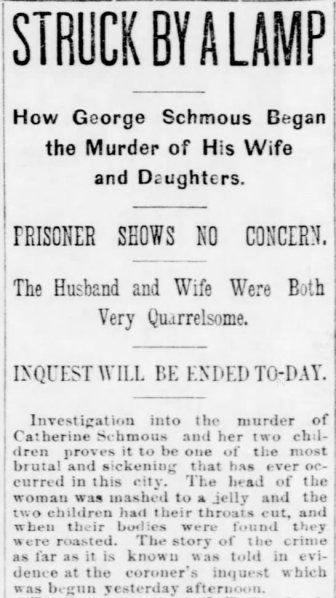
There, in the middle of the night of July 26, 1893, in “one of the most dastardly crimes ever recorded” in the area, Schmous killed his wife and two daughters, Mary and Maggie, beating them with a hatchet and a lamp while they slept, then attempting to set the house on fire to conceal the crime. The beatings were especially vicious. Neighbors intervened before the fire could spread.
Pittsburgh Daily Post, July 29, 1893
Newspaper coverage of the killing was strikingly sexist in its discussion of the circumstances leading to the crime. While characterizing the Schmous’s as poor, unhappy, and struggling, Catherine was described as “a peculiar woman,” unclean, having a violent temper, and a “reputation as a fighter.” George, on the other hand, was “peaceable, honest, and industrious,” though “a German of a very low grade of intelligence” (Pittsburgh Press, July 26, 1893).
Schmous was immediately arrested. He confessed to firemen and police on the scene, but denied his guilt at trial. Though the motive for the crime was not clearly established, speculation focused on an insurance policy on the lives of the children that was in Schmous’s possession. Schmous was also heard to say that he was driven mad by Catherine.
After a brief trial, Schmous was found guilty on September 23, 1893. “The defense was lame,” the Daily Post noted. His claims of insanity and imbecility were unsuccessful in gaining a new trial or a pardon, though the evidence of his mental instability was certainly present.
George Schmous was hanged on September 20, 1894. In its lengthy execution day story, the Pittsburgh Press was especially sympathetic toward Schmous, stating that it was Catherine “who generally caused the trouble in the marriage,” reciting as fact the story Schmous told of the killings, even entertaining the argument that George was innocent and that a neighbor who had a grievance with Catherine had killed her.
Pittsburgh Press, September 20, 1894
An autopsy showed that Schmous was “perfectly sane and a perfectly fit subject to suffer the law’s greatest penalty.”
Johnnie Schmous was adopted into the German community in Pittsburgh.
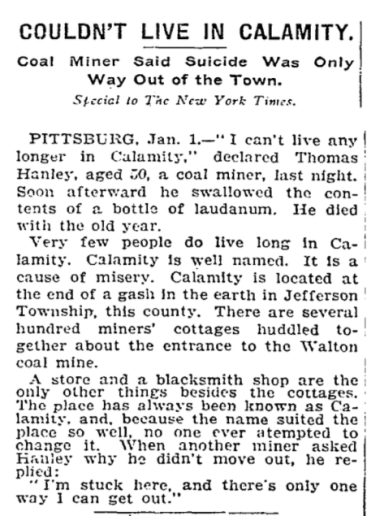
Named as though its future of hardship, violence, and obsolescence was foreseen, the mining town of Calamity was formed by Walton & Company in the coal region south of Pittsburgh in the late nineteenth century.
New York Times, January 2, 1908
The French immigrant miners who settled there were led by August Breyesse. Though the murder in which he was involved would come to be attributed to the labor unrest and anarchist violence of those turbulent times, the more prosaic reality, difficult as it is to disentangle from the conflicting accounts provided in multiple languages, is of infidelity and jealousy.
Pittsburgh Press, September 26, 1893
Breyesse, an intimidating figure, was involved in an affair. When Sofia Raes spread reports of the affair, she and Breyesse’s par amour quarreled. Those quarrels escalated to include Raes’ husband, August, at which point Breyesse and Noel Maison, a coal miner and friend of Breyesse, confronted the Raes outside their home on September 24, 1893.
During that confrontation, Breyesse directed Maison to shoot the couple. Maison did so, using Breyesse’s gun, killing Sofia Raes and injuring her husband. Maison and Breyesse were arrested soon after the shooting.
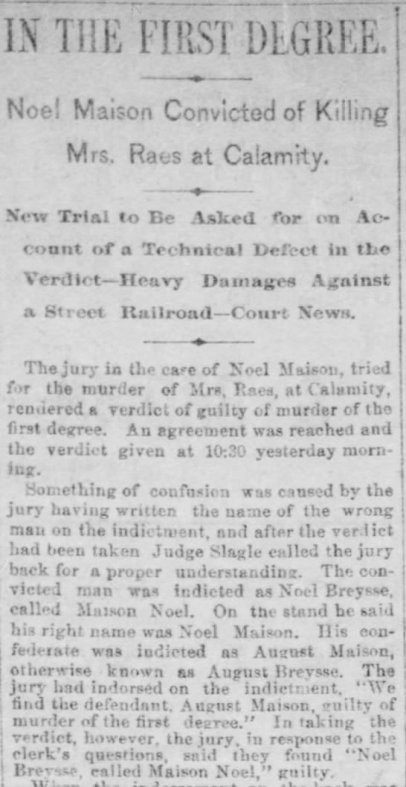
Their trials were conducted through the use of interpreters, which created confusion. Among the confusing issues were the names of the parties, leading to some reports in which the names of Maison and Breyesse were reversed.
Pittsburgh Commercial, October 28, 1893
Maison was convicted of first-degree murder on October 27, 1893, only a month after the killing, and sentenced to death. Breyesse was tried, convicted of second-degree murder, and sentenced to twenty years in prison on November 4, 1893.
After Maison’s conviction and sentence were affirmed, a well-organized and far reaching clemency campaign was mounted. Testimonials on his behalf were received from jurors who convicted him (who characterized Maison as “only the poor ignorant tool of his partner”); his neighbors in Calamity; from Bloye, the small French village in which he was raised; as well as from the French Embassy. He was characterized as well-liked, though naïve and a “tool and dupe” of Breyesse.
Ultimately, those efforts failed, and Noel Maison was hanged on September 6, 1894. He is buried in St. Mary’s Cemetery.
Pardon Board records document the uncertainty over Maison’s identity
Death Certificate, Noel (Meison) Maison
Breyesse entered Western Penitentiary on November 4, 1893. He remained there at least through 1901, when his pardon request was denied.
Western Penitentiary record of August Breyesse
Another murder among French miners in Calamity had occurred the previous year. Redares was acquitted at trial two months later.
The case of George “Babe” Jones and Jesse Carter presented an all too familiar series of events from that era: young working men, alcohol, and fighting, though with one important difference. On April 4, 1882, in a case most similar to the case of John Lutz a quarter century earlier, Jones and Carter killed John Foster outside Martin Carney’s Saloon, at 104 Water St., downtown.
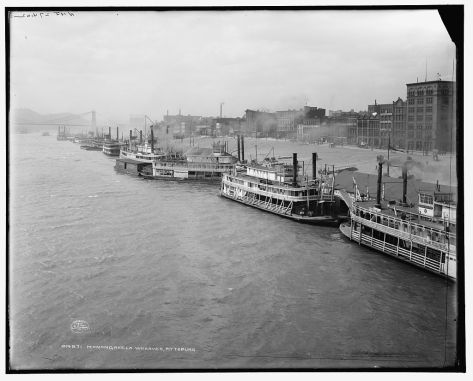
Monongahela Wharf, 1902
Earlier that day, the eighteen-year old Jones had been involved in an argument with another man at a different bar when Foster, a steamboat worker from West Virginia whose ship was docked at the nearby wharf, intervened. Jones vowed and took revenge, shooting Foster, who died more than three months later, on July 25, 1882.
Jones fled, and was arrested a week later in Erie. Jesse Carter, who had accompanied Jones in purchasing the gun and was present for the shooting, was arrested on April 5.
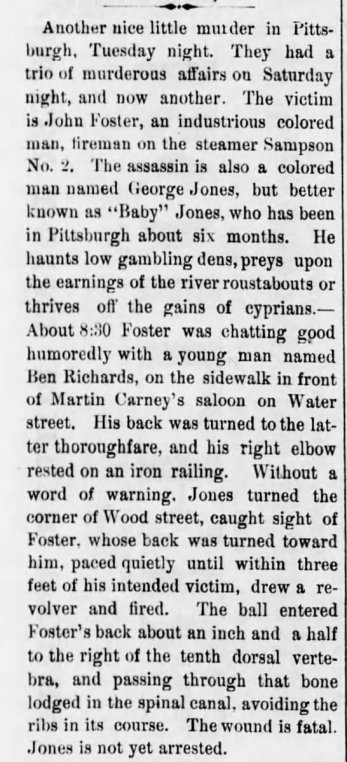
Daily Republican (Monongahela, Pa.), April 5, 1882
Jones was convicted of first-degree murder on December 17, 1882, after his insanity defense failed.
Pittsburgh Commercial Gazette, December 18, 1882
Despite his secondary role and the absence of evidence of his involvement with Jones at the time of the shooting, all of which is frankly acknowledged in coverage of the case, Carter was convicted of first-degree murder on February 22, 1883.
Pittsburgh Daily Post, February 21, 1883
The newspapers cast Jones in the most unfavorable light. Whereas his youth and poverty might have diminished his responsibility or, as with McConkey, provided a basis for compassion, he was portrayed as beyond redemption. Whereas the months that passed between the shooting and Foster’s death and the serious questions this raised about the role of Foster’s medical care in his death* may have diminished his crime, such consideration was not forthcoming.
“He will soon stretch hemp,” the Cincinnati Enquirer (December 18, 1882) declared at the time of his conviction; “he will hang beyond a doubt.”
George Jones hanged on April 3, 1884, before a large crowd inside the jailyard. Several days before his execution, he swore under oath that Carter was not involved in the killing (Pittsburgh Post, April 1, 1884).
Pittsburgh Post, April 4, 1884
Despite commentary that he was certain to be spared, even pardoned, due to his limited role in the case, Jesse Carter was executed two months later, on June 3.
Pardon Board records of Jesse Carter
Newspaper accounts stated that his hanging attracted less attention than any in memory.
Pittsburgh Commercial Gazette, June 23, 1883
What distinguishes this case from its predecessors, of course, is that Jones and Carter were Black, a circumstance that allowed Jones’s youth and disadvantage to compound his dangerousness and Carter’s modest role in the case to be separated from his fate.
Both had been born into slavery and had come to Pittsburgh only recently. Described as a “quadroon by complexion,” Jones was portrayed as particularly dangerous; light-skinned, handsome, dashing, a real underworld character who “haunts low gambling dens, preys upon the earnings of the river roustabouts or thrives off the gains of cyprians” (Daily Republican, April 5, 1882). Foster, on the other hand, was cast as a fine example of his race, “an industrious colored man.”
As far away as Kansas, the Leavenworth Times (April 4, 1884) triumphed his execution as a “Neck-Tie Festival,” an allusion common to lynchings.
Ninety-nine years after Pittsburgh’s first execution, this was the first case in which Black defendants were sentenced to death for a crime that took place outside of the home and outside of the intimate relationships found there.
* A week before Jones’ execution, the Toledo Blade (March 27, 1884, p.8) published a story suggesting that the surgical procedure used on Foster, also used in an unsuccessful effort to save the life of President Garfield, may have contributed to his death.
Fort Pitt Boulevard (formerly Water St.) and Wood St., 2019
Born to free parents living on a plantation near Waterford, Loudoun County, Virginia in 1811, Louis Lane lived throughout western (now West) Virginia and Western Pennsylvania during his adulthood. Working as a cook, waiter, and wool worker, he existed beneath the law – living too marginally to be known by authorities and moving too frequently to be known by his neighbors.
In 1868, he was living in a basement apartment in Pittsburgh’s Hill District, often referred to then as Little Hayti. When his wife, Henrietta (Butler), was found dead in their 211 Wylie Ave. (later renumbered to 1411) apartment on May 9, the morning after her violent illness had alerted neighbors, Lane was arrested.
Pittsburgh Daily Post, May 16, 1868
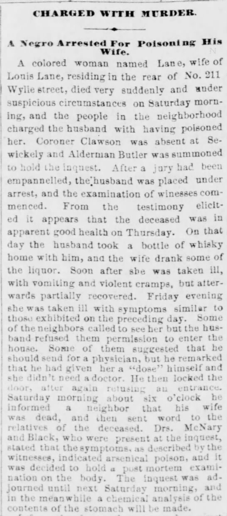
Taken in for questioning, he was seen throwing a small object into a fire. A vial, determined to be arsenic, was retrieved. Examination of his wife found she had been poisoned with arsenic-laced whiskey.
Newspaper reports at the time of his arrest provided widely divergent accounts of his past. The Pittsburgh Commercial of May 11, 1868, reported Lane had four previous wives and had served time in prison for poisoning one of them. The Pittsburgh Gazette of May 11 made the same report, but by May 18 was reporting five previous marriages and five previous suspicious deaths. The Pittsburgh Daily Post’s May 11 edition reported five previous wives, “two or three” of whom his neighbors said died suspiciously. The Ashland, Ohio, States and Union of May 13 reported two previous wives had been murdered. The Nashville Union and American of May 14 reported three previous wives had been murdered.
Lane’s first trial was held in June 1868. His jury deliberated fifteen minutes before finding him guilty of first-degree murder on June 18. After his motion for a new trial was rejected, he was sentenced to death on September 12, 1868.
He appealed, arguing that the jury instructions misstated the law in a manner that denied the jury the opportunity to fix the degree of murder.
The Pennsylvania Supreme Court agreed (Lane v. Commonwealth, 59 Pa. 371, 1868), and reversed his conviction. Lane was retried, convicted of first-degree murder on January 9, 1869, and sentenced to death on February 9, 1869. His death warrant was issued by Governor Geary on March 26, 1869.
Pittsburgh Daily Post, February 22, 1869
That he was able to frustrate the law to the extent that he did, despite his own pecuniary circumstances and the evidence and animus against him is consistent with newspaper accounts that he was well-represented (Pittsburgh Weekly Gazette, January 14, 1869 and March 30, 1869).
Described as a “queer, strange little man” by the newspaper reporters with whom he met, Lane is reported to have made a single request for his execution, that “when I go out to that yard to be hung I don’t want to see the face of a colored person there.” Other reports describe additional expressions of anti-black sentiment.
Louis Lane was executed on April 29, 1869. He is buried at St. Mary’s Cemetery.
Beyond the possibility of racial animus, no motive for Lane’s actions was ever established. Efforts by medical authorities to secure Lane’s body for postmortem examination were unsuccessful.
As Lane awaited execution, the case of the reclusive poisoner grew into a story of a scheming serial murderer and elevated him into a national sensation. Through interviews with Lane, tales of a shocking series of similar incidents unfolded: five previous marriages in Western Pennsylvania and Virginia and four previous suspicious deaths, and a prison sentence for attempted murder of his fifth wife in Washington County.
The story that Louis Lane told (parts that I have confirmed or added are indicated as such or included in parentheses) was of marrying his first wife and cousin, Rachel, in 1837, the same year Henrietta Butler was born in Pittsburgh. They had a son, William Thomas (and, it seems, a daughter, Sarah). In 1846, Lane left home for Wellsburg, (West) Virginia, where he worked as a deckhand on the Ohio River, and then Washington County, Pennsylvania.
Sometime around 1848 or 1849, he sent for Rachel. She died soon after rejoining him in Wellsburg, though Lane stated that Rachel is his one wife he did not poison.
Lane then moved to Wheeling, married a woman he had known previously named McKee, and moved back to Washington County. Their daughter, Margaret Ann, was born there before McKee died mysteriously in 1851 (more likely in 1848 or 1849), arousing short-lived suspicions.
This timeline does not match the 1850 Census, which shows Lane living in Washington County with his third wife, 26-year old Ellen (Bozier/Bosier/Boser), 11-year old Sarah, and 3-year old Margaret.**
Around this time, Lane moved to Pittsburgh for the first time, where he worked as a waiter at the Perry Hotel. Soon after Ellen died in Pittsburgh in 1854, apparently without suspicion or investigation, Louis married his fourth wife, named Lucas, and moved with her from Pittsburgh back to Washington County. There he worked as a waiter at the Mansion House. Lucas also died suddenly, in 1857. This death provoked suspicion among his neighbors, some of whom reported seeing stab wounds on Lucas after her death, though there is no evidence of a subsequent investigation.
Pittsburgh Daily Post, June 6, 1854Pittsburgh Daily Post, June 24, 1854
Still living in Washington County, Lane married his fifth wife, Emma Lewis. On November 30, 1859, Lewis became aware that Lane was trying to poison her. As she was lying in bed recovering from that attempt, Lane set their home ablaze, though Lewis was able to escape by jumping out the window. Finally caught, Lane attempted suicide. Emma was able to testify against Lane, leading to his conviction and a six-year prison sentence.
Baltimore Sun, March 6, 1860
Soon after being released from Western Penitentiary in 1866, Lane married and murdered Henrietta Butler.*
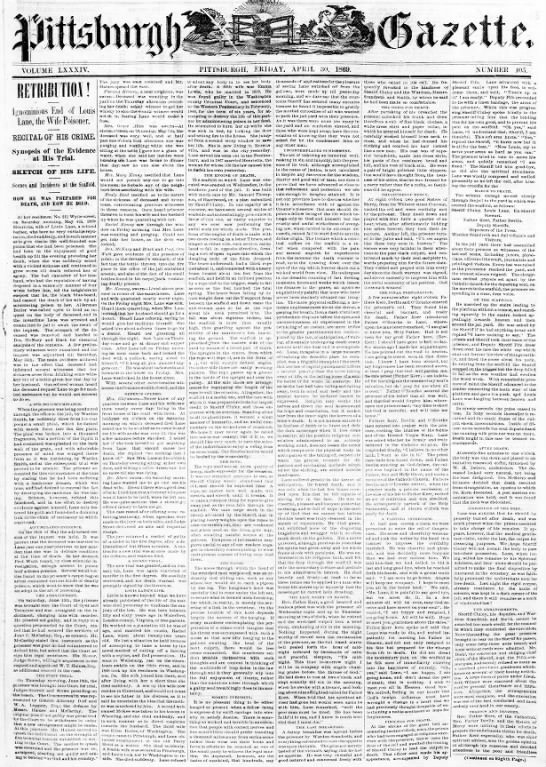
Race and gender had apparently converged to limit the law’s attention to Lane’s shocking crimes. Now that a serial murderer had been revealed, however, media and public attention were riveted (note the full page coverage in the Pittsburgh Gazette above). Dubbed the “Black Bluebeard,” after the serial wife murderer of French folktales, Lane’s execution generated enormous attention.
* Many of the details of this account were reported by the Pittsburgh Daily Commercial on April 30, 1869, based on interviews with Lane. This serves as the fullest account of this remarkable case, though its veracity must be questioned and is difficult to substantiate. As the Pittsburgh Daily Post noted, the events of the Lewis case are “the only authentic account we have of any [other] crime having been committed by Lane (April 30, 1869).”
My efforts to track Lane’s movements, marriages, and murders using court, marriage, and newspaper records have produced some confirming information and additional information about names and dates, though nothing confirming any of the other alleged murders. Likely indicative of the social marginality that made his serial murders possible, however, Lane leaves only faint fingerprints in the records I have examined until his final murder.
** In 1860, Margaret Lane was living with the Loyd family in Washington County, as was Amelia Boser, Ellen’s mother.
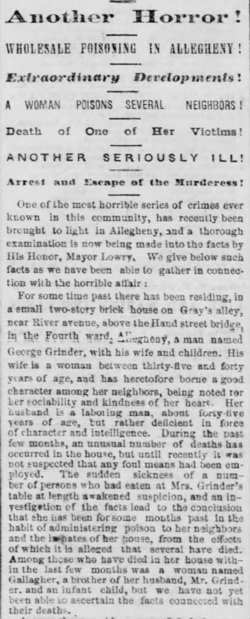
In 1859, George and Martha Grinder moved to Pittsburgh from Louisville, where they had married. The couple first lived in a meager dwelling near the Point while George, described as “slow and simpleminded,” worked as a coalminer (Pittsburgh Gazette, August 28, 1865). Martha apparently had financial ambitions far beyond those George, though from a propertied family, could provide, and the ruthlessness to pursue them.
Without any evident change in their financial circumstances, the couple soon moved to a nicer house on Gray’s Alley, across the Allegheny River in Allegheny City, where Martha quickly gained a reputation for her neighborliness.
Next door lived a younger couple, James and Mary Caroline Carothers. Soon after the Grinders moved in, Mary Caroline Carothers fell ill. Grinder tended to her as she battled bouts of worsening illness. By the time she died on August 1, 1865, the suspicions of James Carothers, who had also been ill, and others had been aroused.
Pittsburgh Gazette, August 26, 1865
Postmortem investigation found arsenic and antimony. Recognizing the trail of death – of Grinder’s first husband, other neighbors, and Jane R. Buchanan, the Grinder’s maid at their previous Pittsburgh residence – in her wake, investigators began to consider that the illnesses that Grinder had become so well known for tending she may also have been causing.
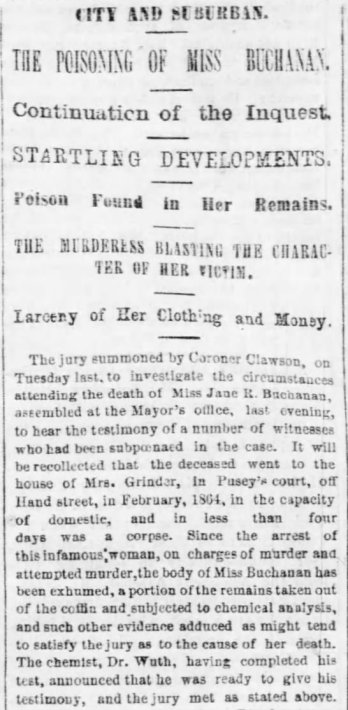
The Buchanan case, in particular, was reopened. After a brief bout of acute stomach pain, Jane Buchanan had died on February 28, 1864, only days after beginning work in the Grinder’s Hand St. (now Ninth St.) home. After Buchanan’s death, which had been ruled to be from natural causes, her friends were troubled to find that valuables were missing from her home. Buchanan’s body was subsequently exhumed and it was found that she had been poisoned.
Pittsburgh Gazette, September 2, 1865
Grinder was arrested on August 26, 1865. Her trial, which focused only on the Carothers case, and which included the testimony of James Carothers, other neighbors who had fallen ill in Grinder’s care, chemists and physicians, and a former servant who had purchased poison for Grinder, resulted in her first-degree murder conviction, on October 28, 1865.
Grinder was sentenced to death on November 25, 1865, at the same time that Frecke and Marschall were assigned the same fate. Pittsburgh had entered a notorious case into the golden age of poisoning. Another, that of Louis Lane, would soon follow.
All the while, the list of other possible victims grew to include her husband’s brothers, Samuel, a veteran of the Battle of Gettysburg who died while on medical leave at his brother’s home on December 4, 1864, and Jeremiah, who died on November 15, 1864. Their deaths reportedly increased the size of the inheritance available to George and Martha Grinder. Mrs. Marguerite Smith, another neighbor, and Mary Caroline Carothers’ sister, Mrs. J.M. Johnston, had also died under mysterious circumstances.
The total number of Grinder’s victims is a matter of considerable speculation. The sensationalistic press of the time characterized her as ruthless and boundless in her villainy, while more careful contemporary observers note the absence of adequate investigation to support many of the allegations.
Grinder, by now the “Pittsburgh poisoner” and the “Pittsburgh Borgia,” and also reported to have been an expert shoplifter, confessed to killing only Carothers and Buchanan prior to her execution.
Martha Grinder was hanged on January 19, 1866. As with so many others who went to the gallows, Grinder died slowly, fitfully, of asphyxiation (New York Times, January 21, 1866).
Philadelphia Inquirer, January 20, 1866
New York Daily Herald, January 20, 1866
In the space of less than eight years, Pittsburgh had executed two women; the only two women it would ever execute.
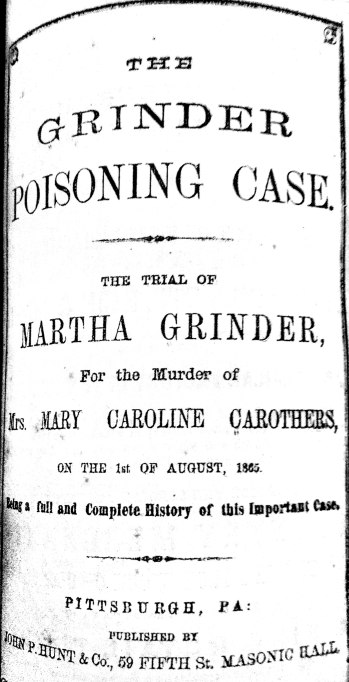
Grinder’s crimes and her execution were quite a sensation, receiving national newspaper attention and entering Grinder into the pantheon of female serial killers that is the subject of so much attention. As was customary for sensational murder cases of the day, the trial testimony was published as a quickly-produced book.*
As historically aberrational as the execution of two women in such close proximity was, these two executions, and the earlier death sentence imposed on Mary Martin, fit a larger pattern in which working class and black women are placed outside of the conceptions of ideal womanhood that otherwise protect women from the death penalty (Linders and Van Gundy-Yoder 2008).
George Grinder died at his home in Parker, Pa., northeast of Pittsburgh, on February 24, 1892.
Pittsburgh Dispatch, February 25, 1892
* An interesting aside relates to the case of Pamela Lee Worms. The account of her trial, confession, and execution in Pittsburgh in 1853 for killing her husband and daughter, though sometimes included among histories of female killers, is certainly fictional and is largely recognized as such. The popularity and this and other such stories at the time has been theorized as a patriarchal response against the broader roles being performed by middle-class women.
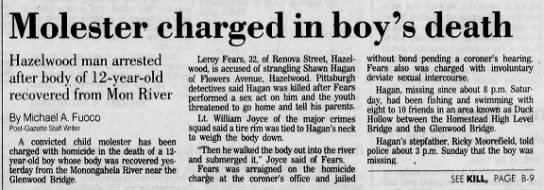
On warm summer days, the youth of Hazelwood play in the calm waters of Duck Hollow, on the Monongahela River. In anticipation of such a day, on June 17, 1994, Leroy Fears, a 32-year old resident of Hazelwood with a history of child sexual offending, paid 13-year old James Naughton to steal some alcohol from his parents and bring it to the river the next day.
Duck Hollow, Summer 2019
Naughton, his 12-year old friend, Shawn Hagan, and other boys spent the afternoon of June 18 drinking, fishing, and swimming with Fears. Later that evening, after Shawn’s friends went home, he stayed with Fears. It was then that Fears raped him, before tying a tire rim around his neck and throwing him in the river.
Pittsburgh Post-Gazette, June 22, 1994
When Shawn Hagan did not come home that evening, a search was launched. Police encountered Fears during their search. He was arrested based on his statements that he had been with the boys and had a record of child sexual offending.
After finding Hagan’s body in the river on June 21, police were able to elicit from Fears a videotaped confession and a reenactment of the crime. Fears was also linked to the murder through a DNA match.
So began an unusual five-month period in which five Allegheny County murders would ultimately result in capital convictions. In the background of this upsurge in capital prosecutions were the historic “tough on crime” elections of 1994, in which death penalty politics featured prominently; increasing executions and historic highs in death penalty support; and the enactment of the punitive and now controversial1994 crime bill.
Death Penalty Information Center
Not permitted to withdraw his confession, Fears, who was born to a twelve-year old mother, was sexually abused in foster care, had a 1984 conviction for sexual abuse of a boy, and had been diagnosed with severe psychopathology, pleaded guilty at trial on December 8, 1994, in an effort to avoid a death sentence.
Fears’ conviction and sentence were upheld on appeal (Commonwealth v. Fears, 575 Pa. 281, 2003) after the Pennsylvania Supreme Court rejected a series of challenges to Fears’ conviction and death sentence. The admissibility of his confession, given without the presence of counsel, was upheld. Perhaps most notable in that decision were the court’s rejection of evidence of Fears’ severe mental illness and rejection of the argument that his counsel’s failure to press the issue of Fears’ competency violated his right to adequate counsel.
Oak Spring Cemetery, Canonsburg, PA
Leroy Fears remains in prison under a sentence of death. He is currently the longest serving Allegheny County death row inmate.
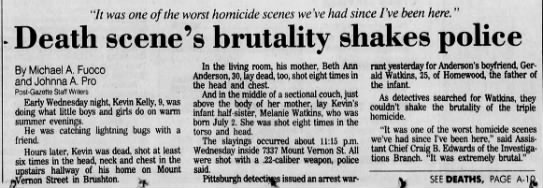
On July 20, 1994, Gerald Watkins shot and killed his girlfriend, Beth Ann Anderson, their eighteen-day old baby, Melanie Geray Anderson, and Ms. Anderson’s son, Charles Kevin Kelly Jr., 9, at her home on Mount Vernon St. in Homewood. The murders were especially brutal. Anderson was shot eight times. Kelly was shot six times, and Melanie Watkins was shot eight times. All of the shootings occurred at close range.
Pittsburgh Post-Gazette, July 22, 1994
Anderson was able to describe what was happening to a friend she was talking with on the phone when Watkins entered her home.
7337 Mount Vernon St. (two story house in center)
An unemployed construction worker with a history of drug charges but no violent offenses, Watkins became enraged after Anderson rejected his marriage proposal and he learned she was involved with another man.
Watkins fled after the shootings. A car he is believed to have used was found in Fort Lee, New Jersey. Sightings were reported in multiple states, but no arrest was forthcoming.
Intensifying their efforts, law enforcement officials placed Watkins on the Federal Bureau of Investigation’s ten most wanted list. The television program America’s Most Wanted aired several episodes about the case. Attention was focused on New York City, where Watkins was raised and where his mother still lived. Finally, he was arrested there on May 5, 1995, almost ten months after the murders.
While returning to Pittsburgh in police custody in August 1995, Watkins confessed to the killings.
At trial, Watkins denied his confession and claimed not to be in Pittsburgh when the killings occurred. With prosecution witnesses – including friends and neighbors of Anderson – placing him at the scene, a motive established, crime scene evidence, and a confession, Watkins was convicted of first-degree murder on December 12, 1996, and sentenced to death the next day.
Pittsburgh Post-Gazette, December 13, 1996
On appeal, Watkins challenged his death sentence and Pennsylvania’s death penalty statute. Those challenges were rejected (Commonwealth v. Watkins, 577 Pa. 194, 2003). Watkins subsequently challenged his conviction under the state’s Post Conviction Relief Act (PCRA). His claims – that his confession was invalid because a brain injury left him incompetent to waive his Miranda rights, that the jury selection process was invalid, and that evidence was wrongly permitted – were rejected (Commonwealth v. Watkins, 108 A.3d 692, 2014).
Wayne Cordell Mitchell and Robin Little met as students at Schenley High School in 1995. They had a son, Malik, in January 1997, and got married in Ohio on April 10, 1997.
Their relationship was troubled from early on, however, by Mitchell’s jealousy, anger, and alcohol abuse. Mitchell had grown up in an abusive and alcoholic home, was diagnosed with a personality disorder, had dropped out of high school, and was intermittently employed.
Living together in Little’s mother’s home, they argued frequently, leading Little to separate from Mitchell in July 1997 and to obtain a protection-from-abuse order against him. She then began seeing another man.
After Mitchell learned of this relationship, on September 1, 1997, he found Robin and raped her in her home. She reported the attack to police, leading to Mitchell’s arrest. He confessed to police and was held in jail.
7611 Hamilton Avenue., now an empty lot
In court proceedings soon after the rape, efforts to have Mitchell transferred to in-patient alcohol treatment prior to further legal proceedings allowed him to be released on his own recognizance to report for treatment. Little had apparently agreed to such an arrangement, though her family and counsel subsequently argued she thought she was agreeing to the treatment, not to the release prior to admission for treatment.
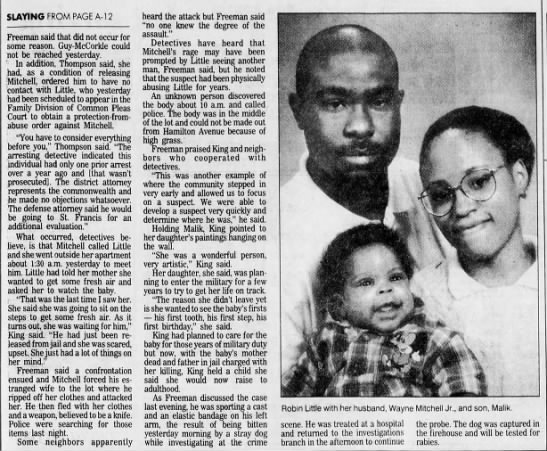
Out of custody on September 9, 1997, Mitchell did not report for treatment. Instead, he returned to Homewood, found Robin in her Hamilton Avenue apartment, left and spent several hours drinking, returned to Little’s home after midnight, raped her again, and stabbed her fifteen times. Her body was discovered in an empty lot two doors down from her apartment building.
When Mitchell sought admission for treatment that afternoon, he was arrested.
Pittsburgh Post-Gazette, September 11, 1997
The incident exposed the failures of the system designed to protect victims of violence.
Once in custody, Wayne Mitchell provided a full, audio-taped confession. Little’s diary, which became evidence, documented two years of abuse by Mitchell. Phone calls and letters Mitchell wrote boasting of Little’s suffering and death were also admitted as evidence. His defense centered on his history of alcohol abuse beginning at age 11.
Mitchell was found guilty of rape and murder on October 12, 1999, and was formally sentenced to death on December 8, 1999.
Pittsburgh Post-Gazette, October 14, 1999
His conviction and death sentence were affirmed on appeal when the Pennsylvania Supreme Court ruled that the trial court had not erred in rejecting his claim of diminished capacity related to alcohol abuse (Commonwealth v. Mitchell, 588 Pa. 19, 2006). Mitchell’s subsequent request for relief under the state’s Post-Conviction Relief Act (PCRA) was also rejected (Commonwealth v. Mitchell, 141 A.3d 1277, 2016).
Wayne Mitchell remains in prison under a sentence of death.



 Joseph Orosz was hanged on September 1, 1896.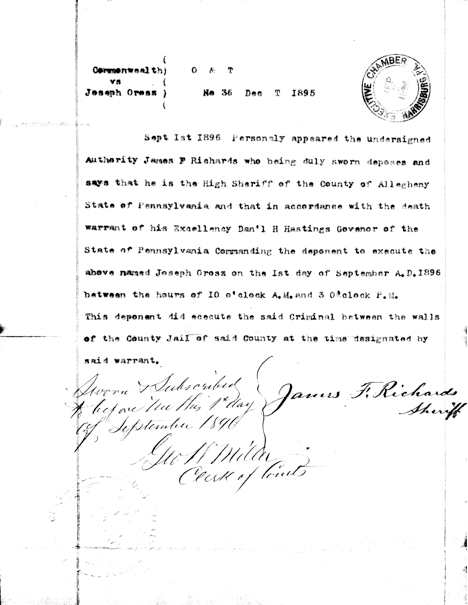


 The focus of these efforts was that Buchanan’s killing was not appropriately first-degree, though evidence that Woodley purchased the pistol the previous day and deliberated the day of the killing suggested otherwise. Though these efforts ultimately failed, it was reported that his execution was respited more than any other in state history.
 Albert Woodley was hanged in the Allegheny County Jail on January 2, 1896. Accounts of his execution indicate that he slowly strangled to death.





















 State Killings in the Steel City: The History of the Death Penalty in Pittsburgh