Ronald Taylor

Harboring strongly felt racial grievances and angry that maintenance workers had not repaired a broken door in his Wilkinsburg apartment, Ronald Taylor, 39, reportedly yelled “you’re all white trash, racist pigs” before setting his apartment on fire and going on a shooting spree in two nearby fast-food restaurants on March 1, 2000.
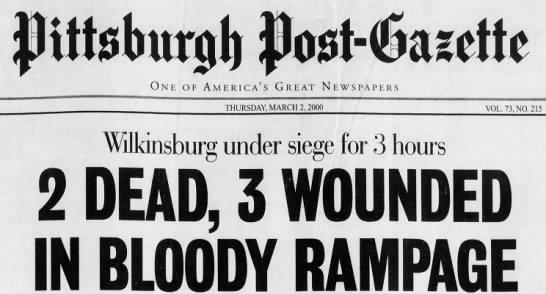
image001

Targeting white victims, Taylor killed maintenance worker John Kroll, 55, as he left his 1208 Wood St. apartment building, and Joseph Healy, 71, and Emil Sanielevici, 20, in nearby fast food restaurants. Two others, Steve Bostard and Richard Clinger, were injured.
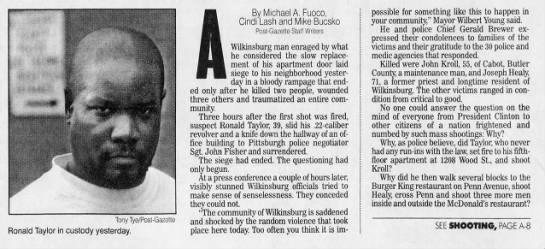
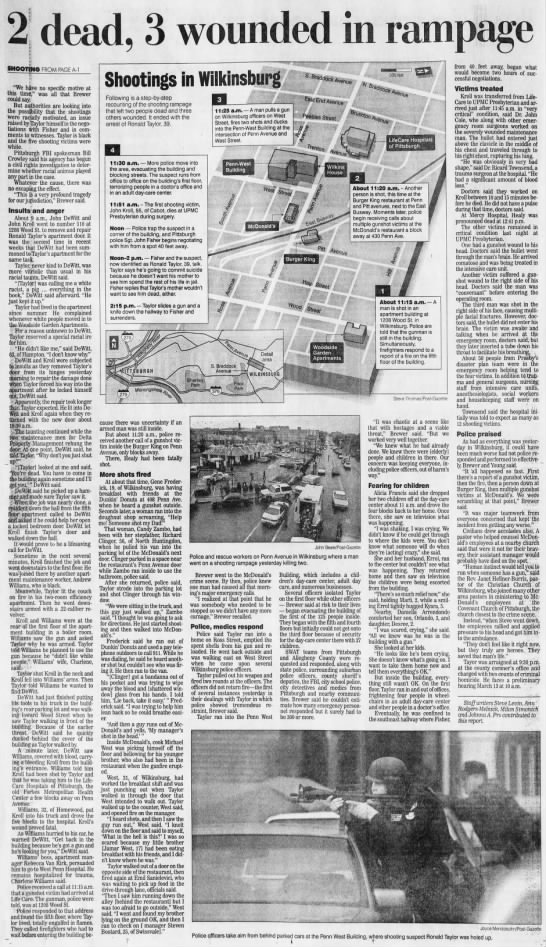
image001

image001
Pittsburgh Post-Gazette, March 2, 2000

Taylor then moved in and out of a series of apartments and offices before taking several white hostages in a medical office. He was encountered by police there. After pointing his weapon at police and at himself while raging about his racist mistreatment, Taylor surrendered.
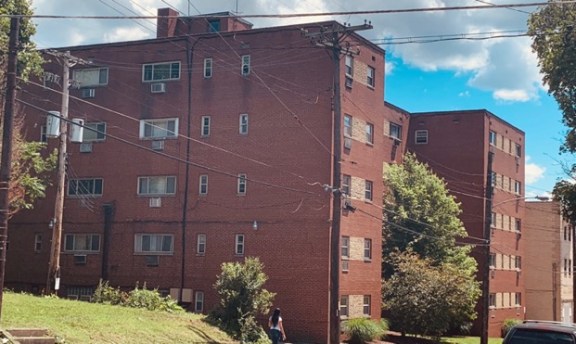
image001
1208 Wood St., Summer 2019

All of Taylor’s victims were white. Healy was a former priest. Sanielevici was a University of Pittsburgh student. Kroll worked with John DeWitt, with whom Taylor had argued immediately prior to beginning his shooting spree.
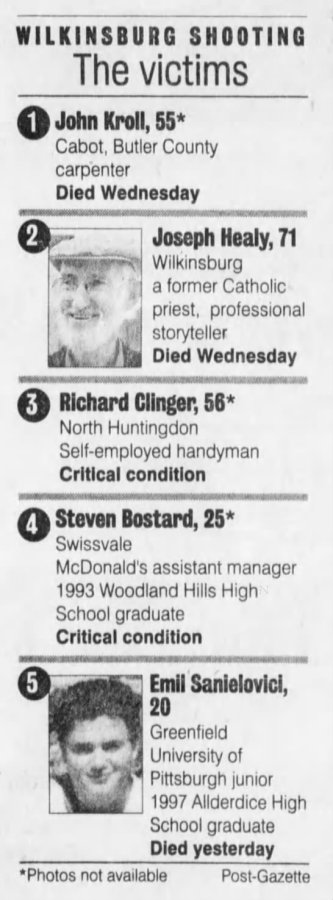
image001
Pittsburgh Post-Gazette, March 3, 2000

In Taylor’s apartment, where he lived alone and unemployed, police found a suicide note and a lengthy statement about the debilitating effects of his mental illness, his mistreatment by the mental health care system, and his hatred of whites, Jews, police, and others. Taylor, who grew up in the Hill District and had no prior legal issues, had received in-patient mental health treatment in the recent past. Friends and neighbors described him as quiet and well-liked.

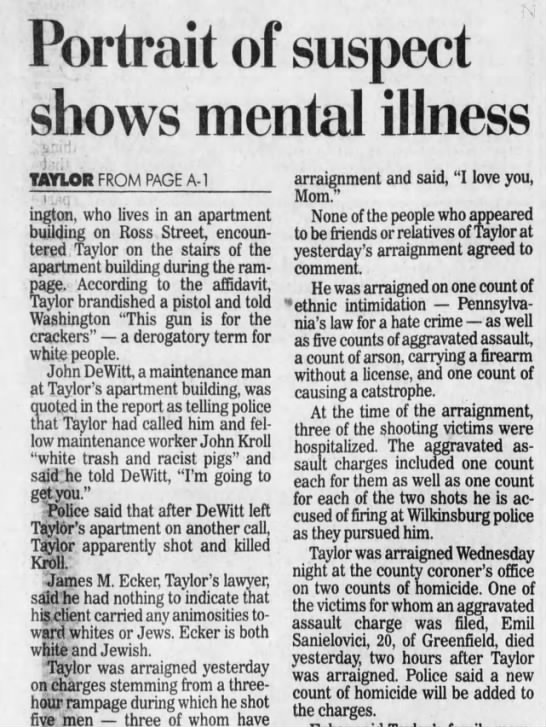
image001

image001

image001
Pittsburgh Post-Gazette, March 3, 2000

After initially being ruled incompetent to stand trial and committed to Mayview State Hospital, Taylor was tried by a jury of eleven white jurors and one black juror. Facing overwhelming eyewitness and physical evidence, Taylor’s mental health defense failed when even his mental health expert testified he was able to form criminal intent. Taylor was convicted of three counts of first-degree murder on November 8, 2001, and sentenced to death two days later.

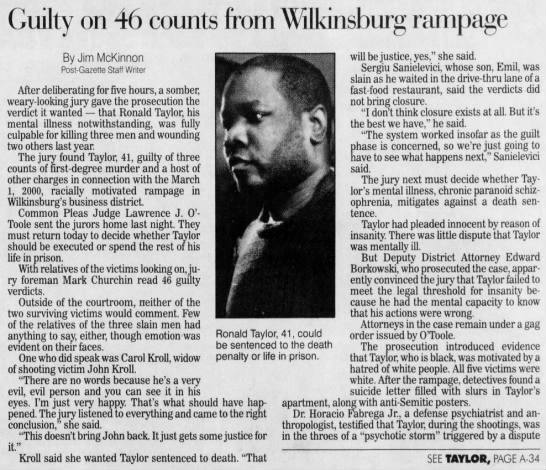
image001

image001
Pittsburgh Post-Gazette, November 9, 2001

His conviction and death sentence were affirmed on appeal on June 21, 2005 (Commonwealth v. Taylor, 583 Pa. 170), though the court left open the opportunity for future litigation over Taylor’s mental health in light of changing United States Supreme Court standards on that issue.

Ronald Taylor died in prison on April 2, 2024, while under a sentence of death.

Richard Scott Baumhammers

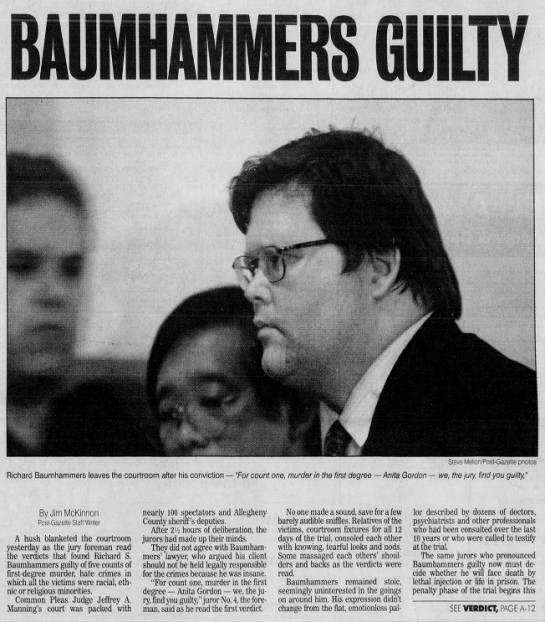
Less than two months after Ronald Taylor’s racially-motivated killing spree, Richard Scott Baumhammers, a reclusive, non-practicing immigration attorney who developed a deep hatred of non-Western immigrants and became an avowed white supremacist, carried out a hate-motivated killing spree across the South Hills. Over a two-hour period on the afternoon of April 28, 2000, he killed five people, injured one, and deliberately spared white people he encountered in his deadly path.

image001

His Mt. Lebanon neighbor, Anita Horvitz Gordon, an Orthodox Jew who lived at 788 Elm Spring Rd., was killed first. Baumhammers then used a Molotov cocktail in an effort to burn down her house, drove a mile to Beth El Synagogue, where she worshipped, and defaced the exterior with a swastika and gunshots.

image001
788 Elm Spring Rd.

Continuing, Baumhammers drove to Scott Towne Center, where he shot and killed Anil Thakur at an Indian grocery. Sandip Patel was seriously injured by gunfire at the same grocery. He then drove to Ahavath Achim Synagogue in Carnegie, which he damaged with gunfire. At Ya-Fei Chinese Restaurant at Robinson Towne Center, Baumhammers killed Ji-Ye (Jerry) Sun and Thao Pham. He then drove to C.S. Kim Karate Studio at Center Stage Shopping Center, where he killed Garry Lee.

At each stop, Baumhammers walked calmly from his car into the business to select and shoot his victims. Lee was with a white man when he was killed; the white man, George Lester Thomas II, was deliberately spared.

Baumhammers was arrested without incident as he drove away from the scene of the final murder. He was found to be in possession of the murder weapon, spent casings, Molotov cocktails, and spray paint. Subsequent investigation found evidence that Baumhammers, who had recently traveled extensively throughout Europe, viewed himself as the leader of a far-right movement.

image001

image001
Pittsburgh Post-Gazette, April 29. 2000

Baumhammers, the son of two prominent dentists, grew up in affluent Mt. Lebanon.

The initial determination of the court was that Baumhammers was mentally incompetent to stand trail. After several months of treatment, he was found competent on September 15, 2000.

At trial in 2001, he did not dispute his role in the killings; rather, he claimed mental disease. Witnesses testified that Baumhammers had told them that he committed the killings and that his motivations were racial. He was found guilty of all five murders on May 9, 2001.

image001

image001
Pittsburgh Post-Gazette, May 10, 2001

In a case that the presiding judge characterized as “more grotesque, vicious and frightening than any case over which I have presided or expect to,” Baumhammers was formally sentenced to death plus 112 to 225 years in prison on September 6, 2001.

His direct appeal was rejected when the Pennsylvania Supreme Court dismissed all of his varied claims (Commonwealth v. Baumhammers, 599 Pa. 1, 2008). Richard Baumhammers remains in prison under a sentence of death.
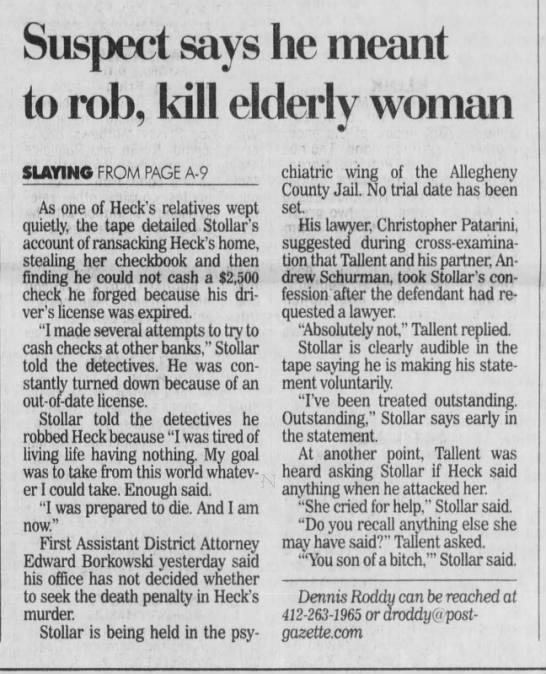
Kenneth Hairston

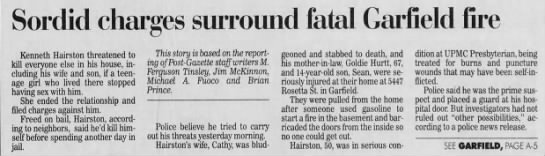
Kenneth Hairston was out on bail and awaiting trial on charges that he had repeatedly raped his stepdaughter, Chetia Hurtt, when he killed his wife, Catherine Hurtt Hairston, in their 5447 Rosetta St., Garfield home on June 11, 2001. Hairston’s 14-year old son, Sean, was also badly beaten. He died of his injuries on June 13.

image001

image001
Pittsburgh Post-Gazette, June 12, 2001

After bludgeoning his wife and son, Hairston went to a neighborhood bar before returning to the scene of the crime, stabbing himself, and setting the house on fire.

Catherine died immediately; Sean died on June 13, 2001. Catherine Hairston’s mother, Goldie Hurtt, 67, who was also in the home at the time, was seriously injured due to smoke inhalation.

image001

In the incident that led to his pending charges, on May 21, 2000, Hairston went to 21-year old Chetia’s apartment, forced her boyfriend, Jeffrey Johnson, out at gunpoint, and tried to rape Hurtt again. Notified by Johnson, police responded and arrested Hairston. Hurtt then told police of the seven-year history of rape she had experienced.

After being arrested in the deaths of his wife and son, Hairston confessed to police that he committed the murders to protect his family from the disgrace of his rape trial. In a case that featured his own confession, multiple eyewitnesses, and a clear motive, Hairston was convicted of first-degree murder on April 17, 2002, and sentenced to death by Judge Jeffrey Manning.

On appeal, Hairston raised a variety of due process, equal protection, and cruel and unusual punishment claims, all of which were rejected (Commonwealth v. Hairston, 603 Pa. 660, 2009).

After petitioning for and receiving the right to file claims that had been barred from his previous appeal, those claims were likewise rejected by the Pennsylvania Supreme Court (Commonwealth v. Hairston, 624 Pa. 143, 2014).

Kenneth Hairston remains in prison under a sentence of death.

Chetia Hurrt has courageously told her story of abuse and survival.

Patrick Jason Stollar

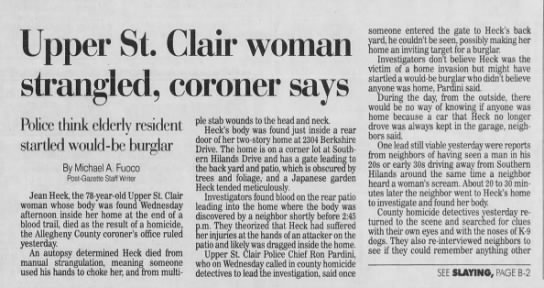
Patrick Stollar was working as a day laborer for a landscaping company at Jean Heck’s home in affluent Upper St. Clair on May 30, 2003. After casing the home and developing his plans to rob and kill Mrs. Heck, he skipped work for the next few days as the crew finished at Heck’s home.

image001

Returning there alone on June 4, he entered the home, killed Heck, a 78-year old widow, and ransacked her purse and house. He then tried unsuccessfully to cash several forged checks at local banks.

image001
Pittsburgh Post-Gazette, June 6, 2003

Tracked down based on evidence in Heck’s home and eyewitness identification provided by a neighbor, Stollar was arrested at a friend’s home on June 6. He immediately confessed to police, acknowledging that he used his job as cover for his criminal plans. He then led the police to the site where he had buried evidence of the crime, including the murder weapon.

image001

image001
Pittsburgh Post-Gazette, June 17, 2003

Other than drunk driving, Stollar had no criminal record, though he had a long history of employment, financial, and interpersonal problems. Friends reported that the well-liked and easy going Stollar had changed recently, becoming angrier. He was taking medications to treat anxiety and depression.

After lengthy negotiations, Stollar was allowed to plead guilty to first-degree murder and waive his right to a jury trial in both the guilt and penalty phases of his case. He entered that guilty plea on May 1, 2006, leaving the court the right to sentence him to life imprisonment or to death.

Unexpectedly, Stollar withdrew his plea the next day, explaining that if a guilty plea left him vulnerable to a death sentence, he would rather face a jury. Stollar is reported to have attempted suicide after pleading guilty.

In preparation for trial, Stollar sought and was granted the right to represent himself. After two lengthy delays while he received in-patient mental health treatment, the second of which was granted after another suicide attempt, Stollar went to trial in February 2008.

image001
Pittsburgh Post-Gazette, February 23, 2008

Representing himself, he was found guilty on February 20, 2008, and was sentenced to death two days later. His conviction and sentence were sustained on appeal (Commonwealth v. Stollar, 624 Pa. 107, 2014), after the Pennsylvania Supreme Court concluded that his various claims were “hollow,” “baseless,” “ridiculous,” and “fail woefully.” Quoting an earlier decision, the Court reaffirmed that “The right of self-representation is not a license to abuse the dignity of the courtroom” (at 133).

After being granted a new sentencing hearing in 2021, Stollar’s death sentence was commuted and he was sentenced to life in prison on October 24, 2023. The hearing was granted after the prosecution conceded that his original jury should have been instructed to consider his lack of a criminal history as mitigating evidence in the penalty phase of his trial.

Jean Lorraine Lloyd Heck was born in Elkins, West Virginia, in 1924.

Richard Andrew Poplawski

The deadliest day in the long history of the Pittsburgh Police Department, April 4, 2009, began with 22-year old Richard Poplawski and his mother arguing over the behavior of his dogs at her home at 1016 Fairfield St., Stanton Heights. The argument escalated to the point that she called the police and encouraged them to enter her house to remove Poplawski, who had a history of violence against his mother and girlfriend.

image001
Pittsburgh Post Gazette, April 5, 2009

Lying in wait armed with multiple weapons, Poplawski, an avowed white supremacist, anti-Semite, Stormfront member, and gun rights extremist who believed those rights were at risk under newly-elected President Obama, shot and killed three Pittsburgh police officers, Eric Guy Kelly, Paul J. Sciullo II, and Stephen James Mayhle, as they attempted to enter the home.

Poplawski was finally arrested after a four-hour standoff in which he and three additional officers were wounded.

image001
The home at 1016 Fairfield St., formerly located between the two houses on the right, has been demolished.

There are conflicting accounts as to whether Poplawski’s mother, Margaret, knew the officers were being drawn into an ambush. However, it is known that the 911 dispatcher failed to tell police that there were guns in the home after being told that there were by Margaret Poplawski.

Tried in Allegheny County by a jury selected in Dauphin County due to the notoriety of the case, Poplawski was convicted of three counts of murder and twenty-five related charges on June 25, 2011. With overwhelming evidence of his guilt, the greater legal uncertainty was whether Poplawski’s defense could avoid a death sentence. After presenting mitigating evidence related to Poplawski’s youth, his lack of a criminal record, and the racist, violent, and unstable home in which he was raised, the jury deliberated for 90 minutes before determining the many aggravating features of Poplawski’s case outweighed the mitigating evidence and sentenced him to death.

image001
Pittsburgh Post Gazette, June 26, 2011

His conviction and sentence were sustained on appeal (Commonwealth v. Poplawski, No. 654 CAP, 2015) due to the strength of the evidence “overwhelmingly establishing that he intentionally and fatally shot three police officers without provocation.”

IMG_0438 (2)
Liberty Avenue, Bloomfield

Richard Poplawski remains in prison under a sentence of death.

He was the last person from Allegheny County to be sentenced to death. With an execution moratorium in place; abolition of the death penalty in recent years in New York (2007), New Jersey (2007), Delaware (2016), and Maryland (2013), joining West Virginia (1965); declining death sentences and executions nationwide; and only three executions in Pennsylvania since 1962, it is entirely possible that no additional death sentences will be imposed. It is all but certain that no additional executions of Allegheny County defendants – the last was in 1959 – will take place.
Thomas J. McCullum

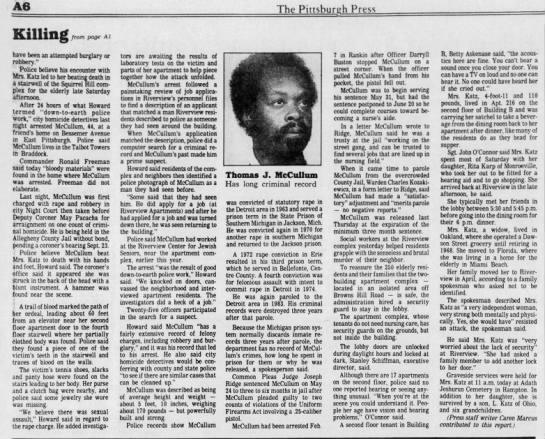
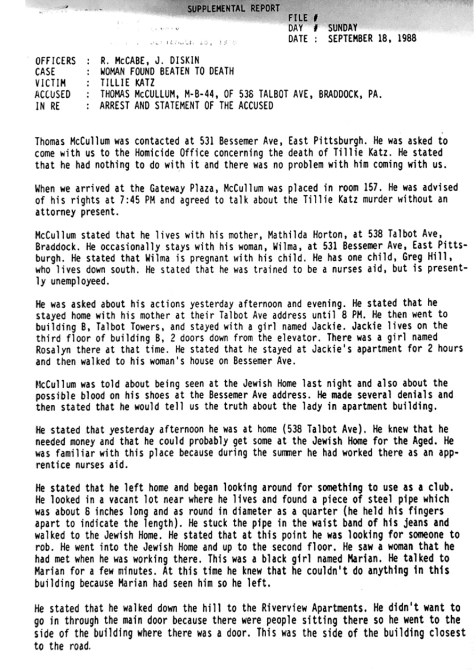
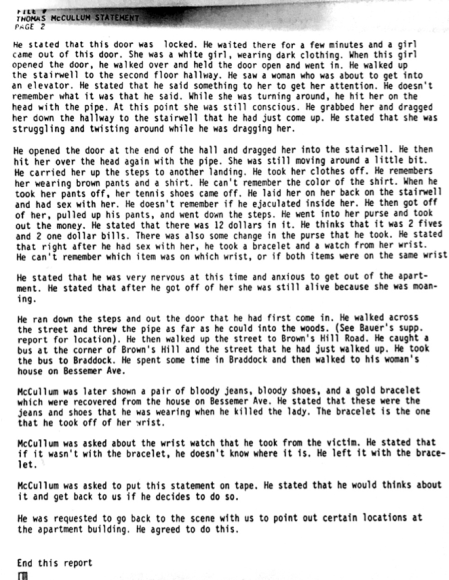
After gaining access to the Riverview Center for Jewish Seniors, in Squirrel Hill, on September 17, 1988, Thomas McCullum robbed, raped, and murdered Tillie Katz, an 83-year old widow, in a stairwell.

image001

image001
Pittsburgh Press, September 19, 1988

He then boarded a bus. At the last stop in Braddock, he assaulted the Port Authority Transit bus driver with a hammer.

McCullum, who was born in Mississippi and lived in Braddock, was taken into custody the next day after police cross-checked employment applications at Riverview with arrest records and found a match for the description of the suspect provided by witnesses.

Under questioning by police, McCullum admitted to the murder, explaining that he set out to commit robbery, then decided to rape and kill his victim. Jewelry and blood found on his clothing were obtained as evidence.

image001

image002

McCullum had recently been released from the Allegheny County Jail after serving three-months for a firearms conviction. His lengthy record included multiple rape convictions, including convictions in Michigan in 1963 and 1970, in 1972 in Erie, and for assault and attempted rape in Michigan in 1974. He was paroled in 1983. In 1972, he had sought psychological evaluation in Erie due to his inability to control his sexual urges.

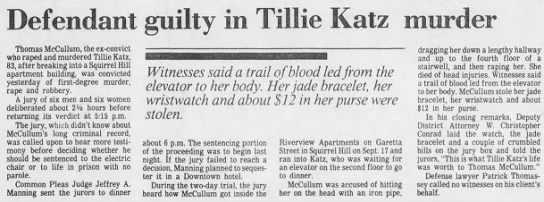
McCullum was found guilty of first-degree murder in the Katz case on June 22, 1989, and sentenced to death on November 1, 1989. On October 25, 1989, he was convicted of assault against Port Authority Transit bus driver, Joan Turner.

image001
Pittsburgh Post-Gazette, June 23, 1989

The evidence against McCullum in the Katz case was overwhelming. His conviction and sentence were sustained on appeal (Commonwealth v. McCullum, 529 Pa. 117, 1992), after the Pennsylvania Supreme Court rejected each of his numerous and wide-ranging claims. McCullum’s appeal under the Post-Conviction Relief Act, in which he alleged ineffective assistance of counsel, was likewise rejected (Commonwealth v. McCullum, 558 Pa. 590, 1999).

McCullum died on death row on November 1, 2007.

Ronald G. O’Shea

Ronald O’Shea had worked at Liberty Avenue News, part of the seedy downtown red light district of the era, until being fired for stealing money. Soon after, on November 21, 1985, he returned to the store, stole knives, throwing stars, gold chains, and cash, and killed store clerk Herbert George Kleber, 23, with a machete.

image001

image001
Pittsburgh Press, November 22, 1985

Kleber’s body was found by police during routine patrol early the next morning. He lived in Homestead with his wife and infant daughter.

Due to his recent firing and his extensive criminal history, Ronald O’Shea quickly became a suspect. The day after the murder, police drove to O’Shea’s brother’s home in Shaler, where Ronald was staying. Given permission to search Ronald’s room in his absence, they found items matching those that had been stolen.

O’Shea returned home while the police were still present and agreed to accompany them to the police station. En route, he discussed the case and ultimately confessed. According to O’Shea, he had returned to Liberty Avenue News for repayment of a small debt Kleber owed him. When Kleber punched him, O’Shea killed him.

image001
Pittsburgh Press, November 23, 1985

After a two-day trial, O’Shea was convicted on July 11, 1986. With felony murder as an aggravating circumstance that supports the death penalty, the prosecution sought and obtained the death penalty the following day.

image001
Pittsburgh Post-Gazette, July 12, 1986

O’Shea’s death sentence was upheld on appeal (Commonwealth v. O’Shea, 523 Pa. 384, 1990). The U.S. Supreme Court dismissed O’Shea’s appeal on October 1, 1990.

O’Shea had a criminal record dating to 1959 that included robbery and burglary convictions and a prior murder conviction. On October 27, 1971, he strangled Thomas Washington, a postal worker, in East Liberty after Washington rejected his advance. O’Shea was convicted in 1972. That conviction was reversed in 1974 when the State Supreme Court ruled his confession was inadmissible because it was provided in questioning conducted before O’Shea had been informed of his Miranda rights (Commonwealth v. O’Shea, 456 Pa. 288, 1974).

The state appealed that reversal. After the U.S. Supreme Court refused to review the case, the state failed to refile the charges within the 30-day time period required by the U.S. Supreme Court. As a result, the trial court dismissed the charges. When the state’s challenge to that dismissal was rejected (Commonwealth v. O’Shea, 465 Pa. 491, 1976), O’Shea was freed.

Returned to jail on robbery and burglary charges in 1976, O’Shea told authorities he had been approached by fellow inmate Charles Goldblum with an offer of $10,000 to kill four men, including three police officers.

Ronald O’Shea died of pneumonia on death row on February 1, 2000. He was 57 years old.

Paul Jaworski

In a series of daring and deadly crimes, Paul Jaworski and his “Flathead Gang” dominated the headlines and the courtrooms of Pittsburgh and the surrounding region in the 1920s.

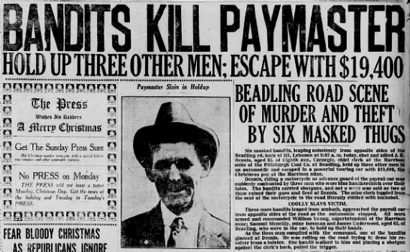
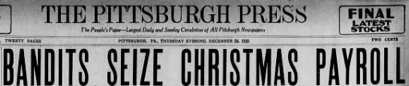
After a number of smaller robberies, Jaworski’s intense, almost suicidal spree began when he and his gang shot and killed payroll clerk John Ross Dennis while robbing him of the $23,000 payroll of the Pittsburgh Coal Company in Beadling on December 23, 1922.[i]

image002
Pittsburgh Press, December 23, 1922

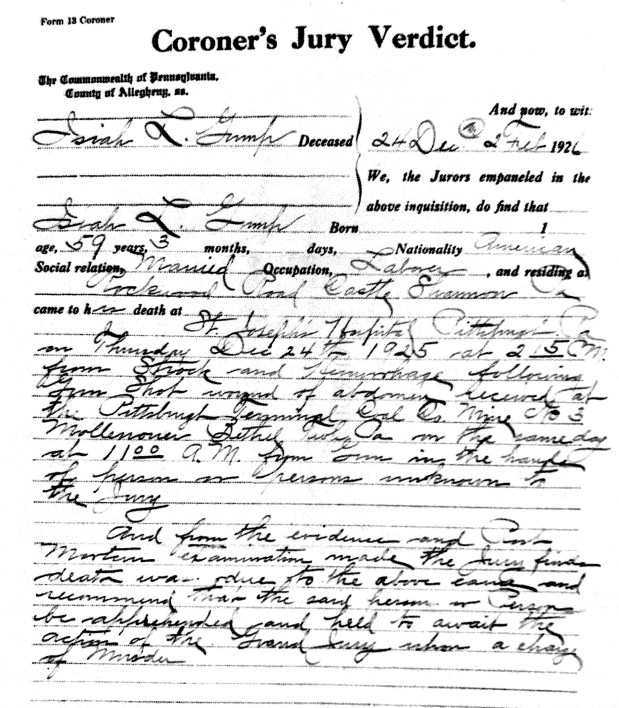
Three years later, the gang pulled the same heist, this time killing Isiah L. Gump, a payroll clerk at Terminal Coal Company, during a robbery at their Mollenauer mine on Christmas Eve 1925. More than $48,000 was stolen before Jaworski fled in a Lincoln touring car.

image002

image001.jpg

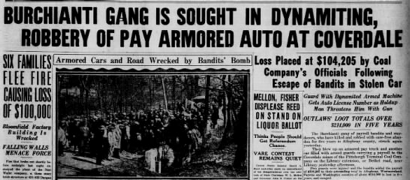
Able to avoid apprehension again, Jaworski returned to the headlines when he led the gang as they committed the first-ever armored car robbery using a landmine in Bethel Township, south of Pittsburgh, on March 11, 1927. They made off with the $104,000 payroll that was on its way to Coverdale, Pennsylvania for the Pittsburgh Terminal Coal Company. No one was killed.

image002
Pittsburgh Daily Post, March 12, 1927

Alerted by a suspicious neighbor, police arrested Jawarski the next day at the Washington County farm of Joe Woscoski. At the time of his arrest, he told police guns and ammunition were buried on the farm and confessed to killing Gump.

On March 26, 1927, just two weeks after his arrest, Jaworski pleaded guilty to killing Ross and Gump. He was sentenced to death on May 18, 1927, in the Gump case.

image001

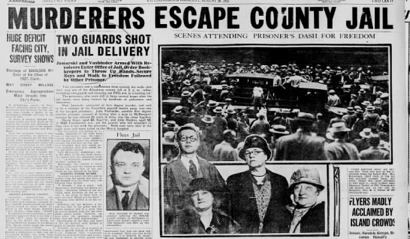
Three months later, on August 18, 1927, Jaworski and fellow murderer John Vasbinder escaped from the Allegheny County Jail. The escape occurred when Jaworski’s brother, Sam, smuggled guns into the jail. As he exited the visiting room, Sam Jaworski pulled out three guns, giving one each to Vasbinder and Jaworski, who then shot their way out of the jail. Two guards were wounded.

image002
Pittsburgh Press, August 12, 1927

Jaworski remained on the lam for over a year before being arrested in Cleveland on September 14, 1928, after a robbery and shoot out with Cleveland police in which Officer Anthony Wieczorek was killed and Officer George E. Effinger was injured. Jaworski was shot in the head by police, but survived.

At the time of his arrest, Jaworski and his gang were planning to storm the Allegheny County Jail to liberate his brother, Sam.

Jaworski was indicted for murder in Ohio the day after killing Wieczorek, raising the possibility he would not be extradited to Pittsburgh to complete his sentence. That his death was reported to be imminent due to injuries sustained in the gunfight with police further complicated his legal status.

Ohio authorities agreed on October 19, 1928, to extradite Jaworski. The appeal of his death sentence, which was pending at the time of his escape, was rejected on October 22, 1928.

image001

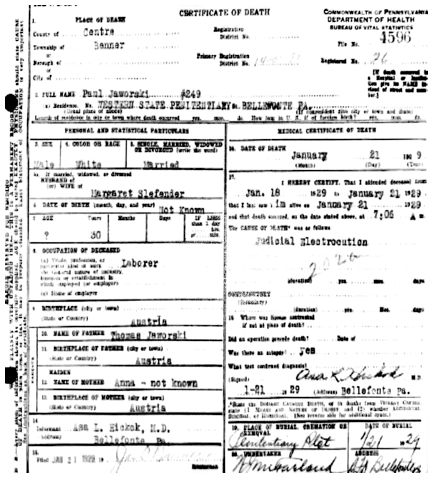
His efforts to win a stay of execution on insanity grounds unsuccessful, Paul Jaworski was executed on January 21, 1929. While awaiting execution, Jaworski claimed to have killed twenty-six people, including four police officers.

image002

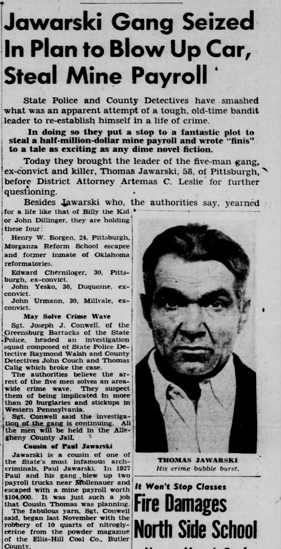
Long after Jaworski’s execution and the end of the gangster era he was so much a part of, his cousin, Thomas, sought to emulate his criminal exploits. That plot was foiled and Thomas Jaworski was sentenced to eight to sixteen years in Western Penitentiary.

image002
Pittsburgh Press, January 11, 1947

[i] Daniel Rastelli, a coalminer from Avella, was arrested, convicted of first-degree murder, and nearly sentenced to death in this case. Questions about his guilt led to a new trial, and Rastelli was acquitted on December 8, 1924. Jaworski subsequently took full responsibility for the killing and fully exonerated Rastelli.

John H. Vasbinder, Jr.

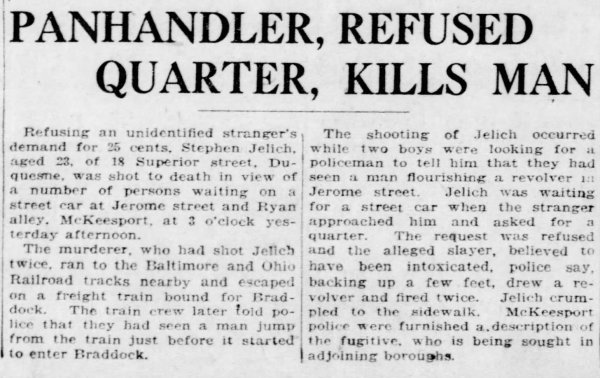
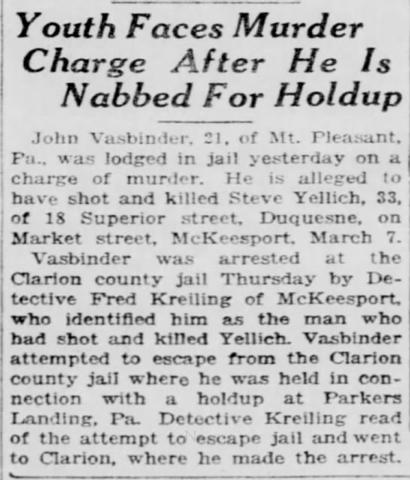
John H. Vasbinder, Jr. (alias Jack Bussinger) was a 22-year old with a long record of minor offenses when he shot and killed Stephen Yelich as part of a robbery on Jerome St. in McKeesport on March 7, 1926.

image004
Pittsburgh Gazette Times, March 8, 1926

Yelich, a Croatian-born Duquesne steelworker, was reported to have told Vasbinder to get a job if he wanted money, perhaps provoking Vasbinder to shoot him. Yelich’s two companions grabbed Vasbinder, who was able to escape. Subsequent newspaper accounts characterized Vasbinder as a drug fiend trying to get money for a fix.

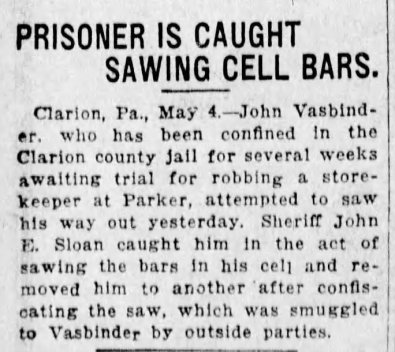
Vasbinder, who was raised in Clarion County, north of Pittsburgh, was arrested at the Clarion County Jail two months later, on May 6, 1926, where he was being held in connection with the robbery of a candy store in Parkers Landing, Pa.

image002
Pittsburgh Daily Post, May 8, 1926

He had tried to escape from the jail. The Pittsburgh Press account of the escape attempt alerted law enforcement to Vasbinder’s whereabouts.

image004
Pittsburgh Press, May 4, 1926

At trial, Vasbinder claimed the gun discharged accidentally during an altercation with Yelich. He was found guilty of first-degree murder on November 24, 1926, and sentenced to death on April 20, 1927.
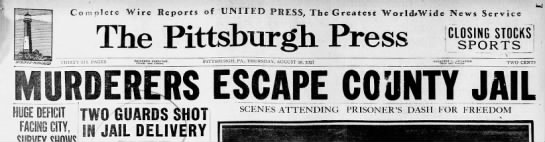
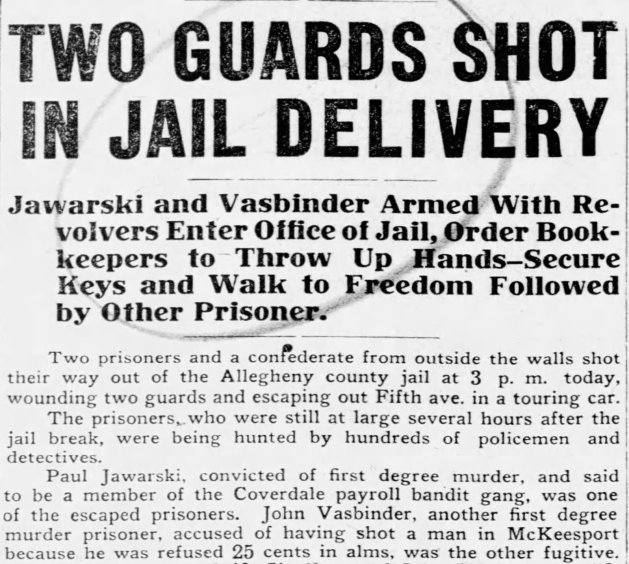
In jail, Vasbinder became acquainted with noted gangster Paul Jaworski, who had recently been convicted of first-degree murder. With the outside assistance of Jaworski’s brother, Sam, the pair broke out of Allegheny County Jail on August 18, 1927, shooting and wounding guards John Hanlon and Harry Riger in the process.

image001

image004
Pittsburgh Press, August 18, 1927

A massive nationwide manhunt followed. The search for Vasbinder was complicated by the fact that there was no known photograph of him.

While he was on the lam, Vasbinder’s appeal was argued and rejected (Commonwealth v. Vasbinder, 292 Pa. 506, 1928).

An effort to apprehend Jaworski and Vasbinder in a Cleveland restaurant on September 13, 1928, led to the murder of a police officer. Jaworski was also shot and apprehended; Vasbinder escaped. Jaworski, extradited to Pittsburgh, was executed on January 21, 1929.

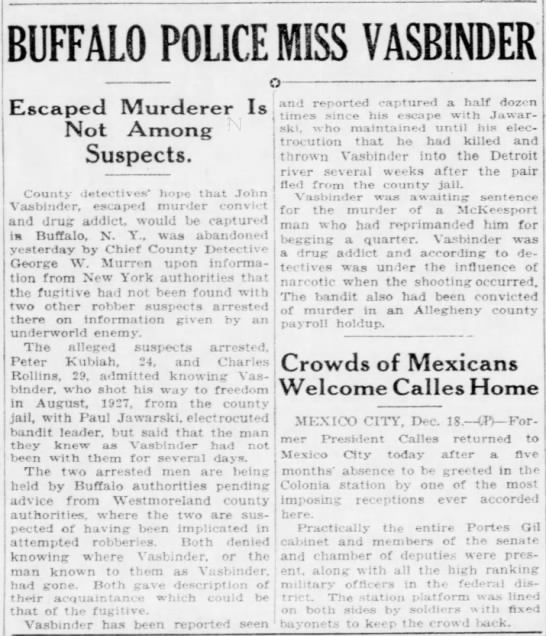
In October 1928, a man initially reported to be Vasbinder was killed during a robbery in Detroit. That report was soon rejected. Other reports, none of them confirmed, placed Vasbinder in Texas, Alabama, Cleveland, Buffalo, and his hometown in Clarion County.

image001Pittsburgh Post-Gazette, December 19, 1929

Prior to his execution in 1929, Jaworski reported that he killed Vasbinder and threw his body in the Detroit River. Police deemed the story a fabrication. None of the many claims about Vasbinder’s whereabouts were ever corroborated. A 1962 investigation by the state attorney general’s office found no trace of him.

John Vasbinder was never apprehended or heard from again.

Jack Thompson

On the evening of November 16, 1917, three Black men were reported to have robbed and stabbed a man in Duquesne and fled by streetcar. While investigating the case, Munhall Borough Police Officer Michael J. Lebedda saw two Black men on the Braddock Bridge.

image001

When Labedda approached the two men – later identified as Clarence Morgan and Jack Thompson – for questioning, Thompson is alleged to have shot him. Reverend Roskovic, who was a bystander on the bridge, was also shot and injured. The assailants fled.

Though Labedda and Roskovic were both able to provide descriptions of their assailants soon after the shootings – both 5’10” and of average build, one light-skinned and one dark-skinned -authorities initially had no idea of their names or their locations.

Labedda died the next day.

image002

Police arrested two men – Pinky Johnson and John Monroe – as they attempted to board a train that night. The men, both migrant laborers from Virginia reported to have quit their jobs at the Edgar Thompson Steel Works that same day, were thought to have known something about the killing.

Questioning led to the identification of Thompson and Morgan, though their whereabouts were unknown. Police alerted authorities in nearby cities, though they were only able to provide a “poor description of the men.”

Thompson, a 23-year old steelworker from Rock Hill, South Carolina, who had arrived in Pittsburgh only months earlier after working as a coal miner in West Virginia, was arrested in Concord, North Carolina, eighteen months later, in May 1919.

His arrest was said to have been based on a photograph. The Charlotte Observer reported that he confessed at the time of arrest. Clarence Morgan was never apprehended.

image002
Concord (N.C.) Daily Tribune, May 15, 1919

After being extradited to face trial, Thompson was convicted of first-degree murder on October 24, 1919, and  sentenced to death on December 20, 1919. He maintained his innocence throughout the proceedings, blaming the shooting on two other men.

image001
Pittsburgh Gazette Times, October 25, 1919

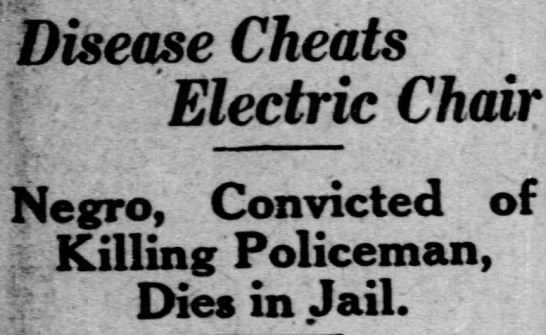
Jack Thompson died in the Allegheny County Jail on April 7, 1920, the third inmate to die while awaiting execution in twenty months. No clemency request or appellate review of his conviction had been undertaken.

image001
Pittsburgh Daily Post, April 8, 1920

Though his cause of death was listed as tuberculosis, his death, like the deaths of Byrd and Kemanos before him, was attributable to the influenza pandemic of that era. Newspapers accounts linked his tuberculosis to having “lost his nerve” after his conviction.

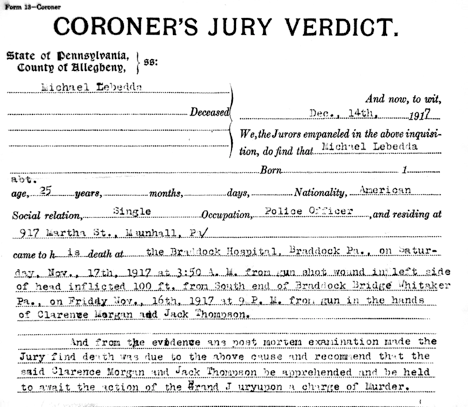
Screenshot 2019-02-01 08.48.36

From the Allegheny County Jail Murder Book, courtesy of Ed Urban.

The absence of a trial record, appeal, or clemency request are particularly unfortunate in a case such as this. The conviction of a recently-arrived single Black laborer for the murder of a white police officer in an era of heightened racism, in a case in which there was so little evidence and media attention, which relied on notoriously unreliable cross-racial identification, and in which the defendant consistently denied his involvement is certainly troubling.