Andrew Toth, Michael Sabol, and George Rusnok

The mill towns of Braddock and Homestead, on opposing sides of the Monongahela River, were the center of the Pittsburgh steel industry when Pittsburgh was at the center of the steel world. Though Homestead would come to represent the violent struggle for the dignity of steelworkers during the epic clash between striking workers and Carnegie Steel that occurred there in July 1892, Braddock’s Edgar Thomson Works, the largest jewel in Carnegie’s crown, operated through the same volatile mixture of class and ethnic tensions.

image001
Edgar Thomson Works, Braddock

Though Carnegie viewed the Edgar Thomson Works as a tribute to the Social Darwinist ideology of his “master,” Herbert Spencer, a place where the natural order dictated workplace relations, a much more exploitive reality prevailed. That reality was on full display on January 1, 1891, when already agitated workers, mostly recently-arrived Hungarian and Slavic immigrants, clashed with native born Western European management and supervisory personnel about working on New Year’s Day.
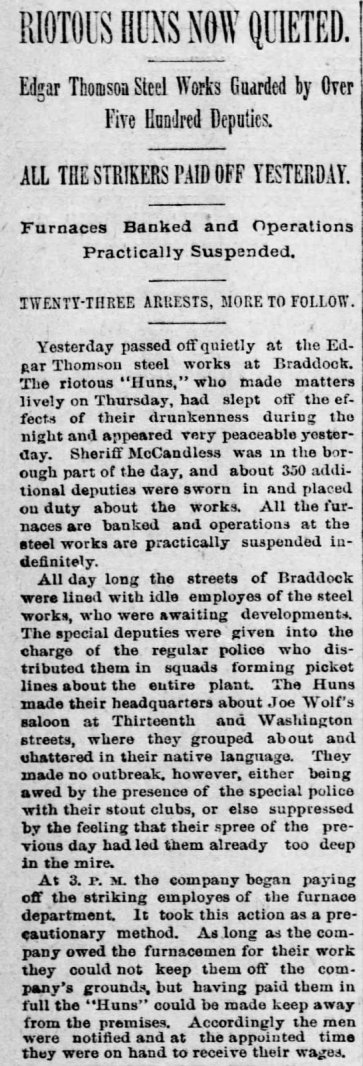
image001
Pittsburgh Daily Post, January 3, 1891

Michael Quinn, an Irish immigrant supervisor, was badly beaten during those clashes. He died on January 5; his cause of death was  listed as a fractured skull.

image002
Pittsburgh Daily Post, January 6, 1891
image002
From the Coroner’s file

Mass arrests followed the riots and the killing, cheered on by newspaper accounts of “semi-civilized Slavs.” Ultimately, dozens of defendants were tried for rioting.

Andrew Toth, Michael Sabol, and George Rusnok, all Hungarian-born steelworkers among the hundreds there that day, were arrested for Quinn’s murder.

Foreshadowing the Homestead Strike and the stark reversal of fortunes it represented for labor as well as the changing face of labor in industry, the three men were the first Eastern Europeans involved in a capital murder case in Pittsburgh’s history. There would soon be many others.

Toth, Sabol, and Rusnok were indicted on January 15, 1891, well before passions could cool. At trial in February 1891, held amidst stories of “riotous Huns,” socialists and anarchists, and nascent revolution, some witnesses testified that Toth administered the fatal injuries. Others testified that Sabol and Rusnok were involved and that Toth was not. Still others offered accounts that did not involve the three defendants.

Despite the conflicting testimony and a defense that drew attention to the rampant prejudice of the time and the trial, all three were convicted on February 7, 1891, on the thinnest of evidence, and sentenced to death on April 8, 1891. The twelve men sitting in judgment of them were, as far as I can determine, exclusively Pennsylvania-born of Western European ancestry.

On appeal, the court affirmed the first-degree murder convictions of each defendant on June 5, 1891 (Commonwealth v. Andrew Toth et al, 145 Pa. 308, 1891). In ruling that, despite the melee preceding Quinn’s beating and the confusion it created, the evidence was sufficient to sustain three first-degree murder convictions, the court stated “if there ever was a time in the history of this state when such a principle [of liability attached to a ‘common riotous purpose’] should be enforced it is now.”

The three hastily imposed death sentences were followed by regrets, recriminations, and, after protests across the country and a massive national and international clemency campaign, reprieves.

image001
New York Times, August 2, 1891

Away from the growing labor tensions in the Monongahela Valley, Governor Pattison commuted their death sentences to life imprisonment on February 2, 1892. At the time of their release from death row, the Post-Gazette referred to Toth, Sabol, and Rusnok as “very happy murderers.”

The conflicting trial testimony and the very different descriptions of what happened during the riot were the justification for the commutations. The high level of public passion about the case was also a factor. Even Andrew Carnegie and his lieutenant, Charles Schwab are reported to have favored the commutations.

Pardon campaigns followed. Included were petitions containing thousands of signatures from Hungarian and Slavic groups around the country, as well as from Braddock and Homestead. Also included were letters of support from the mayor of Pittsburgh; the Allegheny County Commissioner, Controller, Prothonotary, and Coroner; the Police Chief and the Justice of the Peace of Braddock, who wrote that “Rusnok and the other two defendants were litterly (sic) railroaded through the courts to conviction and it was not till it was too late that people came to their senses. Now it is hard to find a single person in the town of Braddock familiar with the facts of this case who does not believe that Rusnok should not have been convicted;” the editor of the Pittsburgh Press; and religious leaders. Their letters emphasized the discrimination and rush to judgment in the arrests, trials, and convictions.
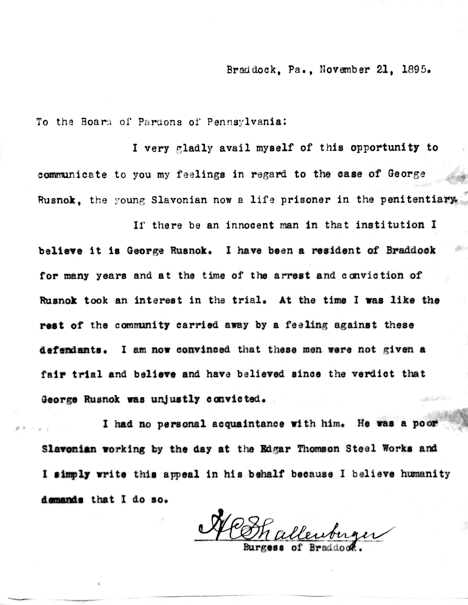
image002

In March 1895, Sabol was pardoned and released from prison. Rusnok’s pardon followed in October 1897. Both men remained in Braddock and resumed the lives that had been interrupted.
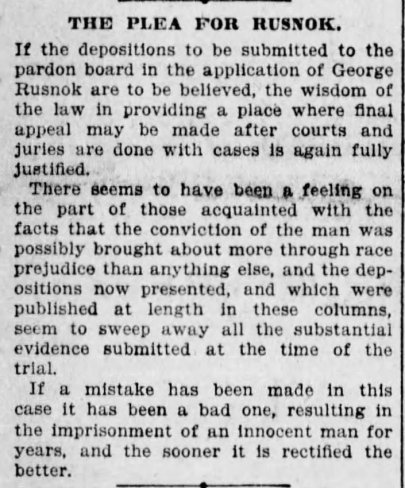
image003
Pittsburgh Press, June 22, 1897

Sabol, 25 years old at the time of Quinn’s death, married in 1899 and started a family. He died in Braddock in 1920. Rusnok, 22 at the time of Quinn’s death, married in 1898, and started a family. He and his family returned to Trebisov, Hungary (now Slovakia), the town of his birth, in 1903. He died there in 1916.

Efforts to have Toth pardoned were unsuccessful for more than a decade. Finally, on March 15, 1911, the state Board of Pardons recommended his pardon and he was released from prison.

image002
Pittsburgh Press, March 18, 1911

Efforts to provide him some financial compensation for his wrongful imprisonment were unsuccessful. “Broken and crushed” (Pittsburgh Daily Post, August 2, 1911), he returned to Hungary in August 1911.
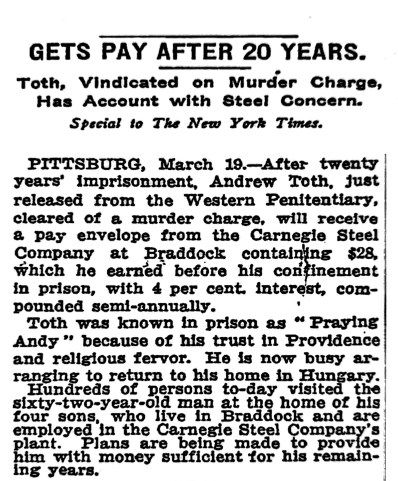
image001
New York Times, March 20, 1911

At the time of his release, the Pittsburgh Press, hardly sympathetic toward the cause of labor, referred to him as “innocent almost beyond a doubt” and “a modern Monte Cristo in servitude and sufferings.”

It was likely Steve Toth, a fellow steelworker but reportedly no relation to Andrew, committed the murder. He is said to have confessed from his deathbed in 1911, after he too returned to Hungary.

In his pioneering research on wrongful convictions, Yale law professor Edwin Borchard included Toth, Sabol, and Rusnock case in his 1932 book Convicting the Innocent.
Frank Gerade

Frank Gerade, a German-born painter, his wife, Sophia, and two children, lived in poverty on Shady Avenue, along the Pittsburgh, Fort Wayne and Chicago Railway line, above Woods Run Station in Allegheny. His brothers, Herman and William, and their families, lived nearby.

image001
Woods Run, 1908

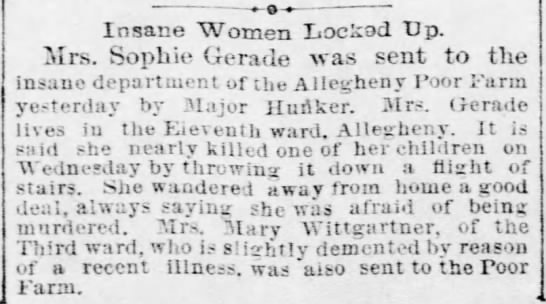
Over the course of years, the Gerades were regularly involved in serious incidents of child and spousal abuse. Sophia Gerade was arrested in 1887 for the near-fatal assault of her daughter. She was sent to the “insane department of the Allegheny Poor Farm” two days later (Pittsburgh Daily Post, November 4, 1887). Frank and Herman were arrested in 1888 when, after police responded to Herman beating his wife, Frank intervened and assaulted a police officer.

image001
Pittsburgh Daily Post, November 4, 1887

This tragic history culminated on March 15, 1890, when Frank Gerade beat and killed his eight-year old stepdaughter, Annie Hofer. Suggestive of the circumstances, the Pittsburgh Daily Post noted that a“ fitter place for the tragic occurrence of Saturday could not be imagined by the writer of dime novel fiction.” Annie’s death was caused by blunt force injuries to the head. There is no evidence or history of sexual abuse.

image002
Pittsburgh Daily Post, March 19, 1890

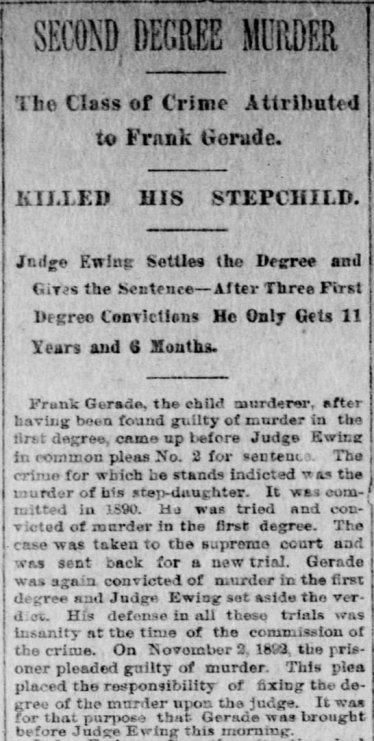
At trial, Gerade was convicted of first-degree murder on October 1, 1890. Ironically, though fittingly, his trial counsel was J. Charles Dicken. He was sentenced to death on November 8, 1890. It was the first Allegheny County capital case in which a child was the sole or targeted victim.[i]

At the time of Gerade’s conviction, an era in which the death penalty was being reconsidered, the Daily Post wrote that his conviction “may mark the advent of a more creditable era in the punishment of capital crimes in Allegheny county. And it may not.”

It did not, at least as that sentiment goes. Gerade’s original conviction was overturned on appeal due to concern that the jury instructions did not clearly explain how to regard evidence of Gerade’s insanity (Commonwealth v. Frank Gerade, 145 Pa. 289, 1891) and a new trial was granted on May 27, 1891.

He was tried a second time and convicted of first-degree murder on November 25, 1891. He was again sentenced to death. After a motion for a new trial, the court ruled on October 24, 1892, that Gerade’s conviction was invalid due to the strength of the evidence of his insanity.

A third trial followed quickly. On November 2, 1892, Gerade pleaded guilty. On April 17, 1893, the court set the degree of murder at second degree and sentenced him to 12 years in prison.

image001
Pittsburgh Press, April 17, 1893

Herman Gerade was arrested again in 1894 for beating his wife and threatening to kill her and their children.

Sophia Gerade, who did not speak English, and their surviving children were sent to the poor farm when Frank Gerade went to prison. She died in 1905.

After being released from prison in 1904, Gerade briefly returned to Germany. Frank Gerade died in Pittsburgh on August 9, 1928. He was 72 years old.

[i] Though a child died as a result of David Evans’ murder of his wife in 1858, Evans was not charged with her murder.

Alexander Killen

Rudert’s Jewelry Store, in Tarentum, was open late on December 23, 1889, to accommodate last-minute holiday shoppers. Mary Ann Rudert and her husband, Paul, were in the back of the Main St. store; their three children were in their adjacent home.

image001

Hearing the sound of breaking glass, Mary Ann ran in to the showroom while her husband went in search of his gun.

Interrupted as they loaded the contents of the display cases into bags, one of the three men robbing the store shot Mrs. Rudert once in the head. She died at the scene.

image002

Though passersby attempted to stop the men, they fled toward the nearby railroad or Allegheny River.

Alexander Killen, who operated a ferry on the Allegheny River,  was arrested soon after the killing. Though police did not have information that linked him to the murder, he had a record of similar offenses. He was part of group of youths convicted of assault with intent to rob in 1876, for which he served a prison sentence. He had also served sentences for vagrancy, disorderly conduct, and burglary. A gun was found in his possession at the time of his arrest.

Police determined that Peter Griffin and Thomas “Eggy” Conroy, who were positively identified from photographs as having been seen near the store the night of the murder, were the principals to the murder.

Despite an aggressive investigation led by Detective Patrick Fitzgerald, who was killed by the Biddle brothers a decade later, Griffin and Conroy were never apprehended. Reports of sightings of men matching their description came in from throughout Western Pennsylvania, Canada, Maine, and elsewhere.

In the weeks after his arrest, Killen denied knowledge of the robbery and murder, stating only that Griffin and Conroy, whom he knew from prison, and a Black man had borrowed his boat to cross the river after the murder and paid him in jewelry, apparently stolen from Rudert’s store.

A Black man identified as Harry Anderson was arrested in relation to the case in Ohio in April 1890 but was later released.

With police unable to develop any other leads in the case, Killen finally went to trial on  October 13, 1890. Though one witness identified him as having been at the store and another said he sold Killen ammunition early on the day of the murder, the primary case against Killen was based on his own statement that he had loaned his boat to Griffin and Conroy and the jewelry found in his possession. He steadfastly denied any knowledge of the murder.

Despite a weak and circumstantial case in which Killen featured as little more than an accomplice after the fact, he was convicted of first-degree murder on October 19, 1890. The jury was reported to be unable to reach a verdict before coming to agreement.

It was Allegheny County’s first capital murder involving a store robbery, a circumstance that would become far more common as retail proliferated.

image001

The foreman of the jury is reported to have wept while reading the verdict, while Killen’s attorney forcefully proclaimed that the matter was not yet settled. Newspaper coverage echoed the sense of injustice these actions suggested.

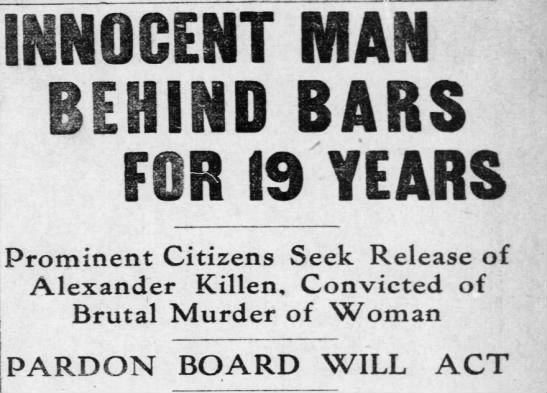
Due to questions about the extent of his involvement in the crime, Killen’s death sentence was commuted on October 29, 1891, and he was moved to Western Penitentiary to serve a life sentence.

image002

Pittsburgh Press, December 31, 1908

Questions about Killen’s role in the Rudert murder grew over time. The belief strengthened that he was entirely uninvolved in the case, a cause that was taken up by Pittsburgh civic, religious, and business leaders.

image001

With their support, his case was presented again to the Pardon Board, which recommended a full pardon on April 21, 1909.

image001

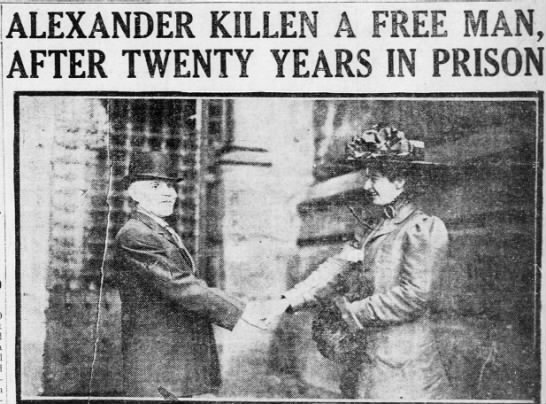
Alexander Killen was released from prison three days later. His release was treated as a cause for celebration, with closely observed newspaper accounts of his emergence into a modern world after almost twenty years behind bars.

image001Pittsburgh Press, April 24, 1909

Alexander Killen died in obscurity on January 25, 1925.

Paul Rudert remarried and became a prominent jeweler and businessman.

William H. Smith

In early September 1889, William H. Smith returned home from out of town and learned that his wife, Mary, was involved with another man, a barber named Patterson. Enraged at Mary’s infidelity, Smith “proceeded to reduce the whisky surplus” before shooting and killing her in their Hill District home on September 4.

image001
Pittsburgh, circa 1900

Mary Smith was 30 years old and had been born in Martinsburg, Virginia, four years before the western counties of that state formed West Virginia.

William Smith attempted suicide by shooting himself immediately afterwards. After recovering from his wounds, he confessed to police.

image002
Pittsburgh Dispatch, October 4, 1889

At trial, Smith pleaded not guilty and claimed drunkenness impaired his memory of the evening. He was convicted of first-degree murder on November 22, 1889.

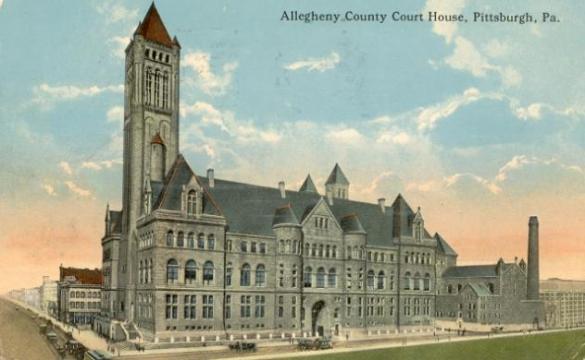
After his motion for a new trial was rejected, Smith was sentenced to death on December 7, 1889. His was the first death sentence imposed in the new, architecturally-acclaimed Allegheny County Courthouse.*

image001

Judge J.W.F. White, who imposed the sentence, openly expressed his opposition to capital punishment and his belief that death was disproportionate in this case, and encouraged a recommendation of clemency.

Demonstrating both racist paternalism and callous sexism, Judge White wrote to the Pardon Board that Smith, born into slavery in Virginia in the final months of the Civil War, was “illiterate and void of intellectual culture.” Though industrious and hardworking, he was “a poor, miserable, ignorant negro, who was infatuated with an unworthy wife” and that many white killers had served a lesser sentence (Pittsburgh Dispatch, March 18, 1890).

The Pardon Board recommended that Smith’s death sentence be commuted to life in prison on March 19, 1890. However, the Governor did not act on the recommendation. As Smith’s execution date approached, he received a respite, then another.

image002
Pittsburgh Dispatch, May 3, 1890

Finally, a sanity hearing (“Commission of Lunacy”) determined on August 14, 1890, that Smith was of unsound mind and unfit for severe penal discipline. He was sent to Dixmont Hospital, an insane asylum.

William Smith died in Woodville State Hospital on April 24, 1919, after almost 30 years of confinement.

Testifying to the disproportionate use of executions against Black defendants, Smith was the sixth Black man in Allegheny County history to be sentenced to death and the first to escape execution.

Testifying to the segregation of everyday life in nineteenth century Pittsburgh, every Black defendant sentenced to death prior to 1898 had killed a Black victim. As interracial homicides became more common in the twentieth century, the racialized practice of the death penalty intensified.

* The sweeping views of the courthouse were short-lived. In an act of “architectural infantilism,” the courthouse was literally overshadowed and largely hidden from view – “dwarfed and emasculated” – by the monuments to commerce that Carnegie and Frick soon erected across the street.

John Abernathy

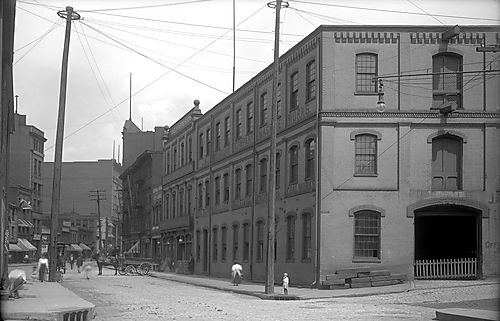
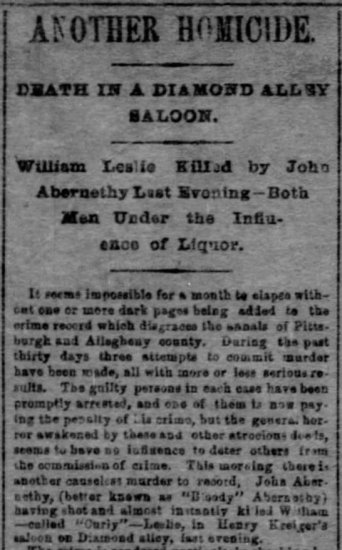
John Abernathy killed William C. Leslie during an argument in Henry Kreiger’s Diamond St. (now Forbes Avenue) saloon on the evening of December 5, 1881. Both men, who were acquaintances, were intoxicated.

image001
Diamond St., 1911

Their friendly conversation escalated into a discussion of who was tougher, which led to a fight, which led to threats, which, after Abernathy left the bar to obtain a gun, led to a shooting. After the shooting, Abernathy went to the bar next door. He was arrested there.

image002.pngNewspaper reports portrayed each man favorably, finding little of concern in the violence between them or in the violence in their backgrounds. Abernathy, nicknamed “Bloody,” was twenty-two years old and unemployed, with a prior conviction for disturbing the peace and reportedly unable to hold a steady job due to unreliability and troublemaking.
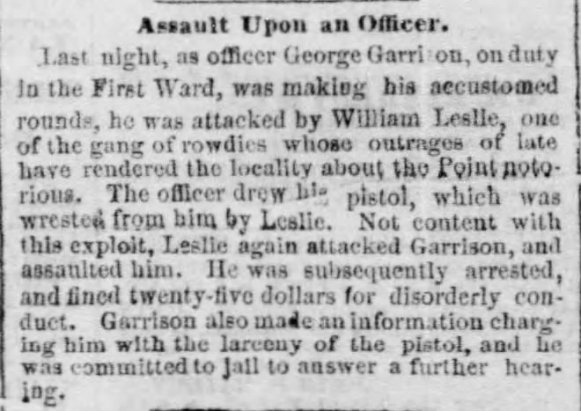

image004
Pittsburgh Daily Post, January 2, 1878
image003
Pittsburgh Gazette, November 9, 1865
image002
Pittsburgh Daily Post, July 25, 1881

Leslie, a 39-year old Civil War veteran of the 6th West Virginia Cavalry, millworker, and volunteer firefighter, was known for his physical aggressiveness.

image001
Pittsburgh Post-Gazette, December 6, 1881

Curiously, the Allegheny City-born Abernathy was related to another Allegheny City killer whose case followed a similar path. Abernathy’s mother, Catherine Teets, was the sister-in-law of Ambrose Lynch.

At trial, Abernathy argued self-defense and an absence of premeditation. Due to the circumstances of the murder – the role of alcohol, the spontaneity of the violence, the instigation by Leslie – it was widely expected that the well-connected Abernathy would be found guilty of second-degree murder.

Instead, he was found guilty of first-degree murder on December 30, 1881. In an era in which most murders involved white native-born or Western European-immigrant men, death sentences were few and executions were fewer.

image002
Pittsburgh Post-Gazette, December 31, 1881

After his motion for a new trial was rejected, Abernathy was sentenced to death on March 4, 1882.

Concluding that the trial court had prejudiced the jury by admitting Abernathy’s history of reform school without explaining that history as the result of paternal abandonment and by excluding evidence of Leslie’s “quarrelsome disposition,” the Pennsylvania Supreme Court reversed Abernathy’s conviction and granted a new trial on November 20, 1882 (Abernethy v. Commonwealth, 101 Pa. 322, 1882).

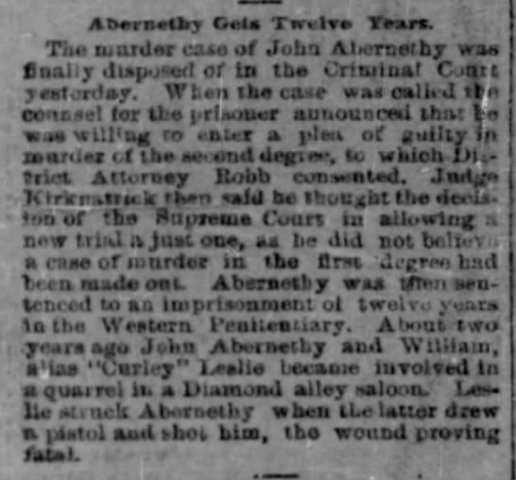
After entering a guilty plea, Abernathy was found guilty of second-degree murder and sentenced to 12 years in prison on April 17, 1883.

image001
Pittsburgh Post-Gazette, April 17, 1883

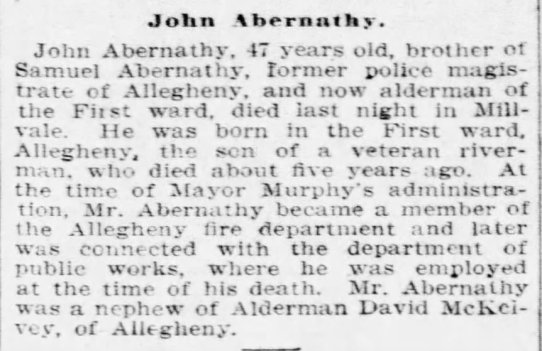
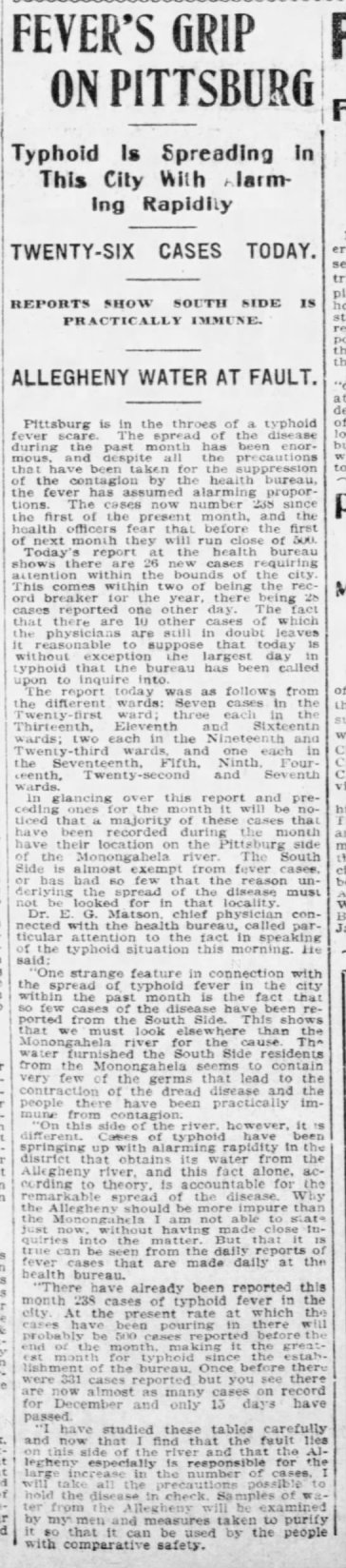
John Abernathy died of typhoid in Pittsburgh on April 27, 1906. His cause of death is notable in that Pittsburgh had the highest typhoid mortality in the United States in the years just before and after the turn of the 20th century.

image003
Pittsburgh Press, April 28, 1906

As explained by the Pittsburgh Survey in 1909, “[b]etween public indifference, private selfishness, and political inertia, the germ has pretty well had its own way with Pittsburgh, and the city’s annual waste of life from absolutely preventable disease has been a thing to make humanity shudder, had it been expressed in the lurid terms of battle, holocaust, or flood, instead of in the dumbly accepted figures of tuberculosis, typhoid, and infant mortality.”

image001
Pittsburgh Press, December 15, 1903

These problems were well-explored by the Pittsburgh Surveya pathbreaking compilation of social scientific reports on social conditions in Pittsburgh. More contemporarily, Carnegie Mellon University Historian Joel Tarr has done remarkable work on environmental conditions in industrial Pittsburgh. Central to his work is an emphasis on the dominance of private interests and the underdevelopment of the public sphere and public good in that era.

Henry Linkner

Henry Schafer’s badly beaten body was found in a ravine along Kitanning Road in West Deer Township on Friday, October 13, 1876. Evidence indicated that Schafer, a cow trader who lived in Deutschtown, Allegheny City, was killed at that location the previous day.

image001

He and his business partner, Henry Linkner, had been driving cattle home from Saxonsburg, Butler County. The men, fellow German immigrants, lived together in Schafer’s house with Schafer’s wife and two children.

Witnesses reported seeing a man matching Linkner’s description with Schafer’s horse, buggy, and clothes on October 13. Schaffer had also been carrying at least $100 in cash.

The circumstances of the crime created confusion. Linkner had a reputation for being soft spoken, polite, well-liked, and pious. It was Schafer who was viewed as  quarrelsome. 

Linkner was arrested at the cow market on October 14, covered with blood and in possession of Schafer’s watch and $100.

He protested his innocence throughout the case, first claiming Schafer was killed by Negroes and later that he was killed by some of his many enemies. The newspapers were sympathetic, suggesting that somehow Schafer may have provoked the killing or otherwise acted to mitigate Linkner’s responsibility.

The jury viewed the case otherwise, convicting Linkner of first-degree murder on December 29, 1876. He was sentenced to death on January 13, 1877.

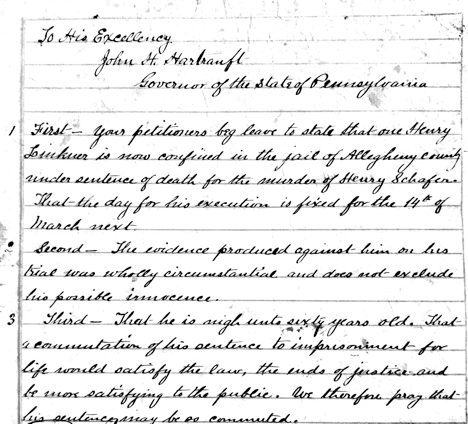
Linkner did not appeal his conviction. However, he filed a remarkable clemency request containing page after page of signatures, more than a thousand all told. Letters of support were also provided by the District Attorney, the editor of the Pittsburgh Post, and other community leaders. Their arguments for clemency centered on Linkner’s advanced age, the weakness of the case against him, and the appropriateness of a lesser conviction and sentence.

image002

The newly created Board of Pardons, established, ironically, to limit the influence of the types of campaigns that Linkner undertook, commuted his death sentence to life imprisonment on March 13, 1877. Later reports suggested that Linkner had “plenty of money” (Pittsburgh Post-Gazette, April 12, 1884), which assisted him in gaining clemency.

image002
Pittsburgh Daily Post, March 13, 1877

In failing health, Linkner is reported to have confessed his guilt to jail authorities after having been transferred to Western Penitentiary (Pittsburgh Post-Gazette, June 7, 1878).

Henry Linkner died in prison on September 4, 1879. In his will, he left money for a library for the jail and a bell for his church.

Frederick Meyers

In the first of a cluster of murder cases involving German immigrants, Frederick Meyers, owner of a saloon at Third Avenue and Market Street (in the basement of the rebuilt Philo Hall, which had been destroyed in the Great Fire of 1845), stabbed his employee, August (Adam) Dorn, on February 29, 1876.

image002
Pittsburgh Commercial, March 1, 1876

Whether or not Dorn had instigated the assault by stealing Meyers’ watch, as Meyers alleged,  is not clear, though possible. Whatever the case, Meyers harassed and taunted Dorn before stabbing him with a hot poker. Meyers was arrested for assault later that night.

Though initial reports indicated Dorn’s wounds were not serious, they proved fatal a few weeks later. Dorn, who was 54 years old, died on March 16, 1876.

Newspaper coverage of the case paints a picture of two disreputable and alcoholic older men, and a sadistic and escalating series of insults and assaults carried out in a seedy “notorious ‘dive’” basement bar.

At trial, the defense argued that Meyers was mentally unfit to sustain the charge. Meyers, who was said to have been suffering from delirium tremens and to have recently attempted suicide, was convicted of first-degree murder on April 20, 1876. His motion for a new trial, which again claimed Meyers was insane, was rejected. He was sentenced to death on September 5, 1876.

image001
Pittsburgh Weekly Gazette, April 18, 1876

Meyers’ insanity defense fared better before the Pennsylvania Supreme Court, which reversed his conviction on January 2, 1877 (Meyers v. Commonwealth, 83 Pa. 131, 1877) after finding that the trial court applied a “beyond a reasonable doubt” standard to Meyers’ insanity claim when a lower “preponderance of evidence” standard is required. The court also ruled that independent of Meyers’ sanity, the state had not established the intent to kill necessary for first-degree murder.

Meyers’ second trial opened on March 12, 1877 and closed without a defense the next day. After the prosecution presented its case, the defense offered to waive its case in return for a conviction of less than first-degree murder. Meyers, by now routinely referred to as “Poker,” was convicted of second-degree murder on March 13, 1877 and sentenced to 12 years in prison.

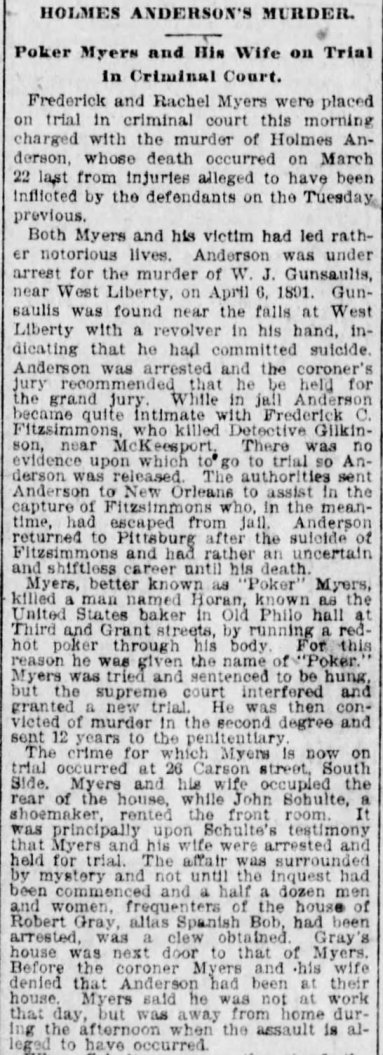
Despite his apparently advanced state of degeneracy, Meyers’ history of criminal violence was only beginning. A decade after being released from Western Penitentiary in 1886, Meyers and his wife, Rachel, were arrested for the March 1896 murder of Holmes Anderson, another man well-known to police who had been implicated in the murder of W.J. Gunsaulis in 1891.

image001
Pittsburgh Press, June 8, 1896

Anderson died several days after being assaulted by Meyers, a circumstance that led to Meyers’ voluntary manslaughter conviction on June 8, 1896. Rachel Meyers was acquitted.

image002
Pittsburgh Daily Post, April 11, 1898

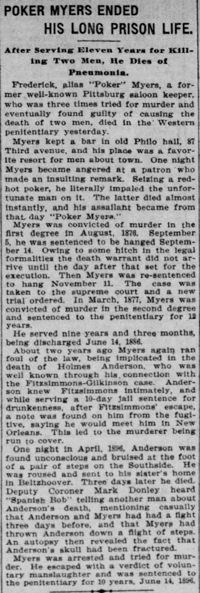
Meyers was sentenced to ten years in Western Penitentiary, where he died of pneumonia on April 10, 1898.

Philip Murray

Only 18 years old, Philip Murray was already an experienced ironworker employed at Shoenberger’s Mill in the Strip District. He and his older brother, Michael, had moved to Pittsburgh from Scranton and lived in Mrs. McGuigen’s boarding house in Lawrenceville.

image001
South Pittsburg and Allegheny City 1873

The Murray brothers had previously worked at Zug’s Mill, at Walnut (13th) and Etna Sts., also in the Strip District. While there, they had feuded with co-worker James White, who had previously boarded with Mrs. McGuigen.

The tension between the young men intensified in August 1874. Threats were exchanged by both sides, with both Murray and White having been heard to say they would kill the other.

After another round of threats was made, Murray went to Zug’s Mill on September 3, 1874. After pushing and shoving, Murray shot White several times. White died of his wounds eight days later.

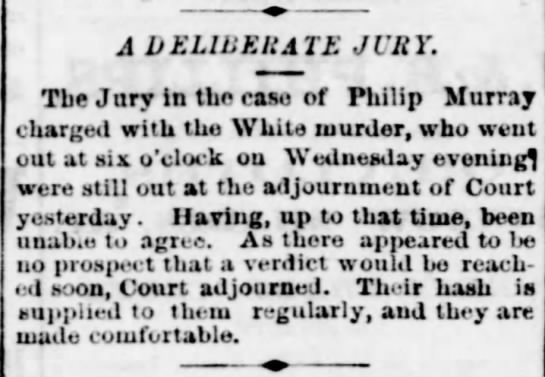
At trial, Murray claimed self-defense, citing the history of hostility between the men and White’s threats to kill the brothers. With testimony from Mrs. McGuigen that Murray had sworn to kill White and testimony from multiple ironworkers indicating Murray was the aggressor, he was convicted of first-degree murder on April 17, 1875, after lengthy jury deliberations.

image001

Murray’s motion for a new trial received unusually long consideration before being rejected. He was sentenced to death on June 12. He is the youngest person to be sentenced to death in Allegheny County.

Concluding that the state could not support a conviction above second-degree murder, Murray’s conviction was reversed by the Pennsylvania Supreme Court on November 15, 1875 (Murray v. Commonwealth, 79 Pa. 311, 1875). In support of its conclusion, the court cited the history of provocations involving the men and the absence of clear evidence that Murray acted with a well-formed intention to kill White.

On retrial, Murray was found guilty of manslaughter and recommended to mercy on June 12, 1876, a result much more in keeping with the reluctance of Allegheny County jurors to impose the full force of the law on young, white native-born men.

image001

On June 24, 1876, Philip Murray was sentenced to ten years imprisonment in Western Penitentiary. He was subsequently pardoned and released from prison on November 20, 1880.

A serious explosion, resulting in numerous deaths, occurred at Zug’s four months later.

image001
Pittsburgh Daily Post, October 13, 1876

Ambrose E. Lynch

Ambrose Lynch was a deputy sheriff in Allegheny City, where he lived with his sister, Mary E. Teets, and her husband, Samuel, at 190 Arch St.

image001
Arch St., 2020

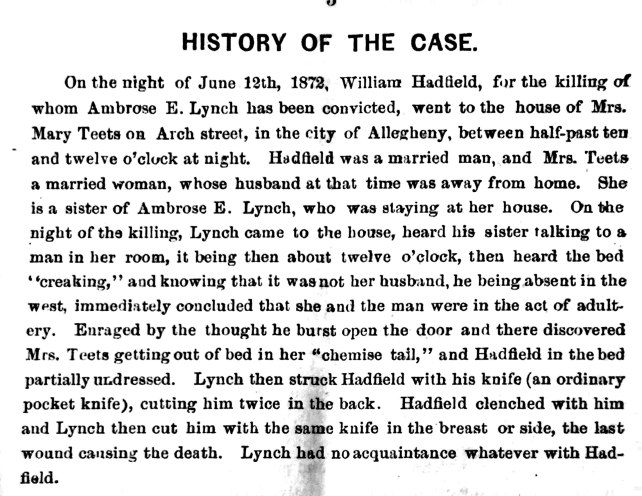
Coming home from work after midnight on June 12, 1872, Lynch, nicknamed “Bruiser,” found his sister in bed with William Hatfield, a married father of six and also a police officer. Enraged, Lynch entered her room and stabbed Hatfield, who stumbled out of the house and collapsed on the pavement in front of the North Avenue M.E. Church. He died later in the morning of June 12. Both men were Civil War veterans.

Lynch, who had a prior record for disorderly conduct, immediately confessed and claimed he acted properly in the face of the adultery he witnessed.

image001
From Lynch’s pardon request

His sister, whose husband was out of town on an extended business trip at the time of the killing, denied an extramarital relationship with Hatfield, saying instead that they were long time friends and were only talking.

image001
Pittsburgh Daily Post, June 13, 1872

At trial, Lynch claimed temporary insanity.  Confronted by his own confession and the testimony of multiple eyewitnesses, he was convicted of first-degree murder on July 10, 1872. After his motion for a new trial was refused, he was sentenced to death on January 18, 1873.

On appeal, he again argued that the conduct of Hatfield and Teets overwhelmed his reason. His conviction was upheld (Lynch v. Commonwealth, 77 Pa. 205, 1873) on November 22, 1873.

After a determined clemency effort supported by a number of prominent Pittsburgh attorneys, clergy, newspaper editors, and business leaders, the patriarchal logic that underlay Lynch’s actions and his defense were ultimately accepted by the State Board of Pardons. His sentence was commuted to life imprisonment on August 7, 1875. Central to that effort was the argument that the evidence of his sister’s adultery created such strong feelings in Lynch that “the elements of premeditation and deliberation were almost wanting” (from a letter to the Board of Pardons).

Another letter to the Board of Pardons in support of clemency, stating that Lynch’s “sudden and uncontrollable anger…under such suspicious circumstances” represented “the best feelings of the human heart,” well captured the patriarchal logic justifying Lynch’s actions.

image002

Lynch was transferred to Western Penitentiary. His legal efforts to contest his conviction continued until he was fully pardoned and released from prison a decade later, on December 23, 1885. He died of tuberculosis on June 27, 1888.

image002.png

In the years before and after the Civil War, Lynch was an early baseball pioneer and a star catcher with the Allegheny club.

image001Pittsburgh Daily Post, April 27, 1888
Samuel and Mary Teets remained married throughout their lives. He died in Philadelphia in 1902. She died there in 1904.

Thomas B. Keenan

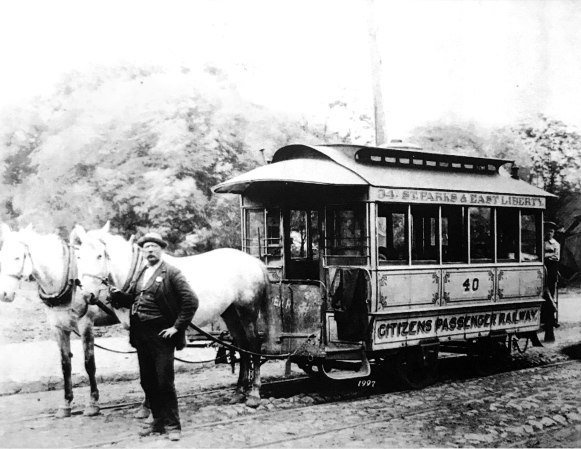
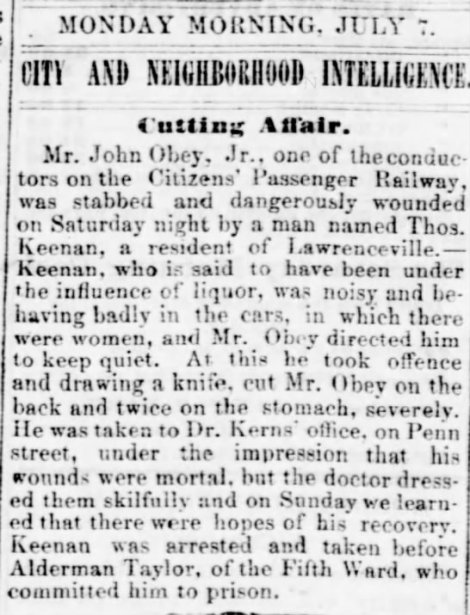
In another of the “cutting affrays” that were the focus of public attention at the time, Thomas Keenan stabbed to death John A. Obey, Jr., a conductor on the Citizens Passenger Railway, on July 5, 1862; it had been precisely a decade since David Jewell had committed a similar crime.

image001

Keenan, a 25-year old Irish-immigrant gunsmith at the Allegheny Arsenal, was returning from downtown to Lawrenceville on the trolley with a group of friends when Obey asked the rowdy and intoxicated group to settle down. When hey continued their rowdy behavior, Obey intervened again, a fight followed, and Obey, Pittsburgh-born and well known, was killed. The group of seven men was arrested.

image001
Pittsburgh Daily Post, July 7, 1862

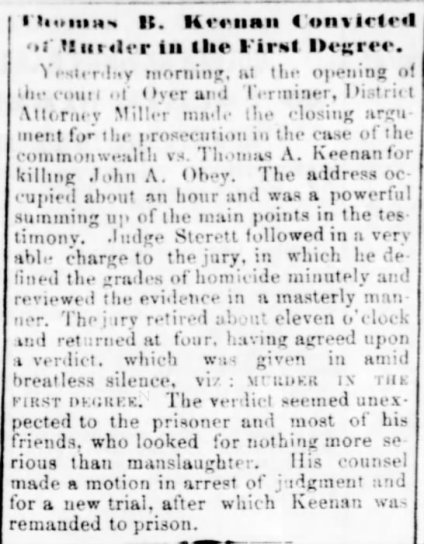
As President Lincoln removed General McClellan from command of the flailing Army of the Potomac in favor of a more aggressive strategy, Keenan was put on trial for Obey’s murder. In a case in which court-watchers expected a manslaughter conviction, Keenan was convicted of first-degree murder on November 13, 1862. After his motion for a new trial was argued and rejected, Keenan was sentenced to death on February 28, 1863.

image001
Pittsburgh Daily Post, November 14, 1862

His companions were acquitted.

Following an unsuccessful appeal (Keenan v. Commonwealth, 44 Pa. 55, 1863), which argued that inadequate consideration had been given to the extent of Keenan’s intoxication, Keenan sought a pardon.

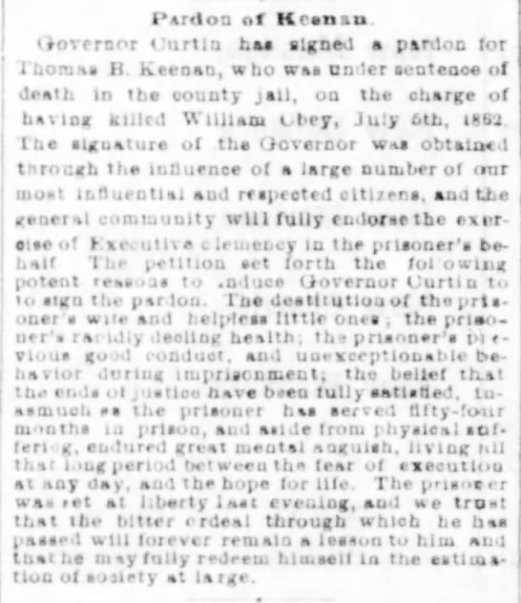
With public sympathy on his side and limited support for executions, Keenan sat in jail. After years in which his case languished, passing from governor to governor, Thomas Keenan was finally pardoned by Governor Curtin on January 12, 1867.

image001
Pittsburgh Daily Post, January 12, 1867

Soon after his release, Keenan, his wife, Alice, and two children, moved to Connellsville, Fayette County. He died there on March 31, 1892.

Much like John Lutz before him, who was pardoned after a suitable period of imprisonment, Keenan’s identity and popularity proved more powerful than the weak checks on the pardon process. The justification for his pardon noted that there was some doubt as to whether Keenan administered the fatal wound and that a number of witnesses were unable to testify at trial, but had provided affidavits on his behalf.

With growing concern about abuse of unfettered gubernatorial pardon power, Keenan’s was the last capital pardon in Allegheny County. The state Board of Pardons was established in 1872.

After Keenan’s conviction, the Pittsburgh Gazette editorialized against carrying daggers, arguing they demonstrated an intention to harm and were “a serpent in the bosom, which may turn upon him and inflict the fatal sting at any moment.”

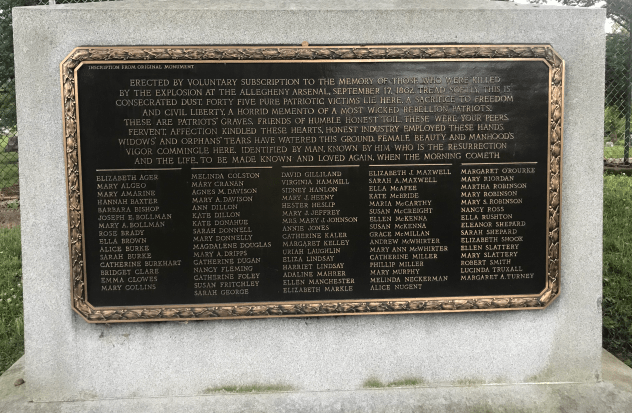
Two months after Obey’s murder, on September 17, 1862, an explosion at the Allegheny Arsenal killed 78 workers, all of them girls and women. It was the largest civilian tragedy of the Civil War and the largest single-incident loss of life in Pittsburgh history, occurring on the same day as the Battle of Antietam, the largest single-day loss of life in American history.

image001.png

Allegheny Cemetery