Edward DiPofi

When 19-year old Robert Stoner drove past his uncle’s home on the evening of March 4, 1948, the lights were on. Knowing the Broughton Rd., Bethel Township home should have been dark – Raymond and Elsie Klinzing were vacationing in Florida – the alert Stoner stopped, saw men in the home, and called police from a neighbor’s home.

image001

When police responded to the scene, they found Edward DiPofi and John Regis Wilson in the home and arrested them. While handcuffed and being escorted to a police car, DiPofi used a gun concealed in his waistband to shoot Officer Joseph Chmelynski and his partner, George Kercher. DiPofi and Wilson fled.
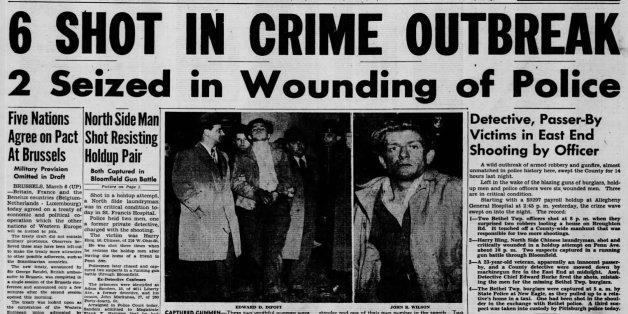
image003
Pittsburgh Press, March 6, 1948

Police set a trap for DiPofi at his home later that evening. When two men approached the home, police opened fire with a submachine gun. The two men – a police officer and a passerby – were wounded. DiPofi was not there.
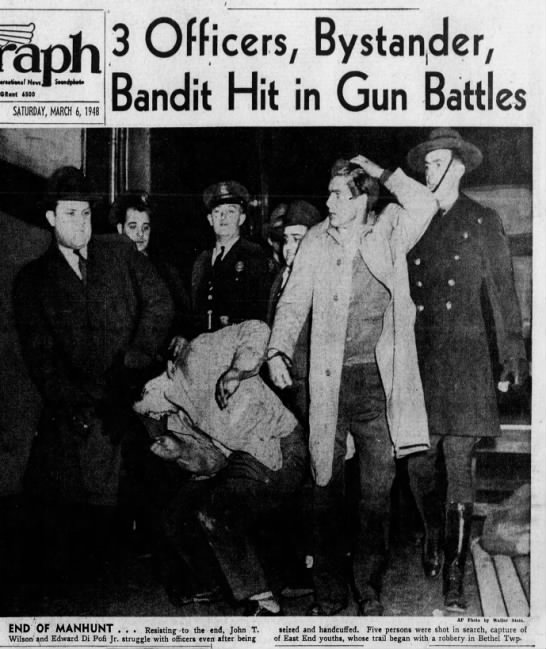
image001
Pittsburgh Sun Telegraph, March 6, 1948

DiPofi and Wilson were apprehended the morning after the killing, in New Eagle, Pennsylvania, after police were alerted by a suspicious taxi driver. The arrest occurred as the taxi arrived at DiPofi’s mother’s home.

Chmelynski died of his wounds on March 9, 1948. Kercher, who had been shot in the stomach, recovered.
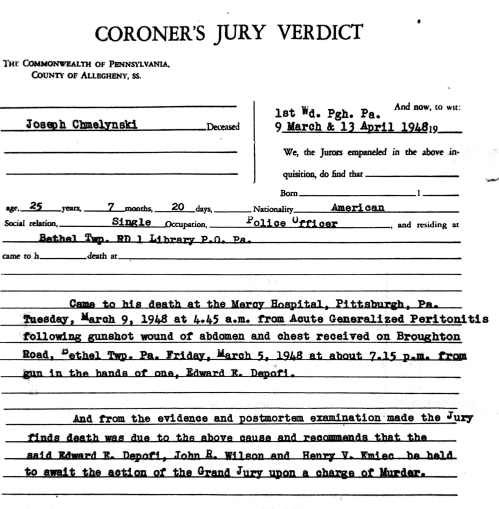
image001.png

Edward DiPofi was a World War II Army veteran from East Liberty. John Regis Wilson was his brother-in-law. They were part of a network of burglars active in the southern suburbs of Pittsburgh.

As they awaited trial for murder, DiPofi and Wilson were among a group of ten men who pleaded guilty to unrelated burglary and larceny charges. DiPofi was sentenced to 15 to 30 years on those charges. Wilson was sentenced to 20 to 40 years in prison. The gun later used to kill Chmelynski was among the items stolen by DiPofi.

At trial for Chmelynski’s murder, DiPofi was confronted by eyewitnesses that included Officer Kercher. He was convicted of first-degree murder on June 12, 1948 by a jury that included seven women and five men. After his motion for a new trial rejected, he was sentenced to death on September 29.

image001
Pittsburgh Press, June 13, 1948

After a delay to allow the passions of potential jurors to calm, Wilson made a last minute decision to plead guilty to murder in September. John Regis Wilson was sentenced to life imprisonment on September 14, 1948. He died on May 23, 1958.

image001

DiPofi’s appeal, which claimed prosecutors prejudiced the jury through the introduction of evidence related to fifteen previous crimes, was rejected (Commonwealth v. DiPofi, 362 Pa. 229, 1949) in favor of the state’s strained contention that knowledge of those convictions was used by the jury only in weighing sentence. Justice Jones filed a sharply worded dissent.

DiPofi’s appeal to the U.S. Supreme Court was rejected.

image001

Despite the heinousness of the crime and the strength of the case against him, a significant clemency effort was mounted on DiPofi’s behalf, involving churches, Italian organizations, and others. Central to that effort was a psychological evaluation that characterized DiPofi as a “psychoneurotic with hysteria,” that indicated he was a combat veteran of World War II who had received mental health treatment during his military service, and that he had experienced multiple traumatic head injuries as a child. This information, the report indicated, was unknown to the defense at trial.

image001

Edward DiPofi’s clemency request was rejected on December 21, 1949, and he was executed on January 9, 1950.

image002

DiPofi was the last white person from Allegheny County to be executed and only the second white person, along with Martin Sullivan, to be executed since 1930. Eleven Black men were executed during that period.

George Kercher became chief of police of Bethel Township. After being removed from that position by a newly elected board in 1951, a firing that he contested unsuccessfully, he was appointed to a position as a county detective. He died in 1954; never having fully recovered from the wounds inflicted by DiPofi. He was 47.

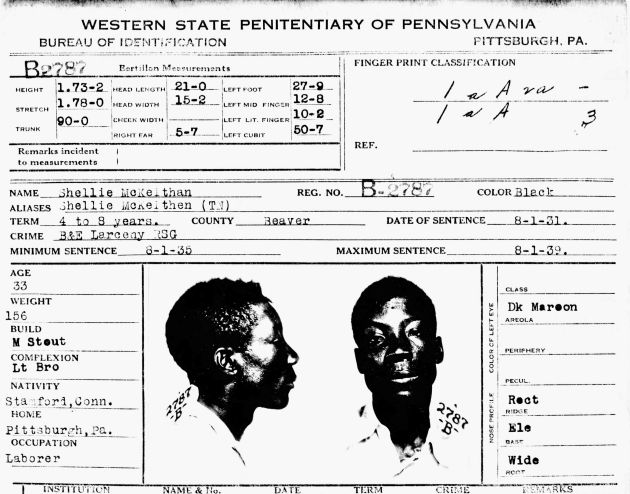
Shellie McKeithen

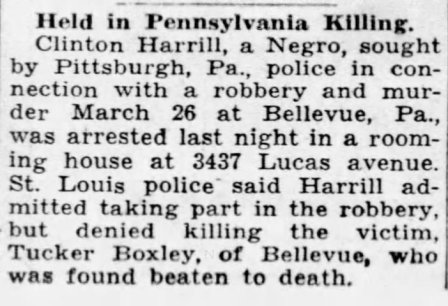
Shellie McKeithen lived in Aliquippa before moving to Cleveland. With Clinton Harrill, McKeithen returned to the Pittsburgh area on March 24, 1944, to rob Tucker Watkin Boxley, whom he knew to be involved in loan sharking and believed would have large amounts of cash in his Bellevue home.

On March 25, the two men robbed Boxley, 68, of $146 and some other items and beat him to death with a hammer. Unable to find any more cash, they set Boxley’s home on fire and fled.image002.png

After the murder, McKeithen, 48, returned to Cleveland, where he pawned some stolen items. When police later questioned the pawn brokers, they identified McKeithen, who was arrested in Cleveland on April 5, 1944. Harrill, 22, was arrested in St. Louis on April 13.

image004
St. Louis Post Dispatch, April 13, 1944

McKeithen confessed and implicated and testified against Harrill. In a trial that was delayed when the judge ruled that the prosecutor was intoxicated and insulting, Harrill was convicted of voluntary manslaughter on December 1, 1944. He was sentenced to six to twelve years in Western Penitentiary.

McKeithen was convicted of first-degree murder on January 10, 1945. After his motion for a new trial was rejected on April 18, he was sentenced to death. His was only the second and the last death sentenced imposed in the county during World War II.

image001
Pittsburgh Sun Telegraph, January 11, 1945

On appeal, McKeithen argued that he committed the same crime as Harrill and should have been charged similarly. The Court ruled against him (Commonwealth v. McKeithen, 353 Pa. 85, 1945), finding that the much younger Harrill was a secondary party, acting under McKeithen’s guidance. His clemency request was likewise rejected.

image001

Shellie McKeithen, who had a lengthy criminal record made up primarily of property crimes, was executed on January 7, 1946. His was the 99th execution in Allegheny County and the first involving a felony murder in which a Black defendant killed a Black victim.

Clinton Harrill died in Cleveland on November 1, 1984.

image001
117 Farragut Avenue on right

William McKinley Blackwell

William McKinley Blackwell and his common law wife, Eleanor Edwards, lived in a third floor apartment in the home of Annie McDonald in the mill town of Whitaker. Blackwell, who was employed as a steelworker at American Steel and Wire, also had a wife from whom he was separated and seven children in his native Virginia.

image001
American Steel and Wire, Rankin

Blackwell and Edwards had purchased some furniture from Richard Parker (aka Alvin Carter), the former owner of the home and Ms. McDonald’s stepfather. Parker was also involved in a relationship with the 22-year old Edwards, which Blackwell said he learned first hand when he found the couple in a compromising position.

When Parker, 44, came to the home at 1214 River Rd. on July 9, 1937, to collect payment on the furniture according to the state or to claim his right to Eleanor according to the defense, Blackwell, 42, shot him numerous times before shooting and also killing Edwards.

image003
Pittsburgh Sun-Telegraph, July 9, 1937

He was promptly arrested. Under questioning by police, Blackwell, who had a reputation for extreme jealousy, confessed on July 12.

The case was barely noted and poorly explained in local newspapers.

At trial, Blackwell claimed self-defense, asserting that Parker drew a knife and that Edwards attacked him with a knife after Parker had been shot. He was convicted on January 28, 1938, and sentenced to death.

image001.png

While awaiting execution, Blackwell elaborated on the circumstances of the killing, claiming he was justified in killing Parker to “protect his happiness,” as any other man would do in similar circumstances.

image001Pittsburgh Press, February 26, 1939

Due to the strength of his religious convictions, the efforts of his supporters, and “an unprecedented religious demonstration” by all 468 inmates in the Allegheny County Jail, his execution was delayed several times while commutation and pardon were considered.

William Blackwell was executed on February 27, 1939.

Henry Edwards

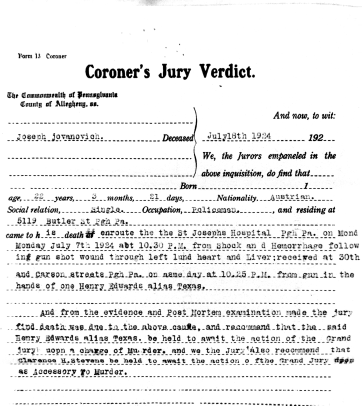
Henry Edwards and Clarence Stephens were on the streets of the South Side at 10:30pm on July 7, 1924, when Pittsburgh Police Officer Joseph Jovanovic and his partner, John P. Abbott, encountered them. Believing the two men to be acting suspiciously, the officers stopped and searched them. As they did, Edwards drew a gun and shot both officers. Edwards and Stephens then fled the scene.

image001
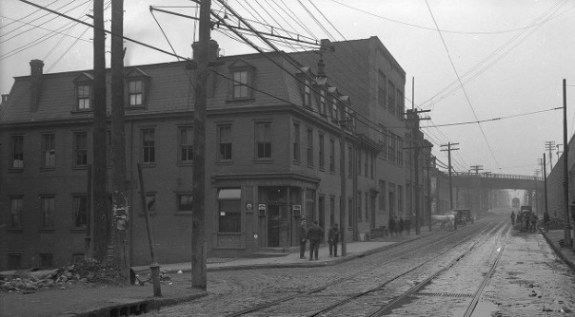
East Carson St., 1921

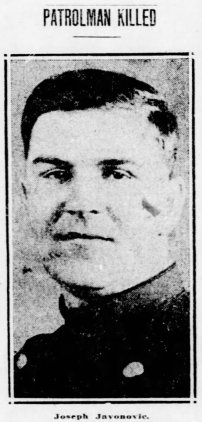
Jovanovic, new to the force and only 22 years old, died en route to the hospital. Abbott, who was shot in the arm, was not seriously injured.

image001.png

image001

Edwards, North Carolina-born, 34-years old, single laborer at the nearby Jones & Laughlin steel mill, had recently been searched by police, who viewed him as a suspect in the robbery of a South Side bar.

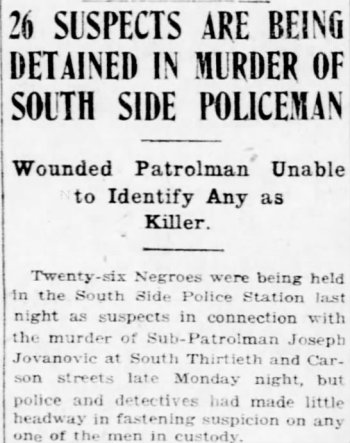
Within a day of Jovanovic’s murder as many as thirty Black men, including Edwards and Stephens, had been arrested as suspects.

image001
Pittsburgh Post-Gazette, July 9, 1924

Abbott was unable to identify either of his assailants, though Edwards was picked out of a lineup by Mildred Trobovich, a white teenaged girl who saw the killing from inside her home.

Under intense questioning by police, Edwards confessed.

After a brief trial at which he acknowledged the shooting but denied any intent to kill, Edwards was found guilty of first-degree murder on November 25, 1924. It was “one of the quickest murder verdicts on record” (Pittsburgh Daily Post, November 26, 1924). Edwards was the only defense witness. Multiple eyewitnesses testified against him.

Stephens was acquitted at the direction of the trial judge, who contended he had no prior knowledge of Edwards’ intentions.

Edwards, a North Carolina native, was sentenced to death on March 18, 1925.

image003
Pittsburgh Press, June 28, 1925

After his clemency request was rejected, Henry Edwards was executed on June 29, 1925. In a move that was unusual at the time, Jovanovic’s father and brother were granted special permission to witness Edwards’ execution.

Henry Jackson

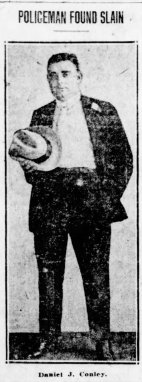
Police Officer Daniel John Conley was walking his Hill District beat in the pre-dawn hours of December 30, 1922, when he encountered a group of young men on Wylie Avenue.

image001
Hill District, 1923

As he was questioning the men, one of them drew a pistol and shot him. Found later that morning, still alive, by a fellow officer, Conley was pronounced dead soon after being transported to the hospital. His assailants had escaped.

image001.png

image001

The police put out a dragnet. Dozens of Black men were arrested and a shoot to kill order was issued. All to no avail.

A lengthy investigation followed. It focused on the one available piece of evidence, a blue work jacket found near the scene.

When Henry “Pistol Pete” Jackson was arrested on Bedford Avenue after robbing a man in the Hill District on June 18, 1923, he was linked to the Conley murder by descriptions provided by a store clerk of the man who had purchased the jacket.

Under questioning by police, Jackson confessed. The Mississippi-born Jackson was found to have a lengthy criminal record in multiple states. Soon after his arrest, he was identified as a suspect in a murder in Steubenville, Ohio, sometime after Conley was killed.

At trial, two of Jackson’s accomplices, Sherman Halloway and Frank Young, testified against him. He was convicted on October 3, 1924. After his motion for a new trial was rejected, he was sentenced to death on November 7, 1924.

Lacking the money to hire counsel to advance his clemency request, Jackson took the highly unusual step of filing on his own behalf. That request was considered and rejected in January 1925.

In a little noted story, Henry Jackson was electrocuted on March 30, 1925.

image001
Pittsburgh Post, March 31, 1925, p. 13

A few days later, the Pittsburgh Courier published an empathic message about Jackson, a much-needed counterbalance to the common racist depictions of Black defendants.

image001

Pittsburgh Courier, April 4, 1925

Joseph H. Thomas

With world war and immigration quotas limiting the availability of once-plentiful Southern and Eastern European immigrants and Black laborers moving and being moved by labor agents to replace them, the Great Migration into the mills and mines of Pittsburgh had begun. With it, already high levels of racial animus soared.

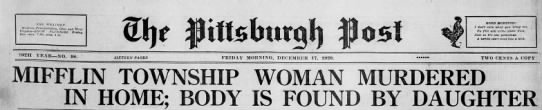
Against that backdrop, Mrs. Annie Mary (Crider) Kirker was killed in her home in a tranquil and affluent section of Mifflin Township on December 16, 1920. She had been robbed, beaten, and shot once in the head; her body was found by her 19-year old daughter, Anna, when she returned home from college after a several day absence.

Police responded to the scene. When Kirker’s husband, Albert, returned from his work as a draftsman at a steel mill in nearby Glassport, police asked him to identify missing items. He reported that his gun and a small amount of cash had been taken.

Albert Kirker became the initial suspect in the murder. Beyond the broader truth that most domestic murders are committed by another resident of the home, Mr. Kirker acknowledged having argued with his wife the previous evening. Also, his missing gun was later determined to have been the caliber of weapon used in the killing and there were no signs of struggle at the home.

image001

Kirker denied any involvement, claiming he had been at work all day. A neighbor’s report of having seen Annie Kirker earlier in the day seemed to eliminate the possibility that the killing had occurred before Mr. Kirker left for work. Neighbors were adamant in supporting Kirker’s defense and were angry with police for questioning him.

Though there were no witnesses to the crime, which occurred in a secluded home with no nearby neighbors, a Black man had been seen in the neighborhood. Also, a bloody trail was left in the snow and a bloody coat was recovered.

A third theory focused on a “tramp” who had apparently been at the home and in the area. After being surveilled by police, he was dropped as a suspect.

image001
Pittsburgh Post, December 18, 1920

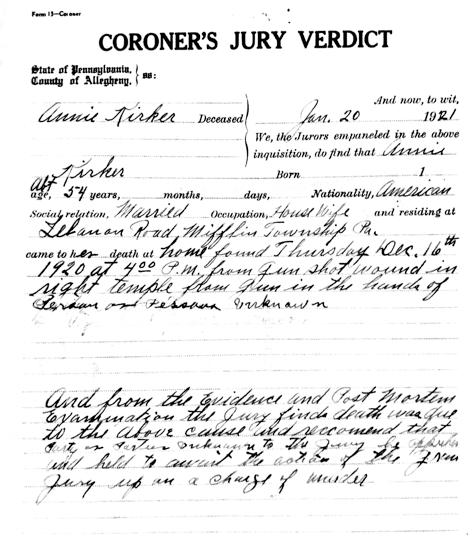
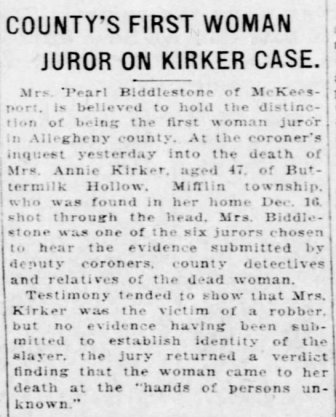
The coroner’s jury which determined that Kirker had been murdered included Pearl Biddleston, believed to be the first woman to serve as a juror in Allegheny County history. Her service had been enabled by the enactment of the Nineteenth Amendment, which had been ratified five months earlier.

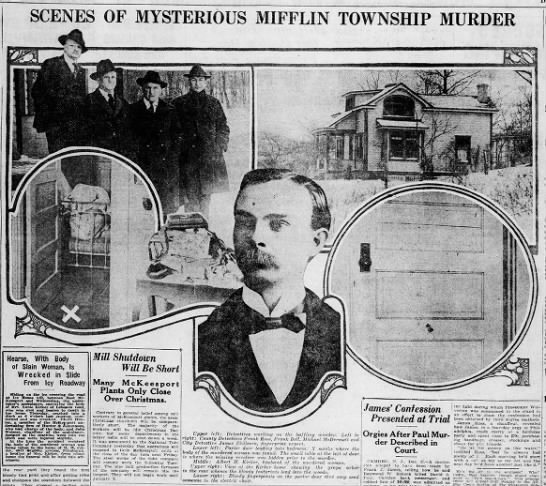
image002

image001
Pittsburgh Press, January 21, 1921

On February 1, 1921, with residents and police anxious about reports of a Black robber or robbers in the eastern suburbs of the city, police responded to a report of a Black man lurking near homes in Forest Hills. When police apprehended the man, a struggle followed and the man was shot by the officer.

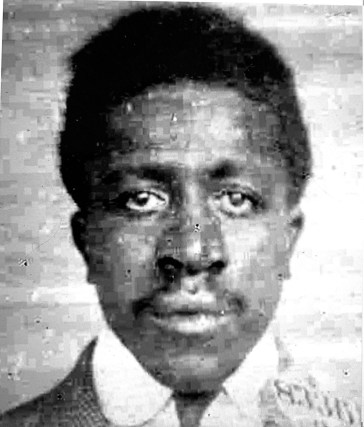
The suspect was identified as Joseph Thomas, a 39-year old, Georgia-born mechanic, who was living and working at the sprawling Westinghouse factory in Wilmerding. When police searched his room, items said to be missing from the Kirker home and newspapers describing the crime were reportedly found. The Kirker murder and the spate of robberies were declared solved.

image001
Joseph Thomas

A week after his arrest, while in the hospital recovering from wounds that doctors thought might be fatal, Thomas jumped out a third story window and fled. A massive and frenzied nationwide manhunt ensued. The guard stationed at Thomas’s door was later determined to have been drunk.

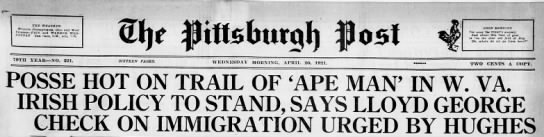
Another murder of a young white woman in the Hill District added to the frenzy to find Thomas. There were reports that Thomas, by now racially caricatured as an “ape man,” was disguised as a woman and as a minister, that he was in his neighborhood, in the mountains, in Philadelphia, and on his way to Canada.

Months passed before Thomas was ultimately arrested in Baltimore in July 1921, after committing another robbery. Returned to Pittsburgh, Thomas was greeted by Mayor Babcock, who all but declared that he would be convicted and executed; a remarkably prejudicial statement from the city’s leading figure.

image004
Pittsburgh Press, July 22, 1921

In the midst of a highly charged racial climate, Thomas pleaded not guilty. His counsel offered no defense and Thomas did not speak on his own behalf; a defense strategy somewhere between unorthodox and incompetent. In his closing statement, Thomas’s attorney claimed the prosecution was racially motivated.

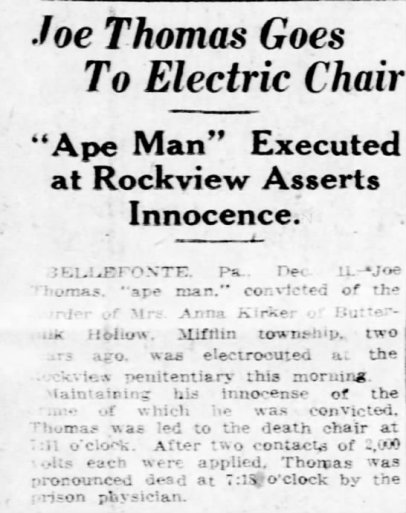
Thomas was convicted of first-degree murder on December 1, 1921, and sentenced to death on February 8, 1922. On appeal, Thomas argued that jury instructions related to the legal significance of his escape were prejudicial. His appeal rejected (Commonwealth v. Thomas, 275 Pa. 137, 1922) and his clemency request refused, Joseph Thomas was electrocuted on December 11, 1922.

image001

The efforts of Robert Vann, the wealthy and prominent Black publisher of the Pittsburgh Courier, to finance Thomas’s appeal or secure his commutation or pardon, had failed. No known copies survive of the Courier’s coverage of the case, which was surely more comprehensive and balanced than that published in any of the city’s white-owned newspapers.

A recent and excellent reexamination of this case in the Pittsburgh Post-Gazette emphasized the prejudicial racism of that era and makes a compelling case that Thomas was innocent. In this version of the case, originally advanced by Robert Vann, Kirker’s husband, Albert H., 51, committed the murder and staged the crime scene, while police abetted this effort by planting evidence in Thomas’s room and building a case against an easily-demonized Black man. 

Supporting this case was a written statement from the jury foreman expressing doubt about the verdict, concern that the argument between the Kirker’s the night before the killing had not been mentioned at trial, and concern about the inadequacy of Thomas’s defense. Additional evidence was provided in a written statement from a man who swore to having seen Thomas on a train at the time of the murder.

Albert Kirker, a Pennsylvania-born steel industry draftsman, moved to California in the months after the murder, reportedly after suffering a “nervous breakdown” due to a “severe grilling” by police who suspected him of the murder. Police denied that account. He did not return to Pittsburgh for Thomas’s trial, nor for his daughter’s wedding a few years later.

In an article headlined with a reference to the “Ape Man,” Thomas noted just before his execution that “I am not afraid to die but I hate to go to the electric chair with the people calling me an ape man.”

image001The lead headline, ahead of national and international stories, April 20, 1921
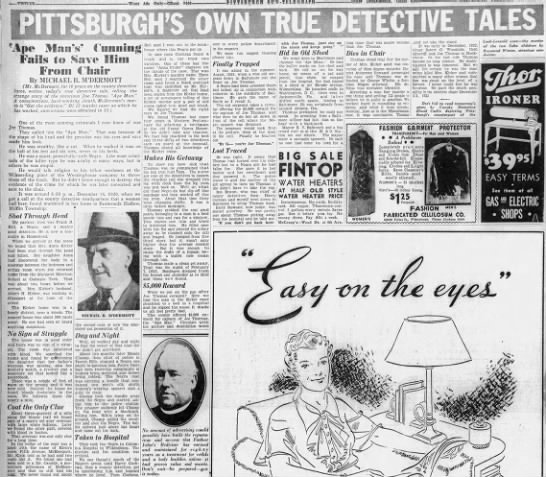
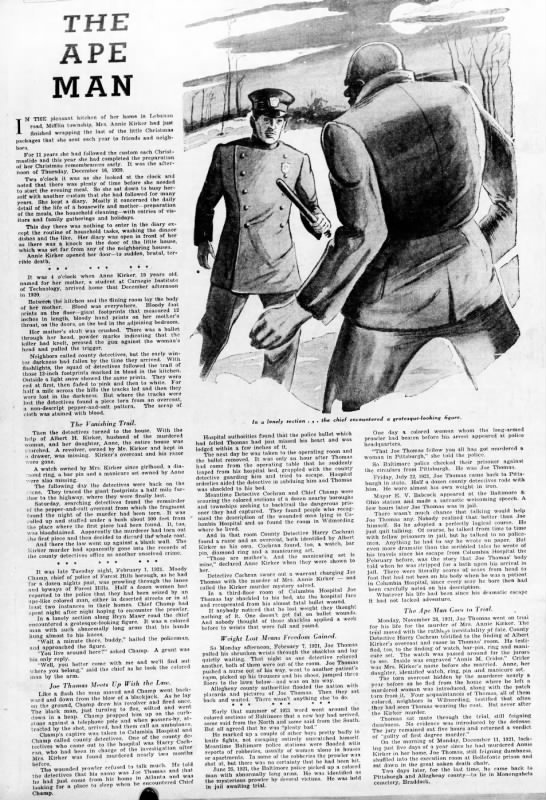
The racist caricature of Thomas and the facile tale of his guilt became a staple of Pittsburgh crime journalism in much the same way as the case of Lorenzo Savage.

image001
Pittsburgh Sun Telegraph, February 26, 1936
image001
Pittsburgh Post-Gazette, March 25, 1939

Marcus W. Newman

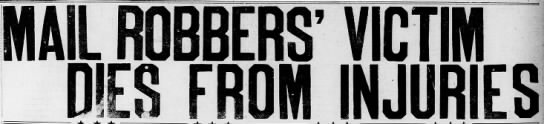
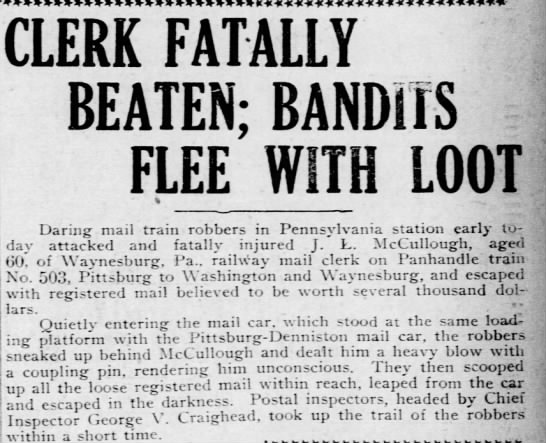
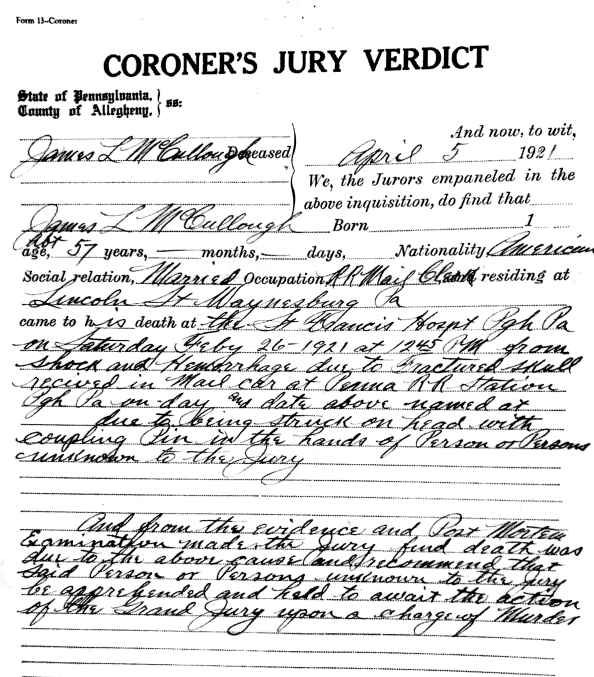
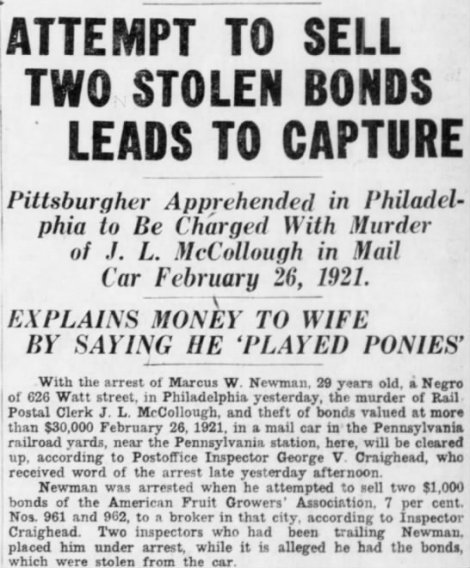
In a case that exemplifies the ways in which race shaped both opportunities and perceptions, Marcus Newman, a light-skinned Black man, robbed and assaulted James L. McCullough, chief clerk of Railway Mail Service, on February 26, 1921. McCullough died hours later. The robbery netted $30,000 in bonds and other negotiable securities.

image001

image001
Pittsburgh Press, February 26, 1921

The murder occurred in the Pennsylvania Station railyard. Newman, 27, was a railroad employee – his ability to pass as white had allowed him to rise to the position of brakeman, a position not available to Black employees – who was familiar with the mail delivery schedule. He and his wife, Esther (Gilbert), were also prominent within the vibrant local Black community, frequently mentioned in the social pages.

Investigators believed the murder was an inside job, but had no suspects.

image001.png

Immediately following the murder, Newman fled to Philadelphia. Four days later, one of the stolen bonds was negotiated there. By June, almost all of the bonds had been negotiated in Philadelphia and New York City. Reports to police identified the man selling the bonds as Samuel Kaufman, who was described as Jewish in appearance.

Meanwhile, Newman continued to live the lifestyle that the stolen bonds allowed, reportedly telling his unsuspecting wife that he had been successful in gambling.

image003
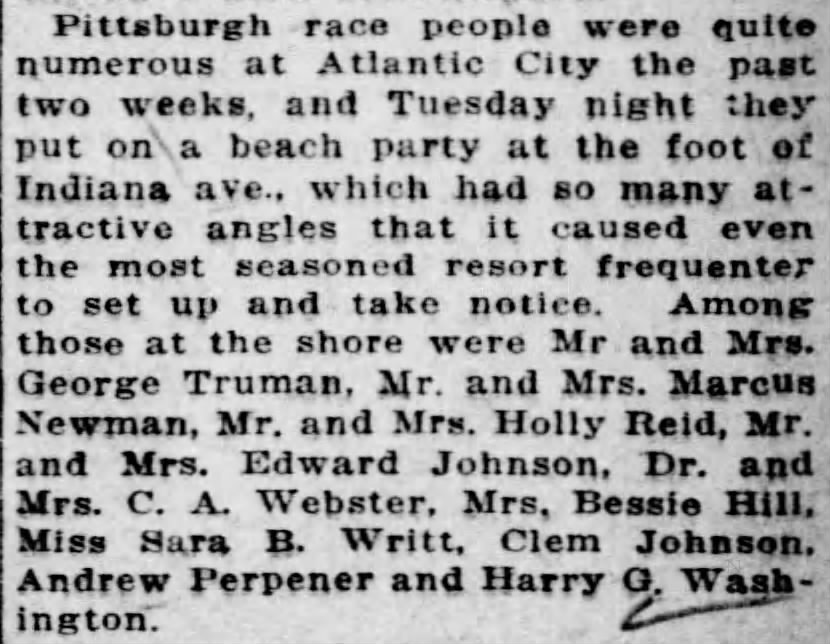
This account, from the Afro-American Notes section of the Pittsburgh Press, August 28, 1921, indicates Newman and his wife remained socially active even after McCullough had been murdered.

Newman was finally arrested in Philadelphia on March 25, 1922, more than a year after the killing, when he tried to dispose of two of the last remaining bonds from the robbery. He was armed when captured.

image001.jpg
Pittsburgh Sunday Post, March 26, 1922

His arrest was delayed because the police, who had identified Newman as a suspect after receiving reports of his unaccountably lavish spending, were looking for a Black man.

Indicted both on federal mail robbery charges and state murder charges, Newman’s murder trial was scheduled first. At trial, the case against Newman was strong, though circumstantial. It was based on his employment at the Pennsylvania Railroad and his close knowledge of its movements of cargo, his possession of the bonds, and his lavish spending. Under questioning, Newman admitted selling the bonds, but denied any knowledge of the robbery or the murder.

Newman was convicted of first-degree murder on October 13, 1922. His motion for a new trial was rejected and he was sentenced to death on November 24, 1922.

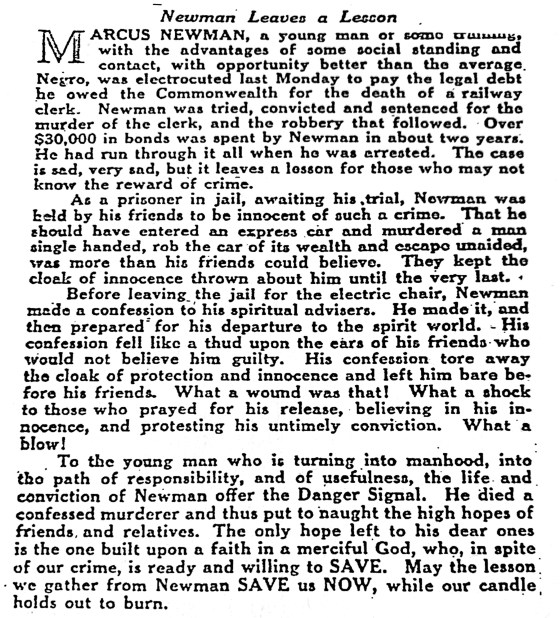
After his appeal, which raised a series of technical points, was rejected (Commonwealth v. Newman, 276 Pa. 534, 1923) and his clemency request was denied, Marcus Newman made a full confession. He was executed at Rockview Penitentiary on July 2, 1923. He is buried in Washington, D.C., where he had been born and raised.

image001
Pittsburgh Courier, July 7, 1923

Esther Gilbert Newman Williams died in Detroit in 1941 at age 47.

Lorenzo Johnny Savage

image001It’s a case that both flaunts and implicates the racial and sexual taboos so prominent at the time and baffles contemporary readers for the utter absence of any coherent narrative as to what happened.
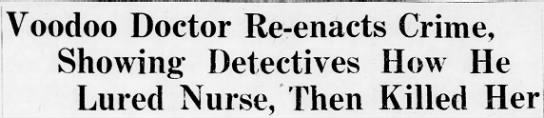
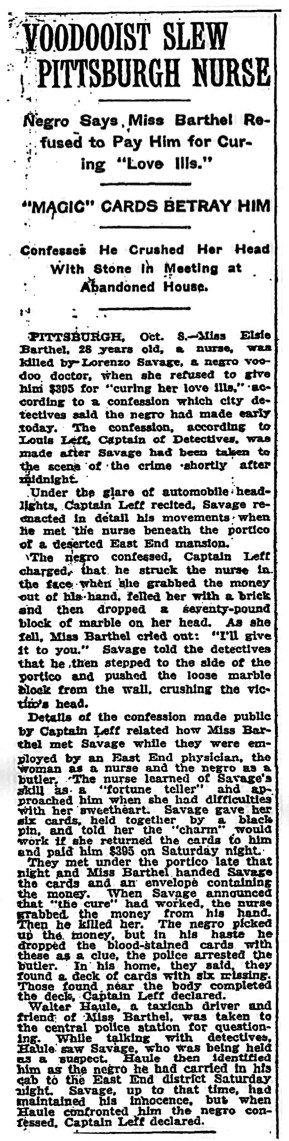
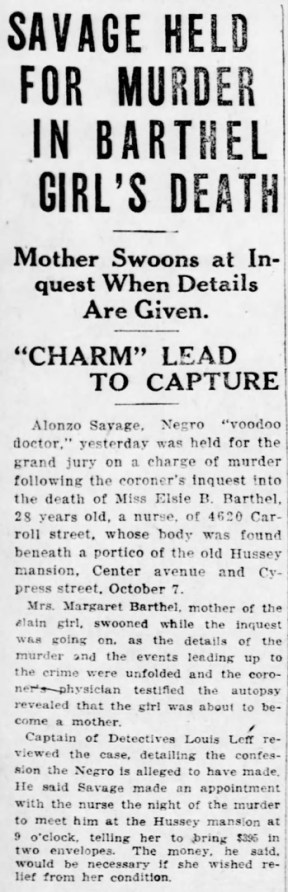
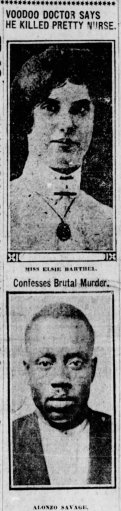
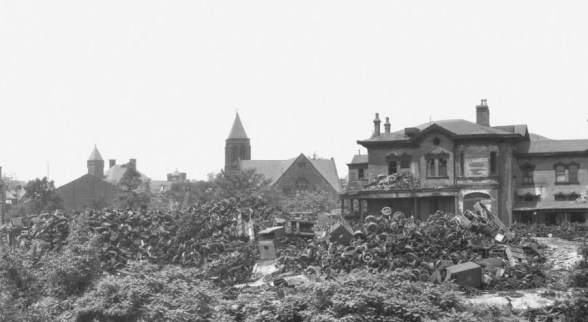
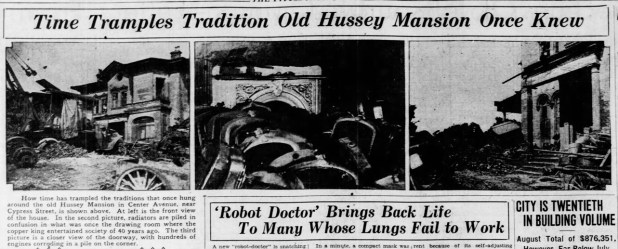
The body of 28-year old Elsie Barbara Barthel was discovered outside Shadyside, an abandoned mansion in Pittsburgh’s East End built by steel pioneer Curtis Hussey, by Alexander McGonigle as he walked his dog on the morning of October 7, 1923. Her head had been crushed by a large stone. One early newspaper story indicated Barthel’s body was identified by John R. Daugherty, who is described as her fiance.

Barthel was single, living in her parents’ Bloomfield home, and working as a secretary and nurse for prominent Pittsburgh doctor, Robert S. Marshall.

By October 8, police had secured the confession of Lorenzo Savage, described as a “Jamaican voodoo doctor,” after hours of intensive interrogation. Savage, who had worked as a butler for Dr. Marshall, became a suspect after Barthel’s family identified him as the man Barthel spoke with on the phone on the day of her death.

image001
                                         Pittsburgh Daily Post, October 9, 1923

At the time of her death, Barthel was pregnant, apparently by someone other than the man she was planning to marry, Walter Haule,* who worked as a chauffeur. (In the discrete fashion of the day, newspaper accounts often suggested that Barthel was ill or was trying to attract a husband, rather than pregnant.)

image001
New York Times, October 9, 1923

Barthel’s pregnancy (which was confirmed by autopsy) was not yet known to others, and she was desperate to terminate it before it was detected.

In the state’s version of events, Barthel sought out Savage, who was known to offer card readings and potions, for assistance with her urgent and delicate personal matter. In September, he told her to carry a particular set of playing cards as a way to end the pregnancy. For his services, Savage was said to have charged $395 (equivalent to nearly $6,000 today).

Barthel and Savage, the state argued, met clandestinely outside the Hussey Mansion on the evening of October 6, where they exchanged the money. When Barthel tried to take the money back, Savage became upset and struck her with a stone, crushing her skull. The money was not found at the scene.

In a remarkable coincidence, Haule, working as a taxi driver, is said to have picked up Savage after the killing and transported him to the Hill District, unaware of Savage’s identity and of what had transpired. It was only the next day, according to Haule, that he recognized Savage as a former co-worker of Barthel. “Had I known what I do now,” Haule remarked, “he would not have lived to be arrested” (Pittsburgh Post, October 9, 1923).

image003
Pittsburgh Post, October 25, 1923

Arrested the next day, Savage confessed under questioning by police and reenacted the murder.

Both the Chicago Defender and the Baltimore Afro-American, two prominent Black newspapers of the era, repeated the state’s sensationalistic and racist caricaturization of Savage in stories replete with chants, drums, jungles, and snakes. The Pittsburgh Courier took a much more skeptical approach to the state’s case.

Savage’s background was far more prosaic than portrayed. He and his seven siblings were born in Virginia to parents also born in Virginia. As a small child, the family moved to Woodbury, New Jersey. There, Lorenzo married Regina Taylor and had a son, William, in 1918.

Despite the many questions raised by the case, it was expected to move quickly to trial. The Pittsburgh Post noted that “a record for speedy justice is expected to be set” (October 17, 1923).

At trial before Judge Ambrose Reid, Savage pleaded not guilty and claimed that his confession was produced by beatings and death threats from police. He was convicted on November 22, 1923, by a jury of twelve white men. Only six weeks had passed since Barthel’s murder.

image003
Pittsburgh Gazette-Times, November 23, 1923

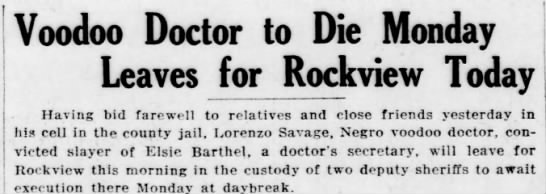
His motion for a new trial was denied by the court that convicted him and he was sentenced to death on January 30, 1924. Lacking the financial resources for appellate review or a clemency campaign, Savage was taken to Rockview and electrocuted on March 31, 1924, without any independent review of his case. He was buried in the prison cemetery.

image001
Pittsburgh Post-Gazette, March 28, 1924

Few cases proceeded from arrest to execution any faster (167 days) or received less post-conviction review, and far more than most this case cried out for such review. The state’s version of the case is clouded by a series of troubling questions. Most broadly, the repeated characterizations of Savage as a “Negro high priest of voodoo,” a Jamaican voodoo doctor, and a diabolical menace, portray him as dangerous and exotic in ways that are not only unfounded but racist and highly prejudicial.

image001
Pittsburgh Daily Post, March 10, 1924
image002
Pittsburgh Daily Post, May 27, 1924

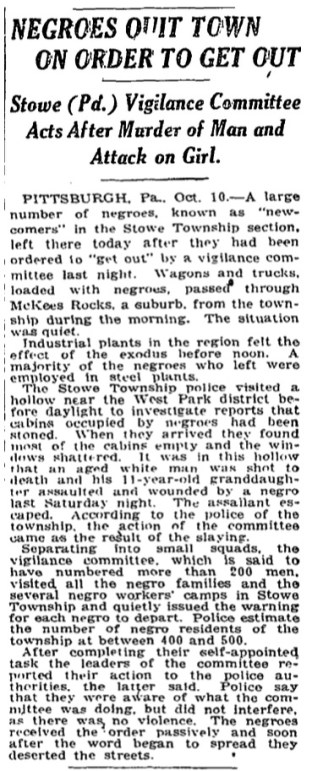
That racism and associated violence were endemic at the time; a reaction against the Great Migration that was bringing unprecedented numbers of Black people, particularly young, male laborers, into Pittsburgh and elsewhere in the urban north. The result was a resurgence of the Ku Klux Klan, which staged a large rally in nearby Carnegie two months prior to Barthel’s murder, and racial terror more generally.

image001
New York Times, October 11, 1923

Add to that the racial sexual dynamic in which the prior relationship and clandestine meetings between Barthel and Savage suggest the possibility that he was the father of her unborn child (a possibility acknowledged in one newspaper story), the presence of Haule at the scene, the identification of Daugherty as a second (or third) love interest of Barthel’s, the statement of Savage that Barthel used the Hussey mansion for “trysts,” the implausibility of Barthel – a nurse – believing that playing cards could terminate her pregnancy and paying the equivalent of thousands of dollars for that chance, and the likelihood of a coerced confession, and alternative and much less convoluted theories of the case become obvious.

Was Barthel’s death somehow related to an abortion? What was Haule’s role in the case? Was it merely a coincidence that he picked up Savage on the evening of the murder? Why was he dismissed as a suspect so quickly? Likewise with Daugherty, who is mentioned early in the coverage of the case but does not appear to figure in the trial. What about the reports of screams and screeching tires heard at the Hussey mansion late on the night of October 6? Does that indicate Barthel was killed elsewhere and transported there?

image001
Hussey Mansion, June 24, 1928

The police and court records with which to better answer these questions are lost. Yet, in reading the newspaper coverage, it is difficult to avoid the conclusion that Savage was knowingly and wrongly convicted and executed or, at least, that the theory of the case on which he was convicted is deeply flawed, as the preferable option to openly acknowledging the circumstances of Barthel’s pregnancy.

image003
Pittsburgh Press, September 27, 1931

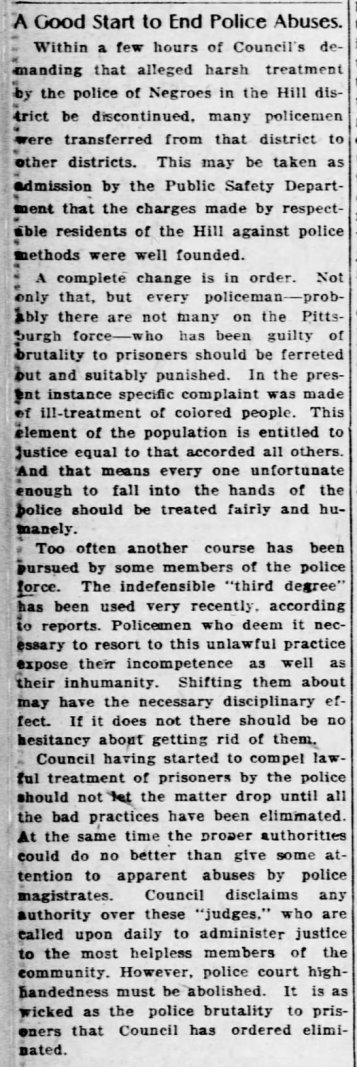
The types of police tactics implicated in the likely wrongful convictions of Savage and Joseph Thomas, as well as in other cases involving Black defendants during this particularly racist era, became a focus of official attention. Only modest reforms were undertaken.

image001
Pittsburgh Gazette Times, June 26, 1925

* Walter Harry Haule was born in Pittsburgh on May 14, 1895. He married Grace (last name unknown) in 1925. He died in Los Angeles on July 3, 1965. His wife died there in 1966. They had no children.

William Kennie Wilson

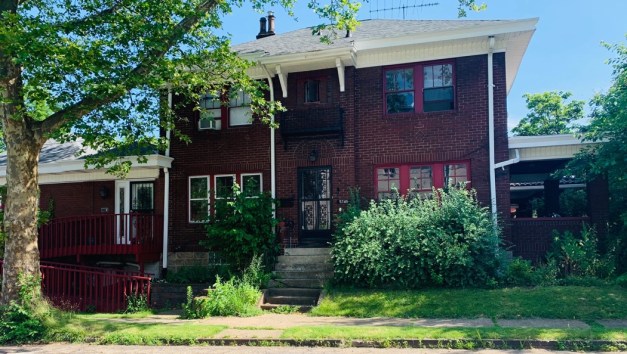
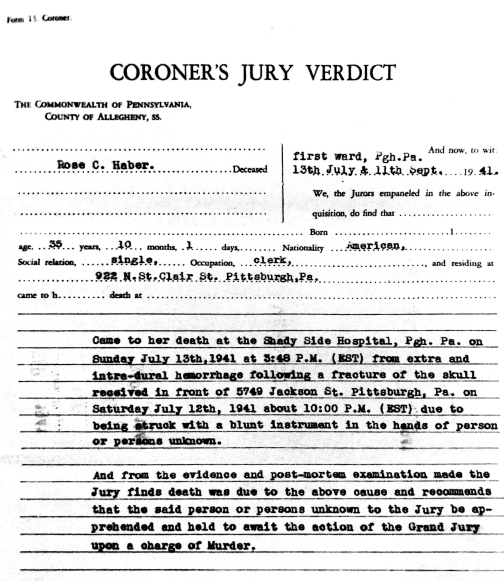
Rose Haber, a 35-year old clerk returning home from work at McNulty’s Drug Store, was hit in the head “with a heavy weapon” (Pittsburgh Press, July 14, 1941) and robbed of her purse after she exited a bus in front of 5749 Jackson St. in East Liberty on the night of Saturday, July 12, 1941.

image001
5749 Jackson St., 2019

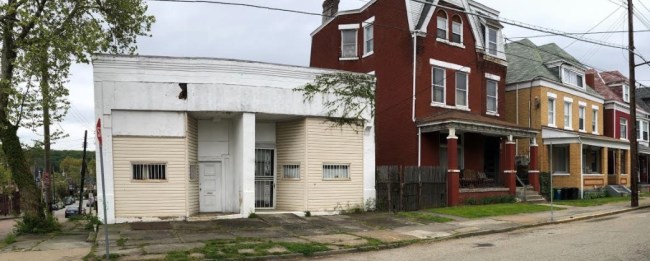
With the help of bystanders, Haber made her way to a nearby drugstore where she reportedly talked about her assault and assailant with the police and others.

image001
Former drugstore, 901 North St. Clair St.

Transported to Shadyside Hospital, Haber reportedly “gave police a more complete description of her assailant” the next day (Pittsburgh Press, July 14, 1941). Though she was initially thought to be recovering, Haber died that afternoon.

image001
Pittsburgh Press, July 14, 1941

Little is known about what Haber was able to report. Surviving police and coroner records do not include a description of her assailant. Initial newspaper accounts provide conflicting information. In its first story on the attack, the Pittsburgh Press reported that Haber told police that her assailant was a “white man” wearing “light colored slacks, a white shirt and a sailor straw hat” (Pittsburgh Press, July 14, 1941). Henry Mazer, a passerby who came to Haber’s aid after the assault, is reported to have provided a similar description of her assailant. That day’s Pittsburgh Post-Gazette reported the same description of her assailant’s clothing but said Haber was unable to identify his race. The Sun-Telegraph’s initial account provided no description of the assailant.

image001

None of the other bus passengers, the driver, or people on the street in the vicinity of the attack were able to provide a description off the attacker.

The next day, police learned of a witness. Ella Kennedy, a young woman who worked as a maid in the home of Herman and Rebecca Fineberg, had witnessed the assault from inside their home next to the bus stop and thought she would be able to identify the assailant. The description reported by the SunTelegraph (July 15, 1941) matched the description provided by Haber. That Kennedy reported seeing the man’s face and that his race was not mentioned in the story likely indicates that the man was white. A positive identification of a Black offender would surely have drawn much more attention; a supposition supported by subsequent accounts provided by Kennedy.

With all the elements of a panic – an unsolved, late night, stranger-based murder of a white woman in a residential area – and other similar unsolved crimes in the area, police were under intense pressure to make an arrest.

In the weeks after the attack, police questioned and released at least six men suspected in the attack. Meanwhile, additional purse snatchings were reported in the area. In every case, newspaper accounts identify the assailants as Black.

The first big break in the case came in September, when police arrested and held Hoy Kenneth Houck,** a white man who became a suspect due to his commission of a series of similar assaults of women in State College, Bellefonte, and Lock Haven, Pennsylvania beginning in December 1940.

Though some newspaper reports indicated murder charges were filed against Houck, the “natty dresser” was ultimately released after police were unable to overcome his alibi that he was not in Pittsburgh at the time of the killing.

In February, 1942, seven months after the murder, suspicion fell briefly on Raymond Dumont, also white, who had assaulted a woman in McDonald, Pa. Ella Kennedy told police “she was positive” he matched the description of the man she had seen assault Haber (Pittsburgh Press, February 4, 1942). Dumont was also released due to a lack of evidence.

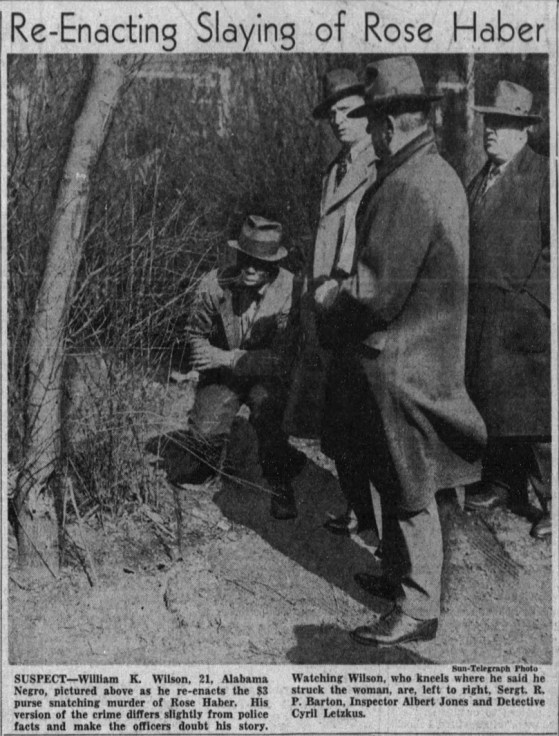
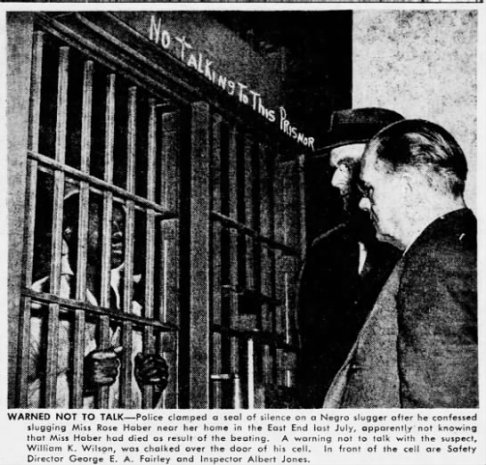
Pressure continued to mount. Then, on March 19, 1942, 20-year old William Kennie Wilson, a homeless, Alabama-born Black migrant being held for assaulting Victoria May on the North Side days earlier, confessed to killing Haber after three days in custody. Lead investigator Albert Jones indicated that police were “baffled” and “puzzled” by Wilson’s confession and reenactment of the crime, which did not match the “known facts” of the case (Pittsburgh Sun-Telegraph, March 19, 1941).

image001
Pittsburgh Police Inspector Albert Jones

A second reenactment conducted a week later resulted in an “entirely different” scenario, compounding the confusion of police (Pittsburgh Sun-Telegraph, March 26, 1942).

image001
Pittsburgh Sun-Telegraph, March 19, 1942. Caption notes that “officers doubt his [Wilson’s] story.”
Up to this point, police had not given any indication that Haber’s killer might be Black, despite accounts from witnesses. Neither had the newspapers, which covered the investigation closely and were always ready for the type of incendiary crime story a Black man preying on white women would have provided.

Also troubling was that news reports of May’s assault had described her assailant as a “giant colored man” (Pittsburgh Post-Gazette, March 19, 1942). Wilson’s World War II Draft Registration card, filled out a month before his arrest, listed him as 5’7” and 157lbs.

image001

  • image from the Pittsburgh Press, March 19, 1942. Notice how small Wilson is compared to the men with whom he is speaking.

Indicted on April 15, Wilson entered a plea of not guilty on May 4, before withdrawing it and pleading guilty the next day after a church missionary interceded. He also pleaded guilty to other robberies, rapes, and assaults, clearing numerous serious crimes for police.

William Wilson was formally sentenced to death by a three-judge panel on May 14. His defense plea for mercy, during which his attorney, P.J. Clyde Randall, told the court that “this defendant has the mind of a child….I don’t mean he’s insane. This boy doesn’t have the same viewpoint of other youths his age,” was rejected.

Poor, alone, disadvantaged in numerous ways, and without benefit of trial, appeal, clemency review, or competency hearing – a remarkable lack of due process for a death penalty case – William Wilson was executed on August 10, 1942. He was the only Allegheny County resident executed during American involvement in World War II.

Having carefully investigated this case, I believe there is a compelling argument to be made that the State of Pennsylvania executed an innocent man.

* Wilson’s family had moved north from Alabama to the coalfields of Cecil, Washington County, when he was a child. Raised in company housing in the coal town of Lawrence, Wilson moved by himself to Pittsburgh in the late 1930s, where he lived on the streets or in the Catholic Worker-led St. Joseph’s House of Hospitality in the Hill District.

** Houck’s connection to Haber’s murder is intriguing. Beyond his physical similarities to the descriptions provided by Haber and Kennedy, his conviction for a series of remarkably similar crimes occurring at the same time in central Pennsylvania (and his suspected ties to two unsolved murders of women in State College), and his regular work-related travel to Pittsburgh at the time of Haber’s murder, he was arrested for purse snatching in Baltimore after being released from prison in Pennsylvania. He was also arrested for child molestation in Florida in 1961. Houck died in Florida in 1991.

image001
The former Haber residence, 922 North St. Clair St.

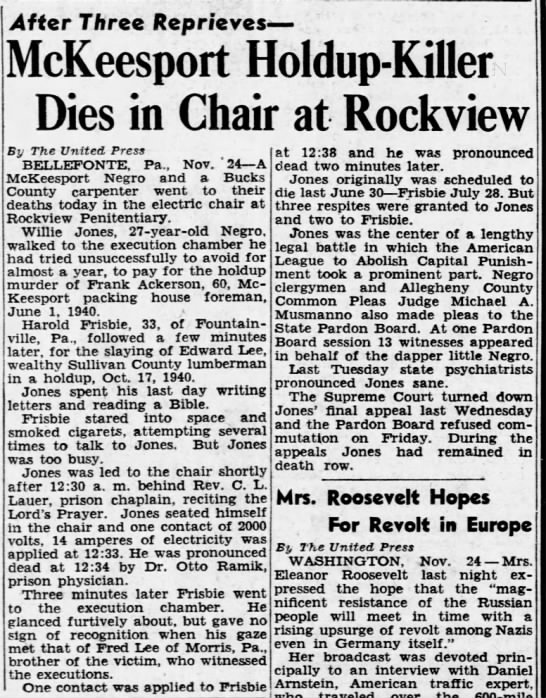
Willie Jones

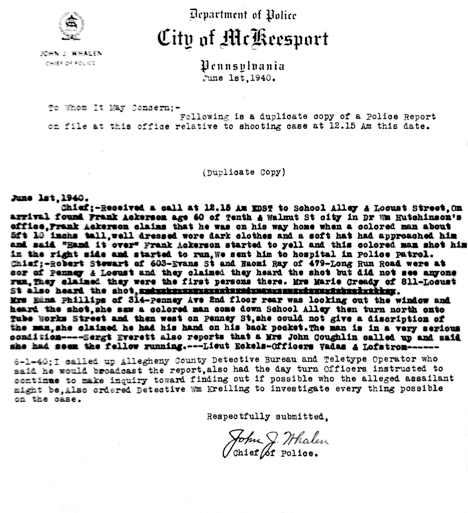
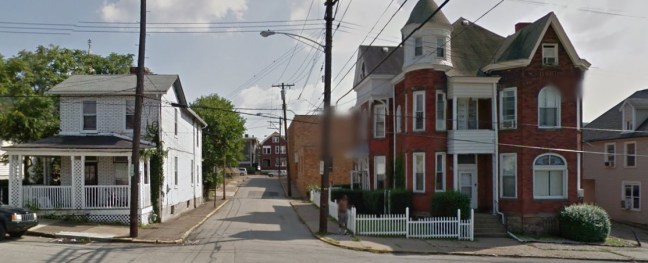
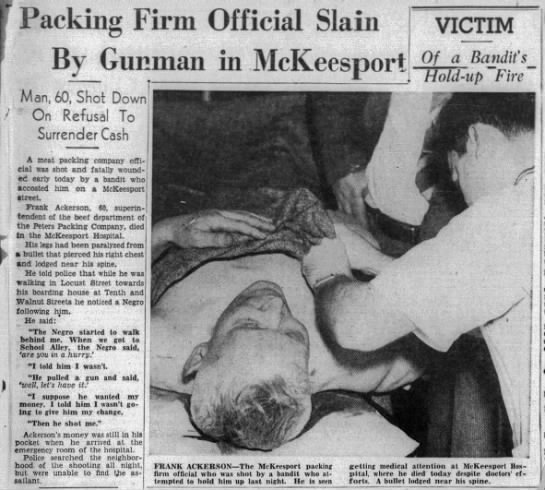
As he walked home from the late shift at Peters Packing Co., a McKeesport meat packing plant, on May 31, 1940, 59-year old plant foreman Frank Akerson was robbed by Willie Jones. Akerson reportedly yelled when approached by Jones, who then shot him. The Swedish-born Akerson died the next morning.

image002

image001
Locust St, with School Alley in rear

Akerson provided a description of his assailant before he died. Jones, who was born in Georgia and lived in McKeesport, was also identified by Edna Phillips, who saw him from inside her home as he fled the scene.

image001
Pittsburgh Sun-Telegraph, June 1, 1940

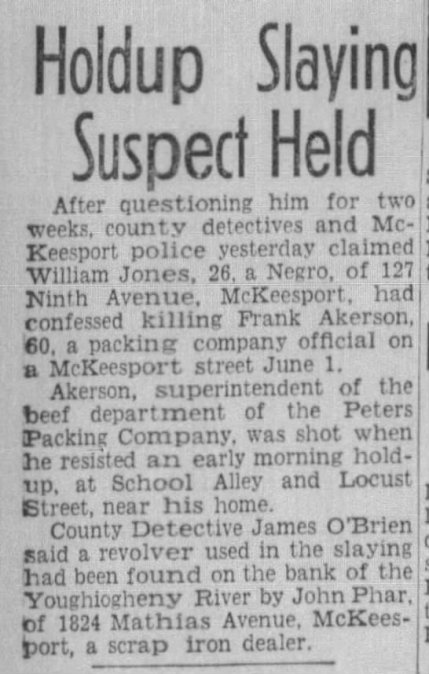
After arresting Jones on June 3 on an unrelated disorderly conduct charge, police discovered stolen items in his possession. After ten days of aggressive questioning, Jones ultimately confessed to killing Akerson. He later claimed that he was beaten into confessing and denied any involvement in Akerson’s killing.

image001
Pittsburgh Sun-Telegraph, June 16, 1940

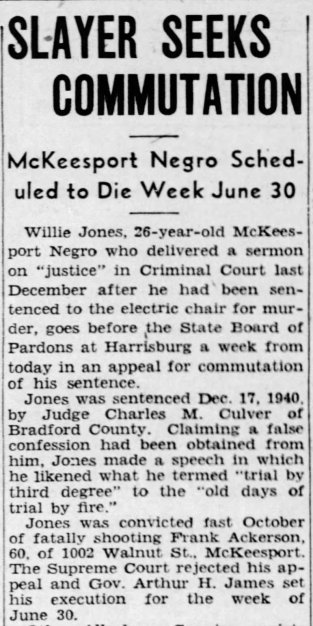
On the strength of eyewitness testimony, his own confession, and the gun used in the murder, Jones was convicted of first-degree murder on October 24, 1940, and sentenced to death. Despite evidence of a racially biased investigation and trial before an all-white jury, proceedings Jones characterized as “poor man’s justice,” his motion for a new trial was rejected and conviction was affirmed on appeal (Commonwealth v. Jones, 341 Pa. 541, 1941).

With the support of the American League to Abolish Capital Punishment and other civic and religious groups and the close attention of the Pittsburgh Courier, the execution of Willie Jones was stayed multiple times while a pardon could be considered.

image003
Pittsburgh Press, June 12, 1941

After the Pardon Board found Jones’s case unpersuasive, a mental competency exam was ordered. Found to be competent, Willie Jones was executed on November 24, 1941.

image001
Pittsburgh Press, November 24, 1941

Despite his execution, Jones’s case marked the beginning of a new era in the death penalty in which cases involving Black defendants would be vigorously contested in court and would receive the attention of national civil rights and abolitionist organizations.