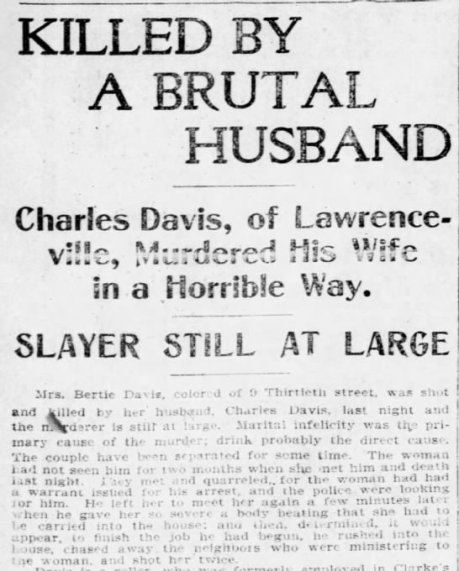
Charles Davis killed his wife, Birdie, in her sister’s 30th St. home on Saturday evening, December 21, 1901. She was shot several times in the chest.
The Davises had fought frequently throughout their relationship, allowing Davis to become “known to police as a brutal character” (Pittsburgh Weekly Gazette, June 27, 1902). Those fights escalated to include death threats, leading Birdie Davis to separate from Charles eighteen months prior to her murder and move in with her sister.
After another death threat, she filed charges and a warrant was issued for Davis’s arrest. He disappeared, only to reappear the day of her killing. When Davis encountered Birdie on the street that day, he beat her badly, leaving her seriously injured. Later that evening, he went to Birdie’s sister’s home, forced himself past the family members trying to protect her, terrorized her further, before shooting her at close range and killing her. Davis fled; he was arrested the next day.
Pittsburgh Press, December 22, 1901
At trial, Davis, an unemployed iron worker, claimed he was under the influence of drugs and alcohol, and that his frequent drinking had earned him the nickname “Kid Booze Holster.”
He was found guilty on February 4, 1902, and sentenced to death on February 27. Henry Taylor, who had killed a man scarcely three blocks from the site of Taylor’s killing, was sentenced to death at the same time. The two men were baptized in the jail on June 13.
Pittsburgh Press, June 13, 1902
Without the resources or support to pursue an appeal or clemency, Charles Davis was hanged on June 26, 1902, barely six months after killing his wife and two days after Henry Taylor was hanged.
Henry Taylor and Edward Sewell were arguing over their mutual interest in Mrs. Martha Stone when they entered a saloon owned by S.P. Lockett at 3059 Penn Avenue on August 12, 1901. Once inside, Taylor shot Sewell four times at close range before fleeing.
Pittsburgh Post, August 13, 1901
After initial reports that he might survive, Sewell died two days later.
While the nation’s attention was focused on President McKinley’s struggle to survive assassination in Buffalo, N.Y., Taylor was arrested September 9, 1901, in Carlisle, Pennsylvania, after police learned that Stone was sending letters there.
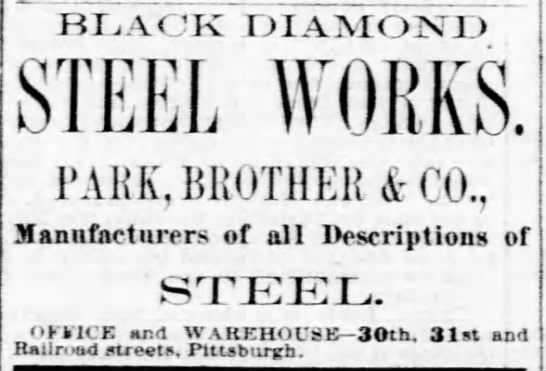
Both men were Virginia-born laborers. Taylor, a puddler’s helper in the Black Diamond Steel mill, the first Pittsburgh steelmaker to employ Black workers, boarded in a company home Stone managed. Sewell, a hod carrier, had previously been involved with Stone, though she denied any such relationship.
After a short and unremarkable trial at which Taylor claimed he acted in self-defense, he was convicted of first-degree murder on January 18, 1902. Due in large part to his inability to invest in his defense, Taylor’s post-conviction efforts to avoid execution were easily turned aside.
Henry Taylor was hanged on June 24, 1902.
Pittsburgh Press, June 24, 1902
In a written statement made just prior to his execution, Taylor denied that the killing was related to Martha Stone.
Characteristic of cases with Black defendants and victims in this era, the case received little newspaper or public attention.
In a case that parallels in time, circumstances, and results the Wasco case, William Patterson (aka Newman) killed Alice Warner (aka Van Horn), a “comely mulatto,” at her residence on June 23, 1899.
Warner resided at the home of Minnie Walls at 314 Grant St. (the present location of the Grant Building) after recently separating from her husband and relocating from Buffalo. Patterson worked as a bootblack and lived at 16 Sachem St. in the Lower Hill District.
Newspaper accounts describe Walls’ home as “disorderly” and as a “resort” and the women who live there as “inmates,” all of which suggest that Warner was a sex worker and Walls’ home was a brothel.
Patterson, described as an “opium fiend,” had become infatuated with Warner. They quarreled on the evening of June 22, 1899, due to her involvement with another man. Patterson returned to her home the next morning and shot her twice in her bedroom.
At trial, Patterson claimed that he was under the influence of drugs and alcohol and that he had a family history of mental illness. His mother and family friends offered similar testimony, to no avail.
He was convicted on July 7, 1899, a remarkable fifteen days after the murder, and sentenced to death. The trauma of the ordeal led his mother to attempt suicide on the street outside the courthouse.
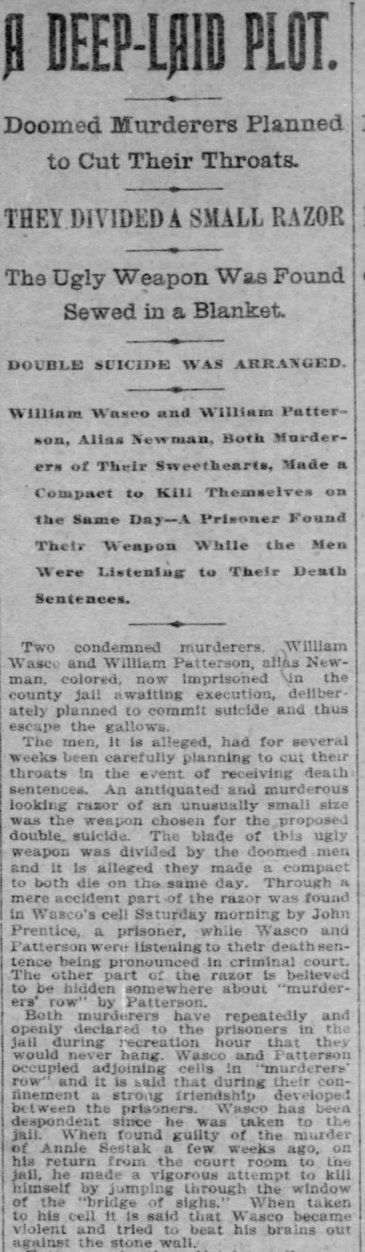
Patterson likewise contemplated suicide. His suicide plot, with fellow condemned inmate, William Wasco, was foiled by jail guards.
Pittsburgh Press, July 7, 1899
A modest pardon effort was undertaken. Included in the materials presented to the Pardon Board were letters that sought to diminish Patterson’s culpability by claiming that he had been raised in a brothel and that Warner was a “vile prostitute.”
After a final statement in which he struck the confessional notes of the era by encouraging “all wayward boys” to learn that “high living” will bring “disgrace and ruin” and to “look to God, who is everybody’s friend,” William Patterson was hanged on January 16, 1900.
A 1903 police sweep of brothels suggests that Walls’ was one of at least two Black-owned brothels operating in the city (Pittsburgh Press, July 13, 1903).
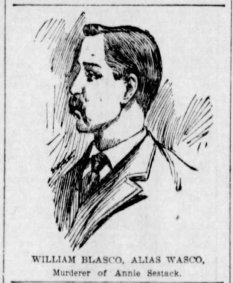
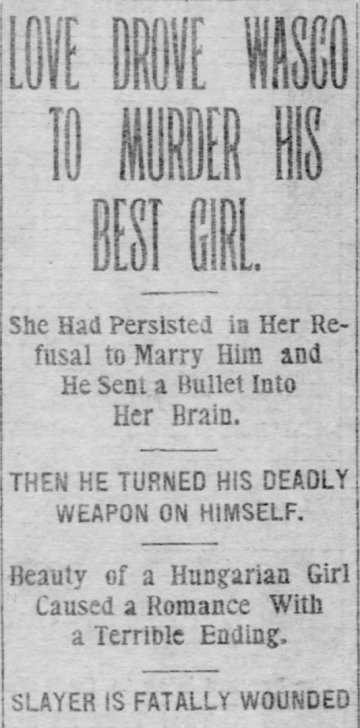
William Wasco met Anna Sestak, a fellow Hungarian immigrant, not long after he had been released from the Allegheny County Workhouse on an assault charge and she had arrived in this country. When Wasco’s attention escalated to persistent efforts to marry Sestak, “a well formed, handsome girl of the Hungarian type of beauty,” she rebuffed him and changed her home and job to avoid his advances.
The case bears remarkable similarities to Joseph Orosz’s murder of Teresa Bobak several years earlier.
Wasco, who worked as a broommaker at a downtown factory, followed her. His attention escalated to pleadings and then to threats and then to violence.
On Saturday, May 6, 1899, Wasco shot and killed Sestak at her 862 Second Avenue, downtown residence and then turned his gun on himself. It was reported that his wounds would be fatal.
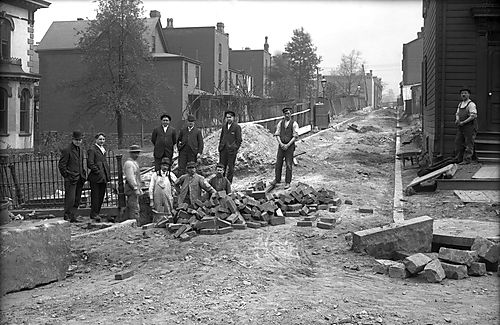
Second Avenue, 1910
Despite Wasco’s obvious harassment of Sestak, news reports described his interest in her as “love.” Despite the lack of evidence that Sestak ever reciprocated any interest in Wasco, news reports described their relationship as a romance and caused by her beauty.
Pittsburgh Post, May 7, 1899
With multiple witnesses and an undisputed set of facts, Wasco was convicted on June 28, 1899, and sentenced to death. His defense was drunkenness.
After his conviction, Wasco again attempted suicide by making a “ vigorous attempt” to jump through a window on the Bridge of Sighs and then by bashing his head against his stone cell walls.
Bridge of Sighs, 1889
Later, he and fellow condemned inmate William Patterson were stopped by jail authorities before they could carry out their plan to slash their throats with razors.
Pittsburgh Commercial Gazette, September 8, 1899
Compounding the tragedy of the case, Wasco’s brother, Joseph, committed suicide in a blast furnace in Braddock on December 17, 1899, just weeks before his brother’s execution. He had worked tirelessly for William’s release and killed himself when he saw it was hopeless.
Pittsburgh Post, December 18, 1899
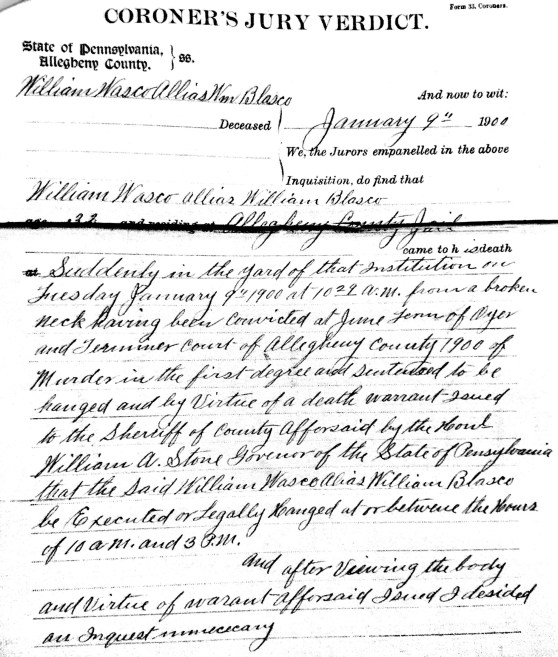
William Wasco was executed on January 9, 1900. Newspaper accounts described the hanging as especially religious and successful. Eights months had passed since Sestak’s murder.
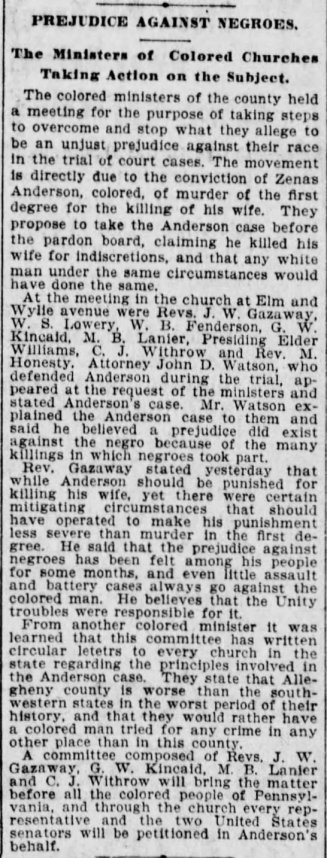
A history of marital discord and violence ended tragically when Zenas Anderson shot and killed his wife, Pauline, on the morning of March 18, 1898.
The shooting occurred in her Locust Alley, Lawrenceville home, which she shared with their three-year old daughter, Lilly, Bessie Johnston, and Rose Robinson.
A Lawrenceville alley, 1908
At the time of the killing, Zenas had only recently been released from Western Penitentiary after serving 18 months for shooting a man from New Castle who was involved with his wife. Pauline Anderson reported her husband to the authorities after that incident, apparently leading Zenas to vow revenge. While he was imprisoned, she lived with another man.
Pittsburgh Daily Post, March 14, 1898
The murder was described as one of the most premeditated and carefully planned in county history.
After the shooting, Anderson fled on foot and by trolley into the downtown and then the West End. Captured by police pursuing in a “shifting engine,” he attempted suicide by drinking poison he had obtained for that purpose. He then provided a full confession.
A straightforward domestic homicide involving a poor Black defendant, a confession, and no mitigating evidence or compelling defense, Anderson’s trial was held only six weeks after the murder and was quickly concluded. He was convicted on May 5, 1898, and sentenced to death on June 4, less than three months after the killing.
In the absence of financial means, Anderson was unable to pursue an appeal. However, the belief among the Black community, a belief strengthened by the recent hangings of the Unity defendants, that Anderson’s punishment was tied to his race – that a white defendant who had killed an unfaithful wife would have received a lesser punishment – led to a clemency request.
Pittsburgh Press, June 24, 1898
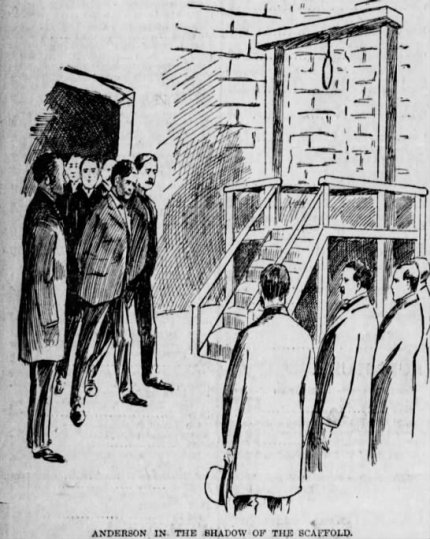
After having his execution respited by Governor Hastings so that his clemency request could be considered, that request was denied. Zenas Anderson was hanged on January 5, 1899.
Pittsburgh Press, January 5, 1899
Anderson and Pauline had married 3 or 4 years earlier in Roanoke, Virginia, where both were born. They moved to Pittsburgh to pursue work in the steel industry. Newspaper coverage framed them as attractive, bright, dashing figures, with particular attention to the “more than comely” Pauline Anderson’s light skin and straight hair as markers of her attractiveness.
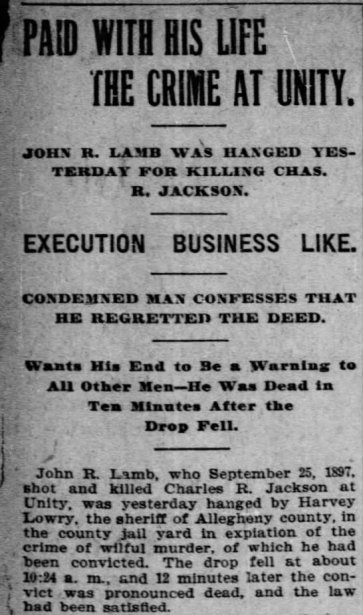
The Carnival of Blood said to be bathing the mining town of Unity continued with the September 25, 1897, murder of Charles Abraham Jackson by John Lamb, who became “the sixth negro to be arraigned in criminal court for murder since July 12. Like all the Unity crowd, he is a burly negro, vicious in appearance.”
The circumstances of the murder are not entirely clear. Lamb, Jackson, and many others were part of a group drinking, talking, and gambling in the mining camp where they lived and worked when a fight began.
There appears to have been a longstanding conflict between Lamb and some women who were part of that group. It is reported that the women may have testified against Lamb for a previous alcohol-related offense. Lamb apparently threatened the women. Frank Grimes interfered and was shot. Jackson, who was nearby Grimes, was also shot, fatally.
Captured by miners and turned over to the police, Lamb claimed that he shot Jackson in self-defense. As testimony to the lethal combination of a highly charged white public and criminal justice system and a poor, black, and socially isolated defendant, Lamb was indicted two days after the murder and convicted of first-degree murder on October 13, less than three weeks after Jackson’s killing.
At trial, numerous eyewitnesses testified against him. Statements Jackson provided to police before he died were also admitted into evidence.
Pittsburgh Daily Post, October 12, 1897
Lamb was sentenced to death on November 13.
An itinerant laborer, Lamb had no friends or family for support. In a frank acknowledgement of the role of money in capital case processing, the Pittsburgh Press noted that “being without money, it was impossible for the condemned man to avail himself of the usual appeal to the pardon board, and the supreme court.”
Pittsburgh Daily Post, April 22, 1898
John Lamb went to the gallows on April 21, 1898. Accounts indicate he died particularly slowly, strangled to death.
The first wave of Black migration to Pittsburgh began in the late 1890s, when the tremendous expansion of steelmaking capacity and profitability made possible by technological changes and the violent suppression of labor drew Black laborers out of the Upper South. Relegated to the lowest rungs of the employment ladder, many of these men worked in numerous mining communities cropping up along the prodigious Pittsburgh seam to fuel the burgeoning steel mills.
These mostly young, single men were essentially industrial sharecroppers, living and working in company towns under highly exploitive and unsafe conditions.
When violent incidents occurred among them, as was inevitable under such conditions, the public and the state responded with force, threatening lynchings and demanding swift and capital punishments.
The center of these incidents was Unity, an early coalmining region east of Pittsburgh. Between the spring and fall of 1897, four recent Black migrants (in addition to Philip Hill, they were John Lamb, George Douglass, and Luther Huddle) were sentenced to death for murders that occurred in the coal fields. All but Huddle were executed. This pattern would be repeated several times over the next few decades, as each wave of Black migration brought with it a violent state counter-response.
The case of Philip Hill was the first in the “Carnival of Blood” newspapers imagined in and around Unity and that marked the introduction of a distinct racial dynamic to capital punishment in Allegheny County.
George Lawrence worked as a supervisor on the construction of the Pittsburgh, Bessemer, and Lake Erie Railway near Unity, on the Allegheny River. On April 27, 1897, Philip Hill and his two brothers, James and John, stole a boat that was being used to ferry construction workers across the Allegheny River at Hulton. When Lawrence tried to stop them, he was shot and killed.
The Hill brothers fled; “a fortunate thing,” the Daily Post noted, as “the people up there are in a good humor to hang a few negroes from the new railroad.” Philip was arrested in Pittsburgh later that day. He confessed to police, and implicated his brothers. James was arrested April 30. John evaded capture.
Railroad Bridge, Unity
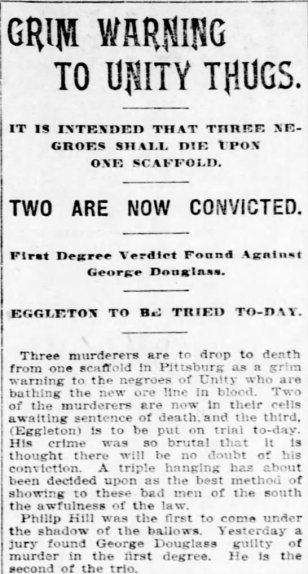
At trial, Hill argued he acted in self-defense, though it was shown Lawrence was unarmed. He was convicted of first-degree murder on July 13, 1897, a result hailed as a “grim warning to the negroes of Unity who are bathing the new ore line in blood,” necessary as a means of “showing these bad men of the south the awfulness of the law” (Pittsburgh Daily Post, July 16, 1897). Hill was sentenced to death on July 31. James was acquitted.
A pleading pardon request filed by Hill’s mother, in which she lamented not having the money to support her son’s defense, and expressed concern that he was tried in an atmosphere of “intense public prejudice,” was unsuccessful.
Pittsburgh Daily Post, July 16, 1897
However, it did persuade an attorney to develop Hill’s appeal and the governor to grant a last minute respite for that appeal to be heard. That appeal (Commonwealth v. Philip Hill, 185 Pa. 385, 1898) failed and Philip Hill was hanged on May 13, 1898.
George Lawrence had been responsible for an 1895 railway construction accident that killed one man and seriously injured another. He was arrested and subsequently acquitted in the matter.
On May 23, 1897, less than a month after the case of Philip Hill drew racially-motivated attention to the camps of Black miners in the coalfields of Allegheny County, George Douglass, James Smith, and Albert Grayer were part of a group of coal miners playing cards on a Sunday morning in the mining hamlet of Snowden, south of Pittsburgh.
In the course of the game, Smith accused Douglass of cheating. Douglass vowed revenge. After getting a gun, he went to the boarding house where Smith was living.
When Douglass encountered Smith, Grayer intervened. The two men spoke briefly before Douglass fired and killed Grayer, shooting him in the head. By other accounts, Douglass shot through a door and struck Grayer without seeing him. He then fled and was quickly apprehended by police.
Pittsburgh Commercial Gazette, May 24, 1897
Confronted by the eyewitness testimony of Smith and others, Douglass was convicted of first-degree murder on July 15, 1897, and sentenced to death.
Pittsburgh Daily Post, July 15, 1897
Pittsburgh Daily Post, July 16, 1897
George Douglass was hanged on November 30, 1897.
Douglass, Grayer, and Smith were Southern-born and single, drawn north to work in the coalfields.
A series of violent crimes involving this initial wave of Black migrants to Allegheny County led to the first episode in which public, media, and legal voices actively constructed and vigorously mobilized against a criminalized, dangerous image of Black men.
In stoking this racist sentiment, note how newspaper coverage, particularly of the Pittsburgh Daily Post, links the events in Snowden and Unity though the two communities were twenty miles apart and the miners in each town had no connections to one another.
Subsequent episodes would occur with subsequent waves of Black migration, first after the turn of the twentieth century and later in the early 1920s.
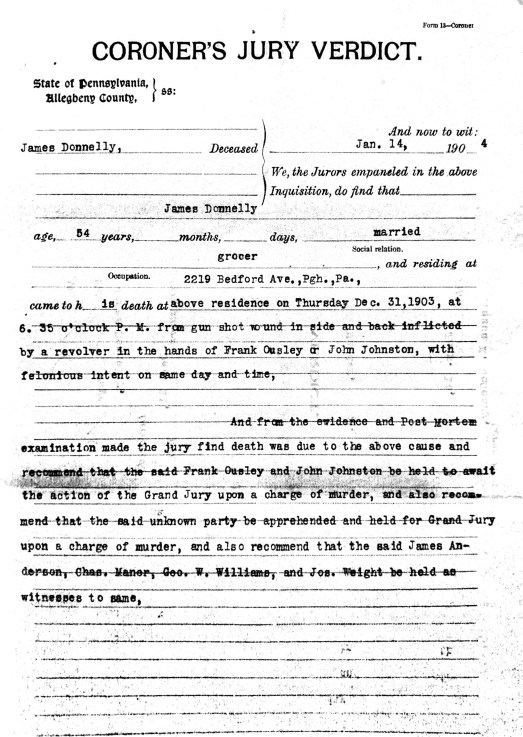
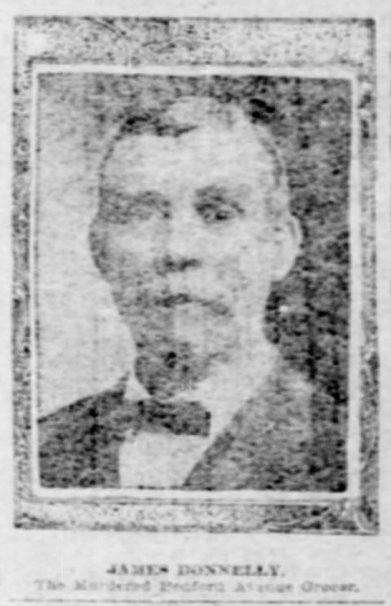
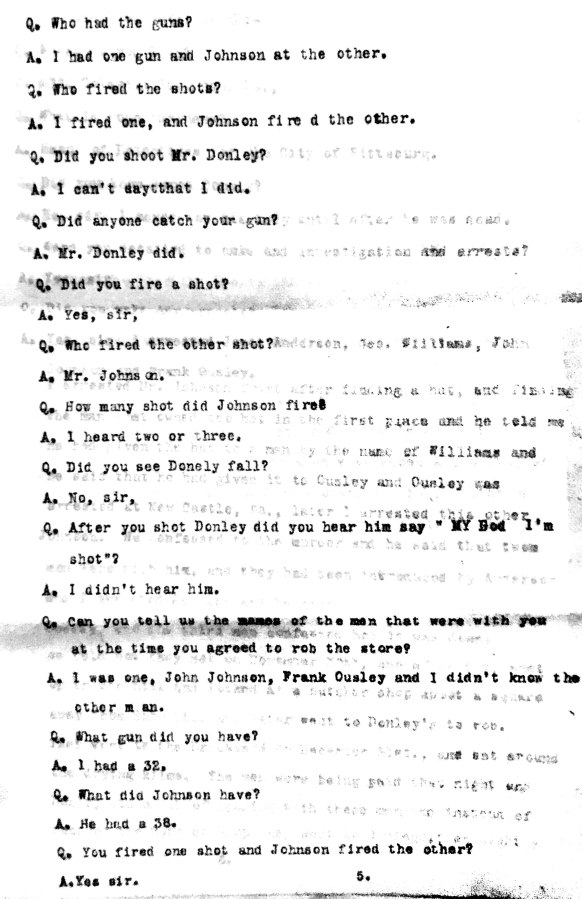
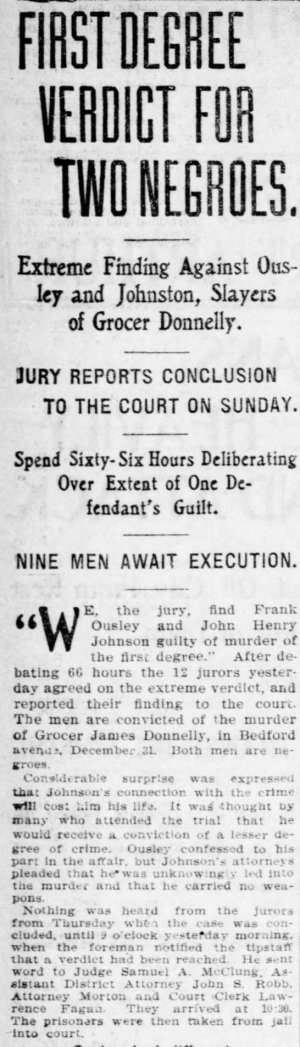
Frank Ousley, John Johnson, and Richard Childs murdered James Donnelly during a robbery of his Bedford Avenue, Hill District grocery on the evening of December 31, 1903.
Pittsburgh Post, January 1, 1904
Donnelly, a well-known and respected businessman, was shot twice.
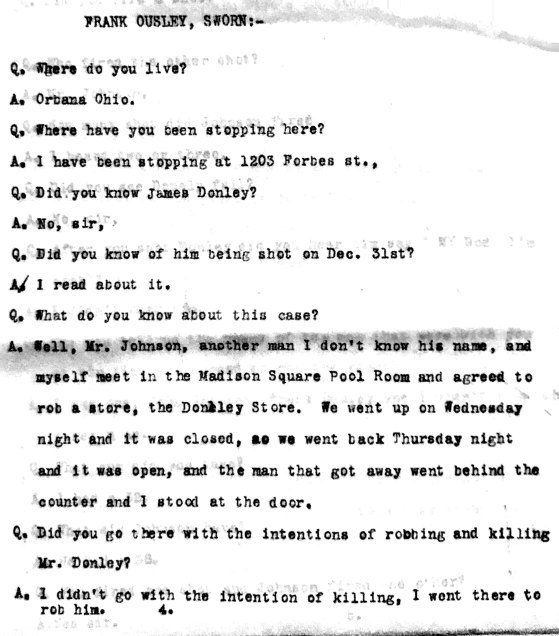
Ousley and Johnson, both of whom had lengthy criminal records, were arrested on January 2, 1904. Ousley, arrested in New Castle, confessed upon arrest. Childs evaded apprehension for years before being arrested in Albany, New York, for burglary in 1906. Linked to the Donnelly murder, he was tried in 1907.
In an era in which escalating racial tensions led to particular punitiveness in cases involving black defendants and white victims, Ousley and Johnson were convicted of first-degree murder remarkably quickly, on February 14, 1904, and sentenced to death. With Ousley as the acknowledged ringleader and shooter, Johnson’s conviction was unexpected due to his lesser role in the murder.
Pittsburgh Post, February 15, 1904
In one of the fastest executions in Allegheny County history, Ousley and Johnson hanged together on July 14, 1904. Just over six months had elapsed since their crime and only five months since their convictions. They were described as model prisoners.
Pittsburgh Post, July 15, 1904
It was the first double hanging in Allegheny County since Murray and Myers hanged together in 1876.
Johnson wrote a confession that was read post-mortem in which he identified himself as a hobo, traveling by rail, who had committed this and four other killings in Pittsburgh and Uniontown.
Nearly three years later, on March 13, 1907, Childs was convicted of second-degree murder for his role in the killing and sentenced to Western Penitentiary.
In the first decade of the twentieth century, the Black Hand Society, a loosely organized group of Italian criminal groups who extorted (placed the black hand on) fellow immigrants, operated in Western Pennsylvania (notably Hillsville and Canonsburg) and Eastern Ohio, as well as elsewhere in the Northeast and Midwest. Some consider it the nation’s first organized crime group.
Pittsburgh Press, January 31, 1904. This article represents the first reference to the Black Hand in Pittsburgh.
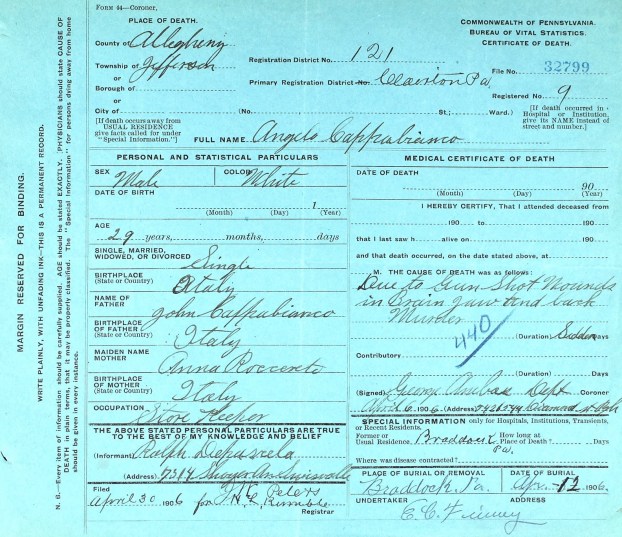
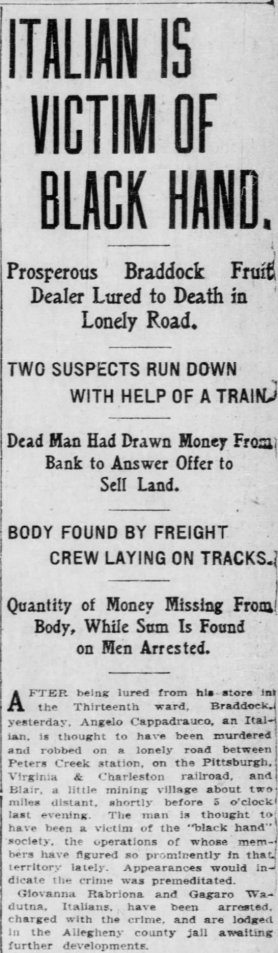
When Angelo Cappabianca, a successful 30-year old Italian-born Braddock fruit merchant, resisted extortion and went to the police for protection, Georgio Quagenti and Giovanni Graziano, two Italian-born hitmen, were brought in from New York City to kill him.
Posing as job seekers, they began by gaining employment with Cappabianca and earning his trust. They then lured him into a remote area near Blair Station, a no longer extant town on the Monongahela River well south of Braddock, on a ruse of buying property to expand his business. There they robbed and shot him on April 5, 1906.
Quagenti and Graziano were apprehended the same day. Money that Cappabianca had recently withdrawn from the bank was found in their possession.
Pittsburgh Daily Post, April 6, 1906
At trial, Cappabianca’s partner was able to identify the defendants. A woman who happened to be in the area of the shooting also testified for the prosecution. The New York Times and Washington Post covered the proceedings.
Quagenti and Graziano were convicted on July 18, 1906. It was the first significant legal blow against the “reign of terror” inflicted by the Black Hand.
Quagenti subsequently confessed, claiming he and Graziano were paid $40 each for the killing by the jealous husband of a woman who had an affair with Cappabianca. He denied any connection to the Black Hand.
Their motion for a new trial was denied and the two men were sentenced to death on December 1, 1906.
Pittsburgh Daily Post, December 2, 1906
No appeal effort was mounted. Their efforts to draw on powerful connections to support their pardon requests also failed after Governor Stuart rejected their petition.
In a sensational final chapter of an already sensational case, the Black Hand apparently sent men to Allegheny County to try to disrupt the execution by blowing up the jail, if necessary. Those men were arrested and jailed just as Quagenti and Graziano went to the gallows.
Pittsburgh Post, July 31, 1907
Georgio Quagenti and Giovanni Graziano were hanged on August 8, 1907, prompting the Washington Post to write this eight-column banner headline.

 Pittsburgh Press, June 13, 1902










 Pittsburgh Press, January 5, 1899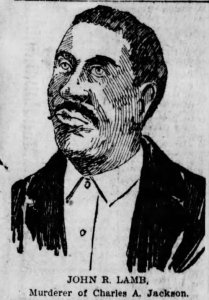







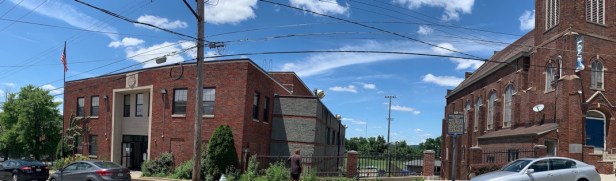 2219 Bedford Avenue today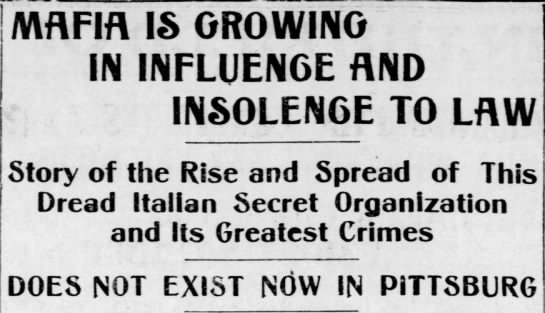
 Pittsburgh Daily Post, April 6, 1906


 State Killings in the Steel City: The History of the Death Penalty in Pittsburgh