George E. Christian

After exiting the trolley at Fifth Avenue and the Maurice St. steps in Oakland late on the evening of September 22, 1900, Peter Hoban, a Pittsburgh-born steelworker, and his friends encountered George Christian and John Hastings. Hoban’s party was returning from work at the Homestead mill.
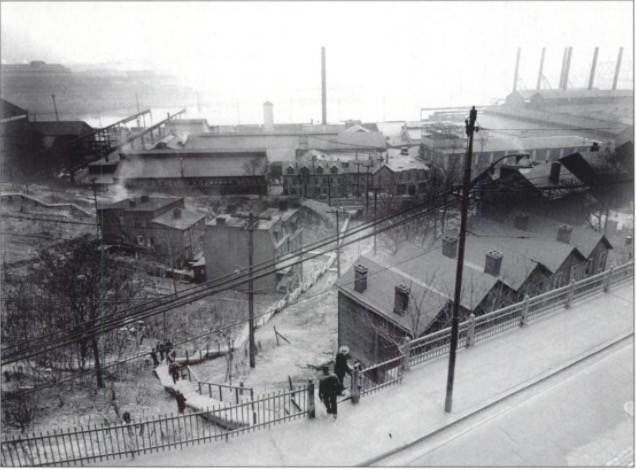
image001
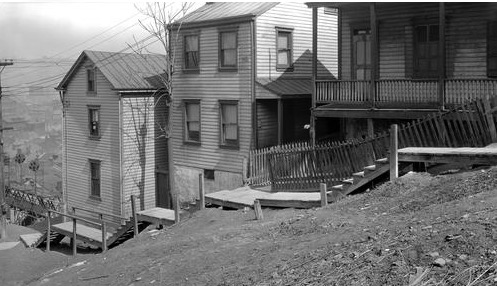
Maurice St. steps, 1952

Much like the Frank Green case two decades later, reports of what happened next vary widely. Hoban’s friends said that Christian and a group of Black men blocked the path of Hoban’s group and pushed them when they tried to pass. Christian claimed Hoban and his friends were the aggressors, pushing the men and hurling racial epithets. Whichever the case, Hoban was shot. He died early the next morning.

image002
Pittsburgh Daily Post, September 27, 1900

Christian fled, traveling to Baltimore and Washington, before going to New York City. He was arrested there on December 5, 1900.

image002
Pittsburgh Press, December 15, 1900

At trial, the prosecution advanced an unlikely story of white innocence and Black aggressiveness. Christian’s defense argued that Hoban and his friends were the aggressors, leading Christian, an obviously proud and self-possessed man, to draw a gun and shoot Hoban once in the chest.

With the racial dynamics certainly favoring the state’s case, Christian was convicted of first-degree murder on January 5, 1901. His motion for a new trial was rejected and he was sentenced to death on February 28, 1901.

image001
Pittsburgh Press, February 10, 1901

After a Pardon Board recommendation, Christian’s death sentence was commuted to life imprisonment by Governor Stone on November 13, 1901, due to questions about the appropriate degree of murder. The same dilemma had faced Christian’s trial jury.

At the time of his release, The Pittsburgh Press published a full-page story of Christian’s life and crimes. Lacking the customary racist tropes of the era, the story is remarkable for the interest and respect it displays for the twice-convicted murderer.

Transferred to Western Penitentiary, on October 1, 1904, Christian was involved in the non-fatal stabbing of fellow inmate Charles Jones. Jones was targeted in retaliation for telling prison authorities of an escape plan that included Christian; famed anarchist and attempted killer of Henry Clay Frick, Alexander Berkman; Biddle brothers accomplice, Walter Dorman; and other notorious inmates. Berkman’s previous escape plan, in 1900, had likewise been foiled.

image002
Pittsburgh Press, October 5, 1904

George Christian was placed in solitary confinement, where he died of tuberculosis on December 5, 1906.

Prior to moving to Pittsburgh, Christian, who was born into slavery in Virginia around 1850, had been sentenced to life imprisonment for killing a man in West Virginia. During the gubernatorial race in 1889, a campaign event Christian helped organize in the Black community was attacked by white residents. Christian was among those arrested and held in a make-shift jail. When the jail was set on fire, Christian escaped, only to be later arrested and convicted of murder for having pushed another man into the fire.

image002
Pittsburgh Dispatch, August 12, 1889

He was pardoned by Governor Atkinson, who was allied with the candidate Christian had been supporting, in April 1900, after serving eight years (the official account of the pardon tells a very different story in which Christian is illiterate and dissolute and an object of pity). Stories circulated of a much darker relationship, in which Christian was a political assassin pardoned to protect him from retaliation.

George W. McMurray, Jr.

Though born into circumstances that would usually free him from such labors, George McMurray worked as a coal miner, apparently unreliably, at National Coal Company in the coal fields west of Pittsburgh. Already 30 years old, McMurray had yet to demonstrate the qualities that would grant him access to the family business.

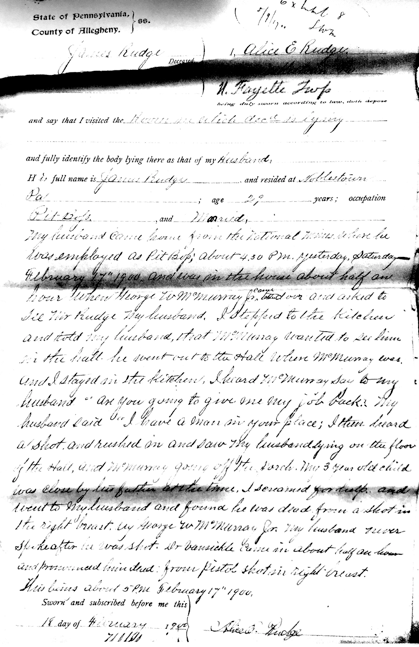
After breaking his arm on the job, McMurray, the son of a wealthy Oakdale family, was fired. He appealed to his foreman, 29-year old, British-born James Rudge, to be allowed to return, only to be told his position had been filled.

McMurray responded by threatening Rudge. He then tried to borrow a gun to confront Rudge. Unable to do so, he bought a gun on February 17, 1900, and went directly to Rudge’s Noblestown home. After asking again for his job and being denied, he shot and killed Rudge. He then turned himself in to police.

The facts of the case were straightforward and uncontested. At trial, McMurray’s defense was that he was intoxicated. He was convicted of first-degree murder on May 10, 1900, and sentenced to death on June 1.

image002

Drawing on the resources of his wealthy father and friends, McMurray vigorously pursued an appeal. His claim that his culpability was mitigated by passion and alcohol was rejected again (Commonwealth v. McMurray, 198 Pa. 51, 1901).

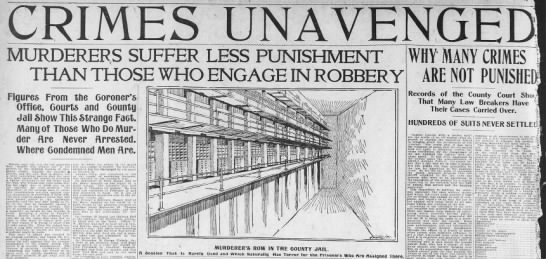
Unsuccessful in the courts, McMurray sought a pardon. In the midst of an upsurge of violent crime and a widespread belief in the inadequacy of punishment, McMurray’s efforts drew harsh criticism from District Attorney Haymaker.

Despite those protestations, after being respited six times, McMurray’s death sentence was commuted to life imprisonment by Governor Stone on November 22, 1901.

image001
Pittsburgh Press, July 14, 1901

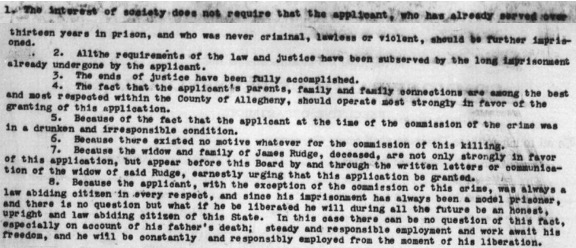
Continuing his campaign to gain release, McMurray was recommended for a full pardon in December 1913 and released from prison on December 20, 1913, months after his father’s death. The Pardon Board was remarkably forthcoming in identifying the factors that influenced their favorable recommendation.

image001
Pardon Board recommendation, December 17, 1913

George W. McMurray, Jr., suffered a heart attack and died while traveling on business related to the family’s oil interests in Richmond, Virginia, on February 24, 1926. He was 55 years old.

Alice Eliza (Martin) Rudge, whose friends feared she would die as a result of the trauma of her husband’s murder, remarried and lived to age 84. She died in 1956.

William Hillman, Jr.

William Hillman, Jr., thirty years old and single, worked part-time on John Conrad Noss’s farm in Wexford, in the northern reaches of Allegheny County. Noss and his wife cared for their 14-year old granddaughter, Bertha Speigel, whose father, John G. Speigel, had been killed by Thomas Burke during a work-related fight on July 3, 1888. Burke was later convicted of voluntary manslaughter and sentenced to seven years in prison.

image001
Wexford, 1922

Hillman was infatuated with the much-younger and uninterested Speigel, a situation her grandparents disapproved of and intervened to stop. When Hillman called for Speigel on March 29, 1898, Bertha’s grandmother informed him that he could no longer see Bertha.

His successful pleadings led Bertha’s grandparents to allow Hillman to talk with Bertha one more time, apparently hoping to pacify him. Reportedly enraged, Hillman drew a gun, shot Bertha three times, and crushed her with a stone. Returning home, he attempted suicide by slitting his throat. Speigel died the next day. 

image001

An effort by neighbors to lynch Hillman was rebuffed by police. As he was being led away to safety, Hillman fought to escape before being subdued and then jailed.

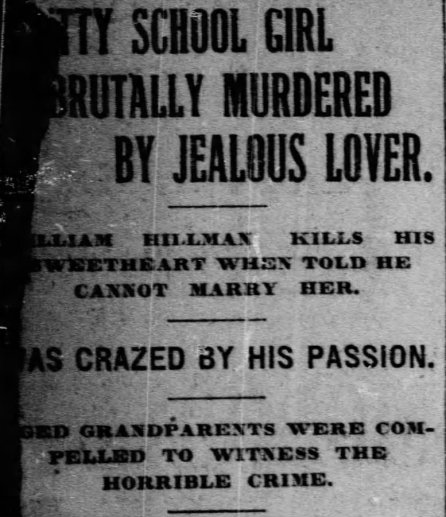
Recognizing Spiegel’s youth and the absence of any relationship with Hillman, newspaper references to a “sweetheart” “murdered by jealous lover” after being “told he cannot marry her” woefully misportrayed the crime.

image004
Pittsburgh Post, April 1, 1898

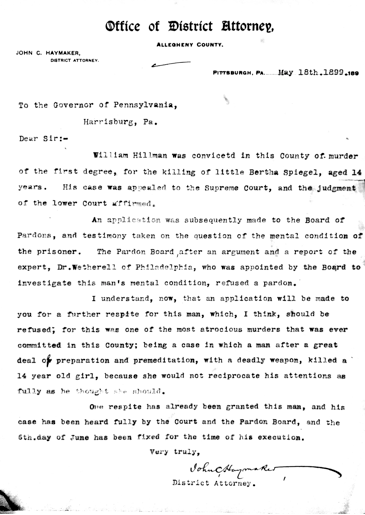
Evidence developed that Hillman had purchased the murder weapon the week before the shooting, leading the Allegheny County District Attorney to characterize the killing as “one of the most atrocious murders” in the County’s history and involving “a great deal of preparation and premeditation.”

At trial, Hillman’s defense was insanity. He countered the state’s clear recitation of the events surrounding the killing with medical and family testimony that he was subject to seizures. He was convicted of first-degree murder on June 9, 1898. After his motion for a new trial was rejected, he was sentenced to death on July 11, 1898.

image001
Pittsburgh Press, July 11, 1898

On appeal, Hillman argued that his crime was not properly first-degree murder and that he was insane. Citing his purchase of a gun and his deliberate steps in using it to kill young Bertha, facts which Hillman did not challenge at trial, the court rejected his first claim. While the court was more considerate of his insanity claim, his failure to draw a clearer connection between his seizures and his actions ultimately led to the rejection of that claim (Commonwealth v. Hillman, 189 Pa. 548, 1899).

Hillman then sought a pardon on mental health grounds. That pardon was refused, though a sanity commission was impaneled to evaluate his mental health.

image002

On July 19, 1899, that commission determined that Hillman was of unsound mind, not suitable for execution.

After the commutation of his death sentence, William Hillman was transferred to Dixmont State Hospital. He committed suicide by drowning while an inmate at Woodville State Hospital on May 11, 1928. He was 60 years old.

image001
Dixmont State Hospital

Anthony McGowan

Anthony McGowan and his wife, Sarah, quarreled frequently. The Irish-born McGowan, who worked at Carnegie Steel’s Carrie Works and owned several rental properties in Rankin, had repeatedly threatened her life. He is also reported to have threatened the lives of at least one of their three children, all of whom had been driven out of the house by his drinking and violent behavior.

On New Year’s Eve 1897, a drunk McGowan shot Sarah in their Second St., Rankin home. She was able to walk to a neighbor’s home, where she implicated her husband before dying. The police responded and arrested McGowan as he slept. A gun was also found in the home.

image002
Pittsburgh Press, January 1, 1898

At trial, McGowan claimed self-defense and drunkenness. With two of his children testifying against him, he was convicted on April 28, 1898. After his motion for a new trial was rejected, he was sentenced to death on June 4.

On appeal, his claims that his responsibility were mitigated by drunkenness and self-defense were again rejected (Commonwealth v. McGowan, 189 Pa. 641, 1899).

With his execution seemingly assured, the Pardon Board recommended McGowan’s commutation on May 3, 1899. The Governor supported the recommendation. Though McGowan’s history of violence created an expectation his execution would be carried out, the legal indifference to marital violence likely weighed against the application of the full force of the law.

image002
Pittsburgh Press, May 3, 1899

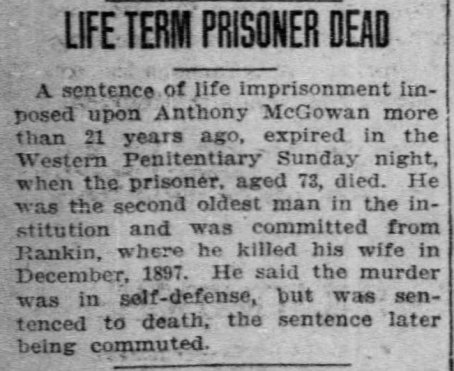
Anthony McGowan was transferred to Western Penitentiary, where he died on June 29, 1919. He was 73. He had been denied a pardon a month before his death.

image004
Pittsburgh Gazette Times, July 1, 1919
image001
Second St., Rankin

Luther Huddle

image001

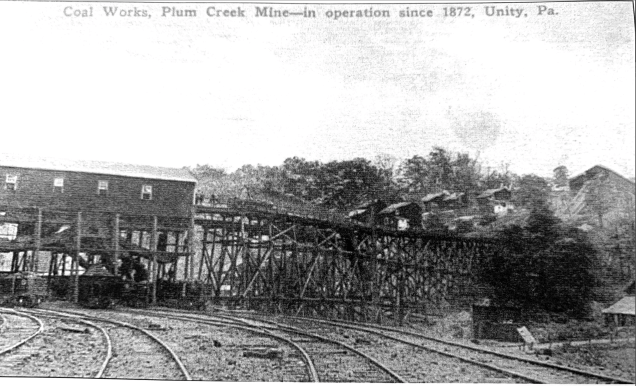
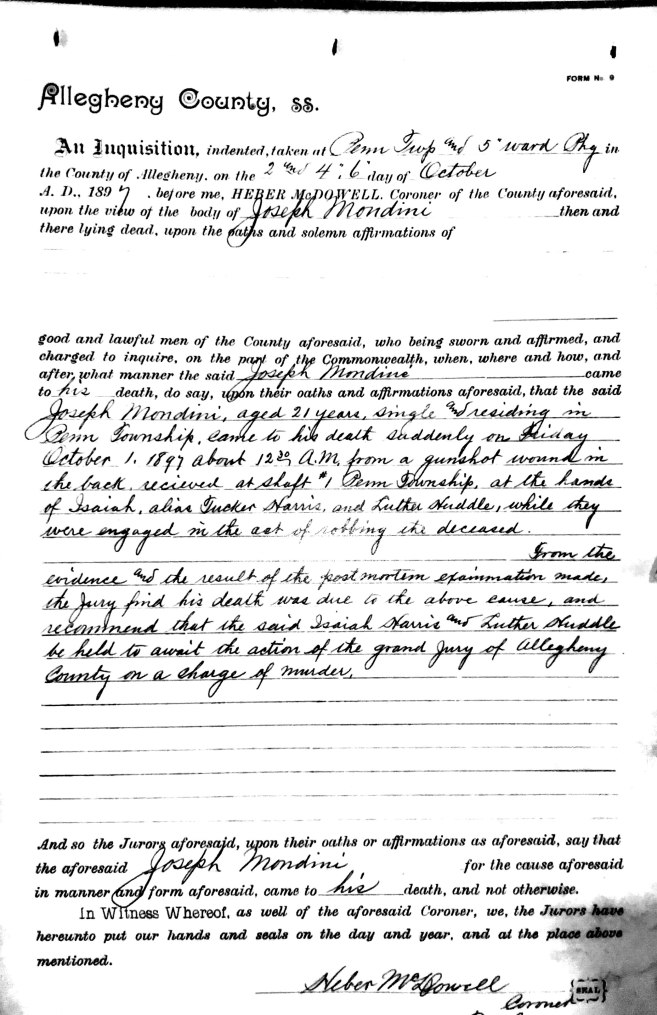
In the months after the racially-charged murder case of Philip Hill began the so-called Carnival of Blood in Allegheny County’s coalfields, Luther Huddle and Isaiah (aka Tucker) Harris killed Joseph Mondini, an Italian immigrant working as part of a crew excavating a railroad tunnel near Unity.

The killing, just after midnight on October 1, 1897, occurred as part of a robbery. Mondini was just completing his lunch break and was returning to the night shift with a co-worker, who escaped unharmed.

image001.jpg

Huddle, a recent migrant from Virginia, and Harris, born in North Carolina, lived in Pittsburgh’s Hill District but had been staying for a few days in the camp of Black coal miners at Unity. While there, they engaged in a series of robberies.

They were arrested in their homes in Pittsburgh later on the day of the killing.

image001

Before and during the closely watched trial, Huddle and Harris each implicated the other for the murder. Huddle was convicted of first-degree murder on October 30, 1897. Isaiah Harris was convicted of second-degree murder and sentenced to 19 1/2 years in Western Penitentiary on December 4, 1897. Huddle was sentenced to death that same day.

Huddle’s death sentence was commuted to 19 1/2 years in prison to match Harris’s on January 20, 1898. The judge who presided at Huddle’s trial wrote to the Pardon Board on behalf of such a change, noting that he believed Harris was “the more intelligent of the two and more to blame in the whole affair.” Under such circumstances, “it would be a reproach to the administration of justice to allow Huddle to be hanged.”

image002

Huddle survived his imprisonment and went on to work as a coal miner in Marianna, Washington County. He died there on March 6, 1920.

James McMullen

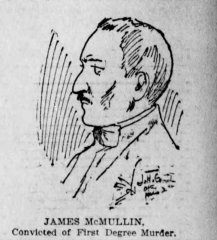
James McMullen, his wife, Elizabeth (Lizzie), both Irish born, and their six children lived in a single room in Rice’s Castle, a tenement that housed forty or fifty families in a neighborhood “more Irish than Ireland” (Pittsburgh Post-Gazette, July 29, 1927) on the point at the confluence of the Allegheny and Monongahela Rivers, in the last decade of the nineteenth century.

image001

McMullen, who worked in a rolling mill, was a heavy drinker and abusive husband who forced his wife to work and used her earnings to support his drinking while his family lived in extreme poverty.

image001

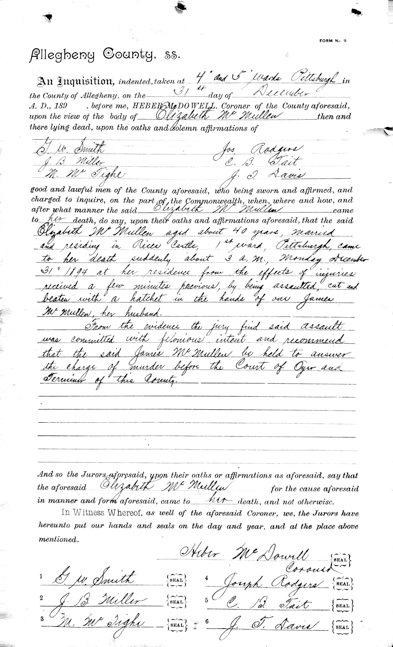
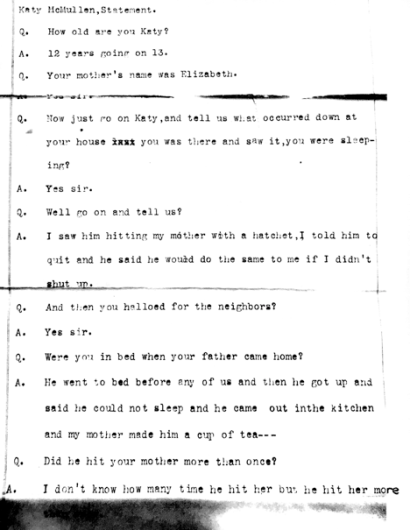
On New Year’s Eve, 1894, McMullen beat and stabbed Lizzie to death, then attempted suicide by slitting his own throat. Neighbors and then police responded, and found Lizzie McMullen dead and James McMullen bleeding. He was arrested at the scene.

image002.png

After three weeks in the hospital recovering from his injuries, McMullen was deemed fit for trial.

His trial, which included the testimony of his children, was described as “the shortest homicide case on record in the county,” though the verdict took forty-five hours and fifty ballots to reach.

image002

McMullen’s alcoholism and the evidence of his mental unfitness complicated the jury’s decision, which, in a “surprise” verdict, found him guilty of first-degree murder on April 25, 1895. He was sentenced to death on June 1, 1895.

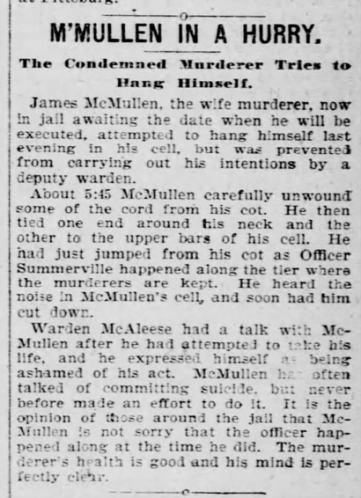
While awaiting execution, McMullen attempted to hang himself in jail on August 17, 1895.

image002
Pittsburgh Daily Post, August 18, 1895

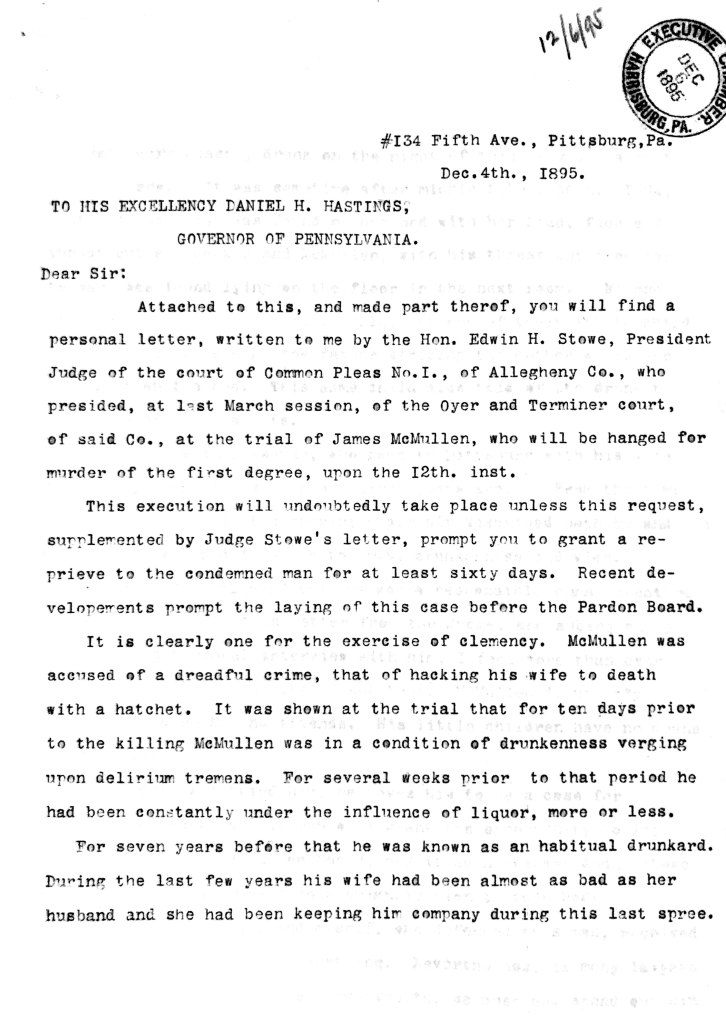
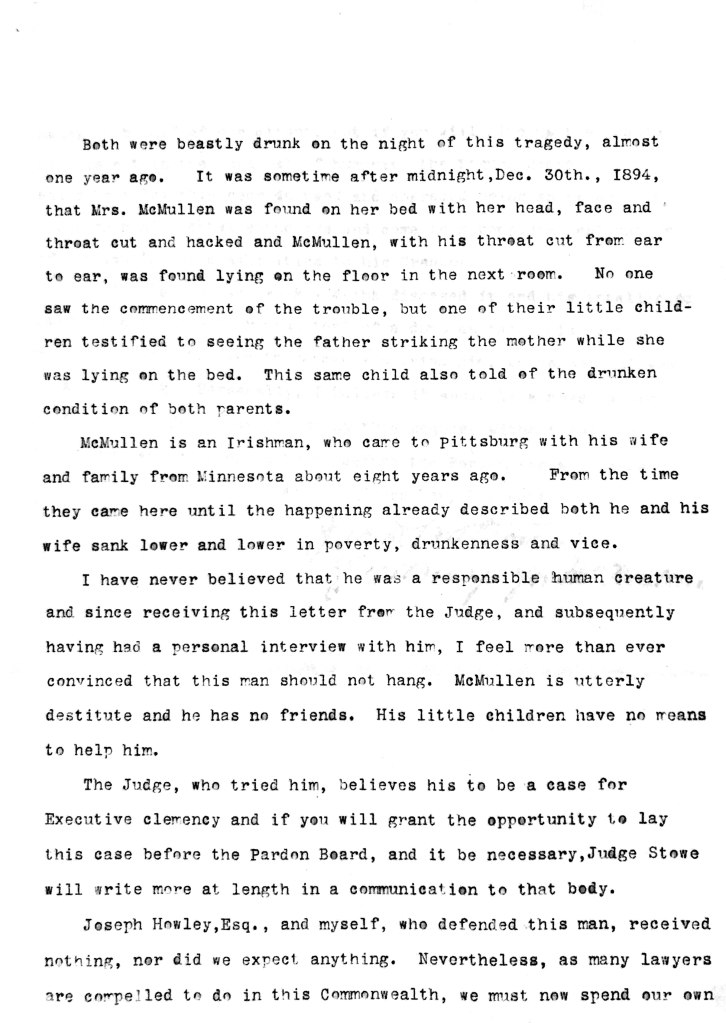
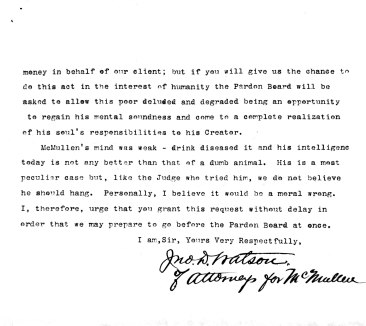
McMullen’s clemency request centered on a letter from his attorney that portrayed James and Elizabeth McMullen as destitute and degenerate, lacking the sensibilities to be deserving of the law’s ultimate punishment or to be worthy of the law’s ultimate protection.

image001

Finding him unfit for execution, the Pardon Board recommended that his sentence be commuted to life imprisonment in January 1896. That commutation took effect on February 8, 1896.

James McMullen spent the remainder of his life in prison. He died of kidney disease in Western Penitentiary on April 23, 1916.
George Dukovic

George Dukovic and Peter Dobrozdravic, Slovenian-immigrant steelworkers who lived in Etna and worked at nearby Spang & Chalfant, had been quarreling since soon after Dukovic had loaned Dobrozdravic money. Though the loan was repaid, lingering resentment about Dukovic’s erratic behavior led Dobrozdravic to publicly threaten Dukovic and claim he was insane.

image001
Spang & Chalfant, 1919

Dukovic responded by suing Dobrozdravic for slander in May 1893. Before that suit could be heard, Dukovic was admitted to Dixmont Hospital for the Insane for treatment.  Dukovic was released in March 1894.

image001
45 Sycamore St., Etna

Still upset about the dispute and convinced that Dobrozdravic led a vast conspiracy to defame him, on the evening of March 12, 1894, Dukovic laid in wait near Dobrodravic’s 45 Sycamore St., Etna home. There he shot and killed Dobrozdravic and fled the scene. He was arrested the next day.

image001
Pittsburgh Press, March 13, 1894

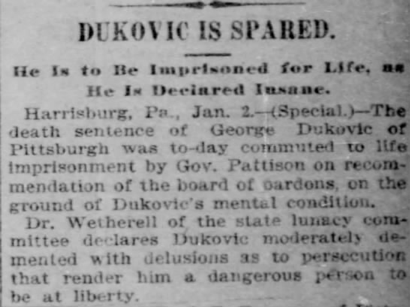
Dukovic’s first-degree murder conviction, on April 20, 1894, was unexpected due to his recent institutionalization and the widespread belief he was insane. His mandatory death sentence was imposed on June 2, 1894.

After numerous delays in the execution of his sentence, in September 1894, a sanity commission determined Dukovic was insane.

image003
Altoona Tribune, September 15, 1894

On that basis, in December 1894, the Pardon Board made a formal recommendation for commutation. That request was granted on January 3, 1895, and Dukovic was transferred to Western Penitentiary.

image002
Pittsburgh Post-Gazette, January 3, 1895

Within weeks, Dukovic’s erratic behavior raised concern. He was returned to Dixmont in March 1895.

image003
Pittsburgh Post, January 18, 1895

Dukovic died in Woodville State Hospital, another state mental health institution, on August 21, 1908.

Soon after his trial, Dukovic was the subject of a lengthy article in the Atlantic Medical Weekly, titled “Insanity and the Courts.” The article focused on the challenges of balancing legal concepts with the growing understanding of insanity and its relationship to issues of responsibility. Dukovic’s delusions, feelings of persecution, depression, and suicidal tendencies are discussed.

James Newton Hill

James Newton Hill was married, had a young daughter, a good job in the burgeoning steel industry, and a home in Tarentum, more than twenty miles east of Pittsburgh. At Apollo Iron and Steel, he worked under Emil Rotzler, a Swiss-born metallurgist with whom he developed a friendship and then a partnership owning racehorses.

image001

Through that relationship, Hill began an affair with Rotzler’s wife, Rosa (Prysi or Prizy).

When the affair became public, Rotzler fired Hill. Weeks later, on December 22, 1891, Emil Rotzler died at age 37. Though these circumstances raised questions among some about the cause of Rotzler’s death, no investigation appears to have been conducted.*

Hill then went to work at Allegheny Steel, a job that required that he board on the North Side during the week. Rosa Rotzler began to visit him there, and then relocated with her son to that neighborhood.

According to subsequent testimony from Rotzler’s son, Edward, in February 1893, Hill came to their home to request money to support a business venture. The economic depression known as the Panic of 1893 that was just beginning may have heightened his desperation. When Rosa refused, Hill brandished a gun and threatened to beat her and Edward.

image001.jpg

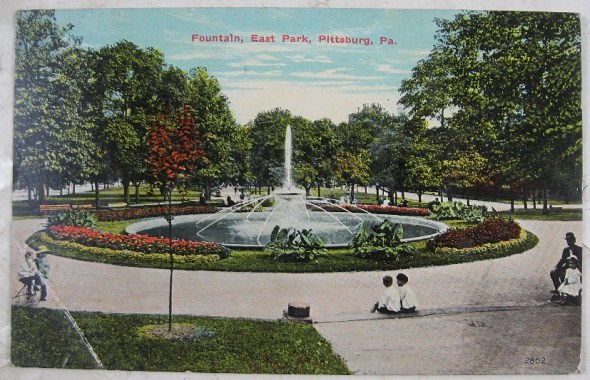
Then, on the mild late winter morning of March 7, 1893, in East Park, on the North Side, Hill shot Rotzler twice and slit her throat. He then slit his own throat. When police found them, Hill was carrying unsigned loan papers.

image001

Due to the seriousness of his injury, it was widely expected that Hill would die. Indeed, his survival became the subject of an article in a medical journal.

The initial understanding of the case, based on a story Hill told and insisted upon throughout the case, was that both he and Rosa had been attacked by an unknown assailant. At trial, Hill’s counsel presented the defense that this unknown assailant committed the murder and was seen fleeing. The case, featuring an attractive and wealthy Swiss widow, an affair, a murder, and an attempted suicide, was a sensational news story that received national attention.

Hill’s defense collapsed when the prosecution presented the man who was seen fleeing, who testified he ran when he discovered the bodies. Hill was found guilty on November 16, 1893, and was sentenced to death on January 27, 1894.

image002
Altoona Tribune, November 17, 1893

A complicating factor was that Hill’s serious neck wound made it impossible to hang him without risking decapitation. His attorney made this concern the central argument in his successful commutation effort, stating that “[h]is execution under the sentence of the Court would only result in a horrible and disgusting exhibition of human torture.”

image001

image002

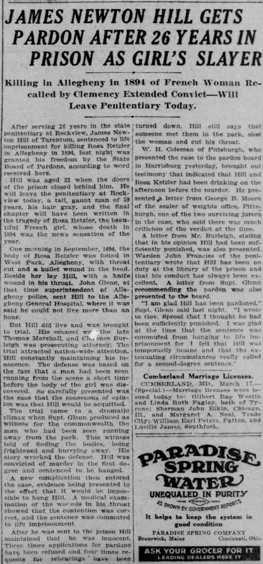
Based on that argument, supportive letters from neighbors and clergy, and petitions signed by hundreds of people, Hill’s sentence was commuted to life imprisonment on October 30, 1894. He served his sentence at Rockview State Penitentiary.

After almost 27 years in prison and numerous pardon requests, James Newton Hill received a full pardon and was released from prison on March 17, 1920. His pardon recommendation centered on the length of time he had already served.

image002
Pittsburgh Post-Gazette, March 18, 1920

James Newton Hill died in Pittsburgh on April 23, 1936, more than 43 years after sustaining what were thought to be fatal self-inflicted injuries. He was 76.

image001
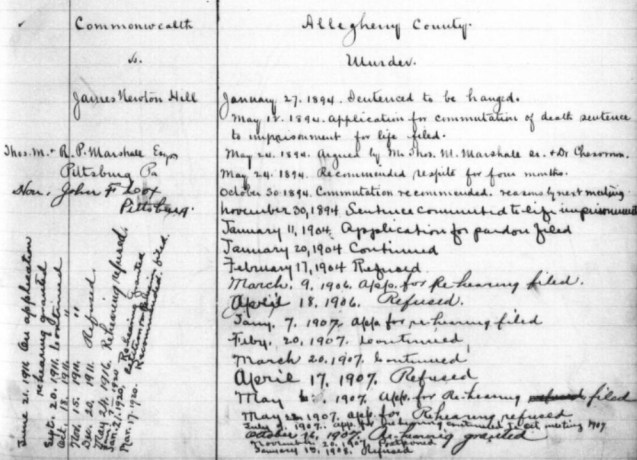
Pardon Board records of the long saga of James Newton Hill

* Emil Rotzler died in Armstrong County, Pennsylvania. His will, signed April 30, 1891, left all of his assets to Rosa. Death records from that county are available beginning in 1893. No publicly available information addresses the cause or circumstances of Rotzler’s death.

George Straesser

George Straesser and Joseph Brandl, both recent German immigrants, boarded in the Stuekenberger home in a German enclave on Holt St. on the South Side.

image001
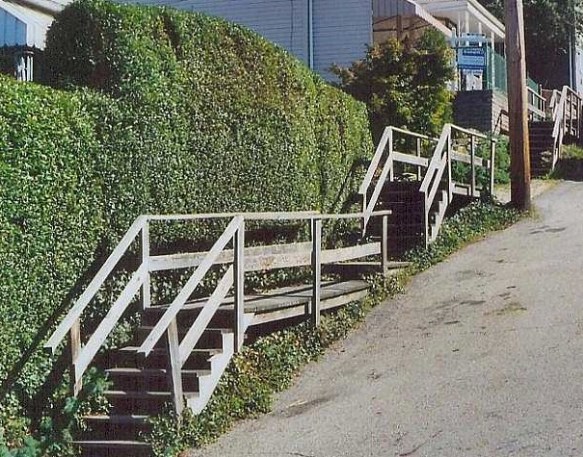
South Side steps

Straesser’s relationship with the Stuekenbergers became strained in the spring of 1892 after he failed to pay his board and, in a related incident, assaulted his landlord’s son,  Joseph Stuekenberger. As a result, Straesser moved back in with his family.

image002.png

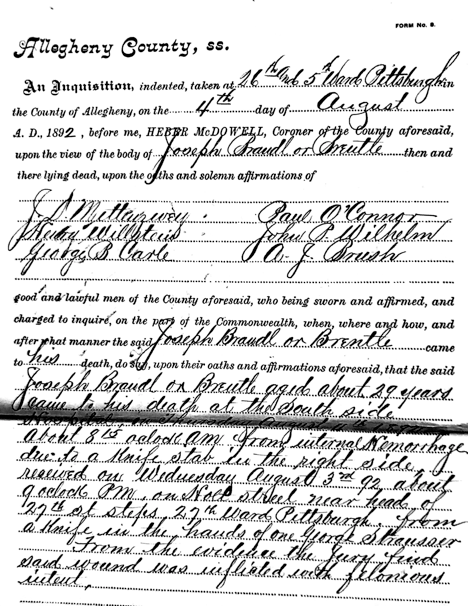
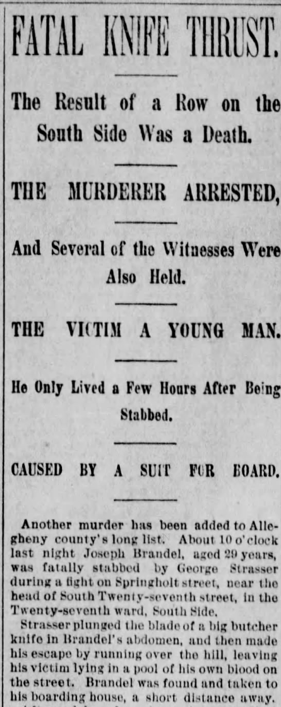
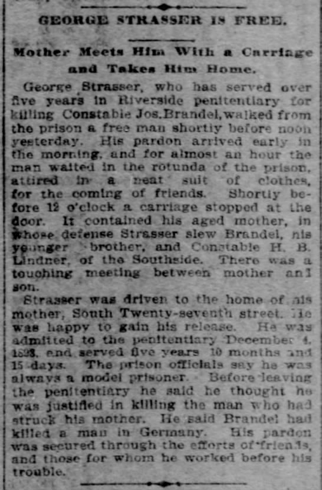
Returning home from a hearing related to these legal matters on August 3, 1892, a quarrel broke out between members of Straesser’s family and Brandl. After insults were hurled at Brandl by Straesser’s mother, Johanna, and sister, Rosina, Brandl struck the two women. Straesser, who was not present when the fight began, came to their defense and stabbed Brandl multiple times. He died the next morning.

image002
Pittsburgh Press, August 4, 1892

At trial, the popular Straesser claimed Brandl was a well-known troublemaker who died after falling on his own knife. Despite conflicting witness testimony as to whether Brandl was armed, who initiated the fight, and the sequence of events in the fatal affray, Straesser was convicted of first-degree murder on October 8, 1892, and sentenced to death on November 28. The severity of Brandl’s wounds figured in the verdict.

After his conviction, Straesser changed his story to admit stabbing Brandl, but claimed he did so after Brandl attacked his mother and sister. On appeal, Straesser’s counsel argued that the state had failed to prove the elements of first degree murder and that Straesser had acted out of passion and without premeditation.

Straesser’s appeal was rejected as not germane to the defense – that “he did not slay the deceased” – he had made at trial (Straesser v. Commonwealth, 153 Pa. 451, at 456).

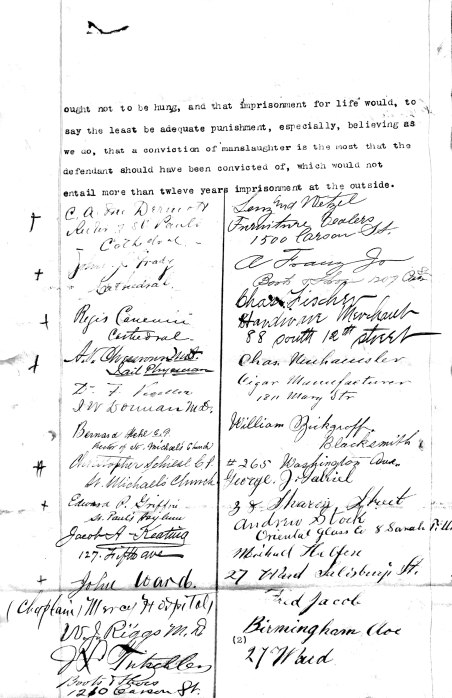
Based on lingering questions about the circumstances of the killing and the extent of his responsibility, Straesser requested clemency. Given his status, the status of his community, and the social sanction for the violent defense of family and femininity, Straesser’s clemency effort attracted the support of the mayor, newspaper editors, businessmen, and thousands of petition signatures.

image001image003

His death sentence was commuted to life imprisonment on December 4, 1893, and he was transferred to Western Penitentiary.

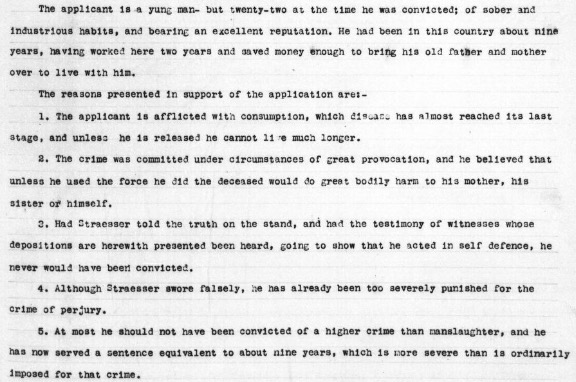
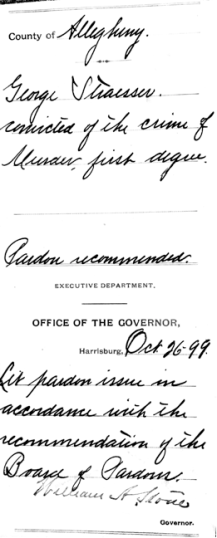
Six years later, Straesser sought a full pardon. The Pardon Board supported his request, finding that he had acted in self-defense.

image001

He was released from prison on October 28, 1899.

image002
Pittsburgh Daily Post, October 29, 1899

image002.png

George Straesser died of tuberculosis, reportedly contracted in prison, in his South Side home on April 26, 1901.

image001
Holt St. steps

Angelo and Joseph Zappe

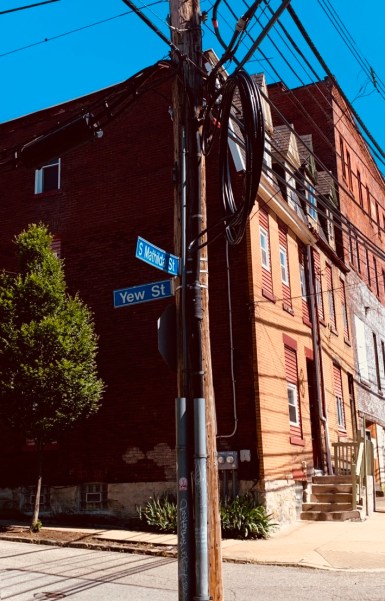
The Italian-immigrant Zappes and their German neighbor Helmstetters lived at the intersection of Mathilda and Yew Streets in working class Bloomfield in the last decade of the nineteenth century. Tensions between the families, which paralleled the growing tensions between earlier-arriving Northern European WASP immigrants and more recent arrivals from Southern Europe, were high.

image001

It is richly and tragically symbolic that those tensions, centering as they did on who gets to be an American, came to a head on July 4, 1892.

An argument involving Annie Zappe and Ida Helmstetter, which included ethnic slurs and literal mudslinging, led to blows and then knives when Angelo Zappe and his brothers, Joseph and Pasquale, and Frank Helmstetter became involved. When it was over, Frank Helmstetter was dead, stabbed by Angelo Zappe.

The 26-year old, Allegheny City-born Helmstetter worked as a copper.

Angelo and Joseph Zappe and five other members of their extended family were immediately arrested.

Newspaper coverage was decidedly tilted toward the Helmstetters, who were described as “very respectable,” while the Zappes were characterized as “very common.” Also notable is that the Helmstetters repeatedly referred to the Zappes in racialized terms, as black.

image001
Pittsburgh Daily Post, July 6, 1892

The epic Battle of Homestead, a red-letter day in Pittsburgh and labor history, followed only two days later. This remarkable episode, in which a private army fought and killed the workers and residents of Homestead with impunity and in which the public officials and public processes of Homestead, Pittsburgh, and Pennsylvania were subordinated to private power, revealed a defining fact of industrial Pittsburgh – that it was a company town.

Within a decade, Carnegie Steel would become United States Steel, a vertically integrated behemoth of coal and iron ore mines, steel mills, railroads, and steamships that controlled and profited from every link in the productive chain in a nation laying railroads and building warships, skyscrapers, and, soon, automobiles at a furious pace. Its principals, Carnegie and Frick, were among the richest men in the world, better known today for their philanthropy and art collections than for the ruthlessness that produced them.

Its labor force – the Zappes and tens of thousands of new immigrants and Black migrants – saw their wages cut sharply, their hours expanded, their working conditions worsened, their organizations dismantled. The craftsmen’s empire had been destroyed and the brutal efficiency of America’s Second Industrial Revolution had begun. The next three decades would witness the most productive, wealth-creating, and labor-immiserating era in American history. Pittsburgh was at its center.

Tried together, Angelo and Joseph Zappe, who argued they acted in self-defense, were convicted of first-degree murder on September 29, 1892, and sentenced to death the same day. Reflective of those changing patterns of immigration, they were the first Italian immigrants to be sentenced to death in Allegheny County. Charges against the other five defendants were not pursued.

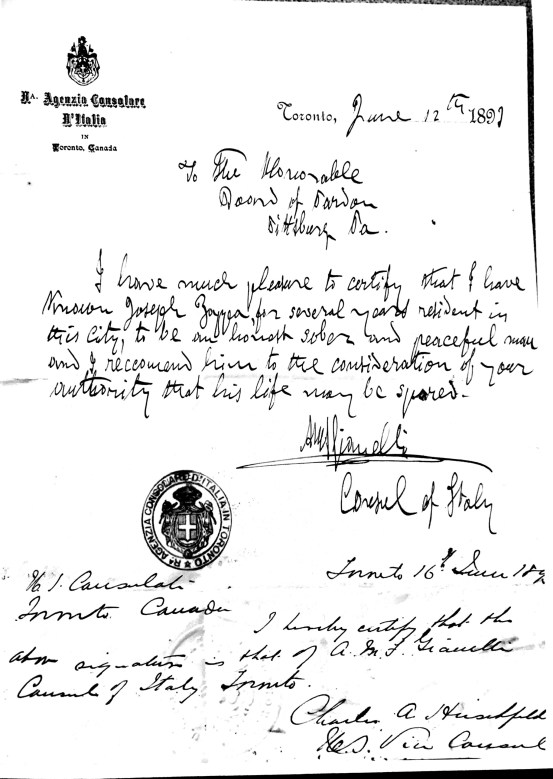
The Zappes’ appeal to the state supreme court failed. A vigorous pardon campaign was then mounted, including entreaties by the Italian Consul in Toronto, where the Zappes had previously lived, as well as their Bloomfield neighbors and members of their jury, emphasizing that the circumstances of the case did not constitute first-degree murder, that Joseph Zappe was not involved in the killing, and that the Zappes had an excellent reputation in the neighborhood.

image001

Agreeing in part, the Pardon Board recommended commutation of Joseph Zappe’s death sentence to life imprisonment on November 28, 1893.

image001
Pardon Board records

Angelo Zappe was executed on December 14, 1893. He strangled slowly before being pronounced dead ten minutes after the trap was sprung. From the gallows he emphasized that his brother, Joseph, was innocent and should be spared.

image004
Pittsburgh Post, December 19, 1894

Joseph Zappe’s death sentence was formally commuted to life imprisonment on January 18, 1894, just over a month after his brother’s execution. He was transferred to Western Penitentiary. Four years later, he was adjudicated insane and transferred to Dixmont State Hospital.

Joseph Zappe died in the Allegheny County Hospital for the Insane on July 23, 1934.

image001
Pittsburgh Commercial Gazette, September 6, 1897

This story from 1897 nicely captures the anti-immigrant tensions faced by Italian and other Southern and Eastern European “new immigrants” during this era. Note how the fight is characterized as a “race riot,” how earlier-arriving and Protestant Northern and Western European immigrants are characterized as “Americans,” and how a distinction is made between the “injured men” and the Italians.