James M. Kelly

James Kelly, Daniel Denny, and John Richards, all single men working as glassblowers, probably at the Aetna Glass Works, went out drinking in their Lawrenceville neighborhood on October 7, 1857. After stopping at a few taverns, Kelly suggested that they go to the nearby home of Wilhelmina Weissman, whom Kelly described as a prostitute.

image001

Weissman lived with her elderly father, Henry, in a dilapidated home on the estate of Philip Winebiddle, a wealthy landowner who allowed the Weissmans to live free of charge.

IMG_1015 (3)

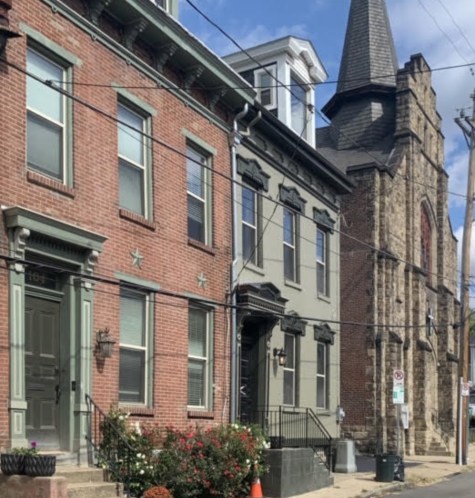
Scion of a prominent founding family with significant landholdings in East Pittsburgh, as a young man Philip Winebiddle killed an unnamed enslaved man and fled efforts to arrest him. He was later tried for murder and “acquitted after a tedious trial of fifteen hours.”

image001Pittsburgh Weekly Gazette, November 19, 1816

When no one answered the door at the Weissman residence that evening, Kelly, Denny, and Richards let themselves in and went to the bedroom where Wilhelmina and Henry slept. Awakened by the intruders, Henry fought the men while Wilhelmina ran for help. When she returned, she found her father had been seriously injured. Henry Weissman died the next day. Richards, Denny, and Kelly were arrested on October 8.

image001
Baltimore Sun, October 10, 1857

Kelly, 20-years old and single, was tried first; his trial began on January 12, 1858. At trial, he claimed that Weissman was a prostitute he had patronized previously and that he and his friends were merely interested customers when they were forced to defend themselves.

After a defense that emphasized Wilhelmina Weissman’s bad character and sexual immorality (including claims that she was pregnant, unmarried, and syphlitic), Kelly was convicted of first-degree murder on January 16. After his motion for a new trial was rejected, he was sentenced to death on March 9, 1858. Denny was convicted of manslaughter and Richards was acquitted.

At the time of Kelly’s original trial, Fife, Jones, Stewart, and Lutz were awaiting execution. The Pittsburgh Gazette of January 18, 1858, wrote “Our jail has never presented such a spectacle to the eyes of the world as at present and we trust it never may present such an one again.” On the same day, the Daily Post wrote “We blush to record the dreadful tragedies for which the community now stands resposible (sic). Fife, Charlotte Jones, Stewart, Lutz and Kelly, with the dismal prospects of others being added to the column. We have no heart to enter upon the discussion of the causes of this fearful increase of the devilish spirit of murder; neither do we desire to reiterate the horrible details of this terrible result. It is enough to contemplate that cold-blooded murder – a total disregard of the value of human life, has been considered a trifle in this region, by bullies and street corner ruffians.”

image001
Pittsburgh Post, January 18, 1858

On appeal, on July 15, 1858, Kelly’s conviction was reversed and he was granted a new trial (Kelly v. Commonwealth, 1 Grant 484, 1858). The reversal was granted due to the court’s concern that the circumstances of the offense mitigated Kelly’s premeditation, raised the issue of self-defense, and, in the absence of a clear intent to rape, did not rise to the level of first-degree murder. Specifically, Kelly had been charged with felony (rape) murder, yet his intent to rape had not been established and could not be used as a component of the charge if Wilhelmina had fled before the killing occurred.

Kelly’s second trial began on November 30, 1858. He was convicted of second-degree murder on December 2, 1858, and sentenced to eight years and nine months in Western Penitentiary.* After serving all of that sentence, Kelly was discharged on September 2, 1867. He died in Pittsburgh in 1914.

image001
Pittsburgh Daily Post, December 3, 1858

Wilhelmina Weissman died in Allegheny General Hospital on May 8, 1899.

* Kelly was the first death-sentenced defendant to serve time in Western Penitentiary. By the time he arrived, the famed Western Pen, a once-promising testimony to the failed belief that prisons could serve as beacons of “moral architecture,” was already on its second (of three) iterations. The idealism surrounding prisons at the time was one reason that the death penalty was not used more frequently. That most murderers were young white men of Northern and Western European ancestry was another important moderating factor. Only two (Jewell and Fitzpatrick) of the thirteen (Honeyman, Moode, Dunn, Lutz, Kelly, Keenan, Lynch, Murray, Meyers, Linkner, Abernathy) white men sentenced to death for fatal assaults involving white victims before the late 1800s were executed. Sounding this note, the Pittsburgh Daily Post in 1858 also wrote that “the humanity of the age forbids [making] the laws more stringent” before concluding that “the best defense is not punishment but prevention.” As the profile of the offender changing later in the century, use of the death penalty increases accordingly.

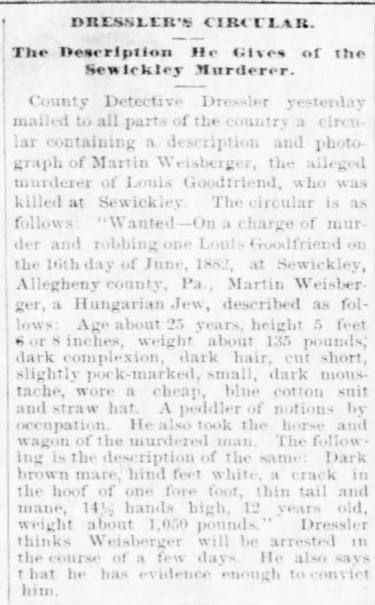
Martin Weinberger

In a remarkable reprise of the Frecke and Marschall, Myers and Murray, and Linkner cases, all recent felony murders of recent German immigrants by their countrymen, Martin Weinberger killed Louis Gotfreund on June 16, 1882. His nude and decomposing body was found in the bushes on the side of the road two days later.

image001

Weinberger and Gotfreund, German Jewish immigrants working as peddlers or “roving junk dealers,” as was common among German immigrants at the time, were traveling in a remote area near Sewickley when Weinberger robbed and shot Gotfreund and fled with his horse and wagon, goods, and cash. Gotfreund, newly arrived and unmarried, was not identified until ten days later, when an uncle living in East Liverpool, Ohio, responded to a newspaper description of the victim and was able to identify his exhumed body.

image001
Pittsburgh Daily Post, June 30, 1882

Based on descriptions provided by witnesses, Weinberger was arrested on July 1, 1882. By that time, the stolen goods had been sold and the money deposited in a bank account in Youngstown. He claimed that Gotfreund had committed suicide and that he tried to conceal the act by removing Gotfreund’s clothes and hiding his body.

With a strong evidentiary case against Weinberger and an “exceedingly weak” (Pittsburgh Commercial Gazette, January 6, 1883) and implausible defense, Weinberger was convicted of first-degree murder on January 6, 1883.

After a lengthy delay caused by the efforts of Hungarian authorities, friends, and family to prevent Weinberger’s execution, he was hanged on September 2, 1884, after having confessed from the gallows.

image001
Pittsburgh Commercial Gazette, September 3, 1884

Martin Weinberger is believed to be the first Jewish person executed in Pennsylvania.

image001
Pittsburgh Press, September 2, 1884

Robert Warden McConkey

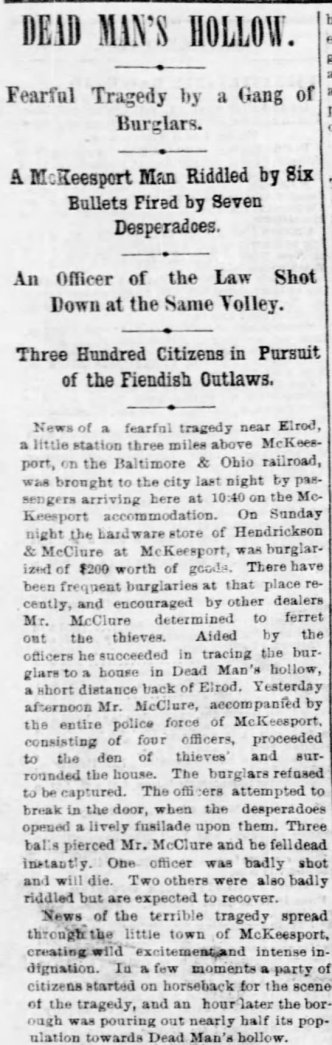
Robert McConkey was part of a gang that robbed Hendrickson & McClure’s Hardware in McKeesport, on July 31, 1881, stealing a large and valuable cache of knives and guns. Two days later, store owners George A. McClure and Wilbert Hendrickson, as well as Joseph Lynch and George Fleming, traced the gang to a bend on the Monongahela River known as Dead Man’s Hollow, near where Fife and Jones had committed double murder nearly twenty-five years earlier.

image001

When they confronted the gang, McConkey, only 19 years old and already with a criminal record, shot and killed McClure. He and his accomplices then fled. A sizable reward was offered for their capture. Reports that they would be lynched were widespread.

image001
Pittsburgh Daily Post, August 3, 1881

Months later, in January 1882, McConkey was found in jail in Little Valley, Cattaraugus County, New York, where he was serving time for theft, and returned to Pittsburgh.

At trial the following month, Hendrickson, Lynch, and Fleming as well as other witnesses identified McConkey as McClure’s killer. His defense, that this was a case of mistaken identity, failed. McConkey, poor, fatherless, illiterate – “[f]ew persons raised in this country of free schools know less,” remarked the Pittsburgh Post-Gazette – and already well down a wayward path, was convicted of first-degree murder on February 15, 1882. His motion for a new trial was rejected and he was sentenced to death on February 25.

image001
Pittsburgh Daily Post, February 16, 1882

McConkey’s appeal, which challenged the veracity of the witnesses and raised a series of technical points, was likewise rejected (McConkey v. Commonwealth, 101 Pa. 416, 1882).

In the days before his execution, newspaper accounts expressed sympathy for McConkey’s youth, his quiet demeanor, and his many disadvantages.

Ward McConkey was executed on May 10, 1883. Due to the unusually high level of public interest created by both the notoriety of the case and the compassion shown to the young white killer, a large fence was erected around the jailyard to obstruct the view of onlookers.

Described as a model prisoner, brave all the way to the gallows, McConkey declared his innocence to the end. His final words were “Good-Bye, murderers.”

About the execution, the Pittsburgh Daily Post wrote: “The moral effect of the execution on the criminal class or those whose steps are verging toward criminality may be safely placed at about zero….We doubt if it has any, or is anything else than the vengeance of society….One valid reason is left…the protection of society. This is tangible ground and one can understand it. McConkey will murder no more. That much has been accomplished by the execution. As a deterrent power on the criminal class we doubt the efficacy of the gallows. There is too long an interval between the crime and the penalty, to say nothing of the uncertainty of the punishment….”

Though the case remained in the news for years with reports of sightings of McConkey’s accomplices, no other arrests were ever made.

Dead Man’s Hollow is now a designated conservation area protected by the Allegheny Land Trust, though its reputation for mystery and violence remains.

image001
Flickr/Kordite

William Murray and Frederick Myers

On the evening of November 11, 1874, German-immigrant Frederick Myers and his companion, William Murray, robbed and shot German immigrant Gotthard Wahl in a remote area north of Pittsburgh. Like Frecke and Marschall before them, the companions who had reportedly come to Pittsburgh only days earlier, made their livings through crime. Like Foerster, Wahl, a father of seven, was chosen because he was traveling on an isolated road near Perrysville and appeared to be a man of some means.

image001
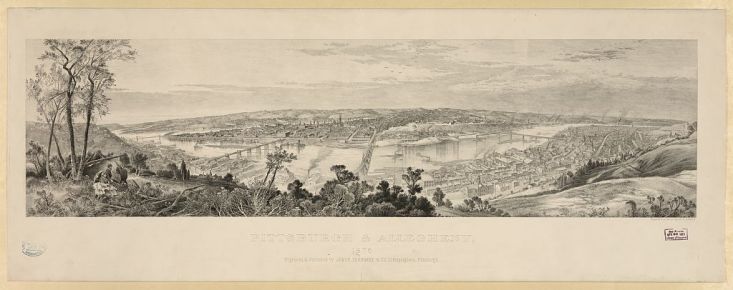
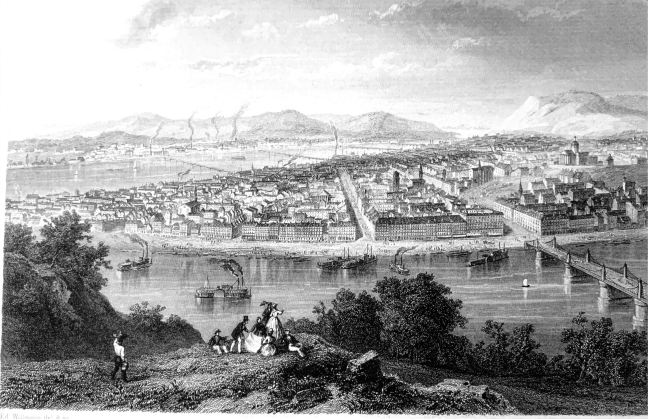
Pittsburgh, 1876

Murray, the leader of the two, fired the fatal shot. Wahl died the next day. A man named Jacobs, who was traveling with Wahl, was injured but able to escape. Both victims were able to provide descriptions of their assailants.

After returning to their room at Mrs. Moore’s boardinghouse, 208 Third Avenue, Mary Kearns, an employee there who had heard of the killing, became suspicious of Murray and Myers and alerted authorities.

They were arrested on November 14.

image002
Pittsburgh Post, November 21, 1874

Murray and Myers were convicted in separate trials in March 1875, and sentenced to death.  Though there was some surprise that Myers was convicted of first-degree murder despite his secondary role in the case, their convictions were sustained on appeal (Myers and Murray v. Commonwealth, 79 Pa. 308, 1875).

image001
Pittsburgh Post, March 27, 1875

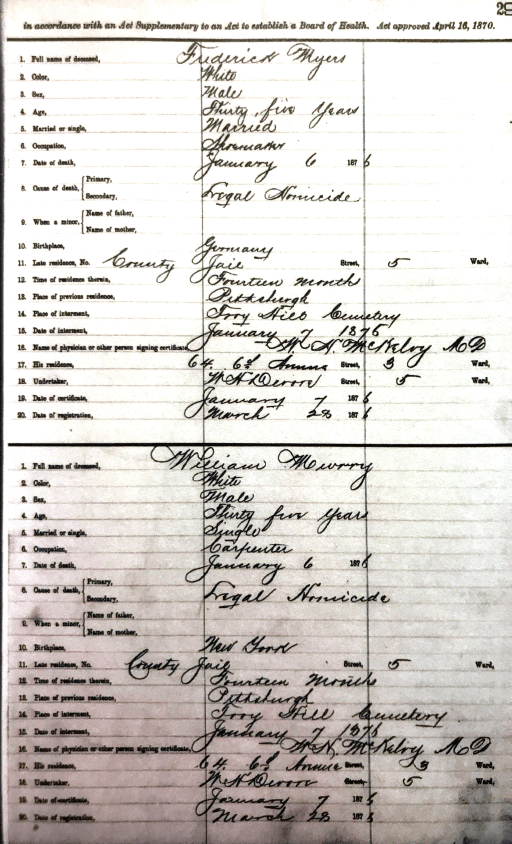
William Murray and Frederick Myers were executed on January 6, 1876, before a reported crowd of 500 people, said to have been the largest crowd ever to see a nominally private execution inside the jail. Murray is reported to have suffered a slow and lingering death twenty minutes after the trap was sprung.

image001

Anthony James Fiebiger

Anthony Fiebiger was arrested on May 23, 1998, on drunk and disorderly charges. At the time of his arrest, he was living in a Goodwill treatment center and receiving alcohol abuse treatment.

Once in custody, he was questioned by police about the February 28, 1989, disappearance of his former girlfriend, Norma C. Parker, who was twenty years his senior. Fiebiger and Parker had lived together in Carnegie at the time and he had long been a suspect in her disappearance.

image001
Pittsburgh Press, March 19, 1989

Putting up little resistance, Fiebiger confessed to police that he had strangled Parker, put her body in a 55 gallon drum, and buried it in Mingo Park, Washington County. Her body was discovered there by police on May 27, 1998.

image001
Pittsburgh Post-Gazette, May 24, 1998

He also confessed to the May 22, 1982 rape and murder of Marcia L. Jones, a teenager from Mt. Washington.

image001
Pittsburgh Press, May 24, 1982

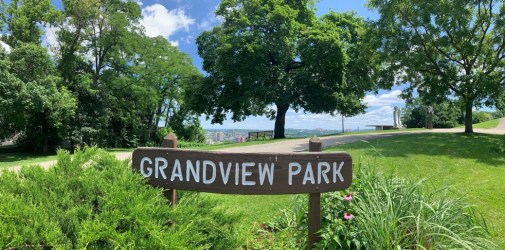
In that case, Fiebiger, who lived in Mt. Washington at the time, said he acted with accomplice Joseph Morton. They set out to find a woman to rape, enticing Jones to join them by offering her marijuana. They then raped and strangled her and left her body in a shallow grave in Grandview Park, where it was discovered that same day.

image001

At trial for killing Jones, Fiebiger, a diagnosed sociopath, was found guilty of first-degree murder on March 1, 1999. The jury deliberated ten minutes before convicting him. He was sentenced to death later the same day. Rejecting the advice of counsel, Fiebiger then pleaded guilty to killing Parker without first obtaining a plea deal. He was sentenced to death in that case on June 30, 1999.

In 2001, Fiebiger ceased all appeals and sought to be executed. The Pennsylvania Supreme Court reviewed his cases despite Fiebiger’s wishes, upholding both convictions and death sentences (Commonwealth v. Fiebiger, 570 Pa. 583, 2002).

Anthony Fiebiger died on death row on April 4, 2022.

image001
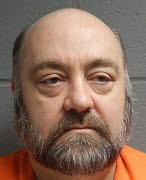
Anthony Fiebiger, 2015

Joseph Morton is serving a life sentence for his role in the Jones murder.

Fiebiger was also implicated in a 1986 rape on Mt. Washington but was never arrested. He was arrested in 1991 for counterfeiting $20 bills in his work as a printer, for which pleaded guilty and served a 2 1/2 year federal sentence.

Edgar Frank Small

Edgar Frank Small and Charlotte (Lottie) McAliece were engaged to be married before Small went to prison on a robbery charge. While he was in prison, McAliece met and married iron worker Nicholas Jacoby. Jacoby’s work as a roller in an era of high wage craftsmanship allowed McAliece to move up from her poor upbringing.

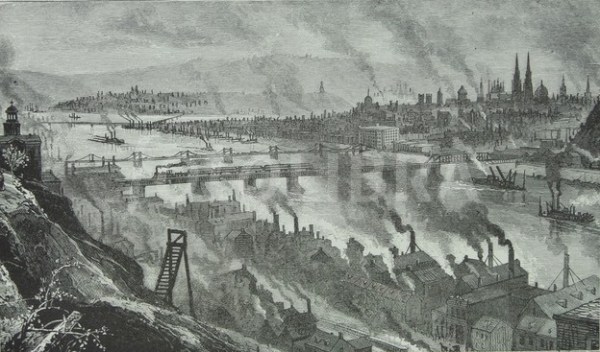
Pittsburgh

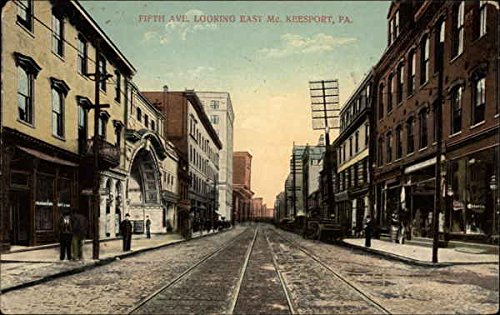
When Small was released from prison, he reconnected with McAliece. During a meeting at Gottlieb Keyser’s Saloon, 321 Fifth Avenue, on January 16, 1879, Nicholas Jacoby confronted the pair and asked Small to cease seeing McAliece.

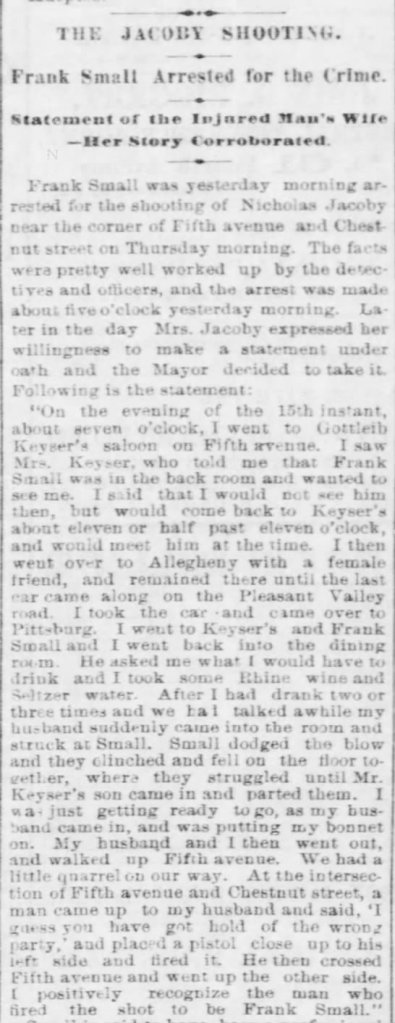
Later that evening, when McAliece and Jacoby were walking home, Small shot Jacoby at close range. He died two days later, on January 18, 1879, after giving police a detailed description of what had happened.

image001
Pittsburgh Daily Post, January 18, 1879

Small was convicted of first-degree murder on April 19, 1879, despite the belief of some that suggestions of McAliece’s promiscuity might mitigate Small’s culpability. Small’s appeal was rejected (Small v. Commonwealth, 91 Pa. 304, 1880) and his pardon request was only acted upon by the Pardon Board after several delays.

Reflective of an era of increasing skepticism about the efficacy and appropriateness of the death penalty, Small was not executed until March 24, 1882. It was the first execution in Allegheny County in more than five years.

image001
Pittsburgh Daily Post, March 24, 1882

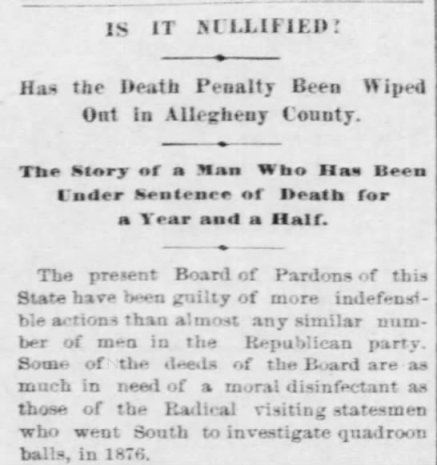
The long delay in executing Small and the infrequency of executions led the newspapers to rail against the leniency of the Pardon Board. The Pittsburgh Daily Post said of the Pardon Board, “they have led the criminal element of the community to believe that the death penalty has been abrogated and nullified and that the statutes of Pennsylvania are pliable reeds in their hands to be bent at will.”

image001

A Pittsburgh Daily Post article on July 15, 1880, struck a similar note. After reciting a long list of recent murders and the less than fatal penalties imposed on the killers, the question was rhetorically posed:

“Is it any wonder that with such a list of deeds of violence, brutal murders, before the people of Allegheny county that they ask the Pardon Board whether any more blood letters are to be set free? Murders will go on and men will go unhung just so long as such blots are allowed on the executive branch of the State Government and crimes which in the days of our grandfathers were looked upon as abhorrent and damnable, will become in the days of their grandchildren, merely gentlemanly pastimes, which add to the credit of him who is the chief actor in them.”

Local juries did not share that sentiment, at least not until the identity of the offender changed with the migration and immigration of African American and Southern and Eastern Europeans in the coming decade. Until then, no executions occurred between 1885 and 1891.

Small was a well-known criminal in Pittsburgh, prominently featured in local crime news while amassing a lengthy criminal record. Among his friends and alleged accomplices in crime was Edward Coffey, who was sentenced to death before committing suicide a few years after Small’s execution.

Charlotte McAliece Jacoby died in Pittsburgh on February 6, 1931. She was 76 or 77 years old.

David S. Evans

David Evans, his wife, Louisa (nee Varner), and their five children – Josephine, Minerva, Sarah, Louise, and Arrabella – lived in poverty on Sampson Street (now Sampsonia Way), Allegheny, an area now known as the North Side.

image001
Sampsonia Way, 2020

Evans, a Pittsburgh-born unemployed carpenter, often stayed out late at night. Despite neighbor and newspaper portrayals of the quiet suffering, devoutness, and rectitude of Evans, references to his late hours and drinking suggest a more complicated reality.

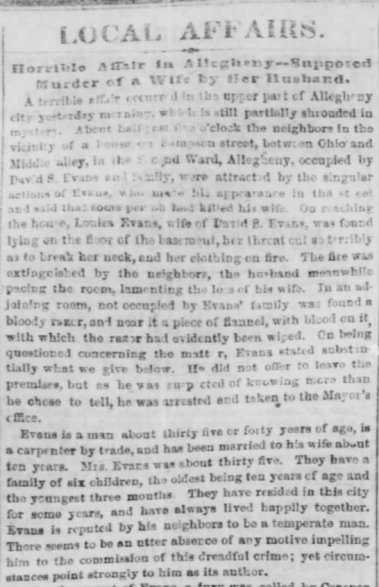
After coming home on the night of May 11, 1858, he fatally stabbed Louisa. When she fell, the baby she was holding, Arrabella, was injured; she died three days later. After killing his wife, Evans attempted to burn her body to conceal his crime.

image001
Pittsburgh Post, May 12, 1858

The authorities were alerted by neighbors after Evans ran into the street to raise an alarm about the fire. He was promptly arrested.

Under questioning, Evans offered the dubious claim that he was sleeping downstairs due to a toothache on the night of the murder and that an intruder entered and killed his wife. Investigation quickly cast doubt on this scenario; the razor with which Louisa Evans was killed belonged to her husband, as did the cloth used to wipe it clean of blood after the murder.

With no other assailant ever identified, no evidence to support his story, and numerous witnesses to establish that Evans was present, he was convicted of first-degree murder on November 13, 1858, after a five-day trial.

No motive for the murder was clearly established, though the family’s financial problems and associated strains were most often mentioned.

Evans’ motion for a new trial was rejected and he was sentenced to death on December 14, 1858. At sentencing, the judge offered this argument in support of the conviction:

image001

David Evans was hanged on May 20, 1859, side-by-side with Christian Jacoby, who had also killed his wife. Evans spoke at length from the gallows, declaring his innocence and his Christian faith.

image001
Pittsburgh Post, May 21, 1859

The following day, the Pittsburgh Gazette editorialized that yesterday “was the scene of one of those terrible vindications of the majesty of the law, which transpire only too frequently for the honor and credit of society.”

Heinrich August Frecke and Benjamin B. Marschall

Heinrich August Frecke and Benjamin Bernhardt Marschall were fellow German immigrants who met as co-workers at a brick company on Boyd’s Hill before joining to make their livings through crime. Both men had families, though not in Pittsburgh. Both men also had criminal records, in Pittsburgh and beyond.

image001
Pittsburgh, 1866

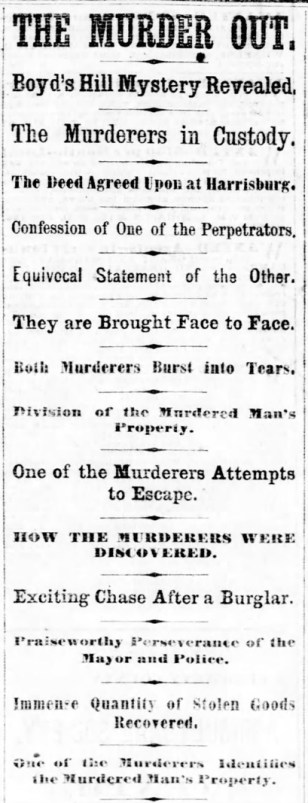
Returning via train to Pittsburgh from New York City, where they had traveled on business – that business being fencing goods they had stolen in Pittsburgh – they met and befriended John Henry Foerster, a newly-arrived German immigrant traveling alone and apparently a man of some means. Upon arrival in Pittsburgh on August 23, 1865, they lured Foerster to a brickyard on Boyd’s Hill on the premise of helping him get established in his new home. There they stabbed and robbed him.

image001
Pittsburgh Gazette, August 25, 1865

Foerster’s body was discovered early the next day, though weeks passed before Foerster or his assailants were identified. Arrests of local men produced no suspects.

Investigators determined that the victim and two other men had been seen in local taverns on the evening of the murder. The first real break in the case came on September 22, when Marschall was arrested in connection with a series of robberies and burglaries in the Hill District. A search of his residence found evidence linking him to Foerster’s murder. He is reported to have fully and freely confessed and to have implicated Frecke, who was apprehended in McKeesport.

image003
Pittsburgh Commercial, September 25, 1865

From his first encounter with the authorities, Frecke maintained his innocence. Marschall, on the other hand, also confessed to two other murders, one in New York and one in Germany.

His account of Foerster’s murder is that he and Frecke committed a robbery on Smithfield St. and then departed for New York to sell the stolen goods. There they met Marschall’s brother, who assisted in fencing the goods for over $500 (approximately $9,000 today). Returning to Pittsburgh a week later, Frecke identified Foerster as a new mark. They remained close with him during the long journey back, gaining his confidence. Once in Pittsburgh, they carried out their plan near Beckett’s brick yard, with Frecke stabbing Foerster.

Frecke, 46, and Marschall, 29, were tried separately. With such a full confession and supporting testimony as well as circumstantial evidence and witnesses, Marschall was tried and convicted of first-degree murder on October 6, only two weeks after his arrest.  Frecke’s trial began on October 11 and ended the next day with his conviction. After their motions for new trials were rejected, they were sentenced to death on November 25.

image001
Execution Warrant for Benjamin Marschall, December 1, 1865

Foerster remained unidentified. On the basis of evidence found in Marschall’s home, Pittsburgh authorities had contacted authorities in Bremen, Germany, asking for assistance. They provided Foerster’s identity on November 8.

Lacking resources and support, no appeals or pardon requests were undertaken. Marschall tried unsuccessfully to escape from jail a week before his scheduled execution.

image001
Pittsburgh Daily Commercial, January 13, 1866

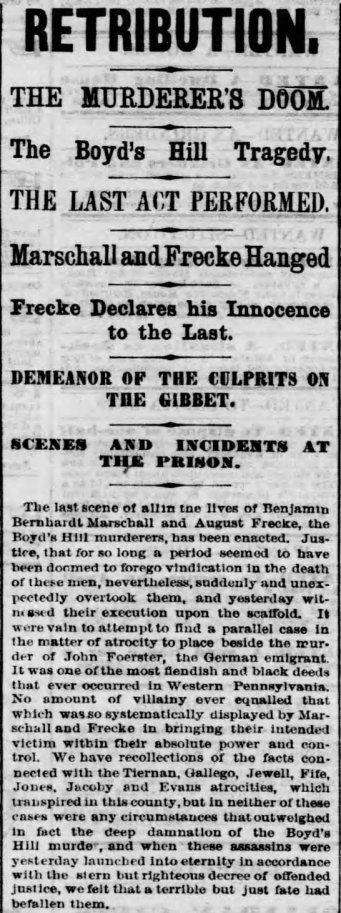
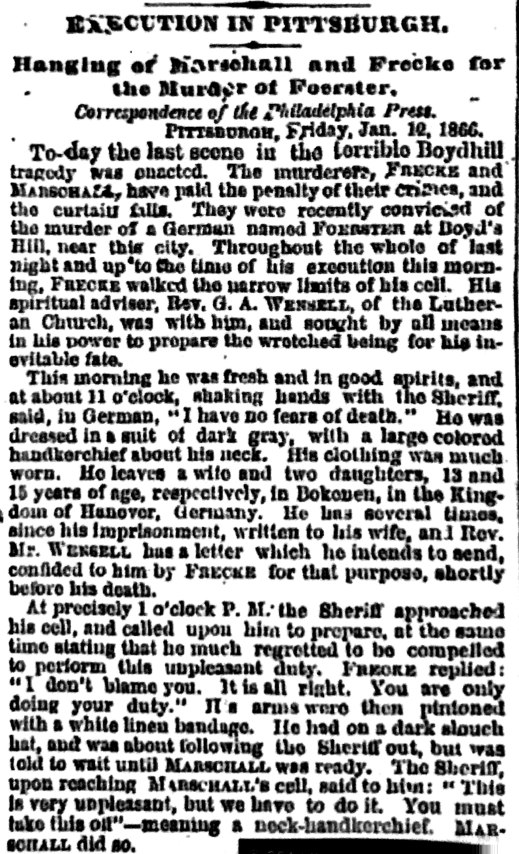
On January 12, 1866, August Frecke and Benjamin Marschall were hanged, just four days before Grinder’s execution and less than four months after being arrested. On the gallows, Marschall rejected Frecke’s request that he exonerate him.

image001
New York Times, January 15, 1866

Dennis Cloonan

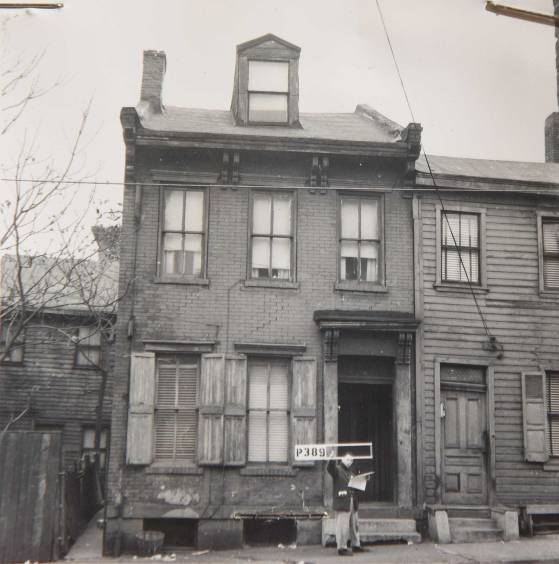
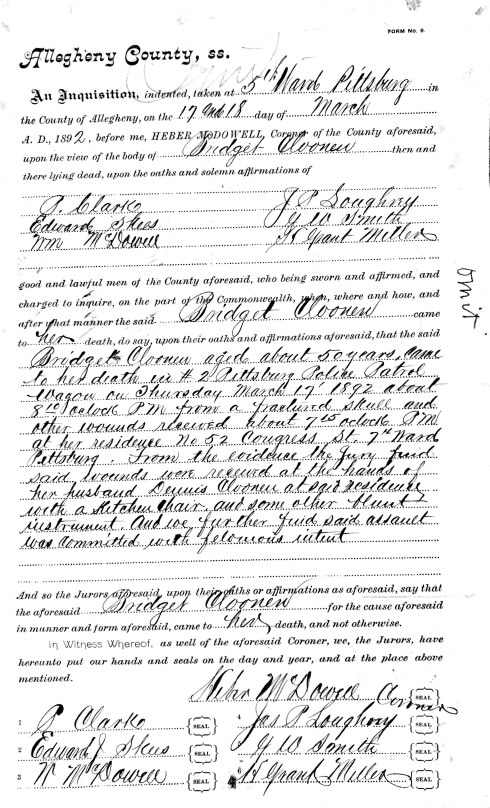
Dennis and Bridget (Skahill) Cloonan, long-married, with four sons, and in their 50s, lived at 52 Congress St. in the Lower Hill District.

image001
49 Congress St., https://newsinteractive.post-gazette.com/lower_hill/

They quarreled frequently, though reports indicated that their unhappiness did not involve violence. An apparent source of tension was a property Bridget had purchased in her own name and had refused to co-title with her husband.

image003
Pittsburgh Press, October 29, 1891

Then, on March 17, 1892, St. Patrick’s Day, the Irish-immigrant Cloonan returned from work at the Pennsylvania Railroad, intoxicated, ate the dinner his wife had prepared, and brutally beat her with a chair. He then went to the neighbor’s home and told her to go to his house to see what had happened. There he told a witness that he had suffered long enough and was not going to suffer any more.

image001Police were summoned and Cloonan was arrested as he walked away from the scene. He confessed immediately and asked the arresting officer to shoot him. After a brief trial, Cloonan was convicted on June 4, 1892, and sentenced to death. He showed little interest in his trial, conviction, or execution.

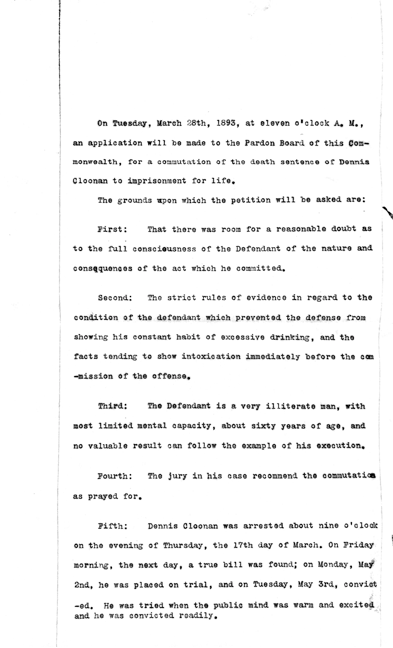
After an unsuccessful appeal, a surprisingly vigorous clemency campaign was mounted, portraying Cloonan as a particularly pitiful and benign character; “a simple minded ignorant, illiterate man, faithful, industrious and kindly in the discharge of his laborious duties…always kind, obedient and faithful.”

image002.png

Despite hundreds of signatures of support obtained from his Hill District neighbors, Dennis Cloonan’s clemency request was rejected and he was hanged on April 4, 1893.

image002

Cloonan’s was the first execution in Pittsburgh after the Homestead Riot. Inasmuch as Homestead represented the defeat of labor unionism and helped to usher in an era of mass production, it may be used to mark the beginning of the peak industrial era in Pittsburgh that lasted until the steel industry began to move closer to the resource deposits and shipping routes along the Great Lakes after 1920.

During this era, Pennsylvania – not Virginia or Georgia or Texas – was the nation’s leading executioner; a result of the migration, immigration, urbanization, and associated racial and ethnic tensions of industrialization.

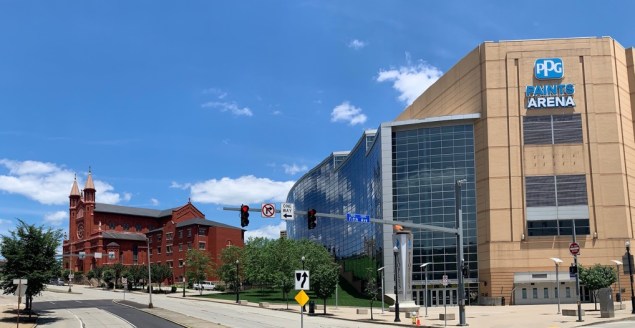
image001                                                         Congress St. today; a post-industrial landscape

James McSteen

James McSteen, 36, his wife, Mary Toole, both Irish-born, and four children lived in a log cabin along the B&O Railroad line near Hazelwood, just as the area was being transformed into an industrial center. McSteen worked at Jones & Laughlin’s burgeoning Eliza furnace and at Glenwood Steel Works.

image001
Eliza Furnace boiler house crew, 1894

During the late afternoon of June 9, 1882, McSteen viciously attacked his wife with an axe and then fled. As he left, he asked his neighbor, Mrs. Mary Welch, to look after his children, leading her to the discovery of the dying Mary Toole.

McSteen was arrested aboard a Pittsburgh-bound train. He confessed to having struck his wife. His motive was jealousy.
McSteen and Toole had been married for five years. She had one child (Patrick, who testified against McSteen) at the time of their marriage. They had three children together.

Newspaper accounts describe McSteen as “ordinary looking” and his wife as “comely,” “honest,” “faithful,” and a “good mother” of “considerable popularity.” Accounts also suggest McSteen may have been of unsound mind, having previously been institutionalized at Dixmont.

Trial testimony indicated McSteen was acting peculiarly on the day of the murder, was “insanely jealous,” and had tried to kill his wife two years earlier (resulting in his arrest and jail sentence). There is no evidence of her unfaithfulness.

McSteen was convicted of first-degree murder on September 22, 1882 after brief jury deliberations, and sentenced to death. Barely three months had passed since the murder.

Prior to the verdict, there was sentiment that the murder was appropriately second-degree, a far more common outcome in cases of intimate partner homicide. No appeal was undertaken, though a pardon request was filed and rejected.

image001
Pittsburgh Daily Post, September 23, 1882

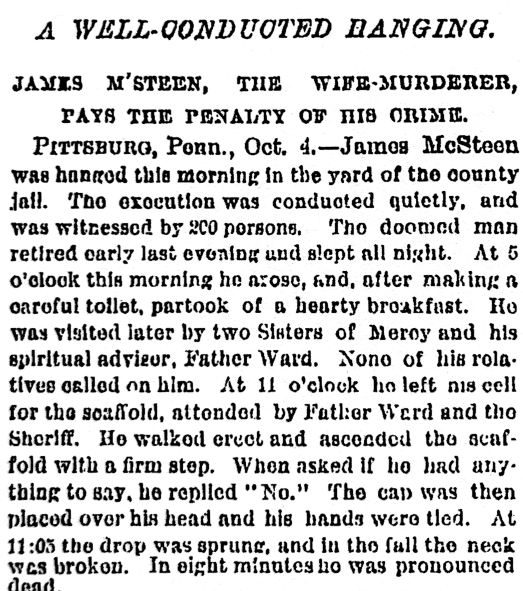
James McSteen was hanged in the yard of the county jail on October 4, 1883. Though described as a “well-conducted hanging,” McSteen slowly asphyxiated. More than 200 witnesses were in attendance and more than 2,000 had applied for admission. He is buried in St. Mary’s Cemetery.

image001New York Times, October 5, 1883